

This Week’s Topics:
- Rundown Preamble Ramble: Sprite Smarter, Sprite Sharder
- TSF Showcase 2024-19 Change Ring by Kawaii Tsun’aho
- TSF Showcase 2024-19.1 Change Ring the Manga by Kawaii Tsun’aho and MPZ
- Student Transfer V8 is Coming Soon! (The Murder Route is Finally Getting Replaced!)
- re:Dreamer is Back, Bay-Bee! (re:Dreamer Version 0.18.0 Releases After 7 Month Delay)
- Microsoft Murders Arkane Austin and Tango GameWorks (Technically They Also Killed Alpha Dog and Consolidated Roundhouse…)
- Another AI Generated Image Musing (No, I’m Not Going to Become An AI Pundit)
- Yes, Nintendo Switch 2 is Happening, But You Gotta Wait! (The Switch-2.0-Roadmap)
- Nintendo World Championships: NES Edition Announced (Better Than Nothing, Worse Than You’d Expect)
Edit 5/25/2024: I got the name of a character in Change Ring wrong. I originally referred to the character of Mai Hasegawa as Mia Hasegawa and did not spot that in editing. I’m going to chock that up to my chronic issues with spelling and the fact that I just wrote a novel with the name “Dia” in it several hundred times. Also, I failed to mention that Change Ring chapter 5 received some edits after launch. In reviewing the series, I was consulting my personal archives, and not the live versions on Pixiv. I have modified the review to reflect this fact.
Rundown Preamble Ramble:
Sprite Smarter, Sprite Sharder
This past week I have been wrapping up VD2.0 Acts 1 and 2. This project has taken me 15 months to complete, and the end result is a 370,000 word juggernaut that is filled with so many ideas it makes my head boggle. The novel has been 100% complete, will be posted on schedule, and it’s done like dinner!
Now, I could talk about the production process, but that’s not really interesting to me. I had a bunch of characters previously established, a dozen who needed to be explored in detail, I gave myself a summer theme, and turned a basic body swapper into something WILD. I let the ideas flow through me, wrote a 50,000 word lore doc, and just… did the work.
I have written so many stories that I don’t really need to THINK about the process. I just get an idea, write and outline, and write the damn story, just like how I’m spitting this intro straight off the dome. However, I do want to talk about the header images I make, as my approach with those is a lot more… systematic and math-like than my writing.
Now, that might sound bizarre, as it is far easier to abstract language into math, and computers have been generating text for a hella long time. However, what I’m doing isn’t on the same level as a ‘real’ artist, and basically boil down to ‘sprite art dioramas.’ Every image is made up of several layers, including the background, the objects, the characters, and titles. All of which follow a designated style guide and frequently feature recycled elements. From elements of backgrounds, such as the design of trees, to objects like furniture, or characters.
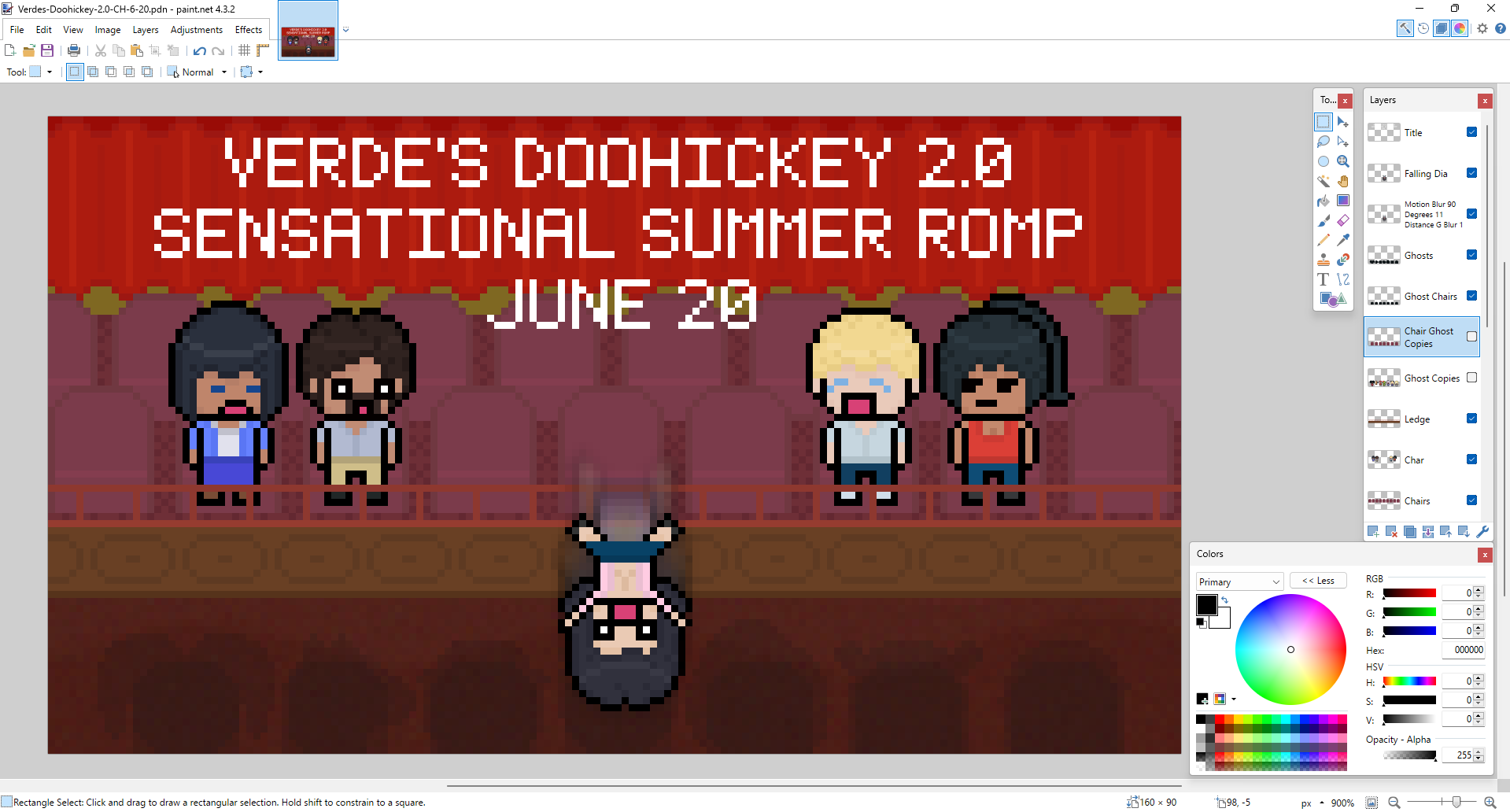
Actually, let me walk you through a pretty typical header image I created. The one for the June 20th chapter. This chapter has five central characters who, due to their importance, should all be featured in this header image. This means I need to use the sprites for Pascal, Dia, Raiyne, Nazz, and Gemma. At this point, I had already come up with the base character sprites. However, I also need the outfits to match the ones used in the chapter. I often detail outfits, but sometimes I just cannot be arsed, and here, I had a good amount of leeway with some designs. So, how do I go about making outfits?
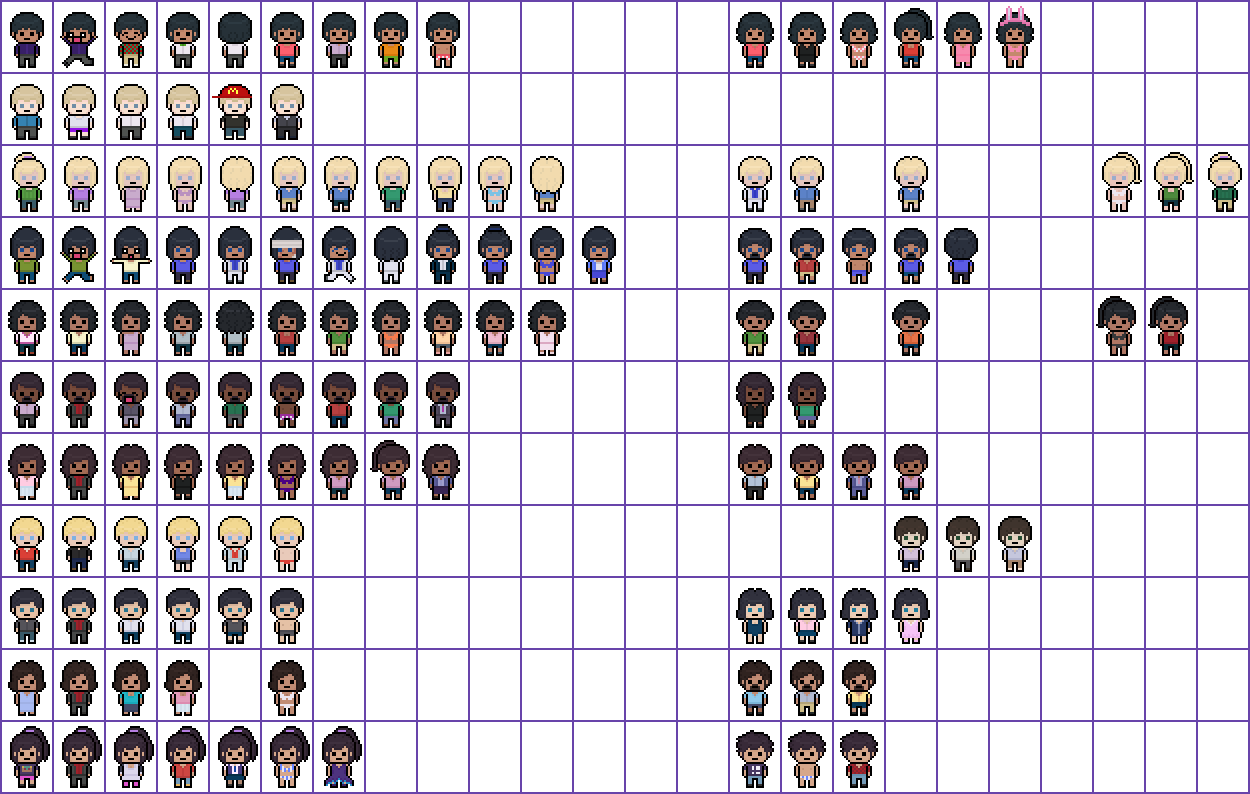
Well, that’s actually a big peeve of mine as of late. I have so many characters with so many outfits that it’s getting hard for me to figure out how to dress each character each day or what exact color I should use. If you look closely at my work, you will notice I recycle colors all the damn time, and the same is true for general outfit designs. Again, I’m not a real artist, so it’s hard for me to find the best blue by playing with hue, saturation, and value sliders. And if I want a specific color I have seen before… I just do the terrible thing or using the teardrop tool and/or the PowerToys Color Picker command.
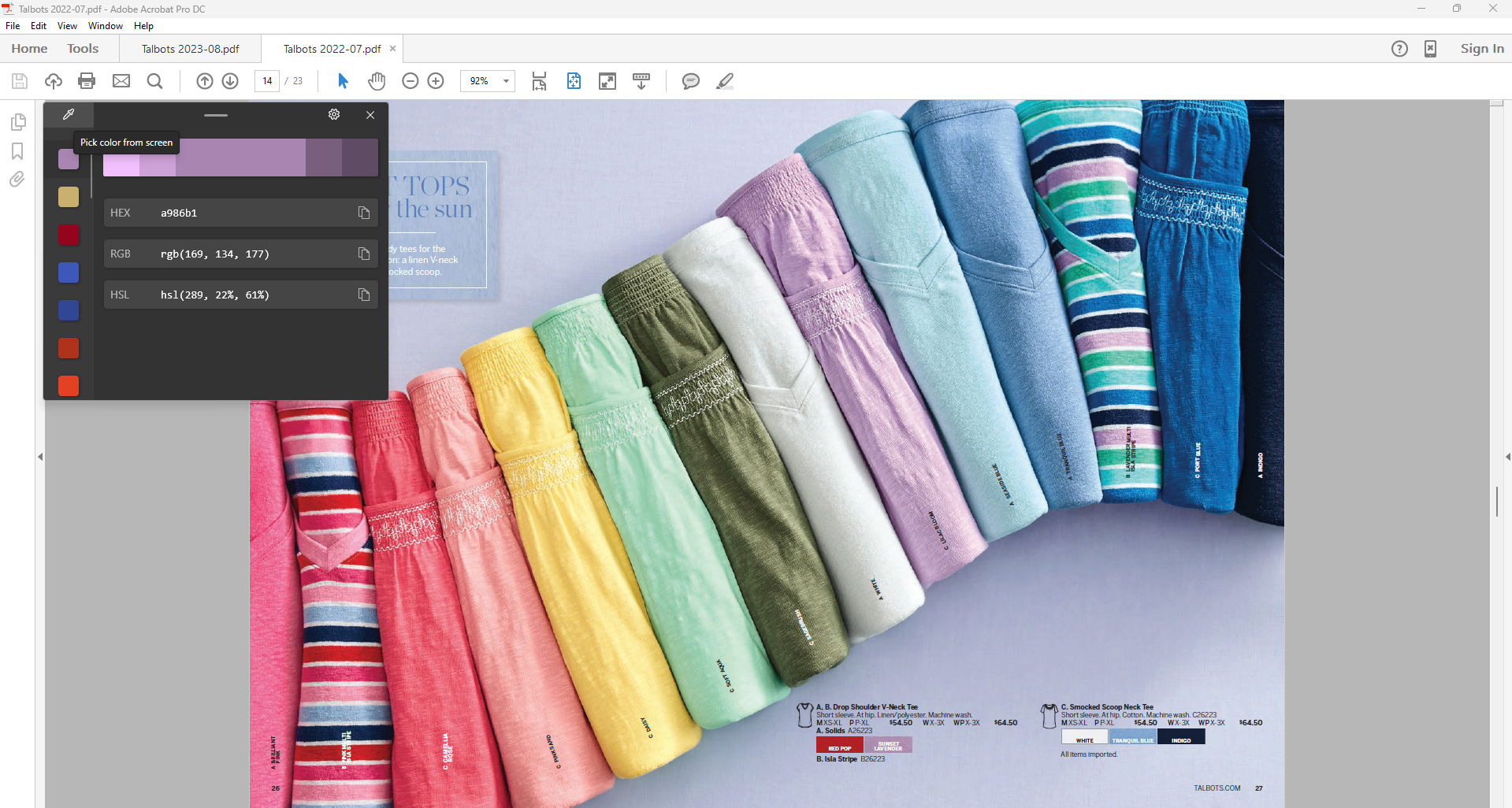
Yes, I reference fashion magazines for character outfits, just like a real artist!
With this in mind, I came up with the outfits for the five characters in this header image. They don’t look that remarkable, but they capture the look for the characters I had in mind.
Okay, so what about the setting? Well, this chapter has multiple potential locations that I could pull from. Clark Street Beach, a Chicago sandwich shop, the streets of Downtown Chicago, an entirely fictional arcade, a bootleg version of Andy’s Jazz Club, a dingy alley, and the prestigious Chicago Theatre. …Naturally, I chose The Chicago Theatre, as I thought it would be a unique setting, and I already looked up the layout in detail during the writing process.
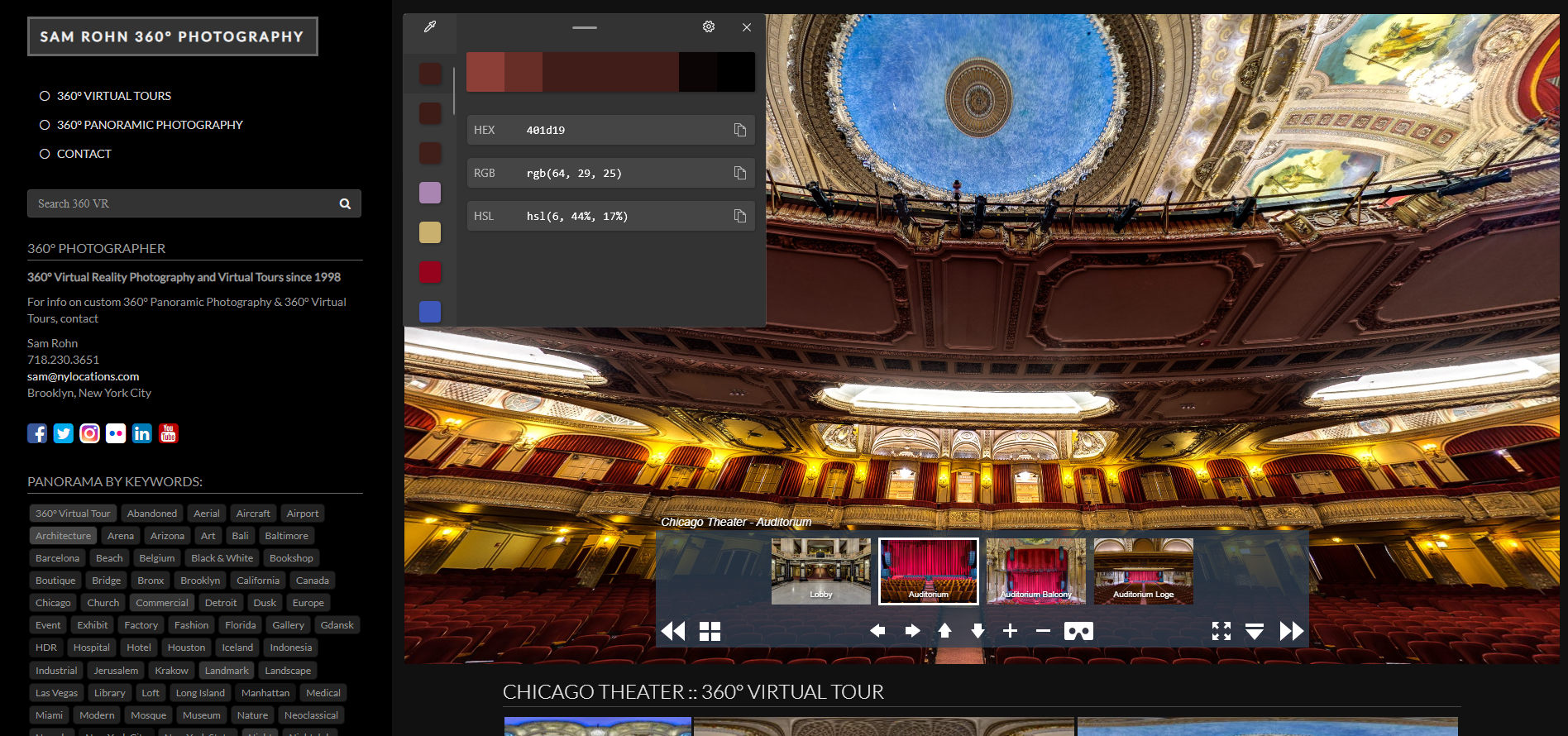
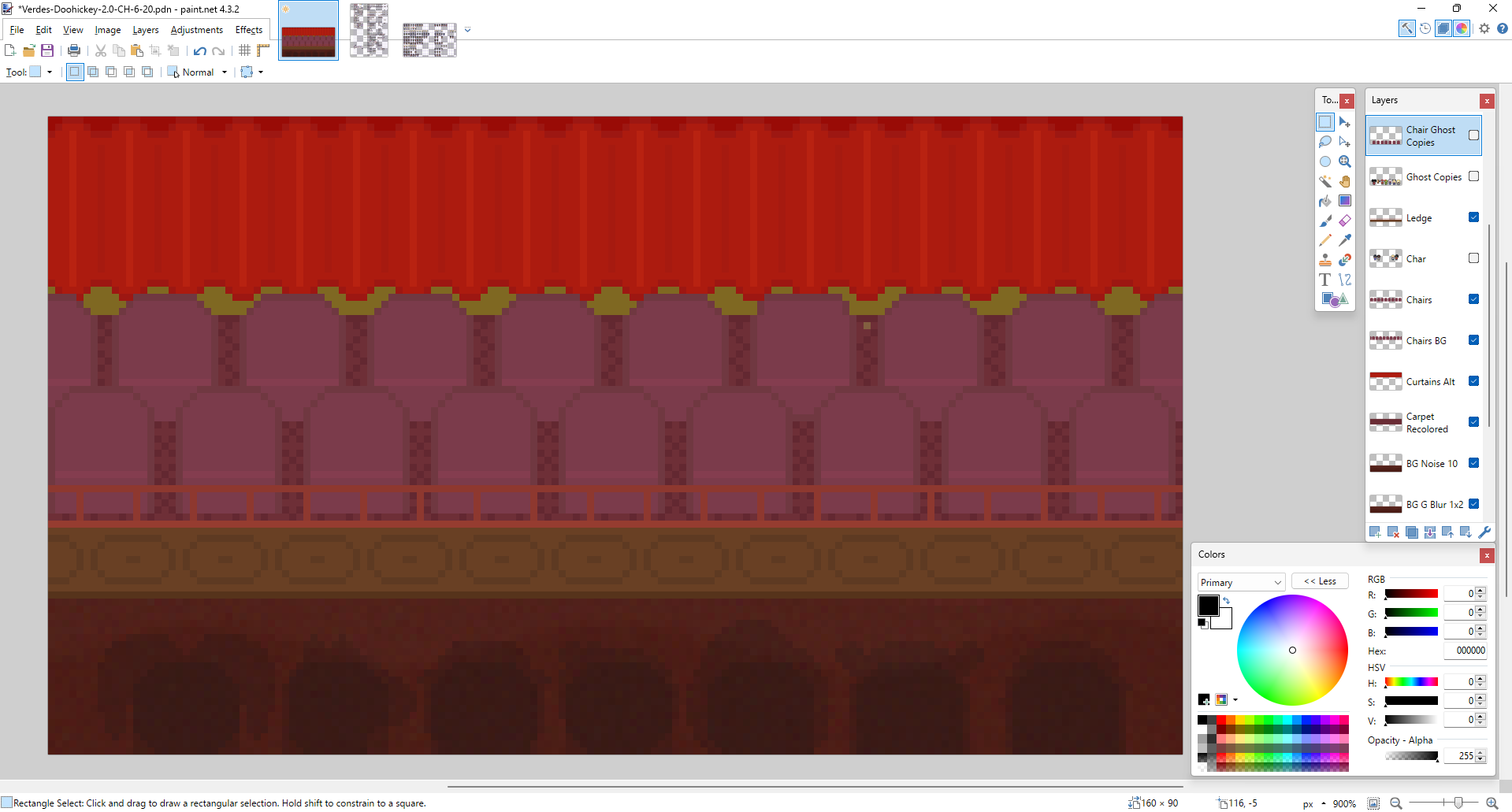
Finding visual resources for the theater interior is easy, and there’s even a 360 degree virtual tour. Now, due to my limited canvas size and presentation choice, I had to begin by compromising the presentation. I quickly decided on just showing one snippet of a balcony with two rows of seats, a defined wall in the background, and a ‘balcony guard’ to visually indicate that this is a balcony. As for the bottom of the image… Well, I just didn’t know how I could squeeze anything in there, so I just made a mental note to fix that.
After mentally mapping the general structure, I began grabbing the colors I needed for this design. Pulling a brown for the balcony, the red guard rails, the burgundy and ‘poop gold’ color of the carpeting, I made the chairs maroon so they would not bleed with the red curtains. And while I wanted the golden yellow walls… red and yellow are not friends unless you wanna remind people of McMoe’s, so I decided to cover the entire wall in red curtains. That is not how the balcony walls look, but red curtains are symbolic of the very idea of theater.
As for what I did with these colors, it was a lot of recycling. For the seats, I modified a cushioned chair design from Dominance Ch 03, getting rid of the armrests and theaters do not actually have those. I looked at the shower curtain design from Malice Ch 09, didn’t think it fit, and came up with a basic geometric pattern to match the curved shape of theater curtains. I also added accent colors to the tops and pattern of the curtains so it is not just a single colored block, as only walls and floors should be single colored block. For carpeting, I came up with another basic carpet design for TSF Series #006-3. It is just creating a 3×3 diamond shape with one color and filling the center with another color. Continue this pattern, lining the diamonds together, creating a diagonal lattice. The balcony of The Chicago Theatre has wooden panels with a curved rectangle pattern, so I simplified it for this new format. And they also have ‘rust red’ metal safety rails, which are… just lines.

Putting all these factors together… this looks pretty good, right? Well, no, there are two big problems.
The carpeting is distracting due to the contrast of the two colors, and there are two solutions I tried. When using layers, I have the ability to set the opacity, letting me tint and recolor the image at a certain layer. This is a powerful tool for establishing mood, and I often use it to better establish darkness… or indicate that someone is a ghost. I tried darkening the carpet, but the contrast is still distracting, so I went with solution two. Say to hell with accuracy and replace the ugly gold color with a darker shade of red. I tried it, and the end result was way better. …Also, the curtains were too bright, so I just darkened and desaturated them.
Problem two is the fact that… the bottom of this background is empty and needs some visual texture. So I decided to do three things. First, I added the silhouettes of various characters from TSF Series, just as a visual cameo and to indicate that there are other people beneath this balcony. I did not want them to stand out though, so I set them at 40/255 opacity. Second, I added the silhouettes of chairs behind them, which are just vague dark shapes, yet help ground that these silhouettes are fellow theater go-ers. Third, because the background was just a boring solid color, I used two of my favorite tricks.
Trick one is one that I call ‘sky shading,’ where I manually draw squiggling horizontal lines that mimic the form of a cloud, and make each of them darker or lighter than the last. This is used to capture how the sky is actually multiple colors, rather than just one single block of color. I draw a line, adjust the color, draw another line, until I have created the illusions of colors that shift. I then take this layer and modify it using one of Paint.Net’s many effects. Gaussian blur! Which… blurs an image, spreading the colors about, and altering its opacity if there’s any transparency. I use this tool a lot, and with this trick, I like to use a Gaussian blur with a radius of 1, and do it twice. I just like how the end result looks.
However, this is still a bit too… plain for the bottom of a header image, so I decided to use another go-to Paint.Net effect, noise. Noise is a quick and dirty way to add ‘texture’ to an image by adding… visual noise. This gives the impression of detail, without needing to deliberately choose the color for each pixel, and it does a better job than I could. Noise can enhance, destroy, or barely do anything, but I find that using the settings of 10 intensity, 100 color saturation, and 100% coverage gives good results. Intensity really makes the difference.
With all these settings, I think the result looks good enough for my standards, so now I need to add the characters and decide the poses. …I have mentioned this before, but my sprite characters are modifications of the ‘8-bit’ sprites used in the Danganronpa series. The sprites were cute, charming, and the style was versatile, so I decided to build upon it when I started creating my sprite header images. In the (almost) 5 years since I made that decision, I have altered the style— using less contrasting hair colors, getting rid of some of the black outlines, and simplifying the designs for visual clarity.

Despite this, I only have a few things these character sprites can do. They can look forward, right, left, or turn around and look backwards— which I don’t usually do, as it requires making a hair back sprite. They can move their arms in three directions, side, pointing up, and stretched out, allowing them to stand, cheer, salute, point, and hold objects. Their legs can stretch out and back to walk in a direction, and by mirroring this pose they can also stretch out their legs. And they can also express emotions by switching their mouth and eyes. The mouth has five states it can be in: neutral, smiling, surprised, wide, and fully open. While the eyes have six states they can be in: neutral, happy, frustrated, closed, snide left, snide right, wide, and three more I’ve rarely used. An alternative frustrated, alternative happy, and what I call evil eyes.
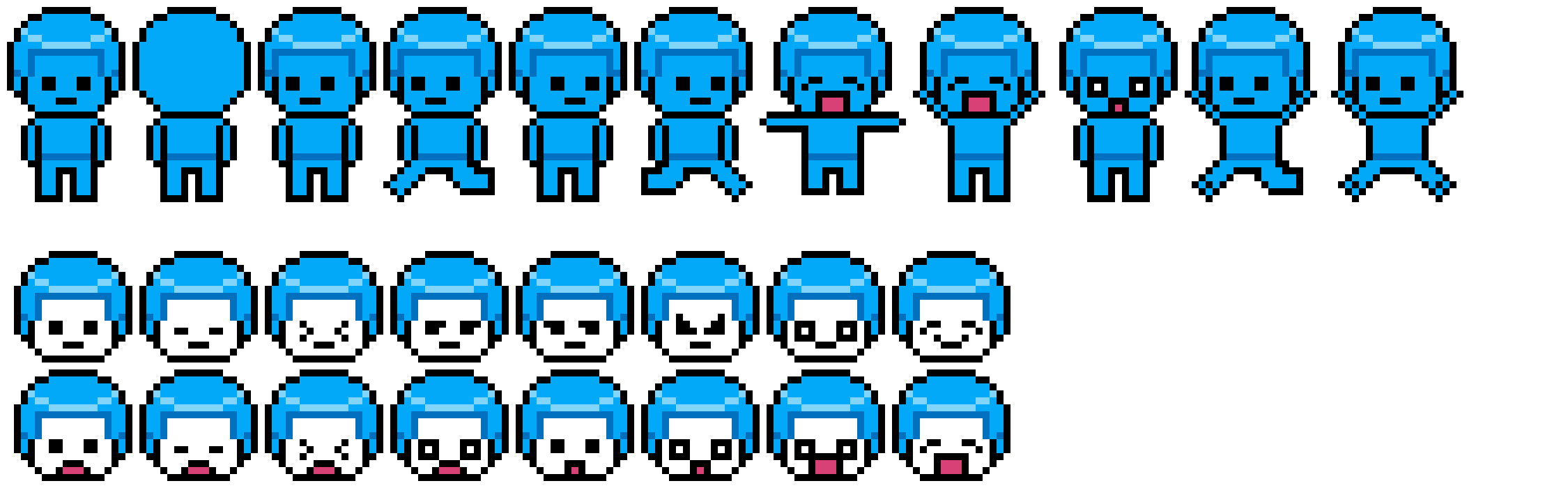
…Okay, so how many options does that give me? 3*3*3*4*5*7… 3,240. Huh. That is more than I expected, but not every eye and mouth combination is good. So 108 times… 16 expressions that are often used. That’s still 1,728 options per character per outfit. …But most of those are highly situational. Also, this is why I don’t make sprite sheets for any given character. It would just be too much work.
That all being said, there isn’t a whole log I can have these characters do other than… sit around in a theater. So I decided that I want the characters to do something dynamic, such as… fall from a balcony! The choice was obviously Dia, as they get drunk in this chapter, and drunk people love falling! I decided on how to demonstrate falling back in TSF Series #006-3, where I fiddled with filters before getting a combination of effects that I like. Those are motion blur at 90 degrees and 11 Distance, followed by a Gaussian blur with a range of 1. It creates an after-image that, to me, immediately conveys motion and, from the direction, down, it is obvious that they are falling.

Dia is falling, so naturally they would be using the wide eyes and fully open mouth expression, or ‘big-eyed shocked’ as I call it, and have their arms pointing up and legs stretched out. As for the other characters, I just had them sit and go through a few other expressions. Raiyne is sighing, sick of Dia’s shenanigans. Pascal is surprised that their wife(?) just took a tumble. Nazz is loving this shit, as it is just another show. While Gemma is giving Nazz a snide eye, ‘like really, dude?’
With that all done… I just need to add the chapter text. I have considered switching over to the modern Rundown format of using letterboxing and using 60 point bold Noto Sans JP. But I think it looks better with the sprite font. Which, for the record, uses a modified version of Minimal 5×7. By modified, I mean that I change every capital D, because I don’t like how the default D looks.

…And that’s how Natalie makes a chapter header for her writing!
Why did I bring this up again? Oh, right. Because I think I need to streamline my production process somehow. Which is saying something, as I use shortcuts with nearly every header I make.
However, there is one thing that I would like to change, and that’s the process of manually creating every expression and pose for every character whenever I want to change it from the default neutral pose. This change is systematic, the results follow a mostly consistent layout, and I keep wishing that I could procedurally generate the poses and expressions for every character sprite.
In theory, software could be developed to create this… but would it actually improve my workflow, or should I just suck it up and manually edit every sprite?
Akumako: “No, because so much of your production process is creating the base sprites and backgrounds. Compared to that, the posing process is immaterial.”
…Yeah, you’re right, Sis.
Akumako: “I’m not your sister.”
Then what are we?
Akumako: “I’m actually Natalie, but I wore a brainwashing Akumako skinsuit, and you’re actually Akumako. You put on a Natalie skinsuit, and were brainwashed into being Natalie.”
…Don’t professional writers say that brainwashing is something you should never use?
Akumako: “Yeah, but fuck ’em up the butt and around the corner. Professional writers are all hacks and pedophiles. The best writers are poor and queer people who make dick shit gangsta bippz off their work. Always has been, always will be.”
So I guess we don’t count, because we make too much money.
Akumako: “EXACTLY! Also, you’re, like, barely queer.”
…You have a penis made of smegma.
Akumako: “I most certainly do! Nothing queer about that!”
TSF Showcase 2024-19
Change Ring by Kawaii Tsun’aho

Well, I sure took my sweet time getting around to this. Kawaii Tsun’aho is one of the many TSF creators I keep tabs on who use Koikatsu. A program that I have sung the praises of in the past, as it allows individuals to tell stories by customizing and arranging 3D character models, and has resulted in some utterly bananas comics. Comics that I would talk about more often, but a lot of creators have been telling these humongous epics. …Including Kawaii Tsun’aho
I’d say something about how they came onto the scene in 2021 and have been delivering oodles of works, and became buddies with the excellent Vel, but that’s not the full story. Kawaii were actually one of the founding members of the Student Transfer development team and worked on the project for the first three years of its development, under the alias of Grizz. So, needless to say, they have almost a decade of experience making TSF works, if not more.

Now, they have a bunch of comics and series that I could discuss, but if I’m going to talk about anything they’ve done… it’s gotta be their tentpole series, Change Ring. I’d begin by declaring it an ongoing 1,600 page comic, but that’d be somewhat misleading. A lot of Koikatsu creators askew the traditional comic paneling in favor of making every page a single panel, exported from the program, with text bubbles and other effects added after exporting things. I actually really like this approach. You don’t need to scroll or zoom in, you just need to press one key per page navigation, and each ‘page’ can be read through in a few seconds, which is good for pacing.
However, Change Ring is also a mostly textless comic. A wise move that makes the comic accessible to readers of all languages, but also means that some of the storytelling needs to be intuited. This might make it a bit hard to talk about… but I’ll try to summarize things accurately, highlight the highs, point out the lows, and explain some things cleared up in supplemental material.

First, the titular Change Ring is a military espionage tool that is capable of capturing and transferring someone’s form to another person. Allowing subjects to exchange identities and for one individual to become someone’s clone. Also, it looks like a hula hoop and the subject’s body is transformed as they pass through the device. It’s like a portable, more versatile, more science-y magical TF mirror, and… I really like it. It’s not as visually striking as a full detailed transformation, but it is one that allows for a clear visual exchange of one form to another, and I admire it from a technical aspect. I don’t know how Kawaii is doing this in Koikatsu, but I know the software was never made to do something like this.
Every chapter follows a different scenario, but they typically fixate on four club members at an unnamed high school. Satoshi is the average brown-haired boy, so potato-like he was born to be a protagonist. Yusei is the glasses pervert whose mother developed the Change Ring and ‘allowed’ him to ‘borrow’ it. Miho is the responsible blonde bombshell who brings in the hammer of order. While Rika is Miho’s mischief-prone redhead friend with breast envy.

Chapter one sees Yusei introduce the Change Ring to the club, where they promptly make like a bunch of sensible people and use it to trade about their bodies. Satoshi and Yusei both become copies of Miho, Miho becomes Rika, and Rika becomes Satoshi. Yusei heads to the roof to masturbate, because of course, while the rest of the crew run around the school after Rika stormed out of the classroom. Whatever she had planned is quickly discarded though, as Satoshi, Miho, and Rika return to the classroom, where they meet the club supervisor and PE teacher, Asuka Miyamoto. A woman with a giant brunette ponytail who, like all adult women in this series, is very well endowed.
Asuka immediately asks to use the Change Ring, where their bodies shuffle around in a scene that still catches me off guard. Kawaii breaks up chapters with recap pages describing who is who in the story, which are a great help in making sense of all the body exchanging shenanigans. Heck, I liked the format so much that I stole it for Verde’s Doohickey – Session Extra. Except here the ‘who is who’ page informs the reader of swaps that happened off-screen. It makes sense as an omission, but it is still strange, nevertheless.
Also, while I’m pointing out oddities, for some reason Kawaii decorated the geometrically simple Change Ring with the dash panels from Sonic Adventure. I guess it was supposed to make it look more abstract and futuristic, but once I saw it, I could not unsee it. This detail is only present in the first chapter, and was omitted from all other depictions.
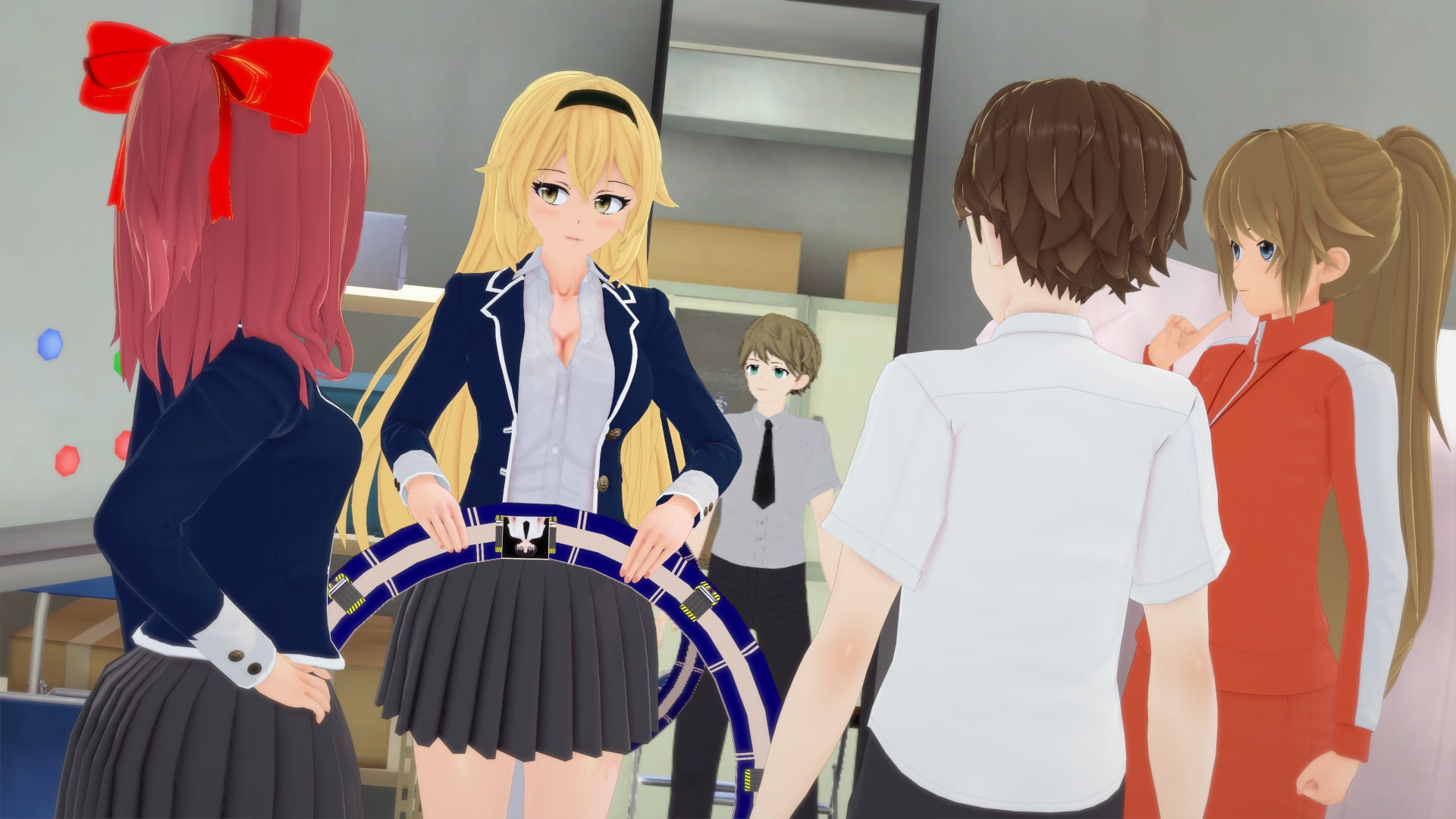
Anyway, under the guise of Asuka, Satoshi feels himself up, as one does, only to stop as Yusei, in Miho’s body, transforms him back to normal before stealing his military grade body swapper. Satoshi meets up with Asuka, currently in his body, where they chat about something or other in a scene that highlights a key strength and weakness of this textless approach. You need to rely on what the characters are doing and their expressions to gather what they are discussing, which leaves many scenes open to interpretation.
In this scene, we can see that Satoshi uses the Change Ring to transform back into Miho, while Asuka changes back to her usual form. They wave goodbye and Satoshi, still in Miho’s form, leaves with the Change Ring in hand. It seems simple, but the lack of dialogue raises several questions. Does Asuka know that Satoshi is Satoshi, or does she think that he’s the real Miho? Because Asuka never saw Yusei in Miho’s form. Does Asuka know who owns the Change Ring and does she think that Satoshi is its rightful owner? And why is she just okay with a student having this powerful tool in their possession, when she could easily confiscate it? Do they have some agreement to share it? I personally like the openness here, as it is an absence of information that spurs the reader’s imagination in the good way.

Now back home, with the Change Ring in tow, Satoshi masturbates in Miho’s form, enjoying himself and getting lost in the erotic thrills. However, and this is the part that just kills me, while he is masturbating, Satoshi’s little sister, Yuuka, sneaks into his room. Sheignores the fact that there’s a girl jilling off on her brother’s bed, and goes right for the Change Ring. She then slyly uses it, transforming into Satoshi, and leaves the Change Ring, never making a noise, or exiting the background of the frame. It lasts all of three panels, it raises so many questions, and is utterly hilarious to me.
Naturally, when Satoshi goes to return to normal, he winds up in Yuuka’s form. Shocked and weirdly choosing not to immediately swap back, Satoshi runs downstairs, tries to get Yuuka to switch back with him, only for their mother to intervene, breaking up their ‘argument.’ Meaning the story just went from a group of friends swapping bodies at school to a family swap scenario without skipping a beat. And that… that is part of the essence of what makes Change Ring such a fun comic to read.

Without the presence of dialogue, the transformations here feel very impulsive, casual, and… recreational in nature. Everybody just wants in on this new toy, trying out another body of their preferences, and their motives are shrouded in ambiguity that leaves room open for a pleasant level of reader interpretation. There are no wordy contemplations about being someone else or anything like that, and everybody cares more about keeping up the crazy combo and having a good time with their borrowed bodies. It’s not egregiously shameless. It still feels grounded in some form of humanity. And it is clearly the result of a creator who wanted to deliver a particular flavor of transformation shenanigans. While there are some missteps, I’d overall say Kawaii succeeded.
Before getting into the next chapter, I’m going to switch over to using my custom format of referring to characters by their mind followed by their bodies in parenthesis. So Satoshi in Miho’s form would be Satoshi(Miho). I’m doing this for brevity’s sake, this is not a standard, and some prefer the opposite, but I just used this format over 4,400 times in a novel I just finished editing, so… I’m sticking with it.

Chapter 2, Family Time, picks up immediately afterwards, with Satoshi(Yuuka) and Yuuka(Satoshi) having dinner. Satoshi(Yuuka) wants to switch back, but his sister doesn’t, so Satoshi decides to just use the Change Ring anyway. Instead of making him Satoshi again, it turns Satoshi into his mother, Shoko. Confused, he heads to the bathroom, where he sees Shoko(Miho), panics as he sees his new face in the mirror, and decides to… troll his mother by transforming her into Yuuka. He even places the Change Ring on a high shelf, because I guess small children cannot stand on chairs?
Seemingly drunk on his newfound power, Satoshi(Shoko) then decides to make Shoko(Yuuka) watch TV with Yuuka(Satoshi) before heading to another room, where he starts to masturbate. Because he is just shameless, and bless him for that. Before he can finish though, the father of the family, Hirotaka, comes in and kisses Satoshi(Shoko) on the mouth. Which Shoko(Yuuka) thinks is just hilarious.

Satoshi wants out after raising this incest flag and goes to grab the Change Ring, but Yuuka and Shoko took it while he wasn’t looking and begin swapping back to normal. Though, I have to wonder if the characters actually know who is who yet again, as Yuuka’s response to landing in Miho’s body during the exchange is to feel up her boobs. So… does Shoko think she’s swapping her children around while they’re going back to their original bodies? Frankly, I don’t wanna know. Shoko is crazy enough that I wouldn’t put it past her.
Why do I say that? Well, once Satoshi goes to sleep, Shoko takes the Change Ring and uses it to make sex with her husband more interesting. Shoko(Miho) shows Hirotaka(Shoko) the joys of a woman’s body as he has his first lesbian experience. But not content to just have sex as a virile busty blonde, Shoko then transforms herself into Hirotaka, and the two have body swapped sex. They go all across the room, in three different positions, and after presumably fucking all night long, Shoko has Hirotaka wake up in her body as the chapter ends.
This is an artistic choice that I choose to interpret as meaning that the two don’t swap back for… a while. Hirotaka’s model doesn’t show up again, and Shoko’s doesn’t appear again until chapter 5. You might think that’s a bit much but… everything in this chapter leads me to think this family embodies many platonic ideas of a TSF family dynamic. They’re all crazy, all pervy, and down to swap… except for the head of the household. Because you’ve got to have some friction to make the juices flow..

Chapter 3, Teacher Training, is an indirect continuation that sees Asuka, burdened by a day full of meetings, wanting to shirk her duties. Naturally, she decided to swap with Yusei, as she’d rather be a glasses pervert attending lectures than an adult woman listening to teachers lecture. …Wait. This arrangement once again adds to the contextual ambiguity I mentioned before— does Asuka know that Yusei is a big pervert— though things play out all the same. Yusei(Asuka) feels himself up, goes to the meeting, and promptly realizes why Asuka wanted out of this, as meetings are boring. So he instead decides to spice things up by visiting the redhead nurse, Risa, and showing her the Change Ring, turning her into another Yusei.
Rather than grapple with how this changed her entire biology, or remember her duty as the school’s only medical staff, Risa(Yusei) just… abandons her post and sees what it’s like being a teen boy. With a fresh body in the Ring, Yusei(Asuka) calls up Satoshi, who gets TF’d into Risa by his buddy so both of them can lose their virginity as they have lesbian sex on an infirmary bed. …During school hours. I get that they are teenage boys with the bodies of mature women at their disposal. That danger spurs the libido. Though, few things make the sex drive shrivel up than having a mature woman of authority walk in and catch you. Well, unless you have the notorious caught fetish.

Unsurprisingly, they cannot screw and change fast enough before Risa(Yusei) comes back, probably from a quick wank knowing this comic, and busts the boys. Their punishment? To stay in their bodies for the next unspecified stretch of time, while Asuka trades her form for Satoshi’s. From there, the story offers an ‘epilogue’ that sees the two boys going about their tasks as the teachers, though it’s not clear what the arrangement is. Was there a time skip? Are they… taking advantage of this situation? Yusei(Asuka) seems to ask Risa(Satoshi) and Asuka(Yusei) about swapping back and Miho visits Satoshi(Risa), but it’s a bit too vague to really sink one’s teeth into.
Chapter 4, Class Swap Cubed, is a lot simpler. It sees a three-way swap between Rika, Satoshi, and Miho. Miho doesn’t want Satoshi in her body, as he just got outed as a body jacking rapist. And Rika’s got a breast size complex— a disability that affects at least 25% of all anime-flavored women— so Miho gives Rika her body, slums it with Satoshi’s, and peaces out for most of the chapter.
The day starts simply enough, before getting a bit… obscure. Rika(Miho) loves her new bust and chats with other girls using her new identity. Satoshi(Rika) fondles himself in a way that… bothers Rika(Miho) somehow. And there is an implied conversation or joke involving two background characters and Satoshi(Rika)… confessing to Yusei for some reason. It’s all a strange section that emphasizes the weaknesses of the textless approach.

Regardless, the two head to the school pool for PE class, which is where I need to comment on the artwork. Koikatsu is a kitbashed wack job of a program, capable of performing miracles, while having wild quality disparities. A lot of these are texture-based, and make the software look like a weirdly optimized PS Vita game. I can overlook most things, but the water? That’s not even comparable to any gaming generation, it’s just bad to look at. At best, it looks like blue Jell-O, at worst, it looks like a flat blue surface characters clip through.
As she starts swimming, Rika(Miho) begins having issues with her breasts, as they don’t feel great in the water. It’s not clear what the exact problem is, if they just get in the way, if they are sensitive to the pool chemicals, or if they brush against the swimsuit fabric in an uncomfortable way. Either way, it is enough for the two to flee out of the gym and back to the clubroom, to quickly exchange bodies. Despite swimming, Satoshi(Miho) seems to like the way the water feels on his breasts, but before he can delve further, class ends and it’s off to the shower.
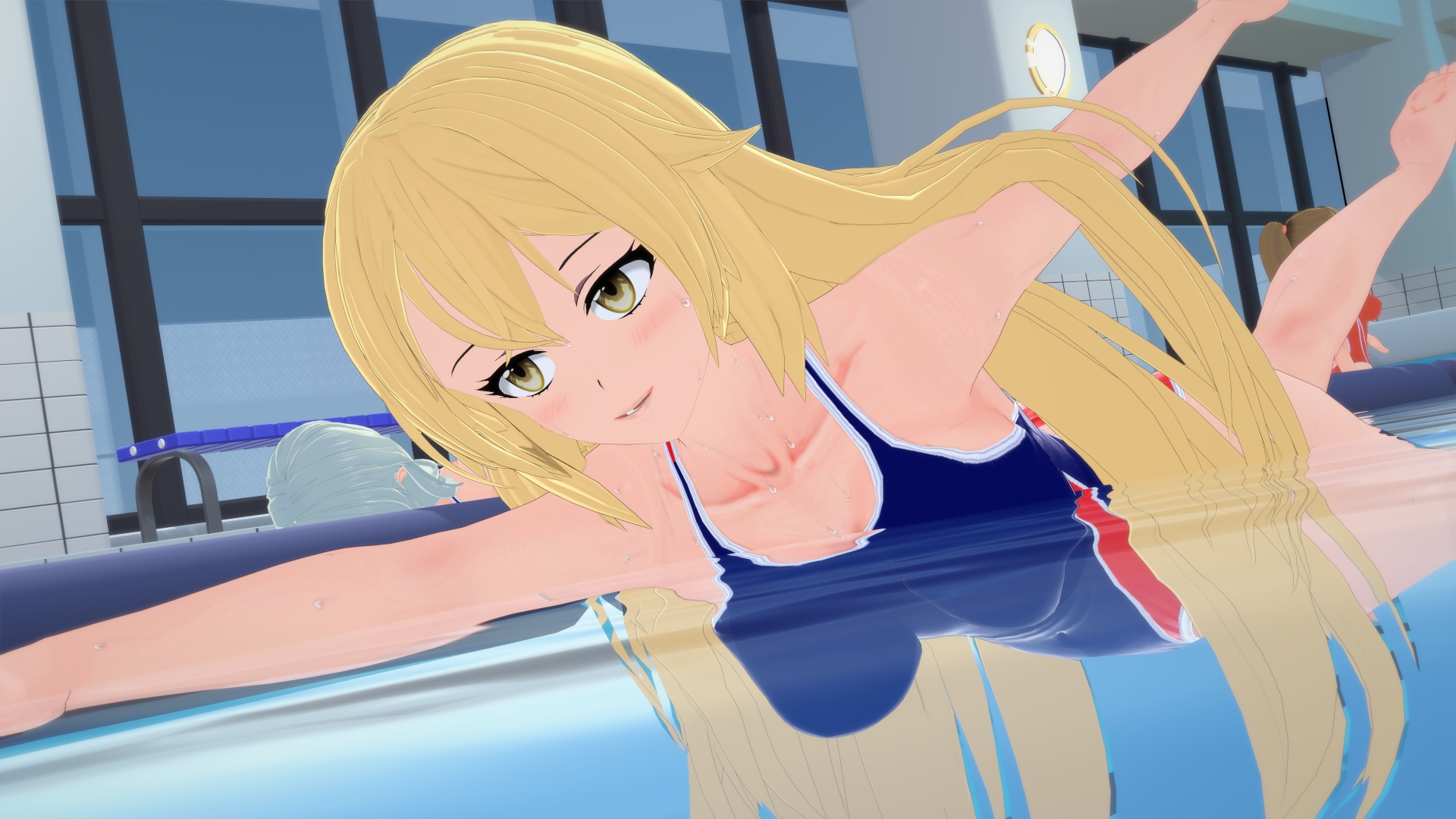
Because this school has weirdly large shower stalls, Satoshi(Miho) is able to use this opportunity to masturbate. You know, despite being surrounded by people on all sides. It doesn’t make much sense, but that in turn only cranks up the degeneracy dial, which is good in my book. Asuka, the PE teacher, notices this, and in one of the only bits of spoken dialogue in this comic, tells Satoshi that ‘he owes her one.’ This bums Satoshi(Miho) out, who only perks up when Rika, back in her own body, feels up his boobs, and the two share a… suspiciously sapphic moment.
Before things can progress further, Miho(Satoshi) is waiting for them in the clubroom, having found out that they swapped after finding two puddles. …Which raises a question as to how the Change Ring handles water, sweat, or non-bodily items. It copies clothes, but if someone is wet, will it capture the moisture, or push it down with the transformation? Because otherwise, I have no clue how they could trail behind that much water. Either way, it’s not a great chapter, though I cannot really highlight much else that could really be done with it. The lack of dialogue hurts things here, and much of it is built around the appeal of girls in swimsuits and masturbating in showers.

Chapter 5, Substitute Sister, is pretty simple, and the worst chapter as well. It is predicated on one swap, involving Yuuka and Yusei, meaning Yusei gets to be a disgusting pervert otaku loli for a day. He uses this profound power to fondle Miho’s boobs, get a face full of Shoko’s boobs, flashes Satoshi, and masturbates as a girl who… isn’t out of middle school, that much is clear.
Now, I am used to this sort of thing coming from Japanese creators, because of cultural differences I’ve hopelessly accepted. …But I know that excuse/reason doesn’t apply to Kawaii Tsun’aho. I won’t shame any creator for making this stuff, but I will look at them dead in the eye and ask ‘really dude?’ I know I just defended this stuff with Transformed Into A Busty Blonde, but those defenses don’t apply here.
As an addendum to the original release of this showcase, I would like to note that Kawaii Tsun’aho actually removed the explicit scenes featuring Yuuka’s body from the main work. Speaking with Kawaii Tsun’aho after releasing this showcase, they clarified they were originally apprehensive about including these scenes, but did so after getting overwhelmingly positive feedback from their Pixiv community. They asked if readers wanted to see scenes like this, they said yes, and Kawaii later soured on what they created. You know what I call that? Growth!

Fortunately, things get better with chapter 6, Beach Trip. The chapter sees Satoshi, Miho, Rika, Yusei, and nurse Risa visit the beach along with a new character, Miho’s little sister, Mai. Another blonde girl, but with a side ponytail and two hairpins that land in the middle of her forehead, forming an X. …Yeah, I don’t get it either. The six arrive at the beach, chill, and try to enjoy themselves. However, Miho quickly gets sick of creepy dudes hitting on her and her sister, so she volunteers to loan out her and her sister’s body for the day.
Rather than just exchange them normally though, this chapter introduces the Change Ring version 2.4. An upgraded model capable of scanning multiple targets at once, store up to 8 subjects at once, and its stored data can, somehow, be backed up. It’s a helluva upgrade, and one that mostly avoids the trouble of needing to have characters exchange forms by being in the same room. It does raise the question of why there aren’t more cloning shenanigans, because everybody could just become a Miho, but I guess that’s more of a preference thing.

Satoshi swaps with Mai while Yusei swaps with Miho. The girls turned boys play with Rika in the water, because they don’t have boobs to worry about. While Yusei(Miho), seasoned pervert, joins Satoshi(Mai) in an obscured corner for some nipple frottage and double fingering. A scene that could really have some additional weight… if these relationships were a bit more developed, if there was more direction in how this should be interpreted. They both clearly love Miho’s body, and think she’s hot, but what about Mai? Is Yusei supposed to be selling the incestuous thrills to Satoshi? After borrowing Asuka and Risa’s bodies, did they get up to more sexual antics? How should their expressions be read?
Tangent aside, Miho(Yusei) seems to understand what Yusei was getting up to in her body, yet before he can face her ire, Risa suggests they do an exchange. Thereby granting Yusei the privilege of being a curvaceous beach MILF, while Risa is free to frolic with the rest of the teens. They have their fun, and curiously head to a… hotel? It’s a series of six rooms that are basically all windowless bedrooms, and the hallway looks over a road that appears to go under the building they are currently in. Not a hotel, not a home, probably just a kitbashed setting from Koikatsu’s limited locales.

Regardless, the crew are only here to do one thing of significance: fuck. With Satoshi(Mai) and Mai(Satoshi) doing the honors, going at it in four different positions, and making them the first couple outside of Shoko and Hirotaka. Now, I want to comment on the narrative significance of this scene. How it informs the reader of their character. How they sell the experience of being a man/woman. Sadly… I don’t think I could really do that here. It’s not a bad sex scene, but unlike the one from chapter two, nothing really sells it as a body swap sex scene, due to the lack of text.
The absence of dialogue makes it hard to read intentional or willful characterization from the creator. Rampant swapping, relentless lewdness, extreme reactions, callous abuses of power, and myriad manifestations of spectacle, can all be sold through visuals alone. But subtler actions, personal desires, and interplay between characters, these things either need text or more detail than what Koikatsu allows without a lot of extra work. Like I said at the start, it’s a strength and a weakness.

Chapter 7, Study Days, is weirdly more of a transitional chapter than much else. It introduces yet another character, the orange-haired glasses girl Moka. Rika brings her into the club as Satoshi is studying, they exchange bodies, and Satoshi(Moka) goes back to studying. Later, he is approached by Miho and Mai, who take him out clothes shopping. Miho is apprehensive of this, and distrustful of Satoshi for his perverted history, while Mai just loves Satoshi(Moka), teases him sexually and regularly, before heading back to school. There, Mai becomes a copy of Satoshi, Mai makes Satoshi a copy of her, and he is sent home so they spend the night as each other.
There’s nothing really wrong with this, but the lack of dialogue hurts it. Moka is just another face thrown in for variety. Much of the chapter is built around the relationship of Mai and Satoshi, but with so much fixation and a lack of dialogue, there is simultaneously a lack of depth and a lack of room for reader interpretation. The visual language makes their relationship clear, they like each other, but Satoshi is not comfortable with Mai taking such a dominant role. Yet anything beyond that is a bit too obscure for me to really grasp. It feels less like something meant to be textless, and more like a textless version of a comic.
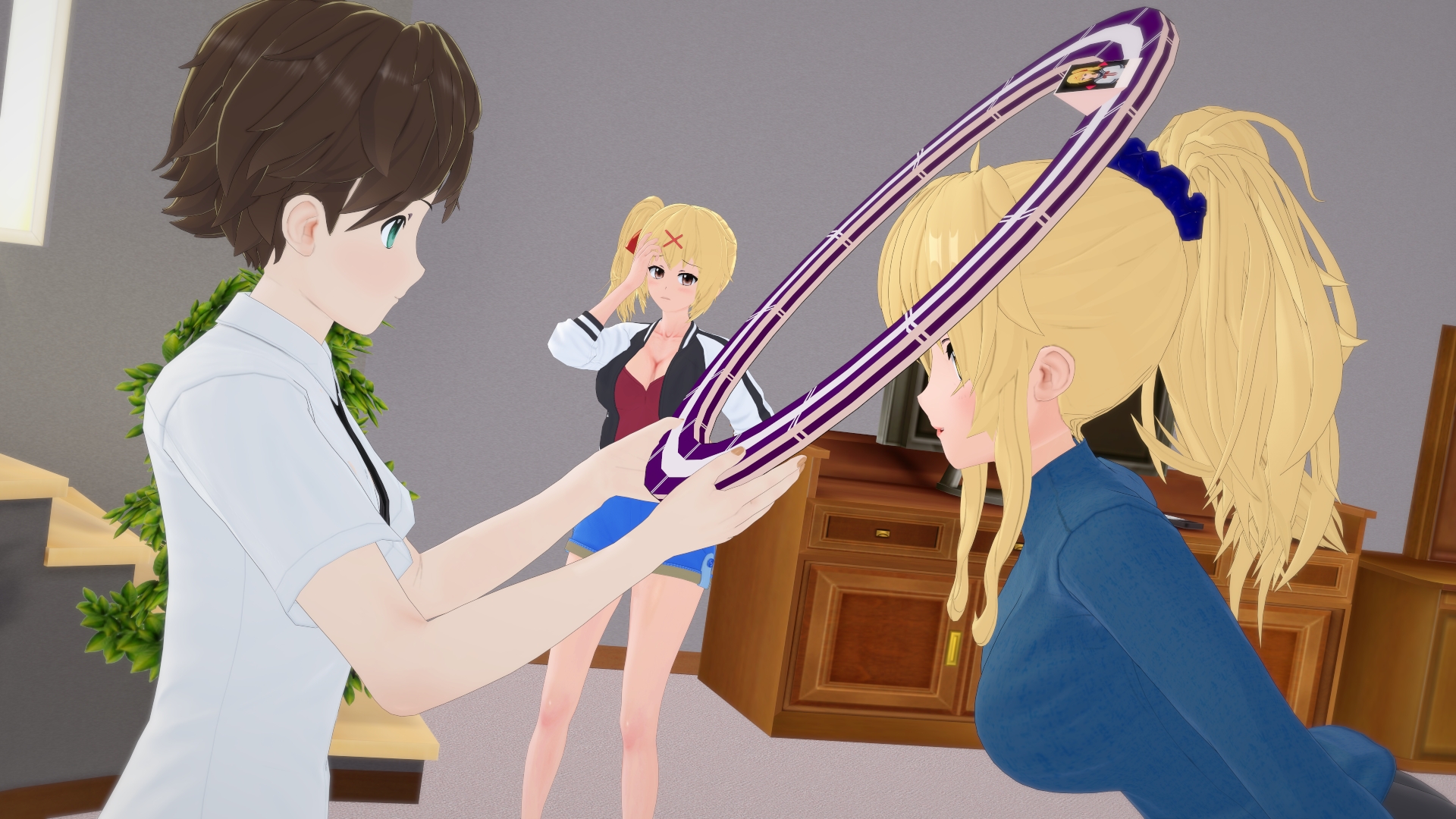
Thankfully, Chapter 8, Swapped Dates is the best chapter in the series! With Satoshi still in Mai’s body and Miho none the wiser, he heads to her home, changes out of his uniform, and meets up with Miho and Mai’s mother, Midori. A refreshingly playful woman who is eager to switch bodies with Satoshi(Mai) using the Change Ring and immediately lumps her husband, John, in on the fun when he comes into the room. Thus leading to an arrangement of Midori(Mai), Josh(Satoshi), Mai(John), and Satoshi(Midori)
This would make for an excellent dual chapter scenario, showing John(Satoshi) and Midori(Mai) going out on a teenage date while rekindling their love enough to ignore the fact that Midori’s in his daughter’s body. While showing Mai to be the loveable girl-pervert-freak she is as she lusts after her boyfriend in her mother’s body. Instead, Kawaii only treats the reader to the latter which… fair enough.
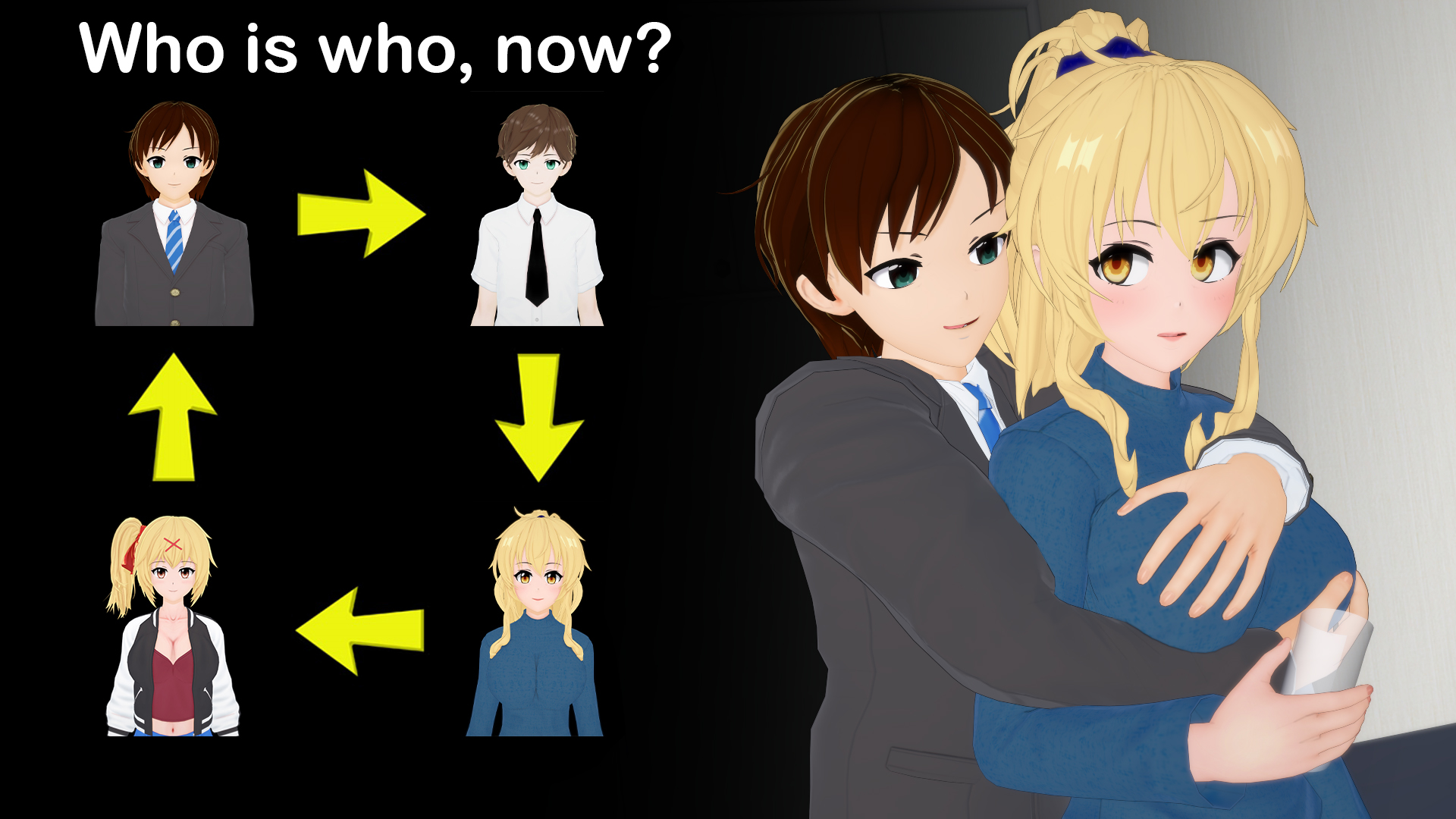
This is followed with some cute diversions, namely a scene where Miho thinks that her suddenly perverted father is actually Satoshi and Satoshi(Midori)’s fashion show— maybe that’s why they had the shopping trip. But the core of the chapter starts when Satoshi(Midori) and Mai(John) are out in the city, going on a date. Playing pool, lounging in what looks like a repurposed castle, and heading to an elevated park, where Satoshi(Midori) enjoys the view of the city. While Mai(John) gives him a better view. His titties. With no inhibitions left, Satoshi(Midori) accepts this and just starts fucking Mai(John).
I love so many things about this scene. The fact that they are physically two grown adults, having sex in the open, in a public park, looking down from the city, it’s some wild exhibitionist shit that I find hilarious conceptually. The sheer disregard Mai has for the fact that she is fucking her mother with her father’s penis. How Satoshi just goes with it, discarding any reservations and letting himself get railed on a railing. Now that’s the erotic kind of danger!
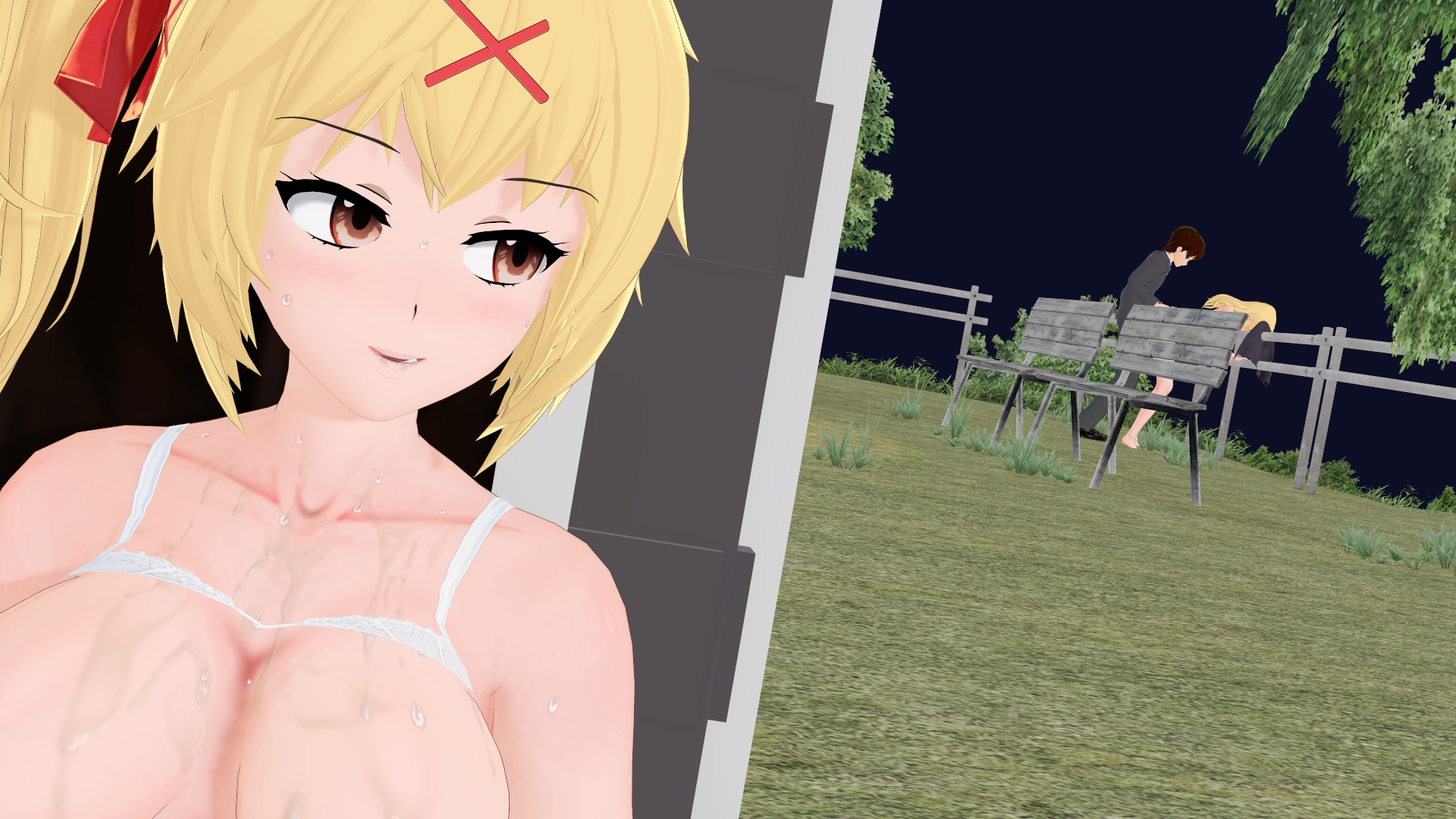
Yet the best part is that, right off to the side, behind some shed, Midori(Mai) and John(Satoshi) are laying there, fresh from their own sexual session. With Midori(Mai) looking at the other pair with a smile, while John(Satoshi) is passed out. It raises so many questions, and I don’t want any of them to be answered. All I know, all I need to know, is that Mai’s a freak in the sheets, and Midori’s pretty much the same, no matter the body, no matter how big the incest is!
After this, Midori returns to her own body, but rather than spend time with her husband, she looks over to Satoshi, now in Mai’s body, and says she loves him. A gesture that… once again, could be read many ways. Because this chapter is full of vague tidbits while never leaving its broad strokes plainly clear, without relying on dialogue. It’s another giddy, eager, body swapping journey, and it didn’t leave me wanting for clarification. It does all it needs to with visuals alone.
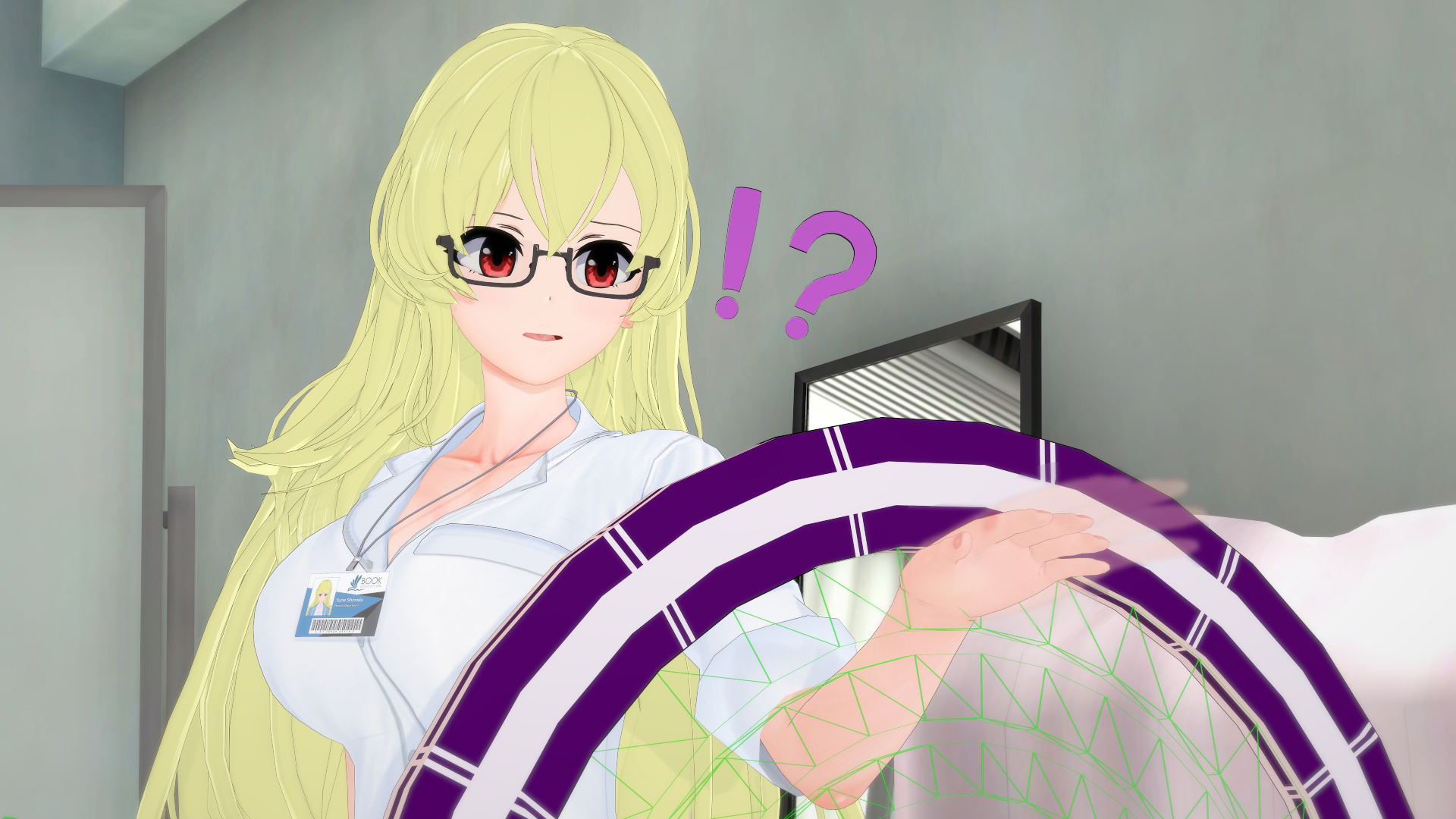
Chapter 9, Consequences, is the latest part so far, and… sadly, it feels like a lot of set-up for the next chapter. This is the proper introduction of Yurie, the green-haired English teacher who has been a background character, yet has never done anything worth remarking. She ventures into the clubroom, discovers the Change Ring, and gets involved in a series of transformations. The actual details are… pretty inconsequential, as they boil down to Satoshi and Yurie switching bodies. Yurie(Satoshi) passes out and wakes up in the nurse’s office while Satoshi(Yurie) tries to be an English teacher, his execution being… questionable.
This leads Risa, the nurse, to switch with Satoshi(Yurie) as he would rather lounge in the nurse’s office than teach a class. While Yurie(Satoshi) ventures to Satoshi’s house, timid and unsure. I like teacher student swaps, ethics be darned, and this is a good set-up. …But again, it feels like something is missing here. It’s not extreme enough to be sold through visuals alone, and it feels like the narrative depth is missing.

Going through Change Ring in great detail… I guess I don’t love it as much as I thought I did? Well, that is partially due to how when I read through Change Ring, I am able to treat it as a darn flipbook, going from page to page every few seconds, so things are constantly happening. The rapid pace helps the narrative shortcomings feel like minor bumps in a mad dash, but when I slow down and look at things in more detail, its lesser traits become more apparent.
Still, I do admire the sheer level and volume of things the comic does without any text, and while the zaniness does have ebbs and flows, when it hits, it hits hard! It really makes me wonder what Change Ring could be if it had more. More character added through text, and more expressive and robust visuals than what Koikatsu will allow.
…
…What, you think I just spontaneously decided to give them a showcase apropos of nothing? Nu-uh, hunies! This was all just a prelude to the real 2024-19 showcase, Change Ring the Manga!
TSF Showcase 2024-19.1
Change Ring the Manga by Kawaii Tsun’aho and MPZ
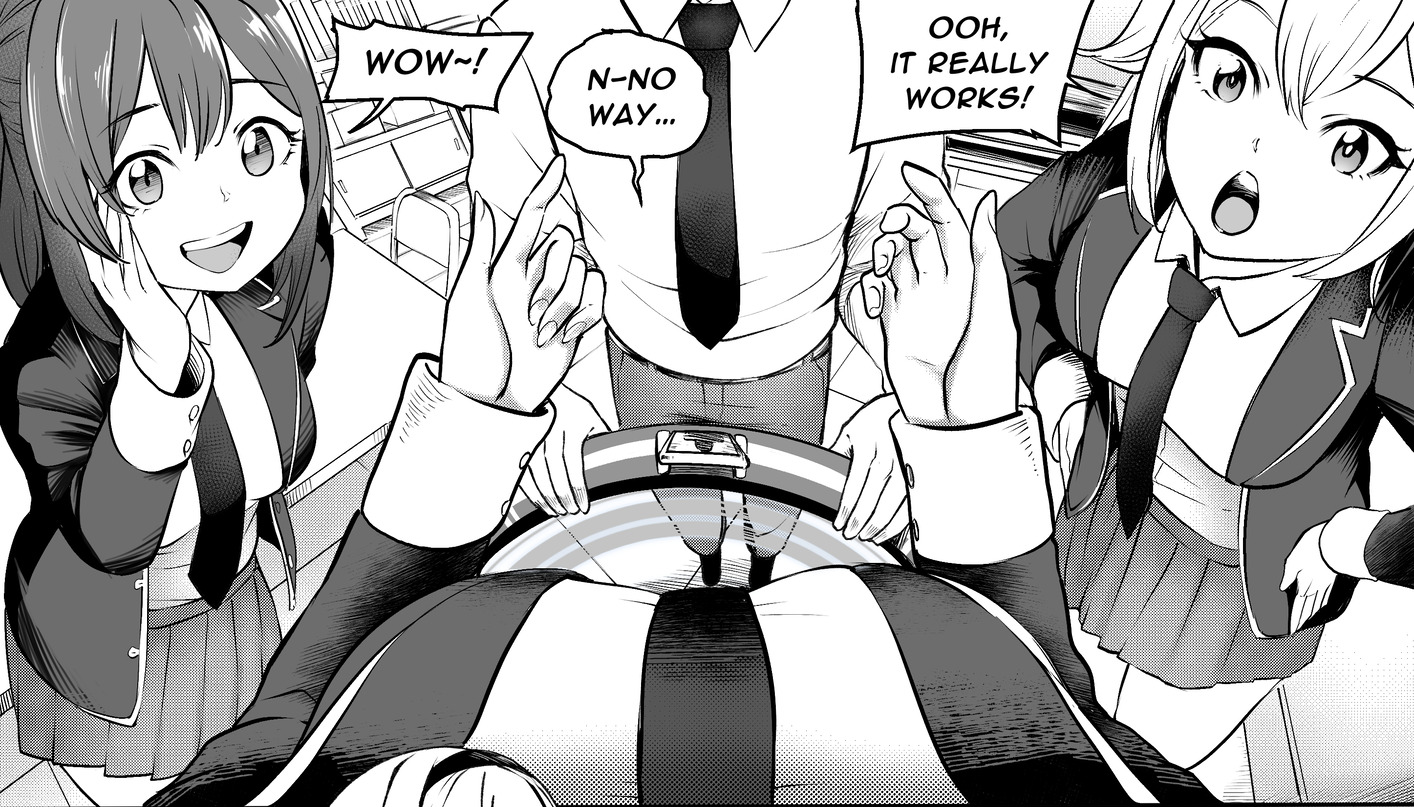
Change Ring the Manga is an adaptation of the first chapter of Change Ring… the Koikatsu Comic, rewritten by Kawaii Tsun’aho and re-visualized by MassivePinkZombie, or MPZ. An artist who TSF Showcase enjoyers might recognize from the visual delight that was sWitch Time. A comic that depicts a multi-page sequence where Bowser Jr., in the body of Princess Zelda, is relentlessly gang raped by the Koopalings. So they were an ideal choice. That might read as sarcasm, but it isn’t. Artists with the capacity to draw buck wild shit have always been some of my favorites.
Having already gone through the first chapter in the above section, the most succinct way I can describe Change Ring the Manga is that it is… more and better than the original. Characters can now speak, so their personality has shot through the roof. Actions that were previously reserved and implied are now vibrant displays. And the erotic scenes have been remixed and enhanced with the refined skills of an experienced NSFW artist.

Instead of having Yusei just introduce the Change Ring with little fanfare, he has all members of the “Scientific Studies Club” gather round and carries himself as a showman. The characters react to Satoshi’s transformation with awe and excitement. The weird way Satoshi in Miho awkwardly removes his tie is replaced with the buttons on his shirt flying off because he’s too damn busty. The way Rika runs away after getting Satoshi’s form is given far more context and feels more natural. Yusei masturbates in the bathroom instead of the roof, like a civilized person, and does so with a perverted vigor that feels… appropriate given where his character wound up.
Every scene is improved and expanded. New minor elements are introduced, such as Satoshi failing to put his bra back on after playing with Asuka’s body. The iffy section with Asuka is fully cleared up, showing that she not only gave the students permission to bring the Change Ring to school, and let Satoshi go home in Miho’s body. On that note, this is the biggest change in the manga adaptation.
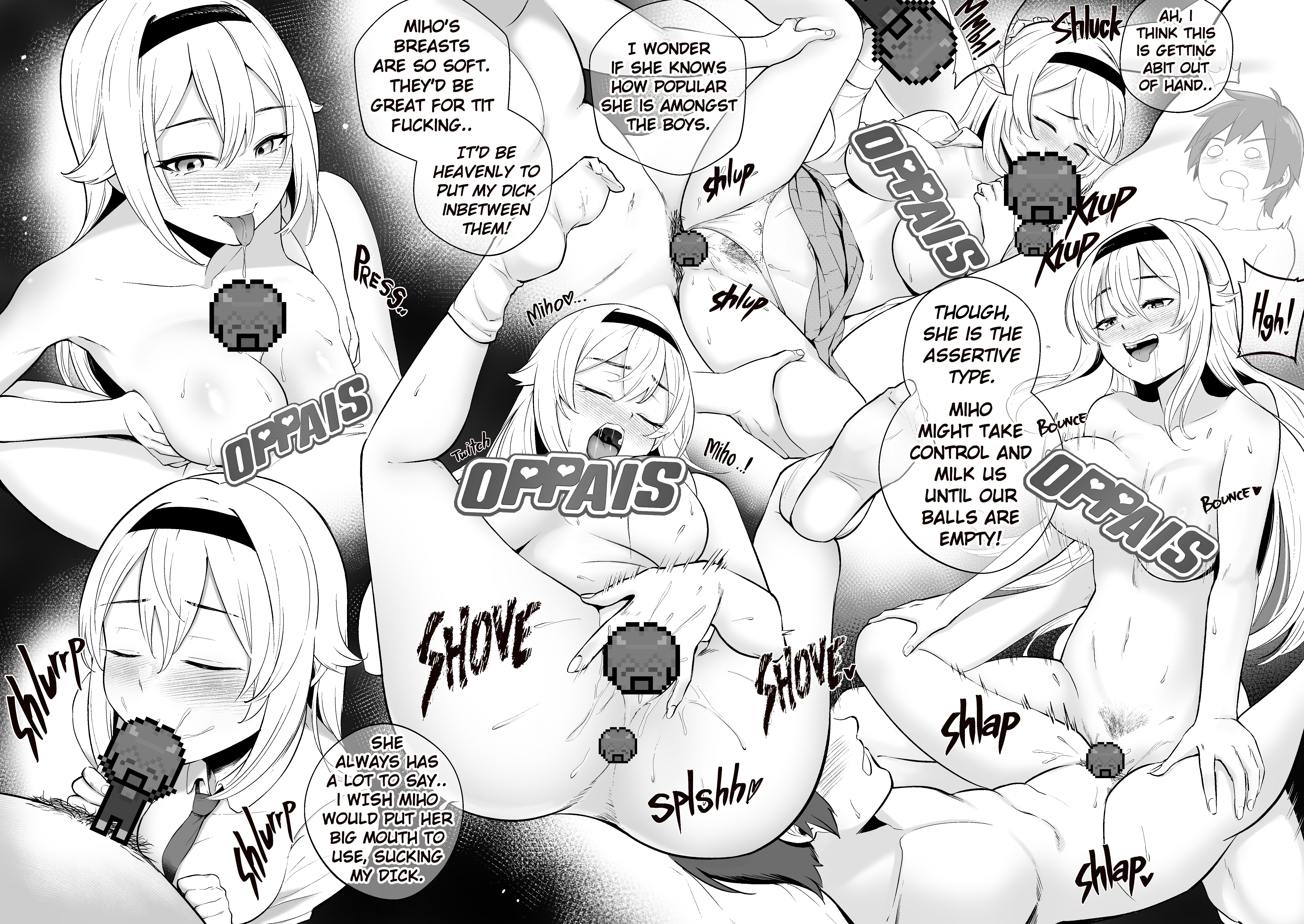
This was the most exemplary horizontal image, okay? And censoring it was fun!
In the original, the Satoshi’s masturbation sequence is just 13 pages of single panel shots, and it’s presented as a straightforward ‘clothed’ masturbation sequence. It shows Satoshi enjoying Miho’s body, but not much else. Not bad, not too remarkable either. The manga version is 10 traditional comic pages, begins with a strip sequence, sees Satoshi masturbate in front of a mirror, narrating as he delights in the joys of his borrowed form. It starts really strong… but then Satoshi imagines himself, his male body, having sex with Miho… while masturbating as Miho.
I know I’ve seen this before, though I still find this as an odd way to present the act of TSF masturbation, of a man enjoying a female body. It is both dissociating from their current body and using its sensations, curves, and tender spots as a form of sexual reference for a masturbatory fantasy. I would expect Satoshi’s mind to at least drift into viewing himself as Miho as the experience continued, as he kept ramming his fingers inside him and fondling his breasts, forming a sensory homunculus. Instead, he just doesn’t. Even in a woman’s body, this TSF protagonist still fantasizes about fucking girls with his dick. It makes me wonder how this rendition would react to being in Mai’s body while having sex with Mai in his.

This is all followed by the same ending, where Yuuka, the deranged girl that she is, steals Satoshi’s body while he is masturbating as Miho. In the manga version, the depiction is far more extreme. There’s a nifty Change Ring POV shot, Satoshi looks as his new reflection in utter horror, and Yuuka… plays dress up with Satoshi’s body, putting him in tight, revealing clothes and giving him hair buns. It’s such a goofy, jovial remix on what was already a good ending, and I love it.
I love every darn thing about this adaptation, from front to back. It is a wonderful refinement of an already quality work. Kawaii, as a writer, did a great job expanding on the original scenario, building up the characters in a way the original couldn’t. While MPZ, as an artist… went hard on this. I adore how some of the shots and panels were framed. The characters are given so much extra life that I feel the need to study each panel to fully appreciate it. It’s premium quality body swap high school hi-jinks, and I’d love to see the same treatment be given to… most of the chapters. Or, hell, maybe something original.
In summary… read Change Ring the Manga, read the OG Change Ring, and read a bunch of Kawaii’s other stuff. Because they know what they’re doing— for the most part— and I’ve only scratched the surface of everything they’ve done over three short years.
Student Transfer V8 is Coming Soon!
(The Murder Route is Finally Getting Replaced!)
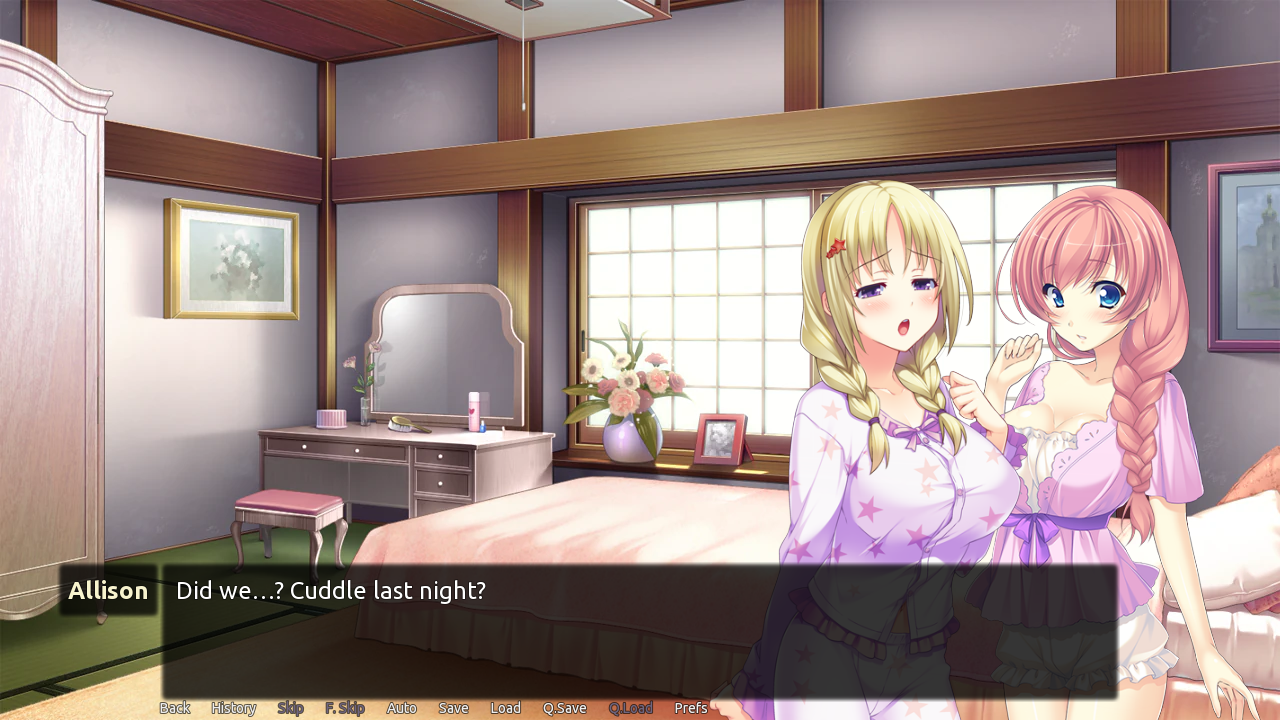
I was so tempted to just download the WIP build of V8 and include one screenshot here. But I don’t want to get on the STDT’s bad side.
Well, well, I guess it is about time that this happened. The Student Transfer dev team blew the horn, announcing that Version 8 is coming soon. Student Transfer updates take a while, as it is a collaborative project and they prefer each update is significant and has its own headliner finished route. Plus, by only releasing new main builds every year (and some change), it gives players a good reason to ‘go back’ to Student Transfer and check out all the new stuff that has been added. At the very least, I prefer it over a fatiguing drip feed of new content.
It’s been almost a year and a half since version 7 came out on November 22, 2022, but fans won’t need to wait too much longer before version 8 drops. Based on V6 and V7, these announcements are made about six weeks before the title actually drops, with the actual release date revealed a few days beforehand. Though, that’s far from confirmed.
Per the latest dev update, the update should include the following:
- The conclusion of the MagicAllie route
- Sizable updates to the KyokoMistake, CharlotteSwap, MagicDelinquents, and MichelleSwap routes.
- A new route that follows up on the Circe wish stub (finally) that sees John enter a sitcom reality
- A new route called KiyoshiWish that sees Kiyoshi abuse magic and become a MILF, which… is obviously the Luckysquid/Gunzil route
- A new route called The Bet, which will mark the first proper John/Katrina route since that unaddressed stub was expanded back in V4
- A reimagined version of the OG Murder route, rebranding and reworking it as the new Mystery route. As a reminder, the Murder route has been inaccessible without editing the game since the release of V4 in 2019.
There were other routes that were at least pegged to get V8 updates, but most weren’t updated since 2022. With the one exception being the Joyride route written by LuckySquid. …Except they were probably too busy with the Kiyoshi Wish route, Crossed Signals, and Mice Tea Gaiden: Oops! All Gyarus!
Am I excited for this update? Oh yeah! I still love Student Transfer, still place it within my top 25 list, and even if the project goes to crap, it will always have played an immense role in TSF genre history. It acts and has acted as an audiovisual narrative delivery platform for dozens, if not hundreds, of creators, and hosted some very high quality stories. Without Student Transfer, we wouldn’t have shit for TSF visual novels. I’m not even sure we would’ve gotten Press-Switch V0.4a!
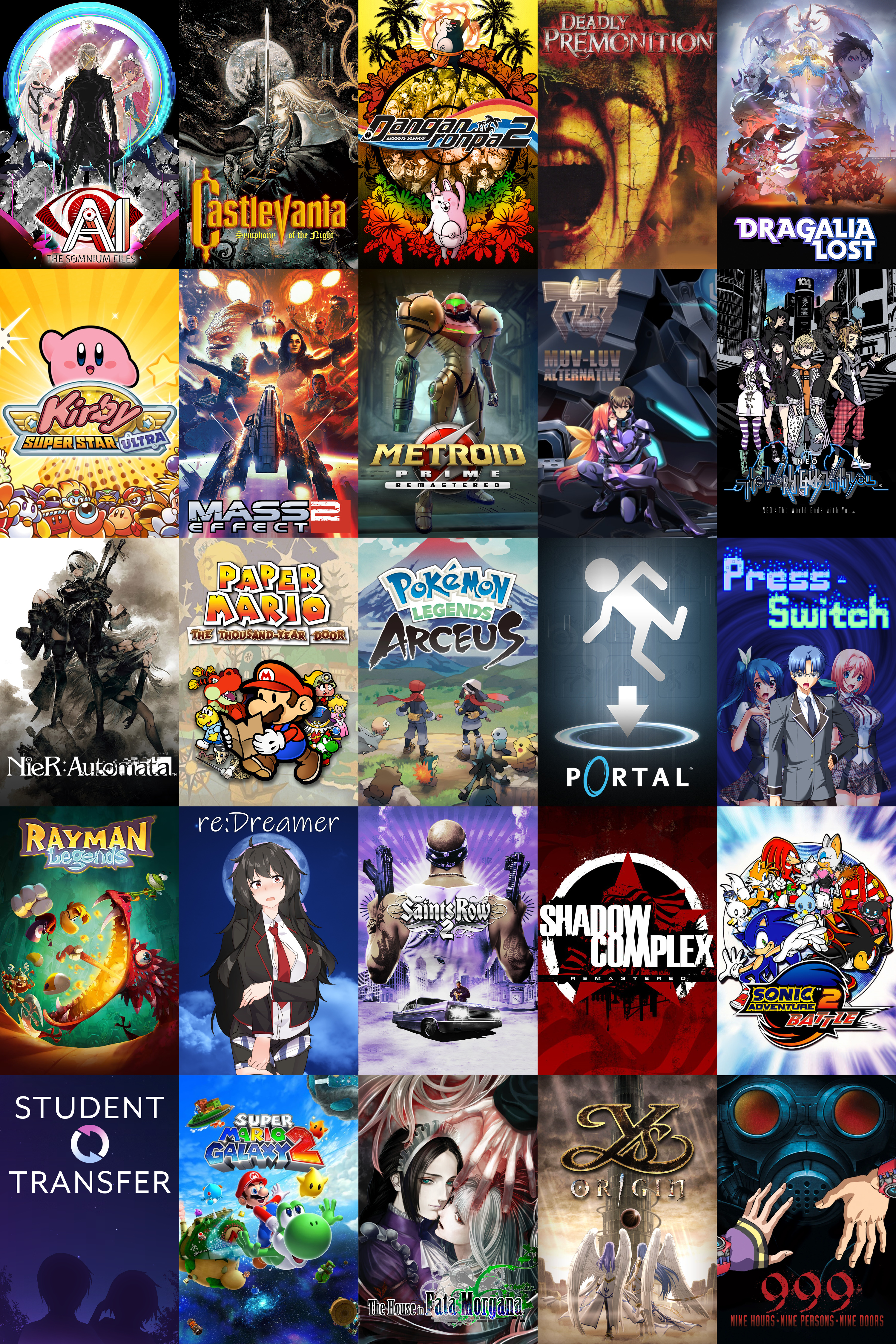
However, with an update coming up soon and my mind steeled for 8 hour days of VN playing and flowchart tweaking, I can’t help but be reminded of some things I really wish the ST dev team did differently. Which include the following:
- Properly credit developers and specify what roles and contributions they made, because the vague list on their website is not good enough.
- Update the website to include the official flowchart link.
- Update the website to include screenshots, or ‘samples’ that aren’t from 2017’s Version 2.
- Introduce a proper blog section on the website, instead of using a member-only forum to host updates.
- Pursue some way to update the game’s presentation, as this is a 720p game in an era of 4K monitors. Maybe look into image upscaling, maybe hold an IndieGoGo so I can contribute $2,000 to custom art assets, I dunno, I just want a solution.
- Introduce a list of ‘best of’ scenarios sponsored by the dev team, rather than requiring people to check third-party reviews or ask around in the community. They already bundled some scenarios with each new version release, so this really isn’t too much of a stretch.
Also, I think the dev team should at least try to have a bigger online presence. I should not be the third search result for Student Transfer. And the dev team are doing a damn disservice to this game by letting notorious shitgobbler PSTGClips garner up views. Just have some schmuck set the game on auto-play, load up OBS, post all content on YouTube in hours-long chunks, and censor the naughty bits. Tag it correctly, and bam, you’ll get dozens of thousands, if not hundreds of thousands, of views and expose a new cluster of people to your game. Some people have tried this, and bless them for it, but make it official, ya stinkies!
…Ah crud, I should get started on updating the flowchart now, shouldn’t I?
re:Dreamer is Back, Bay-Bee!
(re:Dreamer Version 0.18.0 Releases After 7 Month Delay)

Speaking of TSF VN news, Dream Team Studio (meaning CaptainCaption) just released re:Dreamer version 0.18.0, the first release since the anniversary update on October 7, 2023. This release is just in time for my annual June 3rd re-review. As of publishing this, I am getting back into re:Dreamer, and I’m actually a bit scared about this next review. Not because I don’t think it’s going to be gushing— it will be. Not because I think I’ll have a hard time writing it— it will be at least 50% copied over from the last review. But because the game has gotten so bloody long that I don’t know if I’ll be able to go through all of it after this 2024 review.
With re:Dreamer, there are only four/five routes, so I cannot really use the whole ‘review every new route’ approach that I do with each version of Student Transfer. I need to review everything and play through everything. How am I going to handle that in the future? That’s Future Natalie’s problem, when she’ll need to juggle development on Act 3 of Verde’s Doohickey 2.0 with re:Dreamer ruminations.
…And I just realized I’m definitely going to need to go through re:Dreamer and Student Transfer back-2.0-back. …While doing TSF Showcase. …At least my next novel, Psycho Shatter 1988, will be largely TSF-free. Just regular old human-animal TFs and human-divine-beings TFs.
Microsoft Murders Arkane Austin and Tango GameWorks
(Technically They Also Killed Alpha Dog and Consolidated Roundhouse…)

After going on an acquisition tear over the past six years, Microsoft has announced that they are closing two console game studios, effective immediately. Specifically Prey (2017) and Redfall developer Arkane Austin along with Hi-Fi Rush and The Evil Within developer Tango Gameworks.
…What the fuck?!
I talked about the game last year, but Redfall was a sad little loot shooter. It was underbarked, made of problems, and was subjected to a bad development cycle, as the people working at the studio… didn’t want to make that game. It was met with a negative reception, tepid playerbase, yet promised a roadmap of updates. Updates that people have been wondering about consistently since they were announced, yet were not delivered. With content announced at launch still not being in the game.
It has been months since the game was given a substantial update, and the dev team has been silent. I would expect it to get one final rush job of an update before being swept under the rug, where it would only be remembered after a nostalgia cycle. Instead… Microsoft is just cutting their losses. Those who purchased the unreleased and never-to-be-completed DLC will be given “make-good offers.” While everybody who remained at the studio, trying to make Redfall better, working on new projects, is now shit outta luck and left to find new work. Everything about the studio has been callously handled by management, and this is one final nail in the coffin. …Or stake in the heart. And to think that, if left to their own devices, not only would they have released a successor to the modern cult classic Prey (2017), a successor to that would be in development
Oh, and to make things worse, they were planning two updates for the Redfall. One later this month and a second one in October of this year. But both of them will now remain forever incomplete. Like… holy shit, at least let them finish something that was due out in a few weeks.
Then there’s Tango Gameworks. They are, or were, Microsoft’s only Japanese studios, one with a damn good track record. They had a decade of experience, were putting out titles that people resonated with, and delivered a niche that made Microsoft’s offerings more robust. Hell, Hi-Fi Rush is basically the scale that I think most game projects should aspire toward. Just, you know, without the rhythm and ranking elements, ‘cos I’m intolerant of that stuff.
I also cannot tolerate this decision, because this is just abhorrent. I can understand wanting to cut one’s losses with a studio that was hanging by a string and working on a dead-end project. Microsoft did Arkane Austin dirty, but I understand why they would just want to close a studio that has been bleeding staff for years. Tango Gameworks though? They did nothing wrong in their entire run as a studio, which is a damn miracle in this economy! And as a Japanese studio, closing them now is just stupid. The yen is especially weak in the global economy, and there is no way Microsoft could find or foster a developer that can replace them, not even close.
This is why one should always fear acquisitions, fear consolidation, and never assume that a studio is safe. Because the bigger the company, the easier it is to ‘trim the fat.’ With layoffs, with closures, with a callous disregard for the people who create everything they profit from. Just this year alone, Microsoft has harmed so many of their workers’ lives, it’s downright disgusting.
I just hope that the people whose lives were upheaved by this can find some way to land on their feet, continue doing what they are passionate about, and make a living during this economic downturn. Maybe some of the Tango developers can go work with Shinji Mikami again at Kamuy. But either way, as Arkane Lyon’s Dinga Bakaba said, this was “a fucking gut stab.”
At this point… just fuck all big game companies. With stories like this and the Square Enix extraordinary cancellations, it truly feels like there isn’t a good one in the bunch.
It really makes me think that any dollar spent on a corporate backed game is a dollar wasted, and the only good way to spend on games is to… buy indie games. They need the support, because, with all the competition, it’s a war out there.
Another AI Generated Image Musing
(No, I’m Not Going to Become An AI Pundit)
So, in doing one of my semi-regular perusing of the TSF gulags I decided to engage with some TSF AI generated comics. Now, I’ve talked about my thoughts on AI in great detail in Natalie Rambles About 2023, but my opinions are always shifting and morphing, as one’s opinions should. I won’t go down the moral or ethical gulags again, as what I really want to talk about is the idea of someone creating comics using AI, as… I think the idea has some potential. But first, let me talk about TG captions.
TG captions are a low cost and low effort of creating TSF content, as they require an image, a story idea, and a short story, affixed at the right side of the image. Maybe sometimes the bottom, but only the top or left if you are deranged. The stories attached to them were the core original content, and there is some graphical design skill in choosing good fonts, colors, and backgrounds for the text. However, the primary draw for the reader was always the image itself. And while some artists created their own images for captions… over 95% of creators just took an image they found from some place. Such as a Google Image rabbit hole or a Booru. Trust me, I used to run a shitty TG Caption site, I know how the sausage is packed. With rat meat!
These images were used without consent, without approval, and were, in a sense, stolen from its original creators and context. However, this was seen as permissible, as there was no other way of creating TG captions… unless you wanted to license or commission every image. Which would be stupid. That’s like saying every video essay using video game music (85% of them) should license it from the rights holderS.
Now, I want to ask… how is using an image you do not own, and did not create, that much different from using an AI generated image? Well, there is a technical difference in how they are created, or properly credit the original (which is never done in TG captions using photos). But under this limited lens, not really.
I guess what I’m ultimately trying to say here is that… I think that AI-based TSF comics are a sort of evolution of TG captions. They serve the same basic function of allowing writers to independently create works without collaborating with an artist and can be turned out rather quickly by relying on ‘borrowed assets.’ And I think that, in turn, makes them worthy of a comparable level of respect as TG captions. While the image itself is not owned or created by the writer of this piece, they are still creations. They still have artistic intent and purpose behind them and are, by my metrics, art.
Now, I do not consider AI generated images to be artwork, hence why I have refrained from using the term ‘AI art.’ But when paired with context, when used by an artist to create something, things that are not art can become art. If it’s just an image though, with no text? Yeah, no. It would require a significant amount of personal editing for it to become art in my mind. Just like how generating noise, fire, or clouds in an image software is not art itself. You need to pair it with something, put in some effort, for it to become art.
Akumako: “Is this your way of teasing an AI generated TFG comic you plan on showcasing?”
Uh, no. This is just my way of personally reconciling the fact that I checked out creators like AlwaysOlder, Morbin, and NovelChef and found their work to be… interesting. They’re not great, but they do house the… ‘perspective of a creative.’ Their works have originality, personality, and effort. They are clearly interested in using this new technology to bring stories to life. Which, as a writer, as a lover of creativity, is something I like to see. And if people can use AI to manifest the ideas they have in their head into reality, and do it faster and more easily than ever before… then it feels wrong to be blatantly against that.
…However, I do not think any of these creators should be profiting off of their work. I recognize the labor used to script and ‘storyboard’ these works, but do not believe one should sell works unless they fully own them. The typical way of determining that is whether or not they made it, and with AI images, the courts still need to fully decide if they are ‘made.’ Also, too many damn creatives are opening up Patreons. I get that we are in a dystopian hellscape, but every dollar someone might give to you… could have gone to a better creator or a person in more need. Think about that.
Akumako: “…Hold on, if you’re saying you’re okay with people using AI to bring their ideas to life, why do you hate the recent images by Alicia of Great Shift TG Captions?”
Because the AI images she uses are egregious. They are bad to look at. When you aim for realism, you often end up diving into the uncanny valley. Especially with the training data for a lot of ‘photorealistic’ content is filtered to shit! But for cartoony styles and anime styles? AI fares a lot better. It’s inconsistent as clams and the backgrounds are still crap, but it’s better than aiming for the hardest style for computers to replicate.
If you wanna make stuff using AI… stick to anime.
Akumako: “And that’s the straight dope!”
Yes, Nintendo Switch 2 is Happening, But You Gotta Wait!
(The Switch-2.0-Roadmap)

I’ll just keep this quick, as I think it’s futile to try and talk about Nintendo rumors when the reveal will happen in a few months. But this was a big story this past week, so I figure it should get some time in this rinky-dink weekly novella-length horse show.
In short, Nintendo held another investor meeting. To satiate their shareholders, they offered a nugget of information about the Switch successor and their plans. This was later built upon by various prominent leakers who people trust for… various reasons.
Here are the following facts Nintendo has provided:
- There will be a June Nintendo Direct that will focus on the Switch’s lineup for the latter half of 2024
- The Nintendo Switch successor will be announced before March 31, 2025
- The new system was described by Nintendo president Shuntaro Furukawa as “Switch next model” indicating that this is a direct continuation, not a reinvention
The latest trusted rumor distributor, a man audacious enough to name himself after the proud nation of Brazil, has stated the following things:
- The planned release month for Switch 2 is March 2025
- The system will follow the announcement cycle of the original Switch, with an announcement sometime between September and November
- Third parties are allowed to mention Switch 2 starting in June
- There are rumors about a Partner Direct later in this year.
- There will be another Indie World showcase in August
- Nintendo will bring more remasters to Switch this year
- Metroid Prime 4 will likely be the last big reveal for Switch
Meanwhile, some utterly Nintendork sleuths at the degenerate domain of FamiBoards were able to unearth some shipping information about the specs of the Switch 2 and… it seems pretty damn good. Rather than dig through the Famiboards— a wack site for uncool jokers think they deserve the digital security of a damn bank with their digital certificates, I’ll just cite the stuff that was circulated on ResetEra. Namely this thread along with a succinct technical summary provided by ResetEra user Neoxon.
- The system will have 12 GB of LPDDR5 RAM, up from the Switch’s 4 GB of LPDDR4 RAM
- The system will have UFS 3.1 storage of 256 GB, which is good for load times and about enough for two modern AAA games.
- In handheld mode, the system will perform “right above” PS4 specs before taking into account the DLSS upscaling.
- In docked mode, the system will perform comparably to a PS4 Pro or Xbox Series S.
Note: It is difficult to compare the performance of systems that use different chipsets and architectures based on specifications alone. I remember back when people were saying that the 3DS was on par with an Xbox 360 when, as Scott the Woz pointed out, that thing could barely play a GameCube launch title.
I don’t really care about this from a customer point of view, as I do not want to support Nintendo and want to be the rare ‘gamer’ who actually follows their principles. But Nintendo’s sway over the gaming zeitgeist is aggressive and mightier than any other corporation, so I gotta keep tabs on ’em, or else Nintendorks will force me to follow along. I could get over that by shrinking my world, but my world’s already small enough.
Nintendo World Championships: NES Edition Announced
(Better Than Nothing, Worse Than You’d Expect)
There are a bunch of circulated lists of games that were on Wii U but haven’t come to Switch, and every year it’s been getting smaller. Heck, there was a trademark filing leak last week implying that Kirby and the Rainbow Curse and a Pushmo game might be coming to Switch.
But one of the easiest and most glaring omissions here was a game that realistically could run on a human-sized Idaho potato. NES Remix. A series of bite-sized challenges based on Nintendo’s first-party titles from that era, recontextualizing them and presenting them in a unique way by… remixing them. There were two volumes released on Switch, covering different games, and a weird port/compilation for 3DS, but has yet to come to Switch.
I’m genuinely surprised Nintendo didn’t just throw it out for the 40th anniversary of the Famicom last year. Because… that would just be easy money. Hell, they could’ve added it as a freebie for their online subscribers, since they already have access to every game featured. Hold on actually. That would make sense, and Nintendo doesn’t like doing things in a sensible way— I think it’s a fetish at this point— and instead of making an expanded version of NES Remix, they’re making… this.
Nintendo World Championships: NES Edition. A compilation of challenges from 13 of the most iconic Nintnedo developed NES games that are designed for players to blaze through in order to get the highest accolades and scores. It has local multiplayer, online features, and a weirdly detailed unlock system.
This is a very similar idea as NES Remix, but with a stronger emphasis on speedrunning, half the games as the two volumes, and more social features to encourage replay value. …While also being nothing like the original Nintendo World Championships cartridge the title is named after. For those who forgot, 1990’s Nintendo World Championships cartridge is just a sampler of Super Mario Bros., Rad Racer, and Tetris and you can clear it in less than ten minutes by design. It’s not a good game, and because it includes Square Enix’s Rad Racer and The Tetris Company’s Tetris, developed by Nintendo, it would be expensive to license. Well, maybe. I don’t think Square Enix knows what a Rad Racer is. It’s no King’s Knight, I’ll tell you that for free.
Why are they going with this branding then? Because it’s iconic. That’s the same reason they are making an elaborate collector’s edition that will cost $60. Why not just include all 26 NES games from NES Remix, expand things with even more challenges, creating a definitive version of these games, on a system with actually decent NES emulation? It’s their fetish, dude.
If Nintendo was a guy, they would totally be one of those men who jerks off to the 90% point before having sex, so they can cum in their partner’s face after 30 seconds. They’re one of those guys who lets his crap stew in the toilet just so that it will gross out their partner. They’ll clean it up, but only after the partner adds to the dookie mountain.
Nintendo World Championships: NES Edition will debut on July 18, 2024 and cost $30 digitally, or $60 if you are a Hood Certified™ Nintendork.
Progress Report 2024-05-12
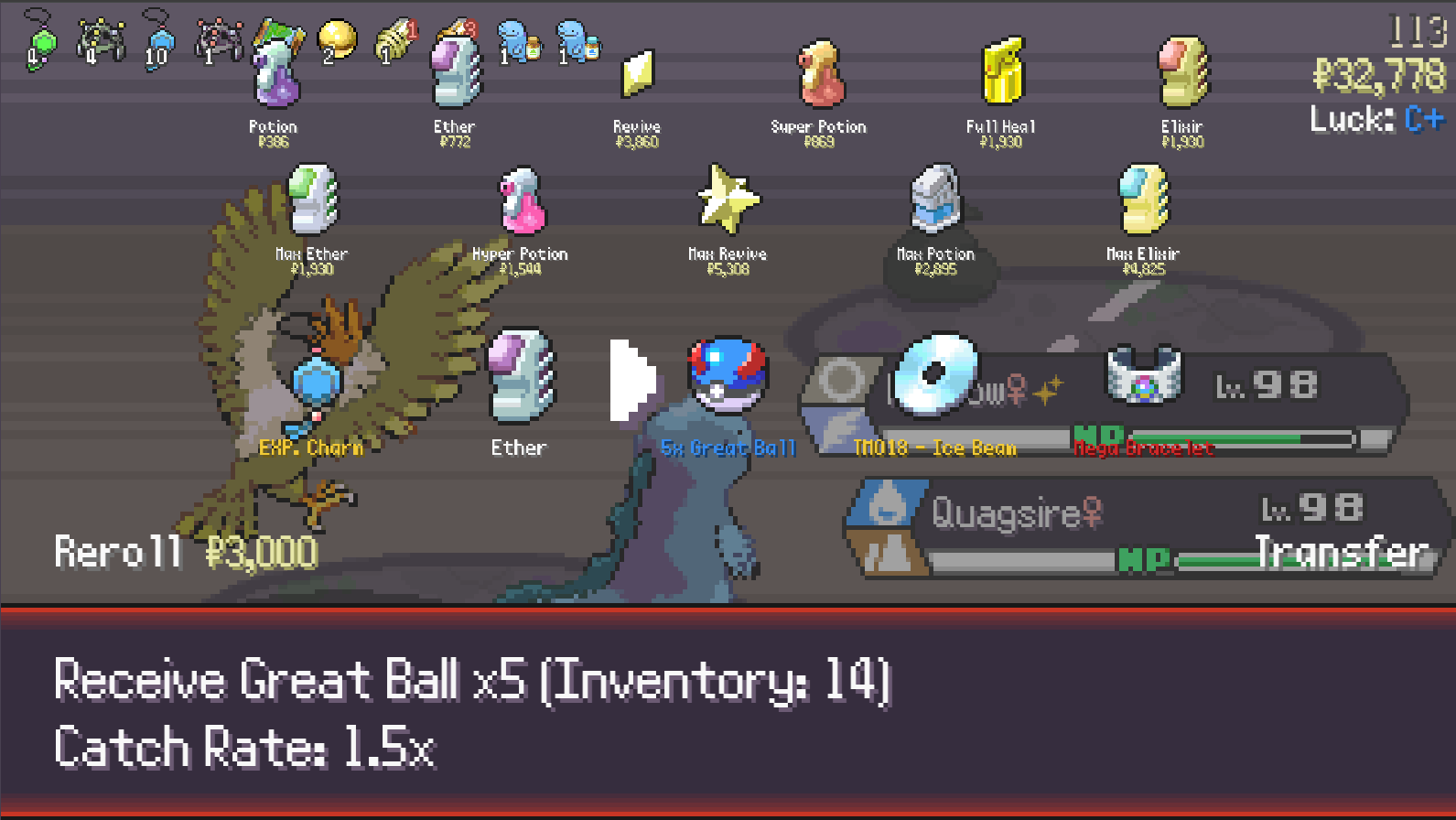
Yeah, I’m gonna need to do a Ramble on this damn PokéRogue game at some point. I love it, but hate what it does to me. Just like my… actually, I never so much as snooked a drag or swished a splash, so I can’t make a drug comparison.
2024-05-05: Did another 4 header images for VD2.0. Got sick of image editing after that, so I started working on this Rundown. Wrote a 2,300 word preamble. Read the TSF Showcase subject, wrote like 500 words for the section
2024-05-06: Wrote 4,800 words for TSF Showcase, because I am bonkers up the butt and around the corner.
2024-05-07: Wrote 2,200 words for the Rundown and made 4 header images for VD2.0. Two more chapters, the cover, the novel header, and the two act headers remain
2024-05-08: Wrote 850 words for Nintendo stuff. Did the final two chapter headers, the cover, the novel header, and the two act header. I will wait a few days to review and export things, but… the images are done, and the novel is at the 99% mark.Fuck it. Stayed up until 2 AM getting this shit done like dinner! Also, facts ain’t shit but piss and grits! So get on your knees and accept it, bitch!
2024-05-09: Busy with work, but editing 12,000 word Rundowns is more than a chicken wing!
2024-05-10: I decided to do an initial rough draft of the Student Transfer V8 flowchart. There are some things that I couldn’t be arsed to understand, but I also know the script is not done, so I’m not gonna stress it. I have skeleton I can build upon, and that’s güt-e-nuff-IV-N0W.
2024-05-11: Started playing re:Dreamer. It’s still very good, but knowing what happens, having the maximum number of flavor text, author’s notes, cut-aways, and secret stuffs going on… the game moves by at a slower pace. Still wonderfully good, still GOATed, but I am not gonna be doing a full 100% line-by-line playthrough in 2025.
Verde’s Doohickey 2.0: Sensational Summer Romp
Acts 1 and 2 Progress Report:
Current Word Count: 372,933
Words Edited: 372,933
Total Chapters: 33
Chapters Edited: 33
Header Images Made: 36
Days Until Deadline: 17
AND NOW I’M FUCKING DONE!!!
I was curious what was involved with those sprites, and turns out quite a lot!
Change Rings’s experiment with no dialog sounds interesting. Some time ago I’d sought out films that experimented with that, not just silent era stuff that tried to have few or no inter titles, but also during the sound era. Have run into something like that at tgcomics too, at least with characters’ word balloons only having emoji or other symbols – though I think they all also had written captions outside of the images, so that you could try reading with or without.
The possibilities of AI are something and one wonders how quickly it will develop. CaptainCaption on the Dream Team Studio Discord had shared an AI experiment in role-play/storytelling that struck me as pretty remarkable: https://poe.com/s/8NRZjCEv4P1Lnxk9jIsA
Making the headers involves a lot of little steps. They rarely take more than a few minutes, unless I want to just fill the entire canvas with different characters, or am making something new from scratch. It can take anywhere from about 30 minutes if I have all the pieces in place, but if I need to make brand new assets, it can take hours. For example, it took me a good two hours trying to make a turtle sprite for TSF Series #016, because I had to make it from scratch, but I didn’t like how it looked in the end, so I filtered it heavily. https://natalie.tf/wp-content/uploads/2023/01/TSF-Series-016-CH-10.png
Right, you mentioned it a few times, but it has been years since I seriously checked out TGComics. Mostly because I’m not a huge fan of the realistic 3D model work that made up the majority of their output last I checked.
I’ve seen Cap plug a few of their AI results in that Discord, but AI writing is something I am far less interested in beyond masturbatory purposes, which I think is mostly what they use it for.
Most of the 3D model stuff doesn’t grab me either. The quality of the models is getting better but often it’s in uncanny valley territory. A bunch of the comics made with them don’t have the greatest stories either, and the use of models seems to even affect the storytelling. One gets the sense that perhaps, having purchased the models and clothing, there’s then an interest in showing them off from multiple angles, multiple outfits, etc. even more than you would expect to see from a character checking out their new body or how they look in clothing completely different than what they previously wore. There’s some where I do like the storytelling, though.
AI being storytelling with prefab parts, I wonder if it could be analogized to Victorian children’s paper doll theaters and to puppet theaters, despite the panel layout (when they have panels – the 3D often doesn’t) being taken from the comic book form.
More often I enjoy the illustrated ones, though. Having only started reading stuff there – this year, I think, or last year at most, there’s a couple decades worth of stuff that’s all new to me. The emoji/symbol-speak ones I’d seen were from different illustrated comics, not 3D. Buck3’s Eden (2014) and TGTony’s Calladita (2024) are a couple, but there were at least one or two other artists who’d done it too. While I appreciate its distinctiveness on some level, TGTony’s art doesn’t grab me, and Calladita’s a forced CD story that I don’t care for, but I’m glad to see people experimenting with different ways of telling stories. (Given the recent autocloset post, I suppose I should mention Calladita features a small lighthouse that inside is an autocloset with non-surgical robot arms that tuck, tape, corset, bewig, etc.)
AI writing – I suppose to a large part I’m marveling at the programming that must be behind it, to wondering where this technology will be in x years from now. I can’t even begin to imagine what’s involved, from the interpretation of prompts to the output. At the same time, I’m surprised at the things they can’t do. Many poetic forms are guided by rules that are programmatic in nature, which should make them a natural for an AI, and yet even though ChatGPT can properly describe what (for example) a sestina is, it has trouble writing one that follows all the rules.
“AI being storytelling with prefab parts”: 3D I meant.