

This Week’s Topics:
- Rundown Preamble Ramble: Compulsory Game Design
- Fall of the Concord (And Future Questions Regarding Live Services)
- Death of the Concord (Oops! Natalie Got Bamboozled by Fate!)
- Natalie Is The Only One Who is Displeased By Astro Bot (Her Opinion Is Probably Wrong)
- Natalie Rambles About The Zelda Timeline (The Downfall Timeline is Bullcrap, But Also Not Really?)
- Fuck The Law, Praise The Archive (An Obligatory Pro-Internet Archive Aside)
Rundown Preamble Ramble:
Compulsory Game Design
Let’s see, what to talk about… how about open worlds? Because I feel that, in the eyes of some, open worlds have become a compulsory element of a modern AAA game. The immense scale of the AAA mainstream gaming industry has seen a lot of genres fold into each other and homogenize as unique features have been borrowed and ancillary mechanics are carried over. As people jump from major title to major title, this alters their perceptions of what games are and should be, as while they might think they are playing a wide variety of games, they really are not. This same rule applies to what I call ‘franchise fans,’ where people are fans of individual IPs within the realm of gaming, yet seldom traverse outside of that spectrum.
While I am also susceptible to these same habits— just look at THE LIST, and note the biases, blind spots, and over-representation of specific genres— I do try to be consciously aware of this. I try to keep my eyes and mind open to whatever unique or experimental things that people are doing or are popular and try to understand them on some level. To keep in mind the fact that games can be just about anything, and there is no one correct way to design a game.
When done well, an open world can be great. Some people are really into the self-determined play offered by a big world with no guardrails. The ability to stumble onto sights of intrigue can be more compelling than a standard bespoke narrative. And the ‘do what you want’ approach makes it easier to sink into a game and just mess around.
However, they also have a lot of problems. The bigger the world is, the harder it becomes to do things right. Populating the world with points of intrigue. Crafting a world that is simultaneously fun to traverse and memorable. Balancing content so players have things to do without getting overwhelmed. A big empty world is far worse than a more linear and gated world. A world crammed with fiddly little nonsense can easily feel like a list of chores. And when dealing with leveling— because leveling and EXP systems are compulsory too— there are generally two options.
Match everything to around the player’s level. Or set an established level for every environment, hoping that the player goes through this open world in the designated linear order. It is possible to mix and match both— to scale levels up without scaling them down, but most games fall into one of these two groups. I’d say the level scaled approach is generally better, as a core appeal of an open world is to go wherever you want, whenever you want. But that appeal is lost when the player stumbles onto a level 10 area when their character is level 30.
There are plenty of good reasons for and against an open world approach… but the worst reason for it is definitely ‘immersion’. I don’t recall when this term became en vogue to use, but it has bothered me ever since I realized what the word actually meant. There’s no good dictionary definition, but the gist is that a game is immersive when it features one of several of the following:
- A detailed world that responds to the player’s actions.
- An attempt/proximity of realism, either visually or mechanically
- The ability to draw the player into an experience and forget about the outside world.
- Evokes the idea that the player has transposed themself into this world and now exists within it (immersed into the game like an object immersed in water).
- Does not remind the player that this is, in fact, a game by highlighting superfluous gamey elements or featuring numerous glitches.
Some will probably look at these things and highlight them as core allures to why they like games. …But I look at them and have to ask if they are even desirable.
I do like reactive world systems, where the player’s actions are reflected in NPC dialogue, story beats, the look of the world, or the ability to do something that makes sense in real life. Like setting grass ablaze, chopping down a tree by hitting it with a weapon, or just breaking shit. Barrels, settlements, terrain— okay, that last one is basically unheard of due to how computationally intensive a breakable world is. Minecraft (2011) is the only go-to example that comes to mind. However, I do not find these to be immersive. It just represents a cause and effect. And while a cause and effect is a constant in the universe, it’s also how if/then statements work and a lot of implementations can feel very… game-y.
Giving a character a gift so they are nicer to the protagonist, completing an objective and seeing that reflected in dialogue, pushing a rock off a cliff and watching it fall. These are all things that make sense in both real life and games, yet I feel that many applications of these ideas emphasize that the video game being played is still a video game. Because reality does not always have as clear cause and effect as a virtual reality.
The idea of realism being immersive has always struck me as a bit strange. It seems to indicate that any video footage of reality, from security footage, to a photo taken by someone on their phone, to a blockbuster movie, are all also immersive. They are all captured versions of reality, but something looking real does not really make one feel as if they are ‘really there’. If so, wouldn’t the news be immersive?
As for mechanics… I just think that most ‘realistic’ mechanics are overrated. Things like hunger/hydration meters, stamina, food rotting systems, decay and degradation— things that capture routine facts of reality, yet turn them into limitations to work around. However, the application of these systems tends to be a gamified mutation of what they are in real life. Such as stamina. Humans do not have stamina meters that recover every few seconds. People can go off into a sprint, run at rapid speeds, and then become completely winded afterwards. The way hunger is handled in nearly every game with a hunger system is only a light approximation of how humans actually eat. And how can you call anything immersive if you can’t make the little man on your computer take a pee-pee and poo-poo in a bush? That’s something millions of people do every day IRL!
Okay, okay, but let’s talk about this desire to be separated from the outside world, because I think this is both undesirable and can be achieved by any good game. As a human being, there are responsibilities one has to address in their daily life. Work, school, chores, personal care/hygiene, hunger, thirst, caring for others they live with, etc. People should address these things, stay on top of them, and wanting to dissociate from all this is… one reason why there was such a prevailing stigma against games for so long. Hell, it’s still going on today. It’s just not reported as much by the western media.
While it feels good in the moment when one gets sucked into a game and turns a one hour session into a two hour one, if that becomes a habit, it can negatively impact one’s life. Millions of people are locked in addiction loops with games and are playing them compulsively for hours every day. And… this is not a good thing. Gaming time, like everything else, should be balanced, and when it interferes with one’s ability to fulfill their daily tasks, then it becomes a problem.
Also, this phenomenon is not inherent to immersive games. It can happen with any game with any style, and has been happening since… 1978? Thousands of Japanese people lost their shit over Space Invaders back in the day, and Pac-Man (1980) got a hit single about how the game hooked so many people. So, does that make Pac-Man immersive?
Let’s tackle this from a different angle. The idea of actually entering the world of a game has been a long-time fascination for people. …But I don’t think that they actually want it, or can do that. The language of games and gaming often has the player refer to their character using first-person pronouns, and view them as an extension of themself. However, the actions that the player is doing when playing most games involve pressing keys or buttons and moving a mouse or analog sticks. There is a vast barrier between the actions a player performs versus the character, even if there is controller feedback. Especially if there is controller feedback.
VR attempts to combat this with motion controls and a headset, but… if the current state of VR has been any indication, people do not actually want that. (A lot of people bought a VR headset, played it a few times, then stuffed it in a bin in their closet. I’d call that a failure.)
Okay, but if the control is not the allure, then perhaps what people mean is that they enjoy the ability to transpose their will onto the game, to execute whatever action they desire onto it. But isn’t that just part of a game with responsive controls? Or does it refer to the ability to do things irrelevant to the core gameplay, like sitting on a bench or seeing the character’s hair or clothing flutter in the simulated wind?
Skipping to the last point, I definitely understand the desire to minimize the amount of clutter, UI, pop-ups, pickups, and so forth in a game. There is a good reason why people like games with minimal UIs, but I would argue it is not immersion. Minimizing the UI and menu use makes a game experience more focused, minimizes the time faffing about in menus, and forces the player to better understand the world. Well, for some games.
Anybody telling me that a Metroidvania is better without a minimap is a dirty liar. But I will forever say that the best version of Metro 2033 (2010) was the Ranger Hard mode on Xbox 360. It turned a standard horror shooter into one with far less resources, weaker enemies, a weaker protagonist, and no UI to measure the protagonist’s health or ammo. Meaning you had to count the bullets fired, hits taken, sacrifice the bullets in the current clip when reloading. Or at least I think that’s how it worked. I assumed it did anyway, and I thought it made the game feel like such a more oppressive and memorable experience. …But I would not call that immersive. It was just a challenge run. Like a nuzlocke or monotype run of Pokémon, but actually fun.
…Shit, this was supposed to be about open worlds, wasn’t it?
I guess what I’m trying to say with this and with various other similar ranty topics like this is that I wish people took gaming as seriously as I do. Sadly, that is a tall order. I know I am smarter than the average person— I don’t like saying it, I wish it wasn’t the case, but it’s true. And as someone who has run a gaming-based site for… over 12 years, I think about games way more than many Gamers™. Hell, a lot of them weren’t even playing games 12 years ago. I know I wasn’t back when I started up Natalie.TF, formerly known as Nigma Box. I was a 17-year-old who had only been playing games since I was 6, and even then I didn’t really get into them until I was 8 and got my GameBoy Advance for serving my time in da boyz club. Oh memories…
…
♫Gaming is fun, gaming is serious, game too much, you’re gonna get delirious!♫
Fall of the Concord
(And Future Questions Regarding Live Services)

PlayStation’s latest live service, Concord (2024), has proven to be a dramatic failure. I already talked about this last week, highlighting how this multiplayer shooter peaked at 697 players on Steam, but that’s not the full story. Why did this happen? How much did it sell? What could have gone differently? These were privy questions to ask, and IGN ponied up their Ziff Davis money to answer it. Industry analysts determined that the game sold roughly 10,000 copies on Steam and 15,000 copies on PS5 as of August 28, 2024— five days after the game’s August 23rd launch.
Now that is dismal. I have heard of AAA games selling under 30,000 units during their US launch month, but by modern standards, based on a global market, and with a budget this high? 25,000 units is so bad that it’s probably less than the worst-case scenario imagined ahead of the game’s launch. I would have set 100k as the ‘bomb’ figure. Which begs the question of… how did this happen? The article says “poor marketing, a high price point, and most critically, a lack of differentiation in an oversaturated genre.” But I think it is a bit more than that.
Concord was announced only three months ahead of launch, making it hard for Sony to build up hype for this new IP from an unproven developer. The game simply did not make waves when it had an open beta in July, with low engagement rates and a muted reception from those who checked the game out. Which really should have been a preview for all of this. The game… just does not have much allure or personality that I could gather from what Sony put out. And the characters… just are not very appealing.
They have been subjected to the usual bigoted racism, fatphobia, and sexism from troglodytes who want to push their White Male Supremacy narrative. My disdain for people like that is well documented at this point, and they are truly pathetic creatures who have, potentially, damaged their minds beyond repair. However… from a sheer character design level, the characters of Concord are all kinda ugly. The color balancing, clothing design, hyper-realistic skin, and attempt at making silly sci-fi attire cool, none of it really works, and when it does, there’s some other clashing element. It makes me wonder if the goal was to make the default skins look bad.
Compared to Overwatch (2016), a game that was sold on its porn first, its characters second, and its gameplay third— the gulf in quality is immense. Hell, I always thought the characters from Apex Legends (2019) looked a bit too generic, but it’s in a league above Concord. And compared to Valorant (2020)… I’ll be honest, my mental image of Valorant is just a Klansman on a toilet. I don’t actually remember what the game looks like.
More marketing could help Concord, but… I think the game was basically doomed for several years. A hero shooter is sold on its heroes, and if they don’t click with artists, that’s a major handicap right out of the gate. Because artists do wonders to sell games. I doubt dumping tens of millions into marketing would have helped this game crawl its way to success. And the game came out three days after 18 million units selling banger Wukong: The Black Chinese Myth (2024), when streamers were still playing it.
Now, I view the failure of games like this and Tom Clancy’s XD-Fiant – A Ubisoft-Tencent Joint (2024) to be a sign that the live service train is a great way to lose all the money. It’s a high risk high-reward situation and not every game can do Zenless Zone Zero (2024) numbers.
However, this article absolutely shattered my perception of things by dropping the fact that “only about 16% of the total revenue of the games market now comes from traditional full-game sales. Publishers are going to keep chasing that 84%.” …Yo, what? That doesn’t sound right to me.
My last reality check to the scale and size of mobile gaming and live services was that Visual Capitalist chart I mentioned back in April. There it showed that, as of 2022, the games industry generated $181 billion dollars. This means that only $28.96 billion comes from full-game sales. It’s not clear to me how DLC is being considered, but no matter how this is sliced… I think this is terrible for gaming. I have accepted that most gaming revenue comes from live services, just due to the sheer number of people who own phones and the ubiquity of live services on phones. There are like 200 to 250 million console users, a couple hundred million PC gamers, and like 2 billion people who play games on their phones.
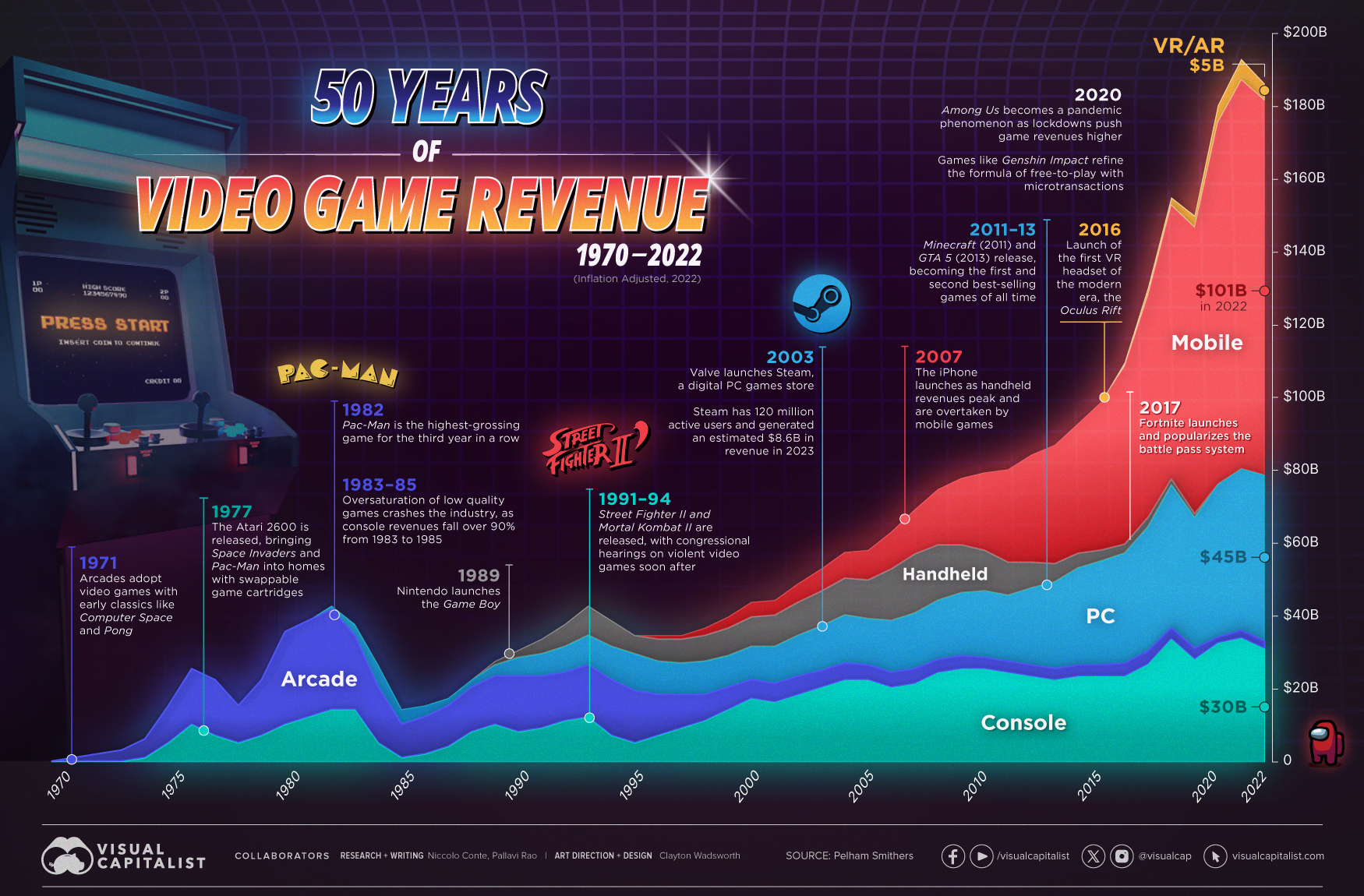
However, the idea that over 80% of the market is dominated by live services is just gob-smacking to me. Assuming that 100% of mobile game revenue goes to live services, then the majority of money spent on games on PC and consoles must also go to live services. How and why are people who are invested in game consoles putting this much money into these games? In the era of cheap PC games for all, why is most PC game revenue going to live services? …And how much can I blame Riot-Tencent Games and Epic-Tencent Games?
This is the sort of thing that I would love to investigate and publish a report explaining how and where money comes from and goes in the world of games. Sadly, I’m not a statistician or data analyst. I could’ve been, but I thought being a tax accountant would be more useful.
Death of the Concord
(Oops! Natalie Got Bamboozled by Fate!)

Akumako: “…And Concord’s dead. Nat-Nat, being a dumbass, drafted the above segment on Concord back on September 1st when she thought it was safe to say something definitive about the game. But then Sony pulled the game from sale on September 3rd, refunded everybody, and shut down the servers on September 6th. She would have just scraped the prior segment, except Nat’s possessive of her cum feces and thought she made some real good points about the game. The limitations of marketing, importance of Kweli-tee character design, and how wack-ass the figures from that IGN article were.”
WOW! A New Record!
Well, not in regards to how quickly this game announced EOS. Immortals: Muv-Luv Alternative (2022) only lasted a few hours due to a critical bug that destroyed the game’s monetization system. But that relaunched as Muv-Luv Dimensions (2023) a year later. Battle royale kusoge The Culling 2 (2018) only lasted 8 days and never came back. Babylon’s Fall (2022) lasted just under a year after a 5-year-long development cycle and two seasons of content. But the failure of Concord (2024) is truly something else.
Concord was in development for eight years, probably had a budget of over $100 million dollars, was only available for sale for a week and a half, and was executed on its two week anniversary. All people who bought the game have been refunded, and Sony has grown quiet on the future of the game, making it difficult to say what this game’s ultimate fate will be.
Sony could always attempt a relaunch that addresses players’ criticisms and give the game a greater marketing push while shifting to a free-to-play model. They could sweep it under the rug, do whatever they can to prevent a disaster of this scale— a game that made less than 1% of its budget within its first week— from ever happening again. The developer, Firewalk Studios, will almost certainly suffer from significant layoffs, if they’re even still open by the end of the year. And only Sony’s C-suite knows what will happen to the myriad other live service games the publisher has in the pipeline.
Regardless, this is a failure of such extremity that it warrants a place in gaming history as a warning for everything that can go wrong with a live service. …Aside from the game’s stability and functionality. I view it to be a bold example of why live services are destructive and not a path to plentiful profit. Unfortunately, as I highlighted in the above section, the overwhelming majority of money in the games industry comes from live services. At best, this will be a wake-up call to Sony.
Most gaming executives are business people businessmen who view games as strictly financial instruments that soak up money and spit money out after a set amount of time. They are guided by a survivorship bias that narrows their vision. They only want to usurp giants, rather than pursuing modesty and sustainability. They won’t learn a single fucking thing from other people’s fuckups, and if something on their watch is a fuckup, then it wasn’t their fault. It was just a natural risk associated with business.
I am so sick of this shit happening all the time, but the world is ultimately ruled by the wealthy, the culture of the powerful moves very slowly and conservatively, and— you already know where I’m going with this. The reason ‘gaming is bad nowadays’ is because more power was given to capitalist shitbirds who don’t care about the games, exploit the artists who make them, and force them to uphold impossible standards. And… this isn’t going to stop in the near future.
Gaming is a young and growing industry, meaning more and more power is going to executives who do not care about it for the art, and do not learn from past mistakes. Because their job is not to benefit the whole, but to benefit their shareholders, benefit their bosses, and line the pockets of the people with enough wealth, power, connections, and clout to be put in charge of billions. They aren’t looking out to the future. They don’t give a shit about where the company will be at in 10 years, let alone the industry. They don’t give a shit, and they ain’t gonna learn shit! But you’ve still gotta give them shit, because is there’s shit all over the floor, nobody’s going to want to go to their store!
Natalie Is The Only One Who is Displeased By Astro Bot
(Her Opinion Is Probably Wrong)
It’s funny how Concord (2024) shut down on the same day that Astro Bot (2024) released. A single-player platformer that was met with widespread enthusiasm from the dedicated gaming community, featured a reverence for gaming history, and was just straight up good. Its critical reception was overwhelmingly positive, and while no ‘serious’ publication will name it as their GOTY (Keighley will probably go with Wukong) it definitely warrants a nomination.
I should be praising Astro Bot (2025) as much as anybody, as the title does represent many things I have celebrated and championed over the years. However… I just cannot help but view it as a project that was only approved for the most cynical reasons.
Astro Bot is a character who, from the onset, was designed around marketing. The initial game, Astro Bot Rescue Mission (2018), was positioned as the marquee all-ages title for the ill-fated PlayStation VR. With the main character being largely designed as an extension of the peripheral’s deliberately sci-fi aesthetic, black visor, white body, and numerous blue lights.
Sony eventually carried on this aesthetic with their PlayStation 5, as they desired more iconic and recognizable hardware than black layer diagonal square-shaped layer cake. And they weren’t going to go back to designing consoles after George Foremans. (That fat PS3 grill meme is old enough to vote, but I still think it’s hilarious.) As such, they chose to use Astro Bot as a mascot. They went so far as to put them in a free game for all PS5 owners, meant to showcase their new hardware, as it would be years before anything else did. This took the form of Astro’s Playroom (2020), which can be summarized as ‘a great platformer filled with love for PlayStation history that is (un)fortunately only two hours long.’

On one hand, I can recognize a good game, and Astro’s Playroom was a very good game. However, in the broader context of Sony and PlayStation history… I actually consider it to be an insult. Because modern PlayStation is not the PlayStation of the PS1, PS2, or even PS3. The company has largely discarded most of its classic IP and has made little effort to bring it into the PS4 or PS5 ecosystem. Most of the people who made PlayStation what it is today have left, and the company has largely shifted to an American operation over a Japanese one.
This was best exemplified by their closure of Sony’s legendary Japan Studio in 2021. A developer whom I consider the second greatest game developer in the history of the medium for their boundless contributions to various projects and dearth of original IPs. …Nintendo is on top, because Nintendo made video games REAL. And don’t tell me that Team Asobi, developers of all Astro Bot games are the modern Japan Studio. That is bullshit! They were only a few dozen people, basically none of the old guard remained, and looking at the credits of Astro’s Playroom, the director, art director, lead animator, and composer are all White men.
PlayStation has also treated its Japanese audience with utter disrespect, if not disdain. And I think the best example of this is how they treated the Dualsense, as they not only removed the carefully chosen and iconic button colors, they forced Japanese players to use the international button standards. Where X is confirm and O is cancel, when the original intention for these buttons was for O to be confirm and X to be cancel. It was a mistake to ever change these in the first place, and rather than maintain this 25-year-long balance, they just told the Japanese audience to get with the times.
And even as recently as this past week, Sony has been disrespecting Japan by hiking up the Japanese price of the PS5, and it hasn’t been the first time they’ve done that either. In the birthplace of the PlayStation, the price keeps going up. But in America? It hasn’t changed a bit!
To me, a game like Astro’s Playroom should have been a statement of intent. A desire to reprise the legacy that PlayStation was founded on, the classic libraries, the beloved characters, the diversity of experiences, after Sony became fixated on narrative-driven third-person action games. Or AAA prestige games.
Since then, what classic IPs have been brought back, what actual love for PlayStation has there been? And the answer is… barely anything. Sony is so committed to their AAA premium standards that they’ve barely been releasing major PS5 exclusives and have had to fill the gaps with remasters of games less than a decade old. Sure, they have done things like Helldivers II, which may as well be a new IP, and Concord, for all its faults, was a new IP. But those games do not capture the essence of what PlayStation was.
In my mind, Astro Bot (2024) is the last vestige of this old era of PlayStation, and I should see it as a celebration. So, why don’t I? It’s a great platformer filled with wonderful systems, excellent level design, and is both vibrant and creative. Well, much of that has to do with the titular protagonist, Astro Bot. I cannot help but see something deeply cynical and marketing-focused in their design, as if it was engineered in a lab to appeal to people of various cultures and easy to attach to merchandise.
A slick futuristic creature with a small pudgy baby-like design, big head, alien-radio antennae, hero cape, eyes based on a retro monitor to indicate that they are indeed a robot. There is nothing inherently wrong with their design, and the last thing I would want to do is besmirch the person who designed this little cutie. But as a mascot? They just feel disingenuous.
Astro Bot does not fit with the rest of Sony’s modern catalog. Put this fella next to Parappa, the Ape Escape monkeys, Sackboy, Toro Inoue, Crash, Spyro, Sly Cooper, Classic Lara Croft, Cloud Strife, Snake the Solid, Daxter, Clank, Jak, Sir Daniel, Ratchet, and Robbit The Jumping Flash, then… yeah, it works. I would accept them the same way I would accept a cutesy console specific Nintendo mascot, because they would fit with the rest of the brand. But next to Ellie Lastuvus, Miles Spiderman, Peter Spiderman, Tsushima The Ghost, NuKratos, Aloy the Android(?), Jebediah Bloodborne, and whomever else? Nah, no dice. But if you take all these characters, throw in a bunch of others I didn’t mention like John Killzone, Drake Nathans, Katrinasha the Gravity Dazérush, then you have one big beautiful family! …And a über ill starting roster for PlayStation All-Stars Brawl (2029).
Okay, but that’s just the character, what about the game? It looks amazing! …But in its attempt to pay tribute to the whole of PlayStation history, it just feels patronizing and insulting. Rather than feature many of the PlayStation characters I just mentioned, it features them as costumes worn by various non-titular Astro Bots. Not the characters, just costumes worn by a marketable corporate character meant to remind players of old characters, old games, and how much better life used to be when you were 12. It even tries to engineer new nostalgia for the PlayStation 5 by featuring the console as a spaceship and its DualShock 5 DualSense controller as a plane.
It feels ghoulish, and just makes me wish for a PlayStation that had the audacity to at least pay for indie devs to make a new game in some of these series every now and again. I mean, an Ape Escape 4 could be made by 25 people for $5 million if one managed the scope properly. Hell, do you know how many devs would cream their jeans to get a hand on even C-tier PlayStation IP like Fat Princess? Oodles!
Astro Bot (2024) is a burning reminder of everything modern PlayStation is and isn’t, and just trying to watch any given trailer for the game made me so, so bitter over the current state of affairs. I would love for Sony to make more games like this. If this was the harbinger of the revival arc of classic PlayStation, I’d be psyched. But for now, I just hate this kind of pandering to long-dormant IPs and appropriating iconography. It’s really not all that different from movie studios paying for a human’s likeness to keep a character alive for the sake of branding.
…And the more I think about Astro Bot as a character, the more I really don’t like anything about them. Even the name bugs me. I keep wanting to read it as Astro Boy, aka Mighty Atom. I know for a fact that this came up during a meeting, and they refused to change it, because they were so committed to naming a character space robot. Hearing that name, seeing that design, it all seems plain and devoid of true character. I know that is not true, as animators can make a sandbag charismatic as fuck and a good enough writer can make a square a compelling character. But… I’ve seen mascots for local comic stores with more heart than this iPhone-Funko-Pop-looking-ass bastard.
Now, it is entirely possible I am dead wrong here, and I am projecting too much against a highly polished and refined game developed by skilled and passionate people. But this is just something I could not get over while watching footage of the game. And after seeing that they have a goldarn Ape Escape tribute level in the first hour, I lost it. I wish I could borrow/rent a PS5 to play this game and write a review, as I would love to reach a more definitive conclusion on this game. But as it stands now, I’m just upset that this is what PlayStation’s legacy is.
And you know the funny part? I didn’t even grow up with a PlayStation. The first PlayStation game I played for more than a few hours was The Last of Us (2013) after I borrowed a friend’s PS3 in 2013. And the only PlayStation consoles I’ve ever owned were a Vita and PlayStation TV. I’ve never touched a PS4, never seen a PS5 in real life, and I’ve never even completed a single game by Japan Studio. I just care that much about respect, legacy, and artistry that I will go on a 1,500 word spiel!
Akumako: “Translation: Natalie’s a dumbass.”
Natalie Rambles About The Zelda Timeline
(The Downfall Timeline is Bullcrap, But Also Not Really?)

The latest version of the Zelda Timeline, revealed during a Nintendo Live event in Seattle this past week.
One of the stupidest debates in gaming centers around the timeline of The Legend of Zelda. A series that really should have never attempted to maintain continuity across non-sequel entries and keep things deliberately obtuse. However, Nintendo just had to keep poking the hornet’s nest, made an official timeline and kept revising it over time. I first learned of it in 2006, via this video, and have been holding back frustration over it since 2012, when I was a greasy teenager who just bought the Hyrule Historia. I’ve been holding back some form of frustration for over a decade and, screw it, the time to dig into this is now!
…Dramatics aside, my frustration with the Zelda timeline is entirely isolated around one single bit of text that just does not mesh with me. The Downfall timeline. The start of the timeline makes sense. Skyward Sword, into Minish Cap, into Four Swords, into Ocarina of Time. That works. However, things get confusing with Ocarina of Time, because it is a story about time travel. And time travel always introduces problems. There’s a reason why I will not include time travel in The Saga of Dawn and Dusk. And if I ever want to do alternate timelines… I can just do that. And I have done that. Because when you have a multiverse, you don’t even NEED time travel!
For those not aware, the story of Ocarina of Time (1998) goes like this. Link is a small child who ventures around Hyrule for three magical doodads so he and small child Zelda can stop some Arabic bastard king— Ganondorf— from wreaking havoc on the world. Link gets the things, but Ganondorf sends Zelda into hiding before he can return. So, on his own, Link opens up the magical Temple of Time and grabs the Master Sword to defeat Ganondorf. However, Link inadvertently opens the gates to a magical realm where Ganondorf claims the Triforce of Power.
Link then awakens seven years later, is an adult, and all of Hyrule is now ruled by Ganondorf, where he needs to venture to six dungeons to awaken the other six sages and finally defeat and seal Ganondorf. As part of this process, he needs to actually go back to the past to defeat a threat that cannot be taken care of beforehand, showing that this is not a one-way leap to the future. Link eventually defeats Ganondorf and is sent back to the past. However, he is actually sent back further into the past, before he initially met Zelda and learned about Ganondorf.
Officially, there are three timelines spawned from this narrative. One that builds off of the destroyed Hyrule where Ganondorf is sealed— The Adult Timeline. One where Link is sent back to meet with Zelda— The Child Timeline. And one where Link is defeated by Ganondorf— Downfall Timeline.
My problem has always been with the Downfall Timeline, as… what does that even mean? An AU where Link died during the final battle against Ganondorf and Zelda/Sheik had to save the rest of the sages? Seriously? I originally wanted to point out how this could be avoided by highlighting the time travel featured throughout OoT… before reminding myself that there are not actually ‘child ‘and ‘adult’ timelines for 99% of the game. Let me explain.
Throughout Ocarina of Time, the player is freely able to travel back and forth between the child Link era and the adult Link era by accessing the Temple of Time and pulling out or inserting the Master Sword. This does allow Link to access the past and the future, but this is not creating a split timeline. Prior to the Shadow Temple, Link is encouraged to go back to when he was a child and go through a mini-dungeon to obtain a powerful artifact. And before Link can complete the Spirit Temple, he needs to obtain the Silver Gauntlets by accessing the same dungeon, but as a child.
This is time travel… but Link is not going back and forth between multiple timelines. He is merely going back and forth across a single timeline, across two periods separated by seven years.
What actually splits the timeline is seen in the very end of the game, when Zelda sends Link back in time using the Ocarina of Time. In doing so, she is using her powers to forge a new timeline into existence. …And I don’t know how this timeline actually works, because if it is a copy of before Link met Zelda, does that mean there are two Links running around, or what? Is Link just possessing his past self or something?
There are a lot of fan theories for what exactly could cause the Downfall Timeline to come to be. …But it really doesn’t matter, because the timeline has never been a focus. And while I can bitch over how this is an arbitrary divide, is it really that different from a game having multiple endings and only building on some of them? It doesn’t matter that much, and it all ends with a massive time jump to 10,000 years after a temporal convergence to Breath of the Wild (2017) Age of Calamity (2020) without the multiverse hubbub. Or whatever justification they’re following these days.
I guess it’s just annoying because the Downfall timeline is where A Link to the Past, Link’s Awakening, Oracle of Seasons, Oracle of Ages, A Link Between Worlds, Triforce Heroes, The Hyrule Fantasy, and Adventure of Link are all located. Along with, probably, Echoes of Wisdom. That’s 9 games, and there are only 22 games in the series. Counting Age of Calamity but not counting Hyrule Warriors (2015-2018), because it is non-canon malarky. Why lock the near-majority of the games behind an AU like this? Beats the stuffing outta me!
…If there was any credibility behind the Ocarina of Time remake rumors, maybe Nintendo could address this with a remake and an alternate ending if you don’t get certain doodads. …But I seriously doubt they will remake that game. Nu-Zelda fans probably wouldn’t get it and dislike how you cannot do the dungeons in any order. …But they should remake Triforce of the Gods 1 and 2 instead and make them more free-form. It’d be a lot faster, a lot cheaper, and you can reuse most of the assets between each $60 release!
…What even was this segment? I don’t have time to be writing stuff like this. I’ve got a novel to finish.
Fuck The Law, Praise The Archive
(An Obligatory Pro-Internet Archive Aside)

Something I have not been following closely has been the attempts by major book publishers to bully The Internet Archive out of existence and worsen their ability to preserve works of historical relevance. For those not aware, The Internet Archive has scanned digital copies of thousands upon thousands of books, making them freely available to lend digitally, just like a physical library. Only one person could borrow them at a time, many of the works were out of print or not widely available, and this really was not impacting major publishers. However, they ferociously sought to defend their copyright and profit with no respect for the public good, history, preservation, or just the very idea of a library.
This is something the US legal system should protect, but many judges are uncouth bastards who care more about the interests of corporations than the common people. As such, they lost their most recent case and had to remove access to over 500,000 books. This is absolute bullshit, and a sign that bad things could be in store for The Internet Archive in the future, and if they’re gone… what the fuck is the point of creating anything anymore?
The Internet Archive has access to the single greatest treasure trove of art in human history, the biggest and most significant repository of the web, and countless works that otherwise cannot be found on the internet. To lose them would be several times worse than the loss of the Library of Alexandria, and would negatively affect humanity as a whole. I make regular donations to The Internet Archive as I recognize their mission as one of the most just and altruistic imaginable— the free distribution of art, knowledge, and history— and I would encourage you all to do the same. Or, if you lack the funds to do so, please sign their latest petition, as they need whatever help they can get.
And hey, it’s a charitable deduction… that most people cannot take on their taxes. All because the Republicans wanted to minimize the incentive for individuals to make charitable deductions in part of their plans to make things better for the top earners and fuck over everybody else.
Progress Report 2024-09-08

I tend to skip out on most trends, but even I could not help but notice that Amazing Digital Circus has been a wildly popular viral hit, racking in hundreds of millions of views on YouTube alone. I don’t actually know anything about the show beyond the designs and the fact that its primary writer and creator is Gooseworx. An artist who I’ve been familiar with since… 2010, back when they were part of the DeviantArt TG community and went by the handle of Ugovaria.
Back in those wild days where quality barely mattered, I appreciated the more zany things she delivered. How open she was about things like her (religious) background and struggles in school. And how she just did whatever she wanted. From fairly ambitious works like Party Girls to the certified classic that is TG Naked Lesbian Sex to all the weird shit they pulled because, hey, why not?
Now, I’m not bringing this up for any reason other than… I think it’s neat. I think it’s neat how a TG artist whose last published work was fan art for Galactic Defender Bubblegum by Da-Fuze went on to become a successful non-TF artist. Successful enough that there are bootleg Halloween costumes based on her characters. And I genuinely don’t know how many people would remember this factoid, or even be able to figure this out. Sure, if you check her Ugovaria account, it’s on the front page. But getting to this from Gooseworx is a lot harder.
Also, in searching for links, I learned that DaFuze, who has been a prominent TF artist for 15+ years, nuked their account. Thanks a lot, dickhead. Not like you didn’t upload over a thousand works over your time. As if you had any shame to speak of. You made shit like this over a decade ago, and your whole brand was degeneracy. So you retreat to Discord? Piss right the fuck off! In fact, screw ’em, here’s their archive.

When Discord dies, that will be almost as bad as losing The Internet Archive, because dipshits store too much shit in there and base their communities there. Do you know how to contact all your friends on Discord outside of Discord? If you do, you’re an outlier to the nth degree.
Tangent aside, I just find these sorts of connections to be fun. In fact, here’s another one. DeviantArt TG oldheads will remember TheTGArtist, the best TG artist around during the late 2000s and early 2010s. She also produced the ICONIC Reality TG Unfortunately, she deleted her account out of shame after she realized she was trans and started her transition. She later resurfaced in late 2015 as TresenellaArt and TransLucid, producing non-TSF artwork, a personal diary comic, and various other bits of artwork. However, her biggest project over the past decade was easily her role as the main artist behind the Cuphead ‘rip-off’, Enchanted Portals (2023). And I thought it was really crummy when people shitted on the game, as Cuphead had a whole team of artists, while Enchanted Portals had one Spanish lady.

…And I already brought it up before, but the co-founder of Student Transfer, Eliza “kmalloc” Velasquez was the original programmer for OneShot and later got a job with Google. I also tried to be her friend and tried to help her with transition-based depression, but we haven’t spoken since 2018. So now I dunno what she’s doing.
…I also haven’t spoken to my only high school friend, Matt, since 2014. Dude wouldn’t even know I’m trans unless he looked me up, and with the power of the internet, I can find out that he’s… doing analytics work at a semiconductor company? Damn it! I knew I should have gotten into analytics instead of tax accounting!
…And with that follow through on a joke, I’m done! Yaaaaay~!
2024-09-01: Wrote 3,900 words for this Rundown, wrote like 300 words for PS 1988 CH 08. Just to get something started for tomorrow. Also, I watched Otoboku with Cassie, and it was a very sweet crossdressing anime that really wasn’t a crossdressing anime. The main character was so femme and such a girlsuccess that he she may as well have been transformed into a girl via magic. It was also a very chill girls hanging out and having fun sort of anime, which is lowkey one of the best genres. Or it was until ecchi ruined it. Just gimme a bunch of cute girls chilling out, going to school, and going on low-key adventures and I’ll gladly gobble that up with friends.
2024-09-02: Was feeling a bit distracted today, again. But I managed to finish up PS 1988 CH 08 with another 6,000 words. Also watched an episode of Minky Momo’s Harmony Gold dub, Princess Gigi, for research. I realized I almost got a reference super wrong, and got to watch an amazing episode where Minky Momo prevents Japan/America from nuking Russia. And that’s not even the craziest part of the episode! Straight up, America was ROBBED by the lack of Minky Momo.
2024-09-03: Wrote 700 word Concord segment. Re-read notes for the next chapter of PS 1988, realized I would need to change things, and then got an email that ate up 90 minutes of my evening, after working from 10 to 19:30.
2024-09-04: rDats! I wanted to get up to speed on PS 1988 and free-ball what I could, but right when I got some free time, a new TSF classic just got translated. And right after I wrote the first paragraph for the chapter, work resumed again. It was basically a 10:00 to 20:00 day with a 90 minute dinner break I used to decompress, and then I started doing proofreading work for the aforementioned TSF classic. Wrote 2,500 words of notes for that.
2024-09-05: Less busy with work, but I got in a rabbit hole with a 1,600 word Astro Bot segment. Then I edited the rest of the 7,000+ word Rundown and made the header. Wound up writing an extra 400 words while editing. Oops! Wanted to resume work on PS 1988… but then I decided to try out Card-en-Ciel and NOW I understand the appeal of deckbuilders. But also, a ranking system in a game driven by RNG is kinda bullcrap. Bad call IntiCreates. Good call with everything else. Including making the game uncomfortably lewd. It’s so overt it’s funny.
2024-09-06: Another 10 hour day at work~! Getting off at 20:30 really does wonders to sap my motivation to do anything that night, as I’m tired, bothered, and would rather just keep working for another two or four hours than try and switch gears to something creative. But nooooo! Outline for the chapter I’ve been dragging my feet on needed to be redone for quality purposes, so I did that, reworking it and expanding certain scenes to be better. I wanted to get through all of it… but I was running on empty after 23:30. Also, I lost 30/40 minutes just to trying to find out the name of that climbing dome thing with holes in it you often see in playgrounds in anime. I’ve seen that thing a hundred times, and I never asked what it is called. But as a writer, I need to describe it. I should NAME it! Also, basically wrote 400 words for PS 1988. Dat’s something!

2024-09-07: Was busy with morning chores and some afternoon work, and finalized the ending bit of the CH 09 outline. Then wrote 4,200 words for PS 1988, which felt GOOD. Unfortunately, the chapter is not done yet. That will be the tomorrow project. Then I will need to do the writing part for the next TSF Showcases. Fortunately, they will be tiny treats of days gone.
Psycho Shatter 1988: Black Vice X Weiss Vice
Progress Report:
Current Word Count: 59,541
Estimated Word Count: 88,000
Words Edited: 0
Total Chapters: 16
Chapters Outlined: 16
Chapters Drafted: 9
Chapters Edited: 0
Header Images Made: 0
Days Until Deadline: 58
Fuck, fuck, fuck, fuck, I gotta go faaaaaaster! Damn you distractions!
On the topic of “Immersion”,
This is just my way of viewing it but I feel like somewhere along the path of the growth of the video game industry something got lost with that term. I remember looking into it a long while ago but this is how I rationalized it:
Every developer, from AAA company to the solo indie artist, usually wants players to be engaged with their game. An engaged player is often willing to play the game for longer, pour more time into understanding what the devs made and is more likely to promote the game or even buy products surrounding the game. With theses huge benefits, people started looking into how to induce this “Engagement” into players more reliably.
I remember reading that “Presence”, or how much the player felt “present”/part of the game’s world, was one of the most reliable predictors of Engagement. Problem is that “Presence” is something only exists in the player’s mind. From my understanding, the term “Immersion” is used to make this “Presence” problem more approachable : “Immersion” is what the devs can put in the game to induce the feeling of “Presence more reliably”.
I feel here a disconnect occurred because people went too fast, cutting corners and simplifying terms. They likely saw modern games with open worlds performing super well on Engagement. So they asked around and determined that that the high fidelity open world and the ability to interact with a lot of things is what immersed players. And so shortcuts like “Open world” => “Immersion” => “Engagement” were born. Same thing likely happened with the other points you list.
However, how the feeling “Presence” appears highly depends on the game and the player. You can feel fully present in a D&D world with just a sheet of paper yet feel completely lost in the cockpit of a cutting edge airplane simulator. And so to find out how to make your game more immersive (/what you can add to your game to make it more engaging) you first need to find out what is even causing the feeling of “Presence” in the first place.
For a game like Pokémon it might be the interaction with Pokémon, so you might want to add more activities you can do with them and show how they respond to them. For a Left4Dead style game it might how good it feels to kill lots of zombies, so you adjust how crunchy/impactful it sounds and feels when a shotgun blast hits a dense crowd. Or, in a GTA style game, it might be how fun it feels to do crimes, so you add more reactions to how NPCs react to you doing a crime. However, finding out what is immersive require lots of effort and time to understand your specific appeal and your players. And why would you do that when you can default back to “proven industry techniques” to enhance immersion? Especially when the deadline is on the horizon.
To close off, I have played games that I don’t feel “Presence” for. But if immersion is applied well, it intrigues me, enhances this feeling of presence and makes me want to play more. One example is Student Transfer : when I felt antisocial, I refused both the remote or the spellbook. I was given the ordinary life ending. The presence of that ending strangely made me feel heard, telling me “Well, you don’t want to play the game, that’s fine. Here is an ending that reflects that.”. Same thing with the “Project Student Transfer” ending telling you “Still waiting for something extraordinary? What you are actually expecting to happen? A Star Wars plot?”. On the other hand, some times decisions can reduce the feeling presence. For example, in Elden Ring, you can refuse Melina’s accord at the start of the game. It is presented as an equal option to accepting. However the game can’t be finished without accepting her, among many other downsides that refusing implies. It puts into question why refusing her is even there, other than making Melina more sympathetic as she is not forcing herself onto you.
Those are you my two cent and my strange definition of Immersion.
Thanks for the rundown, Natalie!
The subject of immersion, presence, and so forth is a truly complex one, in part because there is not much of a clear definition, as the terms developed by usage and different people saw it used in different ways. This language barrier makes it difficult to discuss more nuanced topics, and I basically stumbled into it while writing a retort to some theorizing on ‘if the future of X series will be open world,’ and how that has become the default answer for reviving classic series.
Game design is a deeply complex field, as it basically throws every other medium in a blender, tosses in many of its own unique elements, and the list of things that can be done is staggering. As such, I tend to view any assertation that ‘all games should do Y, as that is superior.’ It is part of a bigger problem of people thinking in binary. Either good or bad, right or wrong, and so forth, without much leeway in between, let alone multi-dimensional spectrum.
I also have a bit of an odd approach when going through most games, as I tend to what to do what the game is designed for me to do. All game designers make games to be played, but they also have a specific vision for how they should be played, as reinforced by their narratives and mechanics. And while I know I can play these games however I want to, I tend to play them in a very conservative and careful way. Be nice to NPCs, do not trust shady folks, never throw away anything, and explore all options on the flowchart. And in games where player freedom is introduced, I try to assume what would be the safe approach for a more conservative playstyle. I still haven’t gotten around to Elden Ring, but in Souls games there are countless options, but I always go with basic one-handed weapon, shield, and sorcery, while being slightly overleveled for all bosses. In Pokemon games, I go for a balanced team with good type coverage, ideally one damage-dealing move per type, with utility moves like false swipe and thunder wave for easier capture. Why do these? And in stealth games… I just aim for no kills runs, but always wind up screwing something up, somehow, for reasons I only determine after finishing the game. Why do I do this? Because in my mind and based on past experience, this should lead to the best experience.
Also, what you said about game developers following “proven industry techniques” is absolutely a major problem in the AAA industry. Games take so long to make these days that they cannot afford to scrap or experiment as much as they could with a PS2 level scope, and content takes so long to make that developers are more likely to leave it in, even if it wasn’t all that fun. Companies like Nintendo still follow this method, making smaller-scale prototypes to test out new ideas, but the AAA scene is filled with a lot of derivative games that copy because it is more likely to generate success. How do you fix this? Make smaller, shorter games with less budget and less complicated details. Sure, Astro Bot had a LOT going for it, being the third game in a series, using existing tools, and having first-party Sony money. But they made a drop dead gorgeous game with loads of well-designed set pieces with only 60 people. Unfortunately, the dream of ‘indie labels’ or mid-tier titles for bigger companies kind of faded away around 2017. There are still plenty of experimental and ambitious games, but the AAA market is and has been the face of gaming for a very long time, and people will defer to it as being the most important, because that’s how it is seen, how it is interpreted, by broader gaming culture. …I’d go on, but this is starting to morph into a semi-related Rundown ramble on its own. :P
the funniest thing to come out of the current “the ps5 has no games” meme is the reaction RIGHT after concorde shut down, “notice how the ps5 is unreleasing games instead of having them”
In all fairness, the day Concord shut down the PS5 got Astro Bot as an exclusive. So there wasn’t really a net change in the number of exclusives for more than a few hours. :P
But yes, the situation for PlayStation 5 exclusives is definitely an odd one, as I cannot think of a console that has done as well as the PS5 while having so few exclusives. 61.7 million units sold and probably less than 20 console exclusives. Ans in terms of general exclusives… probably closer to 10.
The downfall timeline is definitely unfortunate and awkward, but some sort of ass-pull like that has been kind of inevitable since at least Wind Waker, which is super explicitly a sequel to OoT, despite the fact that OoT was originally conceived as the ALttP prequel, ‘cuz those two stories just ain’t compatible. It actually kinda really gets under my skin – and has for the better part of the last decade – when people say the Zelda timeline is complete nonsense and Nintendo doesn’t care, because nearly every game in the series is explicitly a sequel or prequel to another one! That’s *why* the timeline they canonized is so elaborate! Like, literally, I don’t think there’s a *single* new connection that was introduced to it with Hyrule Historia except for the aforementioned downfall timeline. (… except for the fact that FSA takes place after TP, which is stupid but can’t really be helped because FSA doesn’t make sense *anywhere,* and is a non-canon spinoff in all but name).
But speaking of spin-offs: as someone who has played more Age of Calamity than anyone ever should, I can safely say that that game has *no* place on *any* timeline. It was a huge controversy at launch, but the whole game is an AU, damn-near *fanfic* of BotW, which is never acknowledged in any way in TotK… or Nintendo’s official timelines. Soooo… yeah.
… For that matter, the whole topic is something I’ve just… stopped caring about since TotK came out, because that game’s plot pretty much definitively established that Nintendo doesn’t care about the old lore *now*, in a post-BotW world, and for that matter, they don’t even care about making cool *new* lore to replace it, which is one of *many* reasons why it was such a disappointing release for me, but that’s a whole other thing. But I nonetheless stand by the fact that the Zelda timeline *was* absolutely something that they cared about for a significant chunk of the series’ history, especially in the first five 3D games.
Also, totally unrelated, but… GOOSEWORX WAS A TG ARTIST!? That’s *insane!* I had no idea, but now I’m thinking about TADC’s first episode again from that perspective, where Pomni wakes up with a new body, a new name, and no memory of her previous life, staring shocked at herself in the mirror… I’d seen a few fanarts exploring it from such an angle, but I hadn’t considered anything like that seriously til now (not that I suddenly believe TSF to be her canon backstory, but it’s just crazy to realize the might’ve been an actual influence on the show’s direction, even if minuscule).
I’m honestly a little worried now about that trivia becoming popularized, because I’d hate for Gooseworx to get into controversy about it and for “normies” to go poking around like they did in the aftermath of the infamous Sortimid comic. Especially with Gooseworx being a trans woman and TADC being big with kids. You *know* online grifters would take that shit and run with it.
I still don’t get Why Four Swords Adventures doesn’t take place after A Link to the Past, when it was basically a multiplayer spin-off to that game. It even looks like it!
I never actually played Age of Calamity past the demo, so I guess I was just mistaken on how important it was. I blame the marketing!
Gooseworx is a public-facing trans woman on the internet who has found unprecedented success, people don’t need to dig up past dirt to go after her or manufacture controversies. Also, early 2010s DeviantArt TG was a lot more comedy-focused than anything else, and in Gooseworx’s earlier materials, it was often just used as a punchline. As such, there really wouldn’t be much to go into, as it’s not like Gooseworx was creating lewd things under the Ugovaria account. She kept it silly, gross, and perhaps way too personal for someone who was a minor at the time.
Unfortunately, it seems those are just called dome (ドーム) or climbing dome
Thank you. Chari actually helped me figure this out, but I forgot to add that into the progress report.
Also, TS Fictionologist is an interesting name. I’ve met a few people who could be described as that over the years, though the term fictionologist is a bit fringe, with most contemporary examples being related to Honkai Star Rail.
Hey, other people helped too, not just me.
But it’s true that it’s strange that this structure is so rare in real life when it seems iconic of playgrounds in anime. Maybe it’s a shortcut artists have found to draw jungle gyms? Would it even be fun to play around these domes? I feel the holes don’t really offer a good hold for climbing.
You provided the best answer, so you get the credit! :P
I always assumed that a lot of locations in anime are based on a giant book of reference documents and photos, and if that theory has ANY merit, it is possible that the photos of parks simply featured a disproportionate amount of climbing domes. Or perhaps they were a common structure at one time, but have been phased away for jungle gyms and other structures. As a little kid, my favorite thing to do in playgrounds was to climb on top of things or hide in places where people could not see me, and these climbing domes achieve both goals pretty well. They give children something steep, yet not too step, to climb around. The holes give them a lot of creative ways to enter the interior of the dome. And the interior gives them a shady place to hide away from friends, and possibly cause their parents to freak out, and it manages to capture the feeling of a little kid fort. There’s a saying that kids and cats enjoy big empty boxes more than any toy you could get them… and I think there is some truth to it. I had a huge box for a week as a kid, and I liked being in it so much that I think I slept in it one night.
Actually, it kind of reminds me of the play structure I used to have in my backyard as a child, which had a roofed section above the yellow plastic slide and an area near the ground that was supposed to be a sand pit, but the rain drained all the sand away, so it was just a little hidey area that I played in with my friends. …We eventually got rid of that play structure when I was around 16. Some guy paid my dad $75 for it and disassembled it. It was sad, but it had also been about 5 years since I really used it, so I couldn’t complain.
In conclusion, little kids like climbing on and into things, and if a playground could introduce a water-proof box fort, kids would go bananas over it.