

A compilation of TSF Showcases released on Natalie.TF from May to June 2024!
TSF Showcase is a recurring segment where I discuss and platform a TSF work as part of my weekly Natalie.TF Rundowns. This segment is meant to highlight a wide spectrum of TSF materials I encountered throughout my travels and works recommended by Natalie.TF readers. These showcases are evergreen writings buried in a topical post, so I like to compile them into these digest posts for easy reading.
TSF Showcases are not meant to highlight the best TSF materials, but rather anything that I came across and found interesting or otherwise noteworthy. Meaning while there are some high quality works featured here, there are also more than a few oddities, relics, and miscellaneous monstrosities.
This post collects 7 segments, or 9 segments depending on how you count them, originally published throughout the second quarter of 2024. These segments were left largely unchanged from when they were originally published.
For those who don’t know what TSF is, I would recommend checking out my 2022 article, Natalie Rambles About TSF, where I define TSF as the following:
“TSF is a genre of fiction wherein a character undergoes a change in sex through fictitious or fantastical means. With the ensuing narrative, assuming there is one beyond the initial transformation, following how they adapt to these changes. [The name] TSF is an abbreviation of Trans-Sexual Fiction or Trans-Sexual Fantasy, and the term has several different variants. This includes TG, Gender Bender, Gender Swap and so forth.”
This should be the last compilation of TSF Showcases, because after this it’s all bespoke posts. And I’ve… got some wild stuff to show you, so strap in, out, and on!
Table of Contents
- TSF Showcase 2024-20 I Love Yuri and I Got Bodyswapped with a Fujoshi! by Ajiichi
- TSF Showcase 2024-21 Tenkōsei [Exchange Students] or I Are You, You Am Me
- TSF Showcase 2024-21.1 Tenkôsei: Sayonara Anata (2007) [Transfer Students: Goodbye to You] or Switching: Goodbye Me
- TSF Showcase 2024-22 The God Power by Gregor Daniels
- TSF Showcase 2024-22.1 The God Power Seeks Another by Gregor Daniels
- TSF Showcase 2024-23 Shimai ga Nakayoshi Kara Ryouomoi ni Naru Hanashi [How Sisters Go from Friendship to Romance] by Sebire
- TSF Showcase 2024-24 Sekainohate de Aimashou [Meets True Love on the World End] by Sun Takeda
- TSF Showcase 2024-25 True Stories From the Time of The Great Shift by Caleb Jones
- TSF Showcase 2024-26 Toaru Kizoku-kun no Nyotaika Hametsu Ganbou [A Certain Nobleman’s Desire to Become a Woman and Destroy Himself] by Hoshino Iro and Namamugi (Amulai Sweet Factory)
- Further Reading (and Shameless Plugging)
- The Future of TSF Showcase
TSF Showcase 2024-20
I Love Yuri and I Got Bodyswapped with a Fujoshi! by Ajiichi

Digging through my pool of TSF Showcase candidates, I stumbled upon a 20 chapter body swap comedy series that is neither obscure, nor that old. I didn’t realize this back when going through my 2018 archives, but I Love Yuri and I Got Bodyswapped with a Fujoshi! or Ore ga Fujoshi de Aitsu ga Yuri Ota de received a localization back in 2020 and 2021 by J-Novel Club. I honestly never would have expected that to happen considering how niche the premise is, and the to-the-point title.
It’s a comic about a guy who likes yuri swapping bodies with a girl who likes yaoi (or BL, I view them as synonyms), though the wording here immediately strikes me as… questionable. One, they do that thing I hate where they treat body swap as a compound word, when it isn’t and never should be treated as one. I won’t debate this, I know I’m right. Just like how it’s always video game, and never videogame. Two, the comic is assuming the reader knows what a fujoshi is, and fair enough, as I’m sure that term had fluttered around before I learned about it via a TSF Showcase earlier this year.

But if one is going to use a term like fujoshi (woman who likes yaoi), why not use the equivalent for a male yuri fan. Seconds of research reveals that word to be himedanshi (man who likes yuri). However, that term seems to barely exist relative to fujoshi (14,000 Google results versus 10 million), so I guess this is more straightforward.
Titular tangent aside, the series follows Reiji Yoshida, a moody yuri otaku who likes to hide his interests and Mitsuru Hoshina, a carefree and hyperactive fujoshi. The two bump into each other during summer Comiket, outing each other as hardcore otaku. After… a month of waiting, Mitsuru invites Reiji to join her manga club, only for Reiji to decline, as he was bullied in middle school for being an otaku. Well, he was specifically bullied for being a dude into yuri, but he streamlines that into just being outed as an otaku.

Still, Mitsuru insists that he joins, the two undergo an erotic tumble as they argue, and wind up attracting the ire of the manga club ghost, Manko. Manko is pissed at them for acting like a pair of “normies” and as punishment for their transgressions on the sacred halls of a manga club, they get body swapped. If that seems like a random stretch, it’s later revealed to be because Manko is a diehard body swap fan… meaning this probably isn’t so much a punishment as her way of seeing something she wanted to see. And you know what? That’s fair.
When faced with this, the two have little choice but to make sense of their new lives. Mitsuru lives in an apartment while her parents are working in America, while Reiji lives with his mother as his father works overseas. Meaning this is a swap they can keep undercover without too much subterfuge, at least at the moment. As the comic establishes this, the relationship between the two becomes clear and… I have to say I really like their synergy.

Mitsuru is a chronically messy girl who hoards yaoi merch, is bad at cooking and cleaning, is shameless to the core, and generally takes this shift in stride, not getting too worked up about things. …While also generally not really trying to uphold Reiji’s identity, because that would just be boring. Despite the fang that appears on whatever body she embodies, she is not some demon or monster. She is just a carefree girl who understands that a positive attitude can go a long way
While Reiji is far less sociable, more neurotic, and prone to extreme reactions as he is thrust outside of his comfort zone and into things he is not prepared for. New relationships he is meant to uphold, what would ordinarily be fantasies for him, his borrowed female body, and just about anything when the end result would lead to a funny or exaggerated expression. He is far more rigid in his beliefs, insists on preserving the natural state of things, and generally makes for a great ‘fragile straight man’ next to Mitsuru.

They nicely contrast each other, yet despite being interested in opposites from one perspective, despite being extrovert and introvert, they do have a lot in common even before their body swap. You can easily picture them being friends, and the two have a natural comradery that only gets more pronounced as the series goes on.
Going back to the story, after a night where Reiji freaks out about objectifying or casting his male eyes on his borrowed body, things pick up at high school again. Mitsuru has taken this opportunity to revise Reiji’s look, making him into the ‘best friend character from a BL series.’ With oversized sleeves, playfully styled hair, and a cheery demeanor. It’s a minor thing, but something that I just love to see in a body swap, especially from female characters.

Clothing aesthetic and personality changes are wonderful shorthands to convey a body swap, and a source of drama that I just adore. It is the new occupant of a body taking reigns over how others perceive them, while also being a more mundane and reversible shift. Clothes are just clothes, but they are also a key factor in how people are perceived and help determine their reputation. Clothes can play an incredibly important role in illustrating how comfortable someone is with their new body, showing how eager they are to embrace or cling onto an identity, but I think I prefer the aggressive approach. Seeing a character strut in the next day with a new body, looking wildly different, boasting a defiant ‘deal with it’ attitude.
This concept also works particularly well with teenage characters, as it emphasizes a general difference between boys and girls. Most teenage boys are not really taught much about style or fashion and dress plainly, but teenage girls are just the opposite. They’re often pushed into learning how to accessorize and make due with whatever clothing they have to sell a look. This, of course, does not exclusively apply to teenagers, but this is when the ‘skill gap’ is at its most extreme.

Mitsuru’s wardrobe change is, naturally, a source of drama for Reiji, yet before he can try to reason with her, she takes off to hit up the boy’s locker room. Reiji is prompted to do the same, going to the girl’s room, though he is… hesitant about doing anything of the sort. This might seem strange, as being a girl and being able to be part of a yuri relationship should be one of Reiji’s fantasies, no? Well… the sexuality of these two is a bit more unique than ‘heterosexual while harboring desires to embody the form and guise of the opposite sex.’
Reiji and Mitsuru are both fascinated with romantic couples of the opposite sex, yet they do not wish to participate in these relationships. They are perverted in mind, sexually reserved in practice, and only interested in observing relationships. They don’t want to be the top, the bottom, or even the bed. They want to be the ornamental plant in the corner of the love hotel. They derive pleasure by observing fictional characters navigate romance, avoiding the pitfalls of a messy real life relationship.

I would call this an interesting phenomenon… except this is not something remotely unique to these two, as these vicarious romances have become increasingly popular in recent years. Particularly in Japan, as burgeoning adults are becoming less interested in pursuing relationships, and likely derive the pleasures of a relationship via fiction. At least based on videos that keep cropping up in my feed.
Now, do I think this decision to make the two so… romantically and sexually disengaged benefits the story? Not really. As a body swap story, there are clear benefits of having sexually engaged protagonists. And as a story about two people cooperating over a common goal, this just removes a layer of romantic conflict. If you know both characters will keep it in their pants, and that no romance will blossom between anyone, then any allusions to this fall flat.

Cripes, I’m so deep into the analysis I’m still on the third chapter… All of these concepts are touched upon as Reiji meets Aika Andou, Mitsuru’s go-to friend, who is gay, in love with Mitsuru, and confesses to Reiji. This conflicts Reiji, as he both always wants to see Yuri, yet does not view it as right when a male interferes in a yuri relationship. Still being male in mind, he views himself as a man intruding on a pure yuri romance, and this is a point he makes throughout the series. Some of his reasoning can be a bit iffy, particularly one line he drops regarding crossdressing girls not being yuri when… they are. But he is also presented as a young extremist, so I’ll let it slide.
Regardless, Reiji ultimately works through his complex feelings, illustrating part of what I outlined above, and he turns down Aika, who will become a secondary character for the rest of the series. On that note, the next secondary character being introduced in the following chapter, Miyu ‘Bermuda’ Kashibawa. Miyu is a high school age doujin artist who, despite being about 16 or 17, is one of the highest ranked young artists on Pixiv, and has made a significant number of popular doujins. Particularly for Mitsuru’s favorite manga series, the homoerotic teen sports series Double Dribble, or Dabudori.

I’m generally not a fan of hyper-skilled young people like her— it’s just unrealistic— but I will admit that she is written as a very utilitarian character. One who went to middle school with Reiji, tried to befriend him, and likes using him as a character in her yaoi fanfics. Miyu fits nicely into the character dynamics in this series. …Sadly, she’s not used particularly well. Past her initial introduction in chapters 5 and 6, she does not play much role beyond being a package deal with Aika as ‘manga club buddies who try to ship Reiji and Mitsuru.’ Her biggest role beyond that is attending a convention as a seller.
Beyond introducing her, chapters 5 and 6 also contain a wonderful bonding exercise between Reiji and Mitsuru where they each read their favorite series. Lily & Rose, a magical girl series where girls must kiss each other to gain magical powers— which reminded me of Valkyrie Drive of all things. And the aforementioned Dabudori. Throughout the series, there are semi-regular snippets from these series, showing off key moments, and demonstrating why the characters are so entranced in these series. It successfully isolates the coolest moments of the non-existent works, helping the audience understand why both characters wind up loving each other’s favorite series, while serving as a fun diversion.

Just seeing these two absolute dorks gush about their hyper-fixations is a high point of ILYAIGBSWAF for me. It brings them together, cranks up their personalities up, shows their similarities, and their differences. They both clearly just enjoy good character work and good storytelling, but are both so dedicated to their bits they will fixate on minor bit players as their favorites, because they’re a boy/girl in a girl/boy-driven series. They are so close, yet so far away…
While I’m still on a tangent, I probably should address the artwork, as it is what really sells the passion of these characters. For Ajiichi’s first first serialized work, it is incredibly strong. Characters are rendered with an enthusiasm that brightens up every page. The comic makes great use of deformation to emphasize the boundless expressiveness of the cast. Everything flows well from page to page, maintaining its bountiful energy without any unwanted lulls. And it received a very clean localization. A lot of smart, if not inspired, lettering choices sell scenes better than a lower effort production would. The script feels genuine and accurate, never sanitized or watered down for a western market, and it shouldn’t because… just look at the title. I can tell the people behind the English release put a lot of work into it, and it makes the comic a treat to read.

Speaking of reading the comic, let’s get back to that, because I’m over 2,000 words in and only a third done. Chapter 7, easily one of my favorites, sees Reiji visit his mother after living as Mitsuru for several weeks. Reiji’s mother, the 39-year-old Yokiko, makes a bold introduction, pulling off her best tiger mom impression, and looking at this ‘girl’ her ‘son’ brought home with grave suspicion. Not dissuaded, Reiji tries his darndest to act like Mitsuru, gushing about how much he loves yaoi before his mother… only for her and Mitsuru to break out laughing. As it turns out Mitsuru did such a bad job of impersonating Reiji that Tokiko that she found out about the swap on day one. Meaning this entire charade was just a way to mess with Reiji. I love it.
The flashback to Tokiko finding out is hilarious in its hyperbole. Tokiko’s personality is usually very reserved, so seeing her worked up makes her emotions feel all the bigger, and just when you think she’s going to be a regular anime mom, Mitsuru mentions the basement. Inside the basement, Tokiko reveals her personal library, with shelves upon shelves full of… yaoi doujin!

Yes, it turns out that Tokiko, mother of a yuri otaku is a fujoshi. A fujoshi who retained her BL cred into her adulthood, known as a kifujin! She got married and had a son, yet remained a diehard enthusiast with what has to be over a thousand doujin in her possession. Doujin she has used to form a motherly bond with Mitsuru, claiming she’s like the daughter she never had. It’s such a wild left field move that feels wildly unconventional for a body swap story… but completely right for whatever this is.
However, this does raise a question about why Reiji and Mitsuru don’t live in the same house, as the secret is out. Reiji spouts some nonsense about how a man and woman shouldn’t live under the same roof, because that’d be improper. It’s a shame, as the ultimate point of this body swap is to bring these two diametrically opposed otaku-lings together, and nothing brings people together like living together. Also, it would mean more panel time for Tokiko, which I would appreciate, as this woman is just wonderful when teasing her son.
Around this point, the comic more or less enters an episodic format, meaning I should be able to breeze past most chapters pretty quickly.

Chapter 8 is another glimpse into the school life of Reiji and Mitsuru a month after they swapped. It takes the time to show how the passage of time affected their reputations, with Mitsuru making Reiji more popular with the girls, while Reiji struggles to maintain Mitsuru’s life. Though, that’s more of a B-plot, as this doubles as the obligatory period chapter. It sees Reiji faint while running track, Mitsuru rescuing him before teaching him how to deal with his period, and him being predictably aghast by this. I will admit that chapters like this are important to illustrate the differences between male and female bodies, though I will say it is hard to make the contents feel… distinct. It pretty much always boils down to the same conclusion: Menstruation sucks and men are lucky to not deal with it. You can do it well, but it’s hard to achieve that when in a more comedic setting.
Chapter 9 is the obligatory theme park chapter, where Reiji and Mitsuru go alongside Aika and Miyu, all dressed in their fly casual wear instead of their stuffy old uniforms. It’s one part an expansion of the relationship of the club members, cementing Aika and Miyu as a matchmaking duo. One part another way to show the differences between the two leads with their theme park preferences, with Mitsuru loving thrill rides while Reiji cannot stand them. And a pontification on the romantic utility of Ferris wheels in fiction, being slow, isolating, featuring a vast view, and overall intimate spaces. I’m being more mechanical with my description here, but the cast once again is so extra in everything they do they can make waiting at a bus stop seem like a party.

Chapter 10 is interesting as it expands on the relationship of Aika, Reiji, and Mitsuru. Aika invites Reiji to her room, only to lock the door, strip, and throw herself onto Reiji. Which… is a crime. In response to this, Reiji is conflicted. He still views himself as a man despite spending a month like this, and believes in upholding the sanctity of yuri. But when in a position as compromising as this, he has an angel/devil debate, his will falters, and he is only saved by Mitsuru, who ruins the mood. Still, Mitsuru cares about Aika and speaks to her in the same way she did when in her own body. A gesture that sets the flag for Aika to discover the truth of the matter… only for that to never happen. It’s a chapter that could work, it just lacks a proper continuation and would work far better with a less regimented protagonist than Reiji. At least things are book-ended with more grade-A antics from the two, with Mitsuru being a little chaos gremlin.
Chapter 11 is another prime example of what I was talking about how any allusions to romance fall flat. The entire chapter is predicated around a male student confessing their love to Reiji, while he’s still in Mitsuru’s body. Reiji both does not want to prevent Mitsuru from entering a relationship, and feels awkward about being the subject of such affection, though, after enough coaxing from Mitsuru, Reiji turns the male student down. …Only for it to turn out that the male student is just a very androgynous girl. A girl that Reiji would love to see in a yuri couple, but now he can’t because he rejected her. …And that’s the joke!

Yeah, this chapter is little more than a justification for antics, extreme reactions, and tangents from the two leads. Namely a lovely debate about the role of guys or girls in a yuri or yaoi story. Reiji emphasizes that he wants a world with no men, only girls, even if it means he needs to be un-existed in the process, just so yuri is the only option. While Mitsuru tries to get him to see that both yuri and yaoi can exist simultaneously. That any two hetero couples can be broken up and turn into two gay couples, just like that. …It’s definitely funnier in context than how I’m describing it here.
Chapter 12 is the obligatory convention chapter, seeing Reiji tag along while Mitsuru attends a local yaoi convention. Like many, this chapter is another excuse to get Reiji all frazzled as he navigates the convention floor and then works for Miyu as a con salesperson, despite having no experience. Only after his pride is damaged and his otaku pride is threatened does Reiji find the determination to kill it at the sales booth. And for his trouble, he is given a “blessed” doujin by Miyu, showing a supplemental scene from Double Dribble. After which it’s implied that Reiji is turning around to liking yaoi as well as yuri… except that never amounts to anything.

Chapter 13 has Reiji and Mitsuru go through a collection of body swap stories in order to find a way to return to normal. …Even though they know this is a curse, and who cursed them. On cue, Manko the ghost girl reappears and exposes herself as a body swap fan. Specifically, she spies a copy of a 90s manga called Watanobu, or I’m a Trendy Girl and I Got Bodyswapped with a Bandit. Which sounds like Ranma ½ X Inuyasha to me. Manko loves this comic so much that she promises to swap the two back if they can find a Watanobu doujin, leading the two on a race through Tokyo doujin shops. They find nothing though, and with nowhere else to turn, they remember Tokiko’s yaoi library and find just what they’re looking for.
They eagerly run to Manko to get swapped back, only for Tokiko to follow behind them, revealing that she used to be Manko’s fujoshi bud back in middle school. It’s a great bit of closing loose ends, tying the story together in a reasonable, satisfying way, and could serve as a satisfying enough ending for the series. …But then Tokiko pauses, realizing that Tokiko betraying her otaku roots by becoming a mom— a normie— and swears to never break the body swap curse. …Which is both a lame conclusion, and will look extra silly when Manko shows up again in chapter 19.

Chapter 14 is built around the manga club getting tickets to Lily & Rose the Movie, and much of the chapter is about teaching Aika, the lesbian who only reads One Piece, to appreciate yuri. It does not go well, but actually watching the movie, Aika winds up enjoying it, having ‘confused gay feelings’ about it. Which could be the start of turning a lesbian into a yuri fan… except Reiji botches the introduction, overwhelming Aika with recommendations. Cute idea, cute moments, and I liked the cutaways to Lily & Rose, but that’s about all I can say.
Chapter 15 is the obligatory pedophilia chapter, as it centers around the introduction of Shou, Reiji’s 27-year-old cousin, who immediately falls for Reiji in Mitsuru’s body. The core of the chapter is spent with Reiji trying to turn down Shou, only to be coerced into going on a date with him at a fancy restaurant. Reiji tries to gently turn him down with unattractive, honest responses, only for Shou to take all of them well, appreciating the ‘honesty.’ Unable to reject the guy, Reiji invites Shou inside to his apartment so he can control the narrative, except Shou thinks this is a proposition for sex.

Shou pins his cousin to a door, asks him to date him, go all the way with him, and says that sex with a minor is okay if there is consent. Reiji panics, falls, and with his older, stronger cousin over him, he panics and tells the truth, that he body swapped with Mitsuru and is actually his cousin. Shou is taken aback by this, apologizing and leaving… only to show up the next day, with a bouquet of flowers, asking to date Reiji.
On one hand… Shou is a massive creep and I do not approve of playing off the sexual assault of minors as a comedic element of a story. On the other hand… if you age up the characters, make the age gap only… 5 years or so, dial down the comedy, and play things more dramatically… YES. The idea of a family member being attracted to another family member, while they are in the body of someone unrelated, is an idea with some real potential.

By having characters swap around bodies, giving them time to adjust to them, and forcing them into living new lives… you basically wind up creating new characters, new people. By making them into new people, one introduces a vast opportunity for new character dynamics and pairings that previously would not make sense. Such as ones that would not work due to a lack of history, sexual preferences, personality compatibility… or fear of creating an undesired offspring. It’s a topic that I did not really think about too deeply until doing this recap… and it’s hot as hell! Just not when pedophilia is on the table! Sure, it’s a fantasy, but you gotta keep your mind somewhat clean if you wanna stay sane..
Chapter 16 is the obligatory school festival chapter— wait, I just did that naming convention so it’d be weird when I got to chapter 15. Chapter 16 is set during the school festival, and sees Reiji and Mitsuru’s class pursue the ingenious idea of a maid crossplay and cosplay café. Which is such a good idea that I’m pissed I didn’t think of it before. As Mitsuru points out, it is “a balance between fun and sexiness.” Concept aside, this chapter is largely an excuse to put Reiji into a female role and Mitsuru into a male role in a somewhat extreme display.

Reiji is put into the most revealing maid outfit the school allows, gets pestered by Shou the pederast again, and gets hit on by two twenty-something creeps who almost rape him. Mitsuru serves as his knight in shining armor, carrying Reiji like a sack of potatoes, pampering him with food, and spooking two creeps while dressed as a maid and wearing a bra. Just seeing her emanate that aura, with such defined muscles, really shows the skills of the artist behind this work. It’s sweet, ends with Mitsuru claiming that Reiji should rely on her while he’s a girl, and even sees Aika and Miyu— remember them— swoon in the background over how manly Mitsuru is. It’s a good chapter to set up the end of the series… unlike the next one.
Chapter 17 is the illness chapter, as Reiji got a cold during the festival. So Mitsuru, Aika, and Miyu all try to make him rice porridge, only one of whom can cook anything better than dubious food. It has some fun antics thrown in, but is very much a take it or leave it chapter. Which is bad because it precedes the final story arc.

Chapter 18: The Beginning of the End sees the return of Mitsuru’s father, or Daddy, come back from America, with the intention of taking his daughter out of the country. …In the middle of a school semester. That is a conflict in and of itself, but Mitsuru’s father is also the type of dude who makes apple juice by crushing apples with his hands— meaning he’s straight up scary. Meaning impersonating would be hard even if Mitsuru shared critical details with him. Reiji botches it hardcore, going on about how he cooks and cleans, while failing to go sufficiently bananas over a new Dabudori DVD. That’s a three-for-three impersonation misstep!
Mitsuru’s father goes completely berserk over his ‘daughter’s’ sudden change in personality, only to forget about it after Reiji sits him down to watch Lily & Rose. A series so sweet it can lighten the hearts of even the strongest men. It’s a funny way to end the conflict, though there is still the matter of whether Mitsuru wants to come to America, as her father wants her to enroll in college there. Lord knows why, considering how expensive American college is…

Now, this is a conflict that could be easily solved by Mitsuru saying that she does not want to go to America for college (smart girl), but she muddles her words by bringing up the body swap. This misunderstanding leads Reiji to think that Mitsuru wants to go to America and after a surprise visit from Manko, he is given the offer to swap back, on one condition. He must become Manko’s girlfriend once they are swapped back. …For the record, Manko is a ghost and looks like a high schooler, but she’s 39. Goldarn it Ajiichi.
Chapter 19 is largely devoted to the details of this, with Reiji going over if he wants to do this and ultimately deciding that… this is worth any sacrifice. Even if Mitsuru is a “complete idiot”— she’s actually more of an airhead— he admires her carefree nature, is glad that she was such an agreeable swap partner, and does not want to burden her. With a kiss from Manko, the body swap is undone, and Reiji and Mitsuru are back to themselves.

This carries into the final chapter, which sees the fallout of these choices. Manko is a possessive girlfriend who does not want Reiji talking to Mitsuru anymore, and the bonds they spent the past two months building up are left to decay as they go about their school lives. Reiji has become socially isolated once again, leaving the manga club, and Mitsuru feels bad about his sacrifice, as she came to really care for him during the time they spent together. So, she comes up with a master plan.
During winter Comiket, the two meet up again, where Mitsuru has come prepared with an offering to free Reiji of his eternal curse. Manko’s greatest desire, 100 Watanobu doujins featuring her favorite ship! …Yes, really, that’s how they’re ending it, and I love it.

This leads to a wonderfully sweet moment where Mitsuru declares that they are buddies, that all she wanted was to bond with others through a shared hobby, and she wants to be friends with him forever. Reiji is moved by her words, agrees to return to the manga club, and the series comes to an end… right?
No, you silly dummy! It’s a body swap story, and just ‘cos two people swapped back for a… month and learned a lesson, that doesn’t mean you get to end it by undoing the swap! Right as the two leave, they suffer another erotic tumble— with a KISS! This once again inspires the ire of Manko, who swaps the two… again.

Yeah, this is pretty lame in my book. I love long-term body swaps, despite so rarely actually writing them, but having them swap back after a break just feels like a reaffirmation of the status quo. Now, if it ended with a ‘gender transformation’ instead, turning Reiji into a girl and Mitsuru into a boy? 10/10 ending. They should have taken more cues from Meguru Milk. You should end a TSF story with more TSF!
Overall, I wound up liking I Love Yuri and I Got Bodyswapped with a Fujoshi! far more than I expected. I already gushed about its artwork and presentation, but the comic is also consistently funny and its lead characters were a treat to follow, without ever feeling tiresome. It stays true to its premise, is full of an expected yet surprising amount of glimpses into the subcultures it explores, and I’m glad a work like this got picked up for localization. Because TSF will only get bigger if we prop up the good stuff, and this is definitely in that bucket.

However, I also feel that the fixation on comedy and antics distracts the story, which could benefit from a more structured narrative. Despite becoming friends and ultimately being a story about bonds, I do not feel like Reiji or Mitsuru really grow that much throughout the series. Sure, they have reservations they discard, but most of those happen in the first handful of chapters, and the rest of the series is just… them getting into antics. Fun antics, good antics, but there’s a certain lack of… tension or purpose with a lot of what’s featured. It raises various story arcs that could go somewhere, but kind of don’t, and I’m not convinced the mangaka behind it really even wanted to go down these untrodden routes.
As a body swap story, it is missing a few elements to sell the concept as well as I would want to. Whether that be more romance, more conflict around living another person’s life, or just a little something to push it over the edge. Still, for what it is, I thoroughly enjoyed myself from start to finish, and if the length of this write-up isn’t enough of an indicator, it sent my brain on a lot of tangents. Which I think is a good thing.
TSF Showcase 2024-21
Tenkōsei [Exchange Students] or I Are You, You Am Me

Over the past few weeks, I have been regaled with myriad factoids about the history of TSF and its implementation, by a person known as Sajah. A researcher currently working on an English Wikipedia page for TSF. There has been a Japanese Wikipedia page on the subject since 2006, but English speakers have had to settle for, frankly, poor pages on Rule 63 and Gender Flip. Like… saying that ‘gender flipping was popularized by Darkstalkers‘ is wrong on every level.
However, this past week they brought my attention to what I think may actually be another historically significant entry in the genre of TSF. A 1982 Japanese film named Tenkōsei. Which translates to Exchange Students or Transfer Students… or Student Transfer if you want to get conspiratorial. But it is more commonly called I Are You, You Am Me on sites like IMDB and Wikipedia.

The film itself is based on a Japanese novel, Ore ga Aitsu de Aitsu ga Ore de, or I am Him and He Is Me, by Hisashi Yamanaka. A work that has received many adaptations, re-releases, and reimaginations since its first publication in 1979. Ideally, I would start with the original book, though there does not appear to be any English translation, official or unofficial, and I do not want to rely on a machine translation. Which is a shame, as 1979 is still close to the modern inception of TSF. After the influential works of Doron and Boku no Shotaiken by Yuzuki Hikaru in 1972 and 1973 respectively, though before the genre would really become known by the mainstream.
Just looking over the Japanese Wikipedia page, it’s clear this was a pretty successful and important film in its own right. It came from acclaimed director Nobuhiko Obayashi, garnered a few internationally recognized awards, and was received well by contemporary critics. Sadly, it never received an official English release and, as far as I can tell, is not commercially available for streaming anywhere. But there is a fan sub uploaded to Archive.org. The quality is a bit low, and while I was able to find listings of the laserdisc on Yahoo Auctions… I’d feel awkward about sending it to someone with a Domesday Duplicator, like Kineko Video and Kenny Lauderdale.
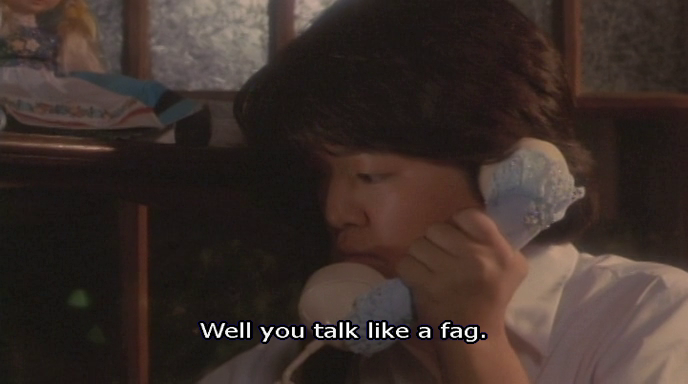
Yeah, it’s just kinda like that sometimes. 1982, ladies, gents, and those beyond the binary.
Tenkōsei is a film of its era, and it has some content warnings attached to it. Namely casual homophobia, repeated use of the slur ‘fag,’ and a fair bit of underaged nudity. As in, the lead actress, who would have been 16 when filming, gets topless several times throughout the movie, and multiple male characters show their bare asses. I don’t know how this was okay in 1982, but it’s pretty uncomfortable whenever this shows up. It really makes one wonder what was happening on-set. …Or maybe I don’t want to know.
Disclaimer aside, the movie follows third-year middle schoolers Kazuo Saito and Kazumi Saito. Characters who sound like they should be twins of some truly dastardly parents, but they’re distinctly not family members, they’re childhood friends. The two reconnect after Kazumi moves back to her hometown of Onomichi, and things start off antagonistic. Kazumi regularly teases Kazuo with embarrassing childhood secrets, while Kazuo tries to maintain a dominant position around her, as he’s not the boy she used to know, he’s a young man. Their bickering sends them wandering across their mountainous hometown, chasing after each other in a cute credits scene, only for the two to get into an accident at the local shrine, falling down the stairs.
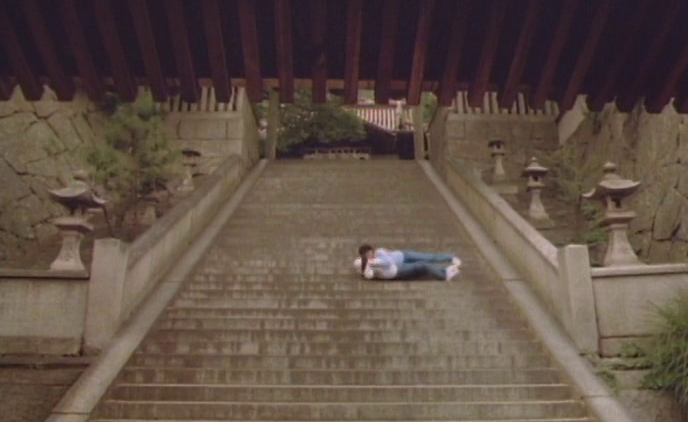
In Japanese media, a semi-common cause for a body swap is two people falling down a set of stairs together, particularly the long stretch of stairs leading up a shrine. I always thought this was just some spin on characters bonking their heads together and swapping their brains, but I’m pretty sure the concept originated here, or in the original book. Although here, the trigger is not definitively caused by falling down the stairs. Rather, the two fall after a can is kicked, and as they fall, the can falls simultaneously. It down the steps and bounces up to a gate at the bottom of the stairs in a way that defies gravity. Maybe it’s the can that’s magical, and not the steps! …Or maybe it was just included to make the scene more dynamic, or add a pinch of symbolism. Symbolism for what? I have no clue.
As the first, at least the first mainstream, example of this, I was curious how they would handle the reaction and… they go for the weirdest call possible. Rather than having either party react to this swap with shock, disgust, horror, anger, arousal, or bliss, they both just… get up from the ground, no worse for wear, and walk away. Kazumi, in Kazuo’s body, looks down at her face but she doesn’t think to wake up her passed out body, or pick up her school bag, before leaving.

Meanwhile, Kazuo, in Kazumi’s body, gets off the ground, fails to notice his long hair, long dress, shorter frame, or different muscle strength as he gets up, grabs both his and Kazumi’s school bags, and walks home. He does not say anything, and he does not realize he swapped bodies until he gets home and looks in his bedroom mirror. I can only assume this was due to production reasons or perhaps a scripting mistake, as this is just not how humans work. If someone became someone of the same sex and build, maybe I could buy this. But humans are very perceptive of their own bodies, and should notice things like the length of their limbs.
Kazuo then rushes over to Kazumi’s house— because I guess she just moved back to her old house after her family abandoned it for a few years? And their reactions are pretty archetypical. Kazuo is a perverted teenage boy, so the first thing he does is feel up his boobs. While Kazumi is more fragile and becomes a sobbing mess as she realizes she’s in the body of a boy. A sensible reaction… that seems at odds with the Kazumi presented during the first ten minutes of the film.

Kazumi is introduced as a loud and cunning woman who actively enjoys teasing Kazuo. I mean, she gets him to spill secrets about his past over the school intercom system. She’s a second-wave feminist gal with bold ambitions painted on her face! Yet, when she is divorced from her body, she becomes a fragile flower. Someone who needs normalcy to be restored to function, and cannot bear to make herself act masculine. Heck, she can barely even speak to anyone beside Kazuo during the first night. I’m not saying there’s anything wrong with the former approach, losing your body sucks, though it is another bizarre writing quirk.
Around this point in watching the film, I wondered if it would continue feeling like a bizarre pre-conventional relic that never did familiar concepts in an unconventional way. Like 1911’s An Exchange of Souls. However, after the 20 minute mark, the film… becomes far more conventional, and all the better for it.
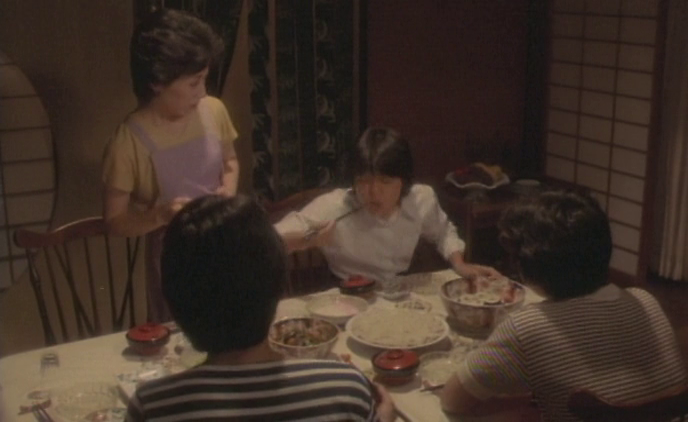
With the swap established, Tenkōsei focuses on Kazuo and Kazumi living their lives, working together to get through this, forming bonds, and bickering about how they should live each other’s lives. Kazuo is routinely scolded or reprimanded for being too boyish with his behavior— he’s more concerned about doing what he wants than trying to be someone else. Kazumi is unable to achieve the expectations people have from her as a man, while clinging to the life she can no longer live, lacking the strength to take up the mantle of someone else.
There are a lot of little chapters, positioned as more vignettes than anything else, that are made to illustrate these differences. Such as how Kazuo shovels food into his face during dinner with Kazumi’s family, while Kazumi is too unnerved around her new family, and shirtless dad, to even eat. They are simple in execution, yet they thrive with a certain personality. Just the awkwardness of the framing and ambient silence of most scenes helps instill a sense of discomfort that matches both the protagonists and the people around them. They feel like something’s not right, and there are bits of this eeriness sprinkled throughout the entire film.
…For better or for worse.
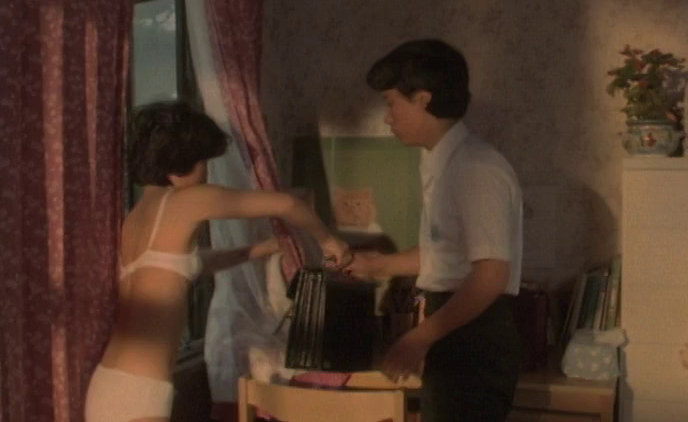
To highlight an example of both extremes, take the scenes where Kazuo is in Kazumi’s bedroom right after getting her body. His actress, Satomi Kobayashi, does a wonderful job of selling the mannerisms of a boy in an overly girly bedroom. Just the way she moves and positions her body, looking over it, makes it very easy to buy her character, especially with the long, static shots used for these scenes. Yet, there is also a lot of time spent looking at an actual 16-year-old girl prancing about in her underwear, changing her clothes, getting naked, and eventually inviting an actual 15-year-old boy into her room through her window. There’s nothing glaringly lecherous about it— the camera doesn’t zoom in on bare girl child ass— but knowing that real people had to do this… just makes it feel icky.
On the other end of the spectrum, I think this realism angle strongly enhances the bouts of violence seen throughout this movie. When attending school on the first day of school, Kazuo gets his skirt flipped by one of his buddies, and immediately rushes at him, taking him out to the fields and knocking him down into the sand. Their actions are jumbled, clawing, and imprecise. Just like real fights, especially between teenagers. Kazuo is acting like a boy with traditional ‘male aggression,’ but it’s channeled through a body where that type of aggression looks wrong.

There are a lot of scenes that capture this feeling of wrongness and unease. Like when Kozou punches his young female teacher in the face, knocking the wind out of her with a single hit. Or when Kazuo and Kazumi get approached by a ‘greaser’ and Kazuo is still the one to do most of the fighting. Kazumi just gets kicked in the dick and needs to jump around to fill it with blood. Which… sounds like some bullcrap a 14-year-old would believe. And then there’s the time where Kazumi gets sexually assaulted by her peers for acting like a ‘fag.’ …This movie doesn’t just aim to go real hard, it feels real.
This realness is also mirrored in how authentically the film manages to capture its setting. Tenkōsei is part of Nobuhiko Obayashi’s ‘Onomichi trilogy,’ a series of three 80s movies set in the same small seaside city of Onomichi, and the film does a wonderful job of capturing how life in this city must feel. It’s basically built on a mountain, so elevation and verticality are key elements in the design of the city. A lot of conversation scenes see characters climbing up or down steps, or looking off into the urban sprawl, leading to the natural harbor and lush green island on the other side.

People are always moving about in the background, easily traveling wherever they need to via bikes, public transit, or just their feet. Homes are very lean wooden structures with open doors and windows, inviting in the crisp southern breeze, and almost all of them have a gorgeous view to call their own. But aside from single-family homes, the architecture… feels very much like the product of a post-war economy. While some more traditional and older structures remain, much of the architecture looks like it was built in the 50s and has stood two or three decades. Not quite long enough to become worn, but long enough to look dated.
The school in particular feels like a government produced building. With dreary off-white walls, cheap desks, and uniforms lacking the pizazz emblematic of Japanese school uniforms. It’s just a white dress shirt and black slacks/skirts. However, it is also a building constructed with the environment in mind. While rooms can be sealed, the hallways have open walls, inviting in a sea breeze and humidity every day of the year. Because AC is expensive, and it doesn’t get that cold in Onomichi.
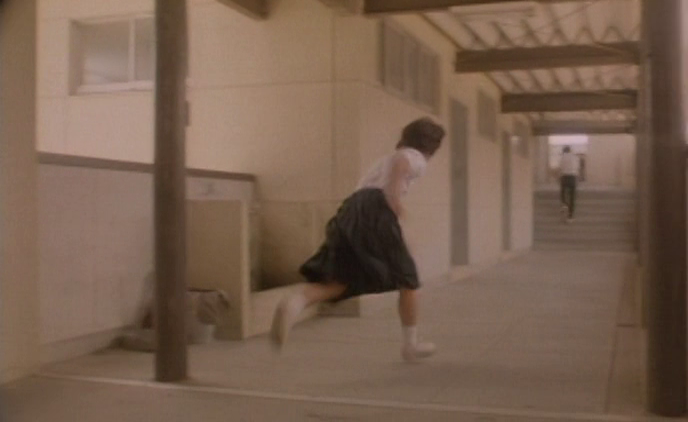
Open air buildings, with water stations, ‘cos kids gotta stay hydrated!
If I had to describe the setting in one word, it would be honest. It does not aspire to glorify the reality of 1980s Onomichi, but to capture it, and make the viewer feel like they are actually there. From the stretch of urban sprawl to the traditionalist shrine, temple, and housing, to the snippets of nature that remain captivating even in potato-quality resolutions.
However, this wouldn’t work if the 14/15-year-old characters didn’t act like kids and… they do. Like, more than any other piece of Japanese media I have ever seen. The students are not obedient or terrified of authority. They’ve juvenile, abrasive, casual, and do things like sneak in early lunch. The boys, despite their age, are crass, perverted, violent, rude, and feel like members of a vastly different post-war generation. And while the girls are quieter, not wanting to rock things too much, they rightfully recognize their male peers as the kinda shitty dudes they are. It weirdly reminds me more of American middle school in the late 2000s than… any anime or manga I can think of.
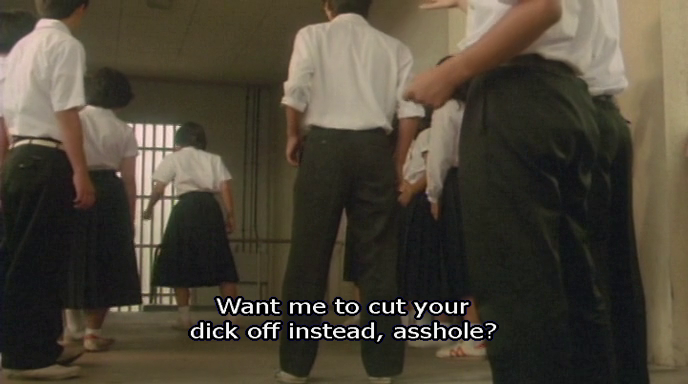
Does that mean I think that Kazou and Kazumi are grounded and realistic characters? Well, yeah! They’re maybe a year older than the characters they’re playing, and do a good job of capturing what it would be like to be a body swapped teenager. Which, for the record, is something I think often falls flat in most live action depictions. Maybe it’s just the fact that it’s harder for me to judge acting outside of my native tongue, but I found both to be shockingly convincing in both their delivery and body language. No wonder they’re both still working in the industry…
Going back to the plot, a lot of it is truly devoted to little scenes that build up the relationship of the two leads, encountering differences in their lives, their bodies, and bopping between events. But the clock starts ticking after Kazumi learns that Kazuo’s family is moving to Yokohama (halfway across the country, near Tokyo). This looming timer— combined with her getting stripped by Kazuo’s ‘friends’— leaves her distraught, hopeless, and clinging for something to latch onto.
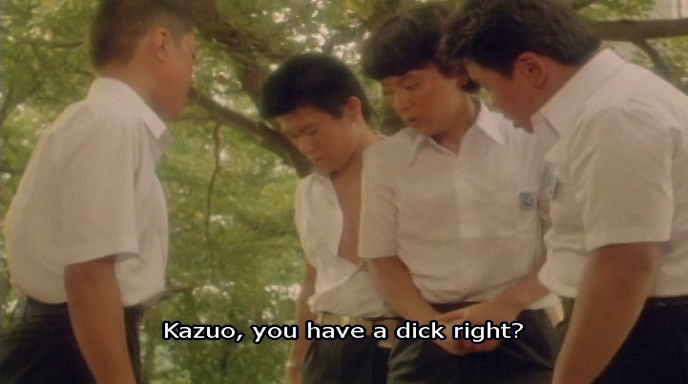
Side note, but this movie really likes talking about dicks, despite never showing them.
This leads into a subplot involving Kazumi having a crush on a boy from out of town named Hiroshi and her telling the truth to a friend of hers, Akemi. It’s built up for about ten minutes, the scene lasts five minutes, and it has little bearing on the rest of the story after that. I guess it’s meant to show how desperate Kazumi is for connections, for maintaining the last vestige of her life, and how miserable she is like this. However, that was already established beforehand, and Akemi disappears after this scene, despite being the one third party who knows the truth. I don’t think it works, but it at least lays some groundwork for a body swap romance and the ‘trusted third wheel.’
The final act sees Kazumi become… suicidal. She does not think she can live as Kazuo and after… getting one last look at her breasts (yes, really), she decides to run away. But with Kazuo on her trail, she instead gets on a boat that is being rented by a group of… office workers, who are going on a vacation to a neighboring city.

Yeah, I could see how some boards could classify this as child pornography. I don’t agree but… I can understand the argument.
Yeah, this part of the movie is where I started getting lost, as the office workers just seem to accept the two teens tagging along on their boat while they get drunk and play party games. Same when at the hotel. They just tag along in the background, looking sad over the situation, slowly accepting that, after several weeks, they are stuck like this. They join their traditional rooms, hold hands while they sleep, and say that they have never seen their faces quite like this before. This is meant to be a touching moment, though I think there is some nuance not quite captured by the translation team.
Regardless, the next morning, after taking a boat back to Onomichi, Kazumi states that she wants to kill herself— again— and begins going to where this whole swap all began. The shrine. As she makes her way there, Kazou reassures her that this situation is not so dire, and says that if she dies, he’s dying too, and that if they stick together, they can get through this. These words ring true given the bonds they made over the runtime but, despite his reassurances, Kazumi still cannot accept that she can never go home, never go back to normal.
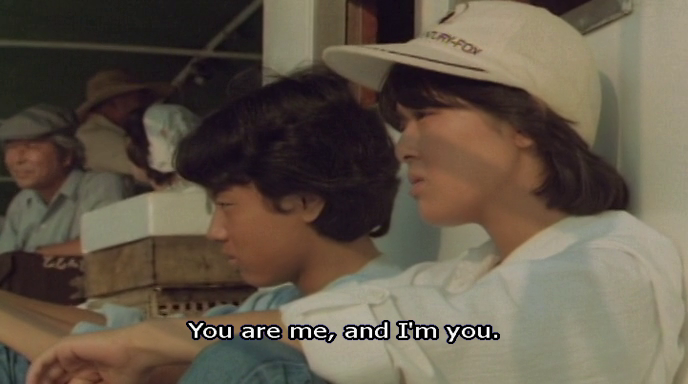
Kazumi begins to walk down the steps of the shrine, aiming to run into the incoming train at the bottom of the steps, only for Kazuo to kick a can, and grab her, throwing the two down the steps. Naturally, Kazou and Kazumi end up returning to own bodies. They hug, they kiss, they feel their chests and crotches as they gawk at how “it’s back” and “it’s gone.” Like this is bloody Misogyny Conquest And the first thing Kazuo does with his body, with his manhood reclaimed… is take a long, hard, 25 second piss. All while Kazumi watches, a smile on her face. …No, I am not kidding. And yes, I will, one day, take this scene and recreate it, because it is hilarious.
After the two say goodbye, Tenkōsei then does something that I didn’t mention during the introduction. The movie opens with 8mm footage, shot by Kazuo on his camera, as he is an aspiring filmmaker. Then it shifts over to black and white, and the film only gains color slightly after the body swap. Similarly, shortly after the body swap is undone, the film goes to grayscale. I would comment on the purpose of this… except it’s a bit beyond me. It’s not looking into the past, not really showing a fantastical world beyond the gray doldrums of reality, and not directly tied to the body swap.

In the epilogue of the story, Kazuo says goodbye to beautiful Onomichi, goodbye to Kazumi, and after getting into the moving truck, with his camera in one hand, he says goodbye to me. Because even though they only spent a few weeks as each other, in that time, part of him became Kazumi, and part of Kazumi became him.
There are definitely things that I could nitpick about this movie, like pointing out how 30 minutes of it lacks much of a point and how odd the first 10 minutes of body swapping is. However, for a movie that was, in many ways, breaking ground in exploring how to depict a body swap on screen, I think it did an incredibly respectable job. I glossed over a lot of details, but there are some absolute gems sprinkled throughout this movie. Small scenes that, while probably not the first example of a body swap concept or trope, are rendered in a grounded and genuine way.
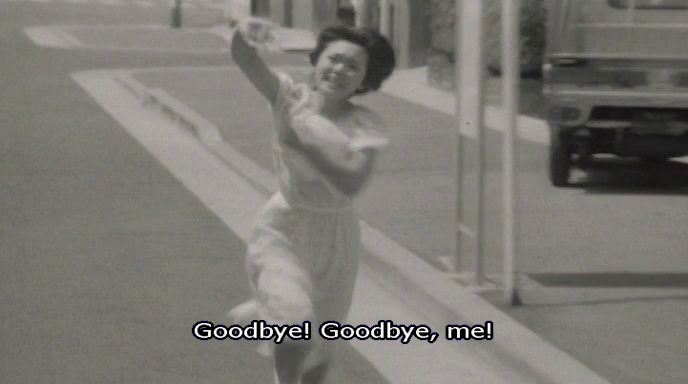
For such an early example of the genre in this medium, it’s surprising to me how well it handles the subject matter. Most body swap movies I’ve seen, or movies featuring body swaps, have treated the concept cheaply. For shock or gross-out humor, easy sexist commentary, or just to be silly without offering much of any substance. But Tenkōsei? As a body swap fan, there’s a lot to love. It, generally speaking, gets it.
While I cannot definitively state this is where concepts began, I think I can say this movie did a lot to spread many staple body swap concepts. It genuinely impressed me and, even without considering its importance to a particular fixation of mine… I still think it’s a good movie.

But, as always, do not just take my word for it. I do these showcases with the intention that they will both provide a resource of information via critique/summary/analysis and encourage people to check things out. So if you like body swapping, download this movie, bear with the quality, and learn how this all got started!
I would say that this is the end of it, possibly pointing to various other adaptations of Ore ga Aitsu de Aitsu ga Ore de. Like this 42 minute TV drama adaptation somebody subtitled back in 2009 (it’s blasé and unremarkable). Or asking if anybody knows a Japanese to English translator I can commission to get an English language version of the original novel. Even though that would be expensive. However, I don’t need to close things out just yet.
Because there is a 2007 remake of Tenkôsei from the same director, Nobuhiko Obayashi, dubbed Tenkôsei: Sayonara Anata. Also known as Switching: Goodbye Me or Exchange Students: Goodbye Me. I was planning on covering it in this installment… but I think 3,000+ words discussing a 2 hour film is enough for now.
Besides, if you are that desperate, you can just watch the 2007 version on YouTube.
…Actually, maybe don’t do that. I watched it before getting this post all ready and it’s… nowhere near as good as the 1982 version. I’ll explain why next time.
TSF Showcase 2024-21.1
Tenkôsei: Sayonara Anata (2007) [Transfer Students: Goodbye to You] or Switching: Goodbye Me

25 years after creating the prior showcase subject, Tenkôsei, director Nobuhiko Obayashi decided to revisit the ideas of one of his most successful films. Except this time it would be in a different setting, be made for and with a new generation of people, and was given even loftier goals, to be a movie “that will be passed down 50 years from now.”
After seeing what Obayashi did last time, I was excited. Tenkôsei (1982), while a bit messy, managed to capture a sense of earnestness and reality. Aside from a few missteps, it was a great body swap story in my book. After doing another 31 films— Japanese directors can have insane outputs like that— it would only make sense that Obayashi improved as a filmmaker, storyteller, and understood the assignment in remaking one of his most celebrated works. They would be older, wiser, and a more experienced storyteller, so what could go wrong?
…A lot, apparently, as 2007’s Tenkôsei: Sayonara Anata is not good.

In reprising elements from the original work, it either adds or subtracts the wrong thing, resulting in a lesser story with weaker characters. The majority of new elements introduced are either under-explored or underdeveloped. It completely changes the latter half of the movie by introducing a fascinating bit of body swap drama… while evidently not understanding the true weight of what it is doing. And it all ends on a note that made me reexamine a crucial perspective of body swapping, and even brought me to tears. …Before I realized that the filmmakers did not understand what they just did.
It’s a mess. I would be viciously curious to know how it was made and what the creative team was planning. And while I do not want to use TSF Showcase as a way to platform ‘bad works,’ I do want to critically analyze stories with big potential that they never achieve.
To illustrate the problems, I want to first give a synopsis so that you can play along, as otherwise I would get too sidetracked in my criticisms. Hopefully, I did a good job and you can play along, spotting some of the holes for yourself!

Tenkôsei: Sayonara Anata follows Kazuo Saito, a transfer student returning to his hometown of Nagato after spending a few years in Onomichi, who lives alone with his mother. When attending school, he encounters Kazumi Saito, his childhood friend— not family member— who regales him with embarrassing stories about his childhood. Stories which Kazuo does not really remember. The two head to Kazumi’s house, where she lives with 5 other family members, who run a soba restaurant together, just to introduce them. Wanting to reconnect, the two travel to the local Spring of Sabishira, to taste the local water. As Kazumi uses a… water cup on a long stick— I don’t know the exact name— the two fall into the fountain together where they, predictably, swap bodies.
Much like in the 1982 version, neither party realizes that they swapped bodies, but at least there is a tacit line about how their ‘minds went blank,’ and they go home, soaking wet. Kazuo is the first to arrive home, and he does not realize he swapped with Kazumi until he sees his discarded skirt and looks into the mirror. Afterwards, Kazuo confronts his mother, wearing nothing but his underwear. Kazuo’s mother freaks out over this half-naked girl claiming to be her son, and sends him off wearing a hoodie, hat, and sneakers. Which I just think is funny and cute.

Kazuo then meets up with a crying Kazumi, the two bike away for a heart-to-heart, and after failing to convince Kazuo’s mother, the two decide to live as each other for the time being. This includes attending dinner as each other, and here the film does something different by having Kazuo be a restaurant owner’s kid. So she is good at cooking, has good table etiquette, and prepares dinner for Kazuo’s mother without a second thought. While Kazuo does not know how to act like anything but a city boy, and just weirds out Kazumi’s family.
The two then have a phone conversation, where they talk more about their water-damaged cell phones than anything else, and Kazuo gets a call from Hiroshi. Hiroshi was a bit character in the 1982 original who has been promoted to being Kazumi’s boyfriend, and acts as a central character in the story. Also, this rendition reimagined him as a glasses-swearing class president type. Kazuo, predictably, does a poor job of acting like Kazumi in front of him.

The next morning, there is a new rendition of the morning scene in Kazumi’s bedroom. Except this one is far briefer, bereft of tension, and is played mostly for comedy as Kazumi’s entire family rushes into the room, catching Kazumi. Despite being an obvious conclusion, they do not assume that Kazumi and Kazuo had sex the following night, and this scene is never referenced again.
At school, things begin with a music lesson featuring over 40 students. Here, it is overtly stated that Kazuo is a piano player and the young female teacher, Mitsuko Ohno, calls on Kazumi to play the piano. As a reminder, ‘Kazuo’ started attending school yesterday, and Kazuo never spoke to her about his piano skills, so Miss Ohno is being rude here.. The pressure of this situation is so bad that… Kazumi decides to run up to the roof, saying she’s going to kill herself.

Kazuo follows Kasumi, navigating the school very well for someone who first stepped foot in it yesterday, and Mitsuko follows them. There, they have a minor scuffle that ends when Kazuo and Kazumi spin around and accidentally smack Mitsuko with one comically powerful strike. This rendition of a scene that worked vastly better in the 1982 version is followed by a new version of the greaser encounter. Sitting in the autumn woods, Kazuo and Kazumi are approached by a… 25-year-old man with a bug catching net and yo-yo. He is a pedophile. Kazuo promptly kicks him in the nuts so hard it causes internal bleeding. He also kicks his legs up and down afterwards, like an injured bug. Honestly, the funniest part of the movie.
Rather than just be a chance encounter though, this is followed up with a scene where Kazuo and Kazumi get punished by the… president of the educational committee— not the principal, for some reason. He reveals that the child predator was his grandson, and to keep the situation under wraps, and to avoid shame on his family, the kids won’t be punished. However, this leads Kazumi’s parents to believe that ‘Kazuo’ is a bad influence on their daughter. An idea that they become extra sure about after Kazuo tries making soba dough with his feet. A faux pas so severe it causes the soba-making grandfather to pass out in shock. Remember this, it’s important.

Next is the field trip and period chapter of the story, and it’s… just weird. It begins with Kazumi informing Kazuo that her period is coming up, Kazuo feels fatigued as it is seemingly beginning, and students then go to a nearby onsen… where Kazuo gets a bloody nose before passing out. This might be a way of visualizing a period through a nose bleed but I’m not convinced this was the best, or even a good, way to illustrate this. After this stint, Kazumi and Hisorshi have a chat, where Hiroshi claims to have figured out that a body swap is afoot, and claims he still loves Kazumi for her soul. Kazumi rejects this though, saying that Hiroshi actually loves her body, in a major bitch move that ends their romantic relationship.
As this happens, Kazuo is singing a song that just appeared in his mind while playing on a piano. For the record, this is implied to take place… maybe a week after their swap. Kazuo has not played the piano throughout the entire movie, let alone with Kazumi’s fingers, and is singing while playing the piano. Which is an impressive skill for someone in a new body. I’m reminded of that piano bit from the mass swap route of Press-Switch…

This marks the halfway point of the movie… and where things start getting very different. It turns out that Kazumi’s ‘period symptoms’ were actually symptoms of a rare disease that affects people in their adolescence and only has two to three months to live. This means Kazuo is confined in a hospital, receiving treatment from the physicians, and gradually losing the strength he needs to keep on living.
Kazumi is initially prohibited from visiting Kazuo in this state, but the lead doctor, who is also the president of the educational committee, eventually lets her in. What ensues is a bunch of weird inconsequential drama that I feel silly recapping. Kazuo’s ex-girlfriend, Akemi, arrives to see her ex-boyfriend as he slowly dies inside the body of a girl she never met. Kazuo shares what is meant to be a final conversation with his real mother. Kazuo learns more about the many members of Kazumi’s family. Then, after twenty minutes of this, they stage a hospital escape.

Kazumi, Akemi, Hiroshi, and the pedophile all work together to carry a wheelchair-bound Kazuo down the stairs and load up into a car. Where do they go? …Somewhere! Yeah, their location is never specified, and when they reach their destination… it’s just some woods. Not a town, not a speck of civilization, not a place that the characters have been to before or mentioned, just… woods. Also, Akemi and Hiroshi get together, because that is how heterosexuals function, before vanishing until the epilogue.
In the woods, as two kids with one backpack and a wheelchair, they meet up with a traveling troupe of kabuki performers, who give them a ride and let them stay at a hotel they’re performing at. Kazuo and Kazumi then share a room in a scene that… is one of the best scenes in the entire film. It captures the sense of dread and longing the two share as they come to accept the looming death over them. Kazumi’s request to see her body one final time is earnest and sentimental. The way the two embrace in one bed speaks to their closeness. And the way they repeatedly mutter “goodbye, me” says a lot about their unwillingness to actually depart with a part of themselves.

This is followed by a bunch of awkward nonsense, including a run-in with some lesbian-coded woodswomen, before the two return to the Spring of Sabishira. The two fall in, swap back to normal, and do not take off their heavy clothes despite it being… probably November at this point. Kazumi says that she wants things to be this way, that she is willing to die for Kazuo, Because she loves him more than anyone else.
The two then venture off into a scenic landscape, where Kazumi reprises the song that Kazuo sang in the onsen, because I guess it is a song tied to her heart. It is implied that Kazumi died right after singing this song, and things cut ahead from autumn to winter. The film briefly shows what life is like for Kazuo and other characters now that Kazumi has passed away, before concluding with Kazuo visiting Kazumi’s grave, saying goodbye to the child in him.

Okay, so… where do I even begin? Well, first, I need to talk about the cinematography. I don’t really have an eye for cinema, but there is one thing that I do know, and it’s that filmmakers should only use shots at an extreme angle, or dutch angles, when they have a reason to. …And most shots in Tenkôsei: Sayonara Anata are at an extreme or notable angle. Most of the ones that aren’t are shots that take place on angled terrain, like a hill, or feature some tilted object in the foreground or background.
The film is opposed to presenting things at a flat angle, and while most of these shots are inoffensive or not too remarkable, once I started seeing them, I could not stop. It is a truly baffling presentational choice that makes everything feel abnormal, off-kilter, and surreal, even when that’s utterly uncalled for. It reminds me of that Roger Ebert quote… “The director . . . has learned from better films that directors sometimes tilt their cameras, but he has not learned why.”

I praised Tenkôsei (1982) for feeling grounded in reality, for building a world that felt honest, with characters who felt like people. The dutch angles make it hard for this film to achieve the same allure, and… I was going to talk about the many ways that the story does not feel real. How its world feels more hollow, shallow, and like things were based more on established conventions of film, rather than capturing a contemporary reality. But then I realized that the film wasn’t even trying to do that.
The setting of Nagato is not afforded the same level of reverence in how it is depicted, and even if it was… half of the movie takes places in the woods, inn, and hospital. Characters are far more archetypical and plentiful, with Kazumi’s family being a bunch of simplistic personality types who are not meant to have depth. And despite arguably having more character to play with, I found the cast less engaging.

Hiroshi, as a character, starts out as a promising reinterpretation that has the ability to act as an intermediary between Kazuo and Kazumi. Yet, after being present in many key scenes in the first half, he barely does anything once the hospitalization chapter starts. And Akemi? She is not even in the movie for 15 minutes, does barely anything, and vanishes in a move that I can only describe as a reckless disregard.
Kazumi is described as a good-natured girl with a penchant for fantasy who diligently assists her family in their business. But when it comes to acting like Kazuo during the body swap… her behavior just feels inconsistent. She goes from being inconsolable to catering for her Kazuo’s mother, to being so filled with embarrassment that she wants to die. She is insufficiently masculine to assume the role of Kazuo, but the movie doesn’t really show much of her struggles. During the latter half of the film, I don’t get the impression she is fraught with depression or sorrow over what Kazuo is doing with her life, or the life she needs to live. Because the movie stops being about her struggles as a woman in the body of a man, and stops showing them.

Kazuo is given far more screen time and opportunity to flex his character. In this rendition, he’s a piano-player who is a bit rough around the edges. He acts more masculine than he should and draws concern from Kazumi’s family, but he’s mostly just oblivious to the struggles of having a larger family or the social cues before him. He’s too self-centered, but rather than view this as a character flaw… 45 minutes of this movie involves everybody caring for him after he gets a terminal illness. Dude doesn’t learn anything!
As for their relationship… the chemistry shared in the 1982 version is simply missing there. The characters talk and have time to themselves, but they don’t converse with each other in the same heartfelt way. I think this is plainly clear just by… watching various comparable scenes. In the post-swap bike scene of the 1982 film, there is some real tension and dread billowing between the two leads. While the 2007 equivalent of the scene captures many of the same beats, just… worse in about every way.

Emotions are dulled, the highs are missing, and the characters do not react to this body swap in the way a pair of 15-year-olds would. I want drama, I want two diametrically different people to cooperate over a shared conflict in order to develop strong bonds. I want to see these two grow as people by becoming each other. The movie thinks it is doing these things… but it just isn’t.
If I wanted to play ‘compare and contrast’ with the original, I would be here all day, so instead let me talk about the original things this story does, namely with the terminal illness. As a body swap fan, I think this is a bold decision that has some real, rarely explored, tension and drama to it. I have seen plenty of body swap stories about someone stealing a body to prolong their life at death’s door, but it is often with a sense of desperation, and I cannot think of a good example like this. Where two characters, swapped against their will, are faced with the reality that one of them is going to die.

The guilt, the regret, the self-loathing of the survivor, the hatred of the person diagnosed with death. There is a lot of rich potential with a story like that, especially if the two people are close, especially if they hate this situation, especially if this is not a natural illness. It’s such a good idea that I’m tempted to just stop writing this script so I could try my hand at it!
Unfortunately, the people behind Tenkôsei: Sayonara Anata looked at this idea… and did not see a vast ocean or opportunities. The actual execution of… everything during the latter half of the movie, teeters between misguided and inept. The story simply does not properly acknowledge the sense of strain this puts on Kazuo and Kazumi’s relationship, as it is too concerned about the other characters. They only spent two minutes together in the hospital, and the core of their conversation is Kazumi saying she’ll do anything for Kazuo, while Kazuo has already accepted his fate. This movie takes a fascinating idea… and delivers one of the most boring renditions imaginable.

They never feel like they have a real conversation about this, about their goals, about their desires, about what they always wanted to do, and about how Kazumi will need to live Kazuo’s life. Just having Kazuo tell Kazumi all about the life she’ll need to live going forward, about how to be a man, could be a gut-wrenching and touching moment, and be a great look into who Kazuo truly is. Who he is when talking about the person who will take his place when he’s gone from this mortal coil. Instead, there’s some worthless conversation about how the little girl character’s mother got run over by a drunk driver. Riveting!
The entire runaway chapter suffers from the fact that… the characters lack any real goal or drive. Kazuo just wants to leave the hospital and go somewhere else, and despite being told the two are very close at this point in the story, it really doesn’t feel like it. The only thing it feels like is two teens walking through the woods, meeting someone in a car, going on a ride, then getting dropped off in the woods, before doing the same darn thing!

There is something to enjoy with a crossdressing performer basically saying that Kazumi would make for a good crossdresser. I do think the scene the two share in the inn is a strong bonding experience. But their rationale and reason to go to the spring to drink the water is just… bizarre. The script could easily be rewritten so that… Kazuo gets a premonition about going back to the spring. I’m assuming they just have amnesia about the spring being the cause, but if the story needs to have them get back there. Maybe have them escape on their own, stay at a rural inn, and trek all the way there on foot, maybe camping together.
Nothing about the premise is bad or unworkable. There are just a bunch of tiny decisions that make this movie… frustrating. And I don’t think there is a greater frustration than the actual ending. After Kazumi sings her final song and dies, the story jumps to Kazuo, back in his own body, visiting Kazumi’s home. The viewer does not see Kazumi die, but the white flowers he brings are meant to imply that she passed away.

Kazumi’s family, fresh off her death, reminisce over something iconic Kazumi did as the grandfather makes soba, talking about how she used to stomp the soba with her feet, going so far as to call it “Kazumi’s way.” I mentioned this about 2,200 words ago, but this is something that Kazumi never actually did. Kazuo did this while in Kazumi’s body. But from Kazumi’s family’s perspective, this was the last action Kazumi took before she became stricken with her illness. Her last act when she was a happy and silly girl. It became an iconic moment for them, a memory that overwrote how Kazumi actually used to make soba.
…Kazuo did not just live Kazumi’s life, he effectively overwrote her loved one’s memories. When her family thinks back on her, they will not remember her, but Kazuo’s rendition of her. This is a… horrifying, disgusting concept. There is a saying that, after death, one lives in the memories of those they touched in their lives, and this… this is denying Kazumi that privilege. And her family, unless Kazuo tells them, will never know that they are doing this.

It is an idea so dark and morose that it genuinely brought me to tears while watching this movie. Because the guilt that I would feel over that would be so suffocating that… that’s all I could do in that situation.
…And you know how Kazuo reacts to all this? How is he living with himself knowing that Kazumi is dead and will never come back? He’s… fine. He’s unphased, unaffected, and is moving on with his life. He’s going on a trip back to Onomichi. It’s even implied that he’s going to get back together with Akemi.
As he passes by Kazumi’s grave, he treats her death as the death of his childhood. Because that’s how he views Kazumi. Not as part of himself, but the girl who helped him… become a man. A dark note that frames Kazuo as someone who went through a life changing experience… and wants to forget all about it. It did not change his life, it just helped him grow up.
Oh, and then there’s the ending statement.

Everyone lives to leave their stories behind.
A person’s lifespan is limited, but a story lasts forever.
Children of the future, are you living to your fullest?
An ending statement that… I cannot help but read as a bitter, cold reminder to the presumably young audience that their lives can be cut short at any moment. So they need to use their life to write a story worth telling. It’s a sentiment that I can understand someone sharing, but the last thing the youth needs to be reminded is that they are going to die and, unless they are extraordinary, they are going to be forgotten. That’s shit that makes kids want to kill themselves.
…I don’t like this movie. It has moments of intrigue, passing bits of promise, but both become lost in the winds. As a successor to Tenkôsei (1982), it is worse on nearly every count. As a body swap story, it has good ideas, but nothing else. The more I talk about or think about Sayonara Anata, the more bitter I become.

I try to approach media with fairness and sympathy. I know I have made my fair share of utter garbage over the years, but when something wastes this much potential, when it comes from such a distinguished creator… I cannot help but get more than just disappointed.
So, I’m going to do us both a favor and move on to something better.
TSF Showcase 2024-22
The God Power by Gregor Daniels

I have mad respect for anybody trying to make a career by independently publishing wackadoo TSF fiction. There are a few semi-notable people in that space, with one of the more prolific being Gregor Daniels. A writer with over 250 novellas under his belt, and who I’ve talked about on this site in the past. Honestly, his work can be a bit hit or miss. His characters can feel bland and their grasp on ‘reality’ can be a bit too simplistic to feel ‘real.’ But when they hit, they go hard and things can be a helluva lotta fun! Like with our subject today, The God Power!
The general premise is pretty simple. Billy’s a bullied high school student who gets access to the ability to reshape reality from an unnamed demonic entity who manifests itself as a cloud of smoke. Branded with a glowing pentagram on his hand— in case the satanic theming was too subtle— the entity encourages Billy to seek out revenge, to punish and torture his abusers to his heart’s content. A standard power fantasy narrative, but because this is from a TSF writer, their protagonist is more than a little curious about having the female form for themselves. …And just so happens to be a fan of transformation in general.
Billy starts using this power in more mundane ways. Preventing car collisions. Transforming his old lady neighbor in his trailer park home into a ‘centerfold model.” Changing his grades. Adding a few zeros to his bank account. The usual things a movie-like average teenage boy written from a perspective of American youth, crystalized from cultural touchstones of 1993 to 2008, would do. When choosing to pursue his first tormentor though, his powers— which otherwise work exactly how he wants them to— throw him into the boy of the lead bully’s girlfriend, Ariel.
Ariel as a character is… worth a tangent. She is the sole female character of the cast and her characterization is all over the place. She is the redheaded girlfriend of the high school quarterback, but she is also… childish in the way that screams this was written by a man. Ariel is obsessed with The Little Mermaid to the point where she named herself after her at age 18 and covers her walls with related posters. She has a seashell collection, a strong love of the beach, and also… stuffs her bra with tissues.
That obsession with that particular film is odd considering this story was released in 2022. The name change detail is presented as if one needs to be 18 to change their name, when they don’t. And… when I was 13 and picked up crossdressing and bra stuffing, I knew enough to not use tissues. I used cotton balls. So seeing this sexually active adult woman still using tissues to fill her bra does not make sense. She has money, she can buy pads.

Tangent aside, Billy masturbates in Ariel’s body while musing over how to best use his powers, as despite his routine abuse, he doesn’t consider himself an evil person. …But that also doesn’t mean he is above getting revenge in more cruel and unusual ways, as seen with how he treats his quarterback bully, Julian. Billy tries to work things out diplomatically, asking Julian to stop bullying him. But Julian thinks it is fair game to discriminate against someone for having the audacity to style their hair in a mullet and comes from a low-income household.
As diplomacy fails, Billy decides to warp reality to switch Julian and Ariel’s genitals. It’s a sudden, out of nowhere, bout of genital swapping that reminds me of a lot of skinsuit/bodysuit manga I’ve read, except instead of going for VIP, Billy is content with getting a blowjob. Well, not even content. He remarks about how “dudes sucking dick [is] normal now,” so the sense of punishment is less severe. It’s a line that sticks in my mind even a week later, as it is trying to facilitate a fetishistic fantasy… while also acknowledging that a scene like this would work better in a story written 20 years ago.
The next chapter follows Billy possessing the body of the Black “hotshot wide receiver,” LJ, where he takes his time getting situated in it. Flipping through his phone, checking out some candids of fat asses, seeing that LJ and Ariel are sexting, all while… feeling up LJ’s cock through his pants. I’d comment on this being an intriguing move, as it is uncommon to see a TSF writer explore male characters enjoying the body of another man like this. Feeling up muscles, exerting strength or authority, or fucking women out of their league? Sure, those are staples of the niche male-to-male possession (or body swap) (or takeover) genre. However, then I remembered this is a White guy possessing a Black guy, and it all made sense. I’ll just say there’s a long history of White men feeling up Black men’s penises.
As for the punishment, Billy devises a somewhat roundabout means of trapping LJ in the women’s bathroom, disappearing his clothes away, and conjuring a “big-tit brigade” to catch him. To humiliate him by being naked in a place he shouldn’t be. Desperate, terrified, and mortified, LJ then locks himself in a stall, only for Billy to reappear, suppressing his identity and wearing a shirt reading “on-demand genie services” so he can do some… attempted infomercial skit. He then goats LJ into saying “I wish they wouldn’t have noticed me in here” and… we get a quality skinsuit emergence transformation sequence.

LJ’s skin droops off, he yanks it away, and reveals a one-in-a-million hyper-attractive woman. But before LJ can even come to terms with what happened, Billy flushes his sheathe of skin down the toilet. Meaning the folks at a waste processing center are going to have one interesting night. LJ goes for the panic route with his reaction, losing all composure as the body has spent so long honing is suddenly lost and he is left with an overtly female physique. However, Billy is pissed that LJ did not immediately jump on being a girl so attractive they could make millions off of thirst traps and modeling. So he promptly steals his body for himself. At first to let LJ calm down… before deciding to let him stew in unexistence. Yeah, the White kid killed a Black kid and stole his body for his own perverted purposes. Tale as old as time.
The final target, Curtis, is honestly the least interesting interaction of the three. Billy arrives at Curtis’s house, sees him working on a car, promptly poofs a lawn chair, makes himself invisible, and starts feeling up his hot new body. He does this while watching Curtis in the background, waiting for some interesting prompt for him to monkey paw into something spicy. Said prompt comes up with an argument between Curtis and his mother, telling Curtis to grow up, which Billy reinterprets as an excuse to… make Curtis shit himself while transforming into a two-year-old girl. That transformation sounds like an interesting challenge to write, but most of the icky details are glossed over, and for good reason.
After the transformation, Curtis is not aware of any changes— his mind was overwritten and is in a divine recycling bin. He is just a happy little child whose parents love them unconditionally and drive away to see their aunt. Hell, Billy even goes so far as to write a good life for ‘Cynthia.’ Which isn’t so much as a punishment… as much as replacing a ‘bad’ person with a ‘good’ person. I think it is a cruel and unusual form of punishment murder, but the demonic haze who gave Billy these powers disagrees, voicing disappointment with him over his lack of violent rage. Billy says that he doesn’t want to hurt people like this, and the demon grumbles about how they’re going to lose a “wager” over this before disappearing.
The next chapter picks up a week later. Billy has spent the entire time in LJ’s transformed body, hasn’t used his new powers to do things like stop wars or mind control world leaders, and hasn’t undone the transformations to his former bullies. Why make this take place a week later rather than a day? No clue! It’s just set-up for Billy to encounter the demonic entity, who attempts to reign control over Billy’s body by… transforming it into a demon. With horns, a giant frame, leathery wings, and taloned feet, all through a well done transformation sequence.

It’s an appropriately wild escalation of events, seeing Billy both lose autonomy while the entity tries to morph his form into something more fitting for their purposes as they go on a violent rampage. Flying through the skies at obscene, disorientating speeds. Breaking doors, furniture, and roofs, all while Billy grapples for control, pushing forward his influence before the demon can kill someone. It’s a cool sequence… though, it doesn’t go on for very long. The demon only really has two targets to go after now that LJ is inexistent, and with Cynthia… the demon just watches as a car crash is about to happen, only for Billy to stop it. It really makes the demon look like some chump, but not in a way I think was intentional.
After calling Billy too soft, the demon then undoes the transformation… while Billy is several hundred feet high in the air. Rather than die then and there… Billy instead casually falls out of the sky outside of Ariel’s house, naked, disorientated, and still in LJ’s modified body. His powers, and the related pentagram, are both gone, meaning he is stuck like this… but he quickly shrugs this off. After all, he is the one who got pissed at LJ for not realizing how profitable a body like this could be. Though, he doesn’t seem to be as concerned with the fact he’s Black now, as his only concerns are about being a woman. Which… fair enough. $5 million in the bank and a ‘top percentage’ body address most of life’s concerns.
While musing to himself, Billy realizes that, if he and LJ are basically one person now, that means he must have a sexual relationship with Ariel. Ariel cannot control herself, Billy is so thrilled that someone has a sexual interest in him that he accepts the weirdness of the situation, and the two have a prolonged sex scene to end things off. Billy discards all concerns about his new life, as he did ultimately get what he wanted. Nobody’s going to bully him anymore. …At least until he picks up modeling. Because models and idols are feisty.
That would be a fine enough ending, a sufficiently accepting note to end this bizarre series of transformation-riddled strain of thought. But Daniels ends things on a more open note, answering how Billy arrived at Ariel’s house… by revealing that Ariel has been branded with a pentagram. And unlike Billy, she appears to be the more vengeful sort.
If you are familiar with my TSF anthology series— brilliantly entitled TSF Series— you could tell that I have a certain love for more eccentric plots that go in wild directions. And that’s pretty much that The God Power offers here. It starts basic enough, but as transformations pile on top of each other, the normal world is wrought into something extraordinary.

Whenever I was getting a bit settled into things working one way, it pulls a pivot out of left field, introduces something unprecedented, and just keeps on going. I appreciate and admire its creative energy and conviction. …But I do need to point out its depth, as the story is only 11,830 words long.
This shorter length is a criticism that I have with a lot of ‘published digital fiction.’ The algorithms that push and denote ebook sales make word count a highly important feature. People— according to algorithms— want to get something worth their money… without being bogged down by something that takes more than an hour to read. It can lead to a lot of stories that are complete, yet feel like they don’t go in hard or deep enough. Sometimes 12,000 words is the perfect length for a story. I personally think I did a good job managing 12,748 words with TSF Series #013: Delusion Kamera – Poolside Switching. But when an author consistently shoots for the same word count, I think it might negatively affect the end product.
…Though, it’s clearly good for productivity. Gregor Daniels put out 12 novellas from January to May of 2024. I wish I had that focus, but I’m too busy with larger scale projects and offshoots… like this! With that level of output, a few duds are almost inevitable… but The God Power is a good, fun, TF-riddled time!
Now, I would be inclined to end things here, as I just promoted a good work from a bigger-than-me-yet-still-small author. …But I am a stickler for covering sequels, and a sequel was released on April 12, 2024. It is not overtly a TSF story in the same way as the first one was. It’s more of a wackadoo TF story that targets… I’m not sure furry would be the best term, but it’s at least three times as weird and crazy as the first one.
I thought about treating this as a regular Rundown segment but… screw it. If that Slowpoke hentai comic was TSF enough for me, this meets the bare minimum.
TSF Showcase 2024-22.1
The God Power Seeks Another by Gregor Daniels

The God Power Seeks Another is an indirect successive entry into The God Power series. Same demonic entity. Same set of powers. Same basic premise. Same continuity? Maybe, who knows, it doesn’t really matter. The mantle of protagonist is handed to Jared, a twenty-something guy who has been trying to make it in corporate America, but he lost his job due to nepotism. Frustrated, Jared engages in the American pastime of drunk driving and finds himself in the local police station jail, where he hears a demonic entity who offers him great power. Power that he immediately uses to secure his freedom, only to test it on an unnamed guard, who does not consider sex work to be ‘real work’ and views prostitutes as objects.
As punishment for having bad beliefs— and being a cop— Jared transforms the guard into a busty redhead who he commands to give him a blowjob. The guard promptly does so, Jared grows his dick to a firm 9 inches, because of course he does. Right after he finishes, the two sex workers in the cell next to him come out, dressed as cops, where they arrest the transformed redhead for… nepotism.
It’s a bizarre projection of Jared’s morals. While I fully understand why a hungover guy with god powers would turn the first thing into an unrealistically idealized woman and fuck them, the conclusion is just… random. And politically confusing, as I cannot really imagine the sex workers wanting to be a cop. That’s like a rabbit wanting to become a wolf.
This display is followed by Jared storming back to his old job. Turning his plain clothes into a suit, walking back his desk, and poofing away any trace of his replacement before kicking up his feet. But before he can get situated, he is greeted by the branch president, Natalie— no relation— to come strutting in, along with her burnout of a boyfriend, Gareth. Rather than just making them believe his reality, Jared lets the two bicker over the situation, using his demonic powers to make the two transparently honest for comedic effect. The two argue, Natalie calls Gareth a “dweeb,” when I think she’s supposed to call him an ass because, as the argument progresses, Jared makes Gareth hee-haw like a donkey, or ass.

Anybody who was ‘activated’ by Pinocchio (1940) would think that they know what’s in store next… but no, it’s somehow even weirder than that. Jared makes Gareth perform anilingus on Natalie’s fat tanned ass… but then he has Gareth’s head merge into her butt. Thus leading into a transformation sequence where Gareth’s body merges with Natalie’s to become a human centaur. Specifically, a nudist human centaur, because it’s not like centaurs can wear clothes besides shirts. Why doesn’t she wear a shirt anymore? …All Jareds are horny.
I’d assume he would just have sex with this new centaur woman creature he birthed from his wild mind, but he just… lets her go. Instead, Jared decides to use his powers to cut police salaries in order to help homeless people. Which… goldarn it. Defund the police doesn’t actually mean paying cops less. It means paying departments less, so they can’t hurt people who are voicing discontent with the government in an alleged democracy. I hate cops as much as the next leftist, but I recognize that most of them are working class.
Anyway, the middle chapter of this story is mostly dedicated to Jared using his powers in a more frivolous, petty manner. And one that really raises questions about his morality. Jared claims to not be a greedy person, but he also claims to lack a “moral center,” and the traces of malice in his actions makes it harder to believe he will just undo them. Unlike Billy from The God Power, Jared doesn’t second guess himself. His morals are a lot looser, and the only thing stopping him from pursuing greater extremes is that… he just doesn’t want to rule or dominate. He renovates his inherited house with magic, gives himself some steady investments, that sort of thing.
I bring this all up, because this chapter sees a doberman take a shit on Jared’s lawn, the owner refuses to pick it up, so Jared does two things. One, he alters reality around the dog owner, forcing them to act like a dog, despite still being a human and capable of doing things like bag up their own poop. Two, he turns the male doberman into a sexy fat-titted dog woman who he names Zoey and gives her human level intelligence, while retaining her dog-like qualities. Such as her love of fetching balls, the snout on her face, her wagging tail, and so forth. …Going into this story, I did not expect Jared to be a furry, or for the main ‘gender swap’ to involve an animal.

Now, this is an example of TSF per my own definition, but one that I have more mixed feelings about classifying as TSF. Generally I tend to not consider animal to human transformations to be the same thing as TSF, even if the animal undergoes a change in sex. They can be if the animal in question is sufficiently characterized or has some personality ascribed to it. Particularly if they are capable of speech and are treated as a gendered character. Dogs typically are not treated too differently based on their sex, and the best way to give them character is… to make them talk.
So if someone decided to create something where Garfield was transformed into a female cat, human woman, or a humanoid cat woman— and they have— that would be TSF. Some random girl beaver becoming a hunky lumberjack man in a piece of shifter fiction? Technically, but not spiritually TSF. Any Pokémon becoming a female gijinka? Yes. Any Pokémon becoming a male gijinka? …Only if they are female coded Pokémon, because male is seen as the default when designing most things in this imperfect, imprecise world. I do not have hardline stances on this, I would need to hear from other people on this über niche topic and see what they have to say before I commit to anything.
Anyway, Jared is doing pretty damn good at this point. He has a cozy managerial job with a big salary, a house with no mortgage, a dog girl who he brings into work, and he traded in his 9 inch dick for a 10 incher. He’s content, and the demonic entity… cannot stand this. They childishly remark “fuck you, Jared” and then disappear, taking their power away— unlike in the first story— before finding a new host. And who do they choose other than… Natalie!
Natalie is back to normal— back to a standard two-legged human, and she is a right pissed! Jared tries to apologize, but he turned her into an exhibitionist freak for the past week or so and created a dog he can fuck without breaking a law (unless he’s in West Virginia or New Mexico). So Natalie sees no reason to not impose cruel and unusual punishment. Which involves… ass-voring his face into a face pussy! Natalie replaces her lower abdomen and vagina with Jared’s face, connects his neck to her ass, and effectively becomes a humanoid centaur again… but with a Jared’s face for her front pussy. The rest of his body then feminizes, he loses his penis in exchange for a back pussy, but doesn’t grow breasts, and… The story doesn’t actually specify what happened with Jared’s arms. But I’m assuming they weren’t dangling between two sets of legs. Because that would just look bad.

I need to pause and highlight how this is such a layered and multifaceted transformation drawing upon so many niches. The idea of putting a person’s face where their genitals should be is, itself, a fetish that I have not thought of in years, but marked one of my first exposures to the wild end. Particularly with this two part comic by someone named Ariel that I’m sharing because I could not find it in five minutes. Is there even an audience for something this niche? This is a commercial product, so there has to be an audience in mind. But is that total global audience more than a few thousand people?
The actual mechanics of the transformation, seeing Jared’s head getting eaten, or vored, by Natalie’s ass, only to reappear on the other side are also strange. It’s more of a conjoinment than a fusion or merge, but it also robs Jared of his autonomy, unable to move anything beyond his face. Yet he and Natalie share most senses. They cannot see out of each other’s eyes, but Natalie seems to be able to feel Jared’s mouth. …I don’t know how to classify any of this.
Next, there’s the TSF element. Jared loses control of his body beneath the neck, but that body is given feminine features, a vagina, but no breasts. Is this TSF? Yes, by my definition. But the eccentricities of the transformations surrounding it are so extreme that I feel that doing so is more like saying any movie with a spooky scene is a horror movie. The fact that there are three edge cases— the semi-random prison guard TF, the dog woman, and the man turned into a female human centaur back half— is enough for me to say… yeah, it is TSF.
Anyway, what does Vengeful Natalie decide to do next, now that Jared is her front pussy? Go around the office and have him give men blowjobs as a form of punishment. Which is a bit questionable, as the prior entry’s protagonist realized that blowjobs were a bad way to punish their enemy. But Vengeful Natalie does a full tour from the office, so I guess the actual punishment is repeated sexual acts to the point of mental and physical fatigue.

After this… the story just goes completely bonkers. And that’s saying something! Vengeful Natalie decides to take an elevator to an isolated fantasy beach island, where she meets her boyfriend, Gareth. Gareth rightfully points out how evil Vengeful Natalie is. In response to his burgeoning insolence, he is transformed into an idealized lover, right outta a cliché romance novel, fully identity death’d. In a more tame writer, this could lead into a wackadoo human centaur sex scene. …But instead Daniels decided to turn both Gareth and Vengeful Natalie into horse centaurs and have them have sex on an isolated beach.
I’m not going to divulge the details too much because, frankly, this insanity is best witnessed in its rawest form. But also because… it’s getting outside of my comfort zone. Now I love horses. I would dare say that they are the best of all the animals. I might even call these hideous monsters my friends. I am, per my own objective analysis, a furry. But I’m just not into centaurs. Horse heads attached to man’s legs? Absolutely! Centaurs though? Nah, throw them in the trash.
Jared more or less becomes an observer during this, just laying witness to this rambunctious horseplay, but it all comes to an end in the epilogue. The demonic entity is displeased with how un-greedy Vengeful Natalie was, as they wanted her to take over the world and bring forth a veritable golden age of oppression. I’m assuming this is still part of the “wager” they made in the original story. But they’re both duds, so the entity exerts its power— power it seemingly lacked in the first installment— to send Jared and Vengeful Natalie to the police station jail. There, they meet the guard, untransformed and now bearing a pentagram on his hand. And if there’s one force that should never get their hands on demon powers… it’s the fucking cops.
The God Power Seeks Another is a gosh darn trip. Looking at it critically, I’m pretty sure this novel was just an excuse for its creator to pursue more bizarre and eclectic transformations. And after he’s written over 250 novellas in about 12 years, I can’t really blame him. However, the escalation, just seeing this madness unfold, is deeply captivating in its own right. Sometimes all you need to make a good bit of TF fiction is a willingness to go further and more outlandish than anyone else would. …And I can’t picture many others having the boldness needed to keep going with something like this.

That being said, it is definitely not the most tightly wound story— Zoey just vanishes after Jared’s transformation into a face pussy. A few details are skipped past in a way that feels like an oversight. And the ending feels like more of an invitation for greater insanity than a satisfying conclusion. Is the reader supposed to sympathize with Jared and Vengeful Natalie? Think that they got their just desserts for abusing divine powers? The God Power was an open ending but here? The only question is how much of a world will be left after this nameless cop manifests his desires unto the world.
But does that really matter when the goal is just to take a bunch of wackadoo ideas and puree them into a viscous cream? …NOPE!
TSF Showcase 2024-23
Shimai ga Nakayoshi Kara Ryouomoi ni Naru Hanashi [How Sisters Go from Friendship to Romance] by Sebire

In publishing this, I’m fresh off of reviewing TSF visual novels re:Dreamer and Press-Switch. And I’m patiently awaiting a release date for Student Transfer V8. So I’m going to take this as an excuse to dig back into the shallower end of the pool… with female-to-male incest! In all honesty, this has been sitting in my maybe pile for a few months now. I wasn’t sure if there was quite enough to eke out a full TSF Showcase for it, but I think I can manage.
The comic opens up with a flashback of two young female twins trying to understand the concept of love and the difference between romantic love and platonic love. The more reserved one, Akari, who wears her hair in a low ponytail, tries to express her love to her more outgoing twin, Airi, who wears a side ponytail. But Airi does not think sisters are supposed to develop a more romantic love, and instead tries to convince her sister to pursue boyfriends instead. Because children have a limited understanding of… things in general.

Years later, Akari and Airi are both high school students, but Akari has not grown past the love she shared for her sister, and has carried this unrequited feeling for years, thinking and hoping for some solution. …Which comes her way in the form of spontaneous human sexual reassignment, a tried and true TSF staple. Akari is hospitalized and by the time Airi sees that her body has transformed into that of a man.
Though, it’s a bit hard to tell with the art. Sebire drew every character with a sharp chin and shadow-casting nose, and opted not to make the hair recede as part of a transformation— as it shouldn’t, because hair length has nothing to do with sex. …Aside from baldness. That’s triggered by testosterone. If you’re AMAB and wanna avoid baldness, get some t-blockers. And if you’re AFAB but thinking of going on HRT, you might wind up a bald man depending on your genetics.

After coming to terms with the transformation, the two sisters, or rather siblings, comfort and reassure the other. Akari is just glad that her sister didn’t turn on them over their transformation, to which Airi states that “guy or not, you’re still you,” and that they should treat each other the same. This is followed by Akari walking around shirtless, emphasizing the differences between their once nearly identical bodies, showing that Airi is, in fact, viewing her sibling in a different light..
Airi then goes out to meet Akari to help them shop for guy clothes, but when she gets there, she’s shocked to see that Akari looks completely different. Their long meticulous hair was cut for something shorter and casual. They traded their wide-rimmed glasses for contact lenses (which I don’t think you can get with a one day turnaround). And are wearing a black T-shirt and jeans— the default boy outfit. Airi rightfully points out that they look like a completely new person, and being around this new Akari leaves her heart racing as they go on their shopping trip, which functions more as a date.

Now is a good time to pause and talk about what I find interesting about this comic. Aside from how rare it is for a TSF story to be MtF that follows the perspective of an untransformed female protagonist. I find the rationale of most forms of incest, especially when transformation is at play, to be interesting. Most people develop a sexual aversion to family members they grow up around, commonly dubbed the Westermarck effect. But that does not apply to everyone, as different families in different cultures operate in different ways. Akari clearly never developed this aversion, and after Airi saw her former sister like this, looking, feeling, and sounding like a different person, she was left conflicted.
Airi knows that this person is/was her sister, and has internalized that seeking a romantic relationship with a sibling is not socially acceptable. Yet she does not have lived experiences with this male version of Akari, who, based on how she describes them, is her type. Is that preference due to a physical similarity between herself and the new Akari? Is this due to latent feelings she has for Airi that she could not acknowledge prior to this fantastical transformation? Even in a simple story like this, it is not made truly clear, and the reader can fill in the blanks with what they think is most interesting.

Now, you could say that later parts of this comic do clarify things. But when two people are in a tense situation, when their relationship is hanging in the balance, it is possible for them to alter their opinions and beliefs. This is especially true for younger people and the people they depend on, and is part of the reason why IRL incest is so dangerous. If a child has a parent come up to them for a romantic and sexual relationship, some will just crack under pressure and convince themselves this is good, as the alternative is too risky. Love, abuse, and coercion are not as clear cut as some might like to think.
Anyway, after their trip, Akari puts Airi in their lap, puts their arms around her, and tells her how much she makes their heart beat, before kissing them on the lips. Airi is startled by this, and when she lashes out at Akari for this action, Akari begins to cry, openly declaring their love for her and how, no matter what, they cannot fall in love with anyone else. All of which leads to Akari saying that they dreamed of becoming a man, so they could be her boyfriend. It is a tear-filled confession, complete with self-loathing from Akari as she anticipates Airi’s rejection. They ask for forgiveness… only for Airi to give them a kiss.

Airi says that if Akari loved her like that, they should have said so, and when asked if she wants to enter a relationship, she agrees with a “sounds good! Let’s do it!” Which I just think is a hilarious line in this context. Airi then reassures Akari, reciprocating their desire for sex, and the two then proceed to have a 15 page sex scene. And… it actually works pretty well.
Akari starts out unsure how to use their new penis, instead gets Airi off with their hands, as the two apparently have the same ‘weak spots.’ I know that’s bullcrap, but I can suspend my disbelief for it. Airi, wanting this to work and committing to this route, then gives her sibling a paizuri. Which I like seeing in TSF erotic works, if only because I think the contrast is neat. And after ejaculating as a man for the first time, Akari is consumed by a sense of vigor that leads them to traditional penetration. Akari uses her familiarity of Airi’s ‘weak spots’ yet again, and the two reach a gushing climax. It’s pretty basic, cut there’s a clear narrative build-up, and I appreciate that. Because without narrative or character, sex is just noise.

After cleaning up, the two are left to face the reality of what they just did, embarrassed by the fact they’ve fallen in love, and Airi ends this story with a confession. That she always harbored feelings for Akari, but kept them locked away for so long. But now, she does not want to hide from anything, and declares that, boy or girl, she loves Akari. This seems like it is a clear cut case, and that is likely the author’s intent, but the power dynamics, considering the alternatives, I still think this is more ambiguous.
Now, that’s not to discredit or claim that their love is disingenuous. A person’s feelings are their feelings, and they should be able to pursue their own happiness. But… that’s the thing about incestuous relationships. What might feel right could always be the way for someone to rationalize their way out of a shitty situation, choosing to pursue love because… it’s easier than ruining a relationship someone has had since birth.
…Yeah, I don’t want to get into any arguments about incest as a storytelling tool, especially as it seems to be getting more flak as of late, so I’m just going to end things here. No real trivia about the artist behind this either, as they are just a regular old hentai artist who, four years ago, dabbled into TSF once, but never again.
TSF Showcase 2024-24
Sekainohate de Aimashou [Meets True Love on the World End] by Sun Takeda

Time for another blast from the past my adolescence! As I mentioned in the Ame Nochi Hare showcase, there were three big ongoing TSF manga that I was following back during my teenage years. Ame Nochi Hare, Nyotai-ka, and Sekainohate de Aimashou. Big, ongoing, stories that all captured a different approach to a TSF transformation, and ones that helped teenage me understand the narrative potential of a TSF story.
I’d love to talk about Nyotai-ka sometime, but that work was licensed by Project Hentai, who opted to only release the series physically. I could, theoretically, order and scan the book myself so that I could use snippets in my Rundown… but that’d be a lot of work, and I don’t want my mother to stumble onto a physical hentai collection. So instead, I’ll just talk about Sekainohate de Aimashou.

Sekainohate de Aimashou, or to use its official English title, as seen in various series logos, Meets True Love on the World End, is… a fairly typical slice of life gender bender manga. Ryoma Yona starts as an average high school boy with a girly face and frail frame who winds up saving a prince from another world. As a reward for sacrificing themself for royalty, Ryoma is revived, but also transformed into a girl and made the prince’s financé. Naturally not wanting to have their autonomy and identity decided for them, Ryoma resists and… hi-jinks ensue.
Unlike the past few showcases, this story is so long and semi-episodic that it doesn’t really make sense for me to go through things by chapter, so I’ll start with a primer on the four main characters
Ryoma is generally kind, somewhat oblivious, and feisty whenever the prince does something they disapprove of. Which, naturally, happens a lot. They are willing to do a lot for their friends and family. They have all the home economic skills of a housewife. And despite regularly insisting that they’re a boy, they adapt to the role of being a girl… pretty easily all things considered. (Also, I’m calling them Ryoma, not Ryouma, because that’s how it’s spelled based on the cover of volume 3.)

The prince, Emillio Ordlock, is a haughty and pompous sort, starting out as an intimidating figure, eager to destroy those he disapproves of. But he gradually softened up over time after dealing with Ryoma, who never gives him a much needed reality check. He’s rarely stupid, yet struggles to adapt to being seen as a regular person or understand Ryoma’s increasingly maidenly heart.
Ryoma’s little brother, Yuuji, is a tall, strong middle schooler who looks like he’s supposed to be 20 or something. He was pretty much raised by Ryoma, and takes to girl Ryoma in a troublesome way. He develops a crush on them, wants to do ecchi things around them, but Ryoma is too committed to seeing Yuuji as their little brother to ever read suspicion into his actions. Meaning they’re basically Emillio’s romantic rival for the first part of the series, before he gets shipped with the next character.

Alicia Barbelle is the alien princess of Titania who comes to earth to take Emillio for herself. She starts the series as what one would expect. A conceited ojou-sama who cares for only herself, views Ryoma as a romantic rival, and uses her profound rich girl assets to achieve her goals. However, throughout the series she undergoes an arc that, weirdly enough, grants her more growth and development than any other character in the series.
Okay, so what exactly happens in this comic? Well, a lot of the early chapters can be grouped into a handful of buckets. There is some school activity going on where the guys obsess over Ryoma, while the girls try to foil or one-up him, only to fail. The prince must attend to his princely duties, whether it be in government or in social soirees, and Ryoma gets involved in some manner. Yuuji thinks about doing something pervy to their siblings, Emillio catches him, and Ryoma catches the two in the act and blames Emillio. And what I’m just going to call ‘general’ chapters that follow plot beats one could find across the broader slice of life genre.

However, the comic gradually shifts from a more episodic affair to be more storyline driven, with the core of the comic being split between two storylines. Except instead of being continuous story arcs, they are broken up throughout the series. The first I’ll call the Alicia Arc, which is spread over chapters 7 to 10, 17 to 18, 20 to 21, 28 to 32, and the second half of 41 to the first half of 45. While the second is the Ordlock Family Romance Arc, which I’d say is spread across chapters 23 to 26, 34 to the first half of 41, 42, and the second half of 45 to 49. Both of which amount to 17 chapters, or 16.5 if you want to split chapter 42 between the two.
This is a… strange way to go order a manga when viewed in the abstract, as it has the reader juggling two ongoing storylines along with regular slice of life antics, but whatever. Let’s get into the recap. And if you’d rather just read it for yourself, skip down to the conclusion, where I give the straight dope on the series.
Also, in case it isn’t obvious, this is an old fan translation that went through a bunch of different groups, so the quality runs the gamut here.
Sekainohate de Aimashou – The Alicia Arc

Alicia Arc, naturally, follows Alicia, a haughty blonde ojou-sama with elf ears who has superhuman strength and, predictably, is super heavy. From her very introduction as a transfer student— because there’s always a transfer student— she makes a strong impression. She immediately demands that Ryoma, not knowing who they are, act as her servant. With duties including undressing her, carrying her during a class marathon gone awry, and acting as bait so Alicia can escape from the erotic ire of horny teenage boys.
But before Ryoma can be taken advantage of by these boys, Emillio shows up, Alicia glomps him, explains her schtick as a space princess, and promptly gets into a fight over who the prince will be marrying. Alicia levies her political power, looks, and renown, but Emillio is not interested in crazy rich girls. She refuses to accept no as an answer though and after learning that Emillio is engaged with Ryoma— not merely a commoner, but for a ‘guy,’ she unleashes her true power. The power to grow giant size! Yes, Alicia is not only a blonde elf, but a giantess too, and I know that’s at least somebody’s fetish out there.

She promptly hulks out, attempts to murder the students who see her, before grabbing Ryoma. But before she can smack them into the ground real good, Ryoma frees themselves… and lands directly into Alicia’s giant boobs. Alicia tears up her shirt, Ryoma inadvertently unhooks her bra, and Alicia suffers the humiliation of a lifetime. Being exposed to a bunch of commoners. She swears revenge and proceeds to get it the way an ojou-sama ought to. With money!
After Ryoma teaches Emillio to cook, as part of the ongoing ‘taming the rich brat’ character arc, the characters see a news broadcast announcing that 90% of the world’s stocks have been purchased by one company. The Titania corporation. …Which is utterly impossible. Not all stocks are publicly traded. You cannot buy something that is not for sale. And if someone were buying that much stock, somebody would stop them.

Alicia officially has more power than any ruler in history, and the resources needed to make most world governments bow to her knees, but she doesn’t want to dominate. Oh no. She wants to get revenge on those who wronged her. She ties up the classmates in handcuffs, lures Ryoma to her executive office, and gloats. But before explaining… how she wants to get revenge, Ryoma calls her out for solving this problem with money, and requests they settle this disagreement with a game.
If Alicia wins, she gets Emillio. If Ryoma wins, she will “put everything back to the way it was.” Which I think would hurt the global economy even more. Alicia agrees, and at the request of Ryoma’s father, the two settle on a game… aquatic butt wrestling. (For the record, this was years before Keijo began publication.)

Alicia is “most beautiful and powerful woman in history” (according to her) so she wipes the floor with Ryoma, getting one point from victory before Ryoma gets crafty, ducks down, and lets Alicia go flying off into the water. Unfortunately for her, she cannot swim and weighs almost 100 kg. Ryoma dives in to save her… but that doesn’t go as planned. Instead, Ryoma actually starts drowning and is saved by Emillio, while Alicia is saved by Ryoma’s younger brother, Yuuji.
Alicia is swooned by Yuuji’s selfless act and, comes the arc’s resurgence in chapter 17, she is completely lovestruck. When confronted by this by her executive aid, Camilla, she tries to deny this but… the girl has a photo collection of this guy. She’s way too deep to be in denial. So, she does what any alien would do and follows the advice of an Earthen magazine to figure out how to fall in love with an Earthling. Per this tome of wisdom, she learns that the secret to romancing Earthlings is to bump into them while holding bread in your mouth, get in an argument, and fatefully meet up again. Which… if manga has taught me anything, it’s that that’s a surefire plan.

Unfortunately, Alicia has yet to learn the Earthen concept of subtlety and takes things too far. She wears a princess dress, has a baguette in her mouth, and a plate full of hot soup, runs into Yuuji, and winds up giving him third-degree burns. Panicking, she chucks the boy into her car, imprisons him in a cell, and greets him as a dominatrix, because she believes this is the attire of an Earthling queen. I mean, it is. Just not the kind she’s thinking of.
Alicia then tries to confess to Yuuji… but cannot bear to say the L-word (typical anime girl) and instead tries to ask Yuuji if he loves another girl. He does— it’s Ryoma— and Alicia is inclined to let him pass her by, as she does not want to interfere with someone else’s love. …But then she pieces together that Yuuji actually loves Ryoma and grows to her giant size again, destroying her downtown office skyscraper. …For the record, she was depicted as being far smaller in her prior bout of ojou-rage, she went from 1956 Godzilla size to Heisei-era size! I guess that’s the power of ojou-rage!

The next branch of the arc sees Alicia turn over a new leaf. Her family has stopped sending money over, she can’t rent property on account of her prior feat of destruction, and the only property she had the funds to buy was a run-down onsen. With no other avenue (beyond getting other jobs), Camilla and the cronies all start working to get this onsen running, while Alicia is still focused on stealing Yuuji’s heart. …But without a car or bus pass, she’s got to walk over to his house.
It’s a test of Alicia’s resolve, her willingness to do things hard or outside of her comfortable ojou lifestyle, and… she predictably gets lost after trying to take a shortcut through a forest. After hours of wandering, she runs into Ryoma, who is busy catching bugs. They have some cute scenes together, showing off Ryoma’s more playful and boyish persona, before Alicia, thirsty and desperate, steals Ryoma’s drink. She feels awful about this, hating how she cannot do things for herself and needs to rely on others. While Ryoma reassures her that she’s growing as a person, there’s nothing wrong with getting support, and so long as she’s not creating problems for those she cares about, she’s on the right path.

This arc resumes with a Yuuji chapter where he gets amnesia and cannot reconcile the fact that Ryoma is his brother. His pervertedness is on full blast, almost rapes Ryoma in their sleep, and as he gets his memory back in the next chapter, he decides to run away from home and hang himself. This does not go as planned though, as some nameless guy rescues Yuuji and takes him to Alicia’s onsen so he can get a part-time job and support himself. (Insert economic and/or child labor joke here)
Since last checking in on her, Alicia has taken on the duties of running an onsen, and while she complains about the long hours and service expressed to patrons, she still does the work. She naturally encounters Ryuuji as he checks in, and with Camilla’s support, she takes on Yuuji as an employee, letting him tag along with her, while she tries to hide how shabby the onsen really is. It’s cute seeing her this bashful yet determined, and Yuuji appreciates it too. He’s inspired by Alicia, helps her out, and even says that he prefers this new Alicia.

Everything is looking up for Alicia. She went through a lot of turmoil, but is growing as a person, is closer to the man she loves, and is devoting her days to something meaningful. She’s not the girl she was at the start, and she’s growing day by day. This could just be their story going forward… but then Ryoma comes in to rescue Yuuji, as they do not trust Alicia and have been protecting Yuuji for his entire life. But Yuuji is not ready to return home after he almost sexually assaulted his sibling, and Alicia does not want to give him up. So they pose as a couple in front of Ryoma to make them lose their will.
Ryoma, however, is a rather stubborn person and after telling a story about how they raised and protected Yuuji, both parties relent to let Yuuji return home. Alicia is not strong enough to protect Yuuji like Ryoma. And Ryoma forgives Yuuji, as they only hold grudges toward aliens. It seems like their relationship is about to end… before Ryoma’s low income family gets footed with a 105,000 yen bill. (About $770 in today’s money, because the yen is weak at the moment.) This means Yuuji needs to work off the debt as a part-timer, much to Alicia’s delight.

The final stretch of the arc finally begins when Yuuji gets into a fight with Emillio… and realizes he has superhuman strength and can fly. This power’s only significant use sees Yuuji accidentally break down walls, which he immediately does upon arriving at the onsen, drawing Alicia’s ire and raising his debt. But that’s not important.
What is important is that two familiar faces arrive at Alicia’s onsen. And by familiar faces, I mean background characters from over 30 chapters ago. A pair of princesses who stay at the onsen with the goal of angering Alicia to the point where she winds up destroying the onsen in her giantess rage. Why? Because she was stuck-up in a way that these stuck-up princesses found uncouth.
The princesses have ridiculous demands, force Alicia to endure an extreme amount of work, even by the standards of an onsen owner, but… Alicia doesn’t crumble. She doesn’t get mad, she doesn’t vent, she just powers through it, enduring this all, because this is her mission, her duty, and her business. And so long as she’s not alone, so long as she has her staff, and Yuuji to support her, she can persevere. Her determination even leads her to risk her life to save these princesses, her political rivals, and in doing so, she earns their respect. Also, she beats up Yuuji until he agrees to marry her.

The Alicia arc is… basically a complete two volume manga in and of itself. Starting out, it offers madcap antics, with transformations, destruction, and general insanity. But as the arc goes on, the very nature of the story transforms to a narrative about personal growth and responsibility. About a high-class girl learning the value of hardwork, the challenges faced by common people, and becoming a wiser, fuller person… while remaining a frantic and highly emotional girl. Sure, she loses the rich girl haughtiness, but winds up being a kinder person through it all, all due to her unshakable desire to be with the one she loves. And for her dedication… she succeeds!
Considering this story was never pitched as a drama, or made out to be anything more than a romantic comedy, and this is ultimately the B-plot, I’m… honestly kind of shocked by how well it works. It has a lot of little oddities and some of its jumps can feel a bit sudden, but the story is fully complete, and makes for a fun read by itself. …However, it has nothing to do with TSF. The fact that Ryoma is merely a source for Alicia’s anger, as she does not want to be beaten in love by a ‘boy,’ could easily be substituted with something else.
Sekainohate de Aimashou – Ordlock Family Romance Arc

The underlying conflict of Sekainohate de Aimashou is Emillio trying to get Ryoma to accept him as their husband and become his wife so he can become king. However, as a royal, he naturally has a long line of royal family members who want to seize power for himself. Hell, the second page of the comic depicts him killing his elder brother in a duel.
The first of these rival siblings appears about halfway through the series in the form of Alex. A young long-haired effeminate boy who uses their childish appearance to get close to Ryoma as part of a ploy to hurt Emillio. Alex gives Ryoma the sob story of his life. How he developed trust issues after his mother was poisoned while testing his food. How the hostile climate they grew up in left them forever fearful of being betrayed. And how they fear Emillio will come for them next.

In light of this paranoia, Alex launched an elaborate plan to kidnap Ryoma. Arming bombs around their house in order to kill Emillio. And having Ryoma attempt to poison the prince… only to muck up the plan by drinking the poison themself. This gesture of self-sacrifice leaves Alex baffled and angry, as that is precisely what his mother did, and he’s been mourning her ever since. Refusing to let an innocent person die, they launch an attack on Emillio’s castle, teleporting into the room where the poisoned Ryoma is being cared for, and give them the antidote.
The two have a heart-to-heart as the prince watches from security cameras. Alex lets their fears and inhibitions flow out, Ryoma comforts them like their late mother, and as a thank you for this, Alex gives Ryoma a potion to turn back into a man. …And at this sight, Emillio sounds the alarms, tears down the walls, and goes after them himself. Cornered, Ryoma takes Alex’s grenade and threatens to detonate it if Emillio hurts Alex. They have another one of their heartfelt speeches, voicing the value of family, how Emillio and Alex should cherish each other, that sort of thing. After some hi-jinks, Emillio agrees… but feels the need to spank Alex for attempted assassination. I know that spanking is frowned upon these days, but I think it’s warranted here.

With Alex sent back to his kingdom, Emillio and Ryoma go about their usual bickering. Emillio is still amazed at how kind and boisterous Ryoma is, and wants them to know how much he appreciates them. Except he cannot just say it, because he’s a child of alien political subterfuge. And while Ryoma is outwardly aggressive, rude, and bossy around Emillio, it’s really just a form of tough love, as they want Emillio to be a better, kinder, and more respectful person. They see good in him, but also give him shit because… dude kind of stole Ryoma’s autonomy and identity. Sure, they might like being a girl, but that doesn’t mean it’s okay to just force someone into an engagement.
After this, Alex invites Ryoma and Emillio to a dance at his castle in the nation of Denver. Ryoma is reluctant, but gets stuffed into a pretty dress by Emillio’s maids. At the dance, Ryoma grazes about, unsure what to do or how to function in high class society, before being greeted by a man on the castle balcony. A tall man with a lion-esque mane of hair named Nicolai Leonow. He’s Emillio’s younger brother, ruler of Luzania, has a weak constitution, and… the dude is just transparently evil.

His first villainous act is with a bombing, an attempted assassination that kills five guards and this causes Emillio to go on high alert. He does not want Ryoma to die because of him and, out of his love for them, he offers them a potion to return to their original form (and to cover their family’s living expenses). This is clearly a move done out of compassion, a way for Emillio to make things right for Ryoma, and to free them from the threats that come with being a prince’s fiancé. It is a moment of development from him, as he was so adamant about keeping Ryoma like this, showing how seriously he values their relationship. But Ryoma does not see it that way, calls out Emillio for being selfish, and Emillio gets brash, calling Ryoma “a bother.” It’s a communication failure born from high tensions and a lack of sleep.
Ryoma then travels through the teleporter door to go back home… only to get kidnapped by Nicolai. When Ryoma wakes up, they find themself in a cold empty mansion, stripped naked, where they wander into a room full of stuffed corpses with horrific zombie-like faces. After seeing this and being aghast, Nicolai regales Ryoma with how much of a twisted bastard he truly is. Describing how he’s grown desensitized to death after seeing so many people around him perish. And how he wants nothing more in his life than to test his resolve against Emillio and hopefully, for one final moment, feel the joy of life.

Ryoma rightfully explains that they have no value as a hostage and that Nicolai has nothing to prove against ‘idiot prince’ Emillio. But before anything else can happen, Emillio comes in, agrees to a 1 vs. 1 duel, and the brothers draw swords, ready for a dramatic battle. …Only for Nicolai to get in a quick stab and win. This pisses off Nicolai, so he does what any mad king would do. Use science to cause his enemies profound despair! Though, when I say science, I really mean magic. The science of these alien societies is very loose, and is presented more like magic. Partially due to the 18th/19th century European aesthetic, and partially due to how wildly disproportionate it seems to be.
Anyway, Nicolai used his science-magic to turn Emillio into a beast. A hulking fluffy monstrosity incapable of speech, but still recognizes Ryoma. Upon realizing who this beast truly is, Ryoma cries tears of joy, happy that, no matter what form he may be in, Emillio is at least alive. But before their reunion can commence, the two are rushed out of Nicolai’s castle by guards and are sent out into the wintry wilderness, alone, with only a little bit of food to keep them going.

They take up refuge in an isolated church (Christian missionaries really did get everywhere), which protects them from the elements, but not much else. It’s blizzard season, making any voyage outside a dangerous one. There isn’t a town they could reach before freezing to death. They only have each other, and as the long nights stack on, Emillio finds his sanity slipping, hid thoughts growing more aggressive and bestial.
This is all part of Nicolai’s plan. To have Emillio’s mind slowly drift to that of an animal, and slay Ryoma. Shortly after this, the transformation will fade, Emillio will become human once more, and he will be faced with the reality that he killed the person he loved more than any other. A sick twisted plan that narrowly works… before Ryoma reflects on all they’ve been through. On how much Emillio has grown. On the kindness he is capable of. And looks forward to the future they will have together. All before topping it off with an ‘I love you.’

Emillio assaults himself, fights against his inhibitions, and as Ryoma tries to stop him… they remember they still have a transformation reversal serum Emillio gave them. The next day, Nicolai arrives at the church to feast upon Emillio’s despair, only to find it empty, and to be ambushed by Emillio, with an army of soldiers behind him. Ryoma, the blessed little thing they are, says that Nicolai will have a chance to atone, and they laugh… unleashing a torrent of blood from their throat.
Nicolai then explains their backstory. How they truly do have a weak constitution due to how they were born and… this is where things get crazy, so buckle up!
Nicolai was conceived in response to learning that Emillio’s mother was pregnant with him, and in order to have him be born earlier in the line of succession, his family accelerated his birth. This resulted in Nicolai being born… seven months premature. He was barely alive afterwards, and throughout his childhood, he was blighted by ailments and was told he would not live into adulthood. He was seen by his family as a failure, his mother was hanged for her failure to birth an adequate child, her final words being “look Nicolai, it’s your fault. Because a failure like you was born.” This despair intensified when he learned of Emillio. A healthy, genius prince born a single day before him. Nicolai despised Emillio, and devoted what remained of his life to amassing power and seeking vengeance.

All Nicolai wanted was to prove his worth, to defeat this brilliant prince who had everything he lacked. But with his life near an end, he was denied even that. Nicolai then takes his sword… and severs his throat, ending his life. It’s an incredibly dark storyline to insert into a story like this. And while the hyper premature birth is a bit silly— two-month-old fetuses are a centimeter long— this, conceptually, is pretty on brand for European royalty. Children were treated as pawns to consolidate power. Bloodlines were condensed in ways that harmed the children who inherited them. Women were abused and murdered for giving birth to ‘defective’ children. And I’m sure that children were ripped from the womb early just to be born first.
The drama and tension between Ryoma and Emillio throughout all this is very strong, really showing the love and affection the two have built up over their shared experiences. A love that leaves them denying their base urges, smiling even in the face of death, and always supporting each other as they withstand hardships. It really feels like the storyline that should lead the two honestly confessing each other and starting their life as a couple. …But I think the editor or readers or something didn’t take well to this direction.

After attending Nicolai’s burial… Nicolai comes back! Yeah, he just died, but he’s back to life… except not really. It turns out that Nicolai… extracted his brain cells and used a device to duplicate his brain and memories. Meaning he’s not a digital copy, he’s just a brain in a vat! He projects himself as a hologram, is able to travel anywhere… and you better believe he appears throughout this final stretch of the arc! Also, he saved his sperm and tried to convince Ryoma to impregnate themself with it. For the record, there’s no way a dude born seven months premature can produce virile sperm. People born two months premature are lucky to be able to procreate. Instead, Ryoma rightfully throws it into the woods, where it gets lost in the snow.
Now we get to the bad part of this comic. After their bonding experience in Luthania, Ryoma is being a fussy bitch and getting mad at Emillio for not remembering what happened when he was a monster. Ryoma is usually your typical hot/cold tsundere type, but here they just lose sight of their principles and get out of line. They basically forget the development they underwent, generalize their relationship, and faff about for several chapters, all because the other one doesn’t want to apologize. Which, for the record, is a sign of a dysfunctional relationship. Swallow your pride or else you’re never gonna make it!

They whine, they bicker, other characters come in and point out Ryoma for being the unreasonable one— when they should be defined by kindness. After the two take some time away from each other, Ryoma makes Emillio bacon and eggs while talking about how… they don’t actually mind being a girl. The world’s a big place, no one is the same, and it’s not a big deal if there’s a boy who became a girl running around. Which… is about as good as you could ask for for a 2012 manga.
…Then everybody barges into Ryoma’s house, Alex and the phantom of Nicolai hit on Ryoma, and the story jumps ahead in time in… a way that I just hate.
When two people get together in a story, I want to see them get together. See them go on dates, be in love, be together at ceremonies, and live together as a couple. But here? There are two pages dedicated to the prince’s wedding, where Ryoma does not appear, and two pages showing Ryoma doing laundry before picking up her 4-year-old son. I’m glad the story actually confirms that they get together in the two extra pages, but… this just seems terribly rushed. …And so many romantic comedy manga series end this way for some reason.
Sekainohate de Aimashou – The Big Conclusion


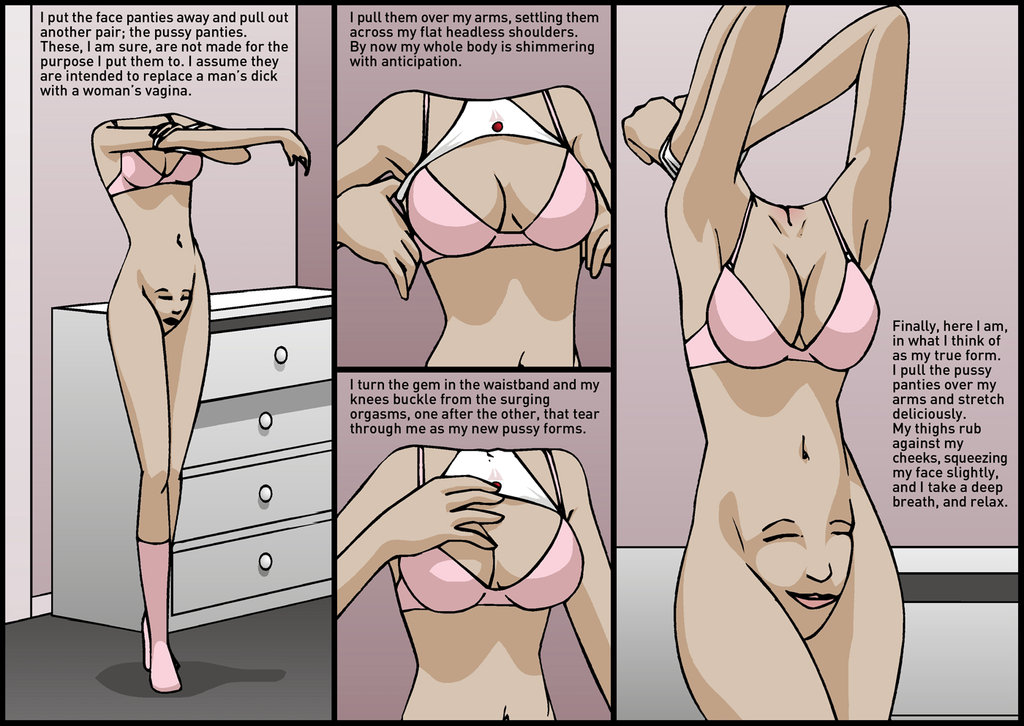
Overall… I have really mixed thoughts on this series. I think that when the series works, it works incredibly well. The comedic antics between the cast of characters are funny. The characters are a lot of fun to watch, however basic their characters may be. The artwork, while a very late 2000s style, is expressive and detailed. I think that the two storylines that I outlined— because somebody had to— are good, entertaining stories. Well, except for the end of the family romance arc…
However, the mix of storyline focused chapters and more disconnected episodic affairs is one I’m not particularly fond of, as it makes anything not storyline-driven feel like filler. And I’m not sure the story quite understood what its identity should be. The emphasis on Alicia and Yuuji’s storyline. The dark twist with Nicolai. Everything about the last few chapters. It all makes me feel that something happened in the series’ development. Something that caused the creator to lose focus and do whatever they wanted to do at the moment, right up until they had to wrap it up after a four-year run.

And I think the biggest casualty of this loss of focus is… how the story treats its genderbent lead. Ryoma does the Ranma Saotome thing of asserting that ‘I’m actually a guy’ and wants to go back to normal for the majority of the series. Which is a fine starting spot. But rather than really dig into the gender and psyche of Ryoma… the series just isn’t interested in assessing that. The comic makes passing mentions of how Ryoma is thinking like a girl now. The way they dress indicates they are comfortable being seen as a girl. But… a lot of the time I feel you could replace Ryoma with a tomboy and it would not make much of a difference.
(I am using a more classical definition of tomboy here. A girl who is prone to boyish behaviors and interests, typically dislikes longer hair and skirts, and prefers more ‘aggressive’ play styles. The term tomboy has been co-opted to mean 24 other things in recent years, and I don’t know why.)
Ryoma is a little cutie, I think they are adorable, but the story simply is not interested in telling a TSF narrative about someone being thrown into an unwanted situation and learning to embrace what they’ve been given. I tried finding something to latch onto or some greater theme, find some deeper gender exploration to dig into, but… there just isn’t much here.

So, do I recommend Sekainohate de Aimashou? …I do, as a manga, as both of its main arcs go hard in places, and it is some thoroughly edible slice of life antics during the interim. As a TSF manga though? …No. This would just leave someone hungry for more.
As for Sun Takeda, after this project he moved onto Gleipnir. A comic about a boy who gains access to a furry monster bodysuit that he crawls inside of. …After the darker shift and loose body horror seen in the Nicolai chapters, this makes perfect sense to me. Takeda clearly had a fascination with transformation, and it seems that Gleipnir was far more successful than any of their prior work. It lasted from 2015 to 2023, saw 14 volumes— all of which have been officially localized into English, and saw a 2020 anime adaptation. It seems like something I might dig but my manga bandwidth is kind of dominated by TSF Showcases.
Also, in March 2024, they launched Guardian in Young King OURs. A hero manga created for a post One Punch Man, post Chainsaw Man world. I read the first two chapters, and it’s… cool, looks really good, but it’s hard to tell what substance it’s building up to. So… no TSF, but they’re still working on stuff and seemingly finding success. And that’s just swell in my book.
TSF Showcase 2024-25
True Stories From the Time of The Great Shift by Caleb Jones

I just went through an extra long manga last installment, so I’m going to give myself a buffer before getting into the next 1,000+ page comic on my loosely defined list. Meaning it’s time to dig up another oddity and check out one of the first TSF stories I ever read. (Or at least the first one that I remember.)
I previously talked about Caleb Jones’s work, and how he influenced me as a creator, when covering his seminal work, Body Switched. However, I don’t think I ever properly discussed The Great Shift before, and I probably should, as this scenario has become seldom used outside of TG caption writers.
The Great Shift is a narrative concept cultivated by TSF writer Morpheus. An incredibly prolific Fictionmania writer whose output includes over 300 works, though a good chunk of them are just chapters in larger stories. In 1998, they came up with a body swap story concept with a simple premise. What if approximately 90% of the human population swapped bodies? Parents switching bodies with their children, husbands switching with their wives, people switching bodies with people on the other side of the planet, the possibilities are as vast as can be.
It is an innocently naïve concept when looked at from a more realistic perspective. Especially given the globalized nature of the world circa 1998, let alone after a global pandemic. But it is a concept that I always felt offers a truly vast potential to examine the structure of society. The prejudices that people carry when viewing each other, and whether people will choose to conform or rebel when confronted with a vastly different form.
It’s a lowkey dream of mine to see someone who knows what they are talking about— an expert in related fields— to seriously examine scenarios that could follow from an event like this. And for experienced fiction writers to use that research to a variety of stories in the same shared continuity. One that focuses on familiar and interpersonal struggles, people forced to abandon their identities as they are thrust into new roles, geopolitical turmoil, and how society deals when everything is upheaved.
That level of research is beyond my wheelhouse, but more serious explorations of The Great Shift are a major ‘major bucket’ list item for me. I want to explore that eventually, but first I should examine what other writers have done, so I could try and see what I can learn. There are better places to start than here, like with the first wave of stories from the late summer of 1998 but… this was where it all began for me.
True Stories From the Time of The Great Shift is an anthology story with a unique framing device. The story is presented as a series of excerpts from a #1 New York Times Best Seller book written by reporter Caleb Jones. Which… really confused me as a 13-year-old. I knew it wasn’t real, obviously, but the fact that the story claims it’s an NYT best seller, presented as novel excerpts, and features photographs that were “used with permission from the victim’s personal collections” is very strange to me. Even after all the strange crap I’ve covered.

Also, you read that right, this story contains photos! Fictionmania, despite being an ancient website, supports stories with images, allowing writers to include crusty JPGs. It’s a wild feature for such a basic site, as you’d never see a feature like this on sites like AO3 or Scribble Hub or TGStoryTime due to how much storage space images take up compared to text. Also, it’s not like the site isn’t still being used by writers. 11 stories were uploaded the day I am writing this, 55 the past week, and a good chunk of them are using images.
Tangent aside, the story opens up by introducing Caleb Jones’s fictional persona of the same name. A night newsroom editor who is heading home after getting the paper out for the day, only to faint when he is driving home. As he wakes up, he is being kissed by a bearded man, and holding onto his penis. This is clearly meant to be a sex scene of some manner, but this story is rated ‘G’, so all we get is deep kissing and it ends just as quickly as it begins. The bearded man then leaves, treating Caleb as his girlfriend, and Caleb is left to gradually piece together the fact that he swapped bodies with someone.
I actually think this has the means to be a strong introduction for a story like this, but the opening feels… poorly thought out. Caleb claims to be a skilled and diligent journalist, yet his overall analytical skills of the situation are lacking. They does not grasp they are in the body of a woman until he speaks or that they are now Black until looking at their ID. And rather than painting them as a panicked yet intelligent individual, the writing just makes them seem a bit… oaf-ish.
The narration also feels… artificial. Caleb, despite being someone who, in-universe, adapted to and accepted life as a woman, writes this section in a very exaggerated manner. They are rapt in shock and awe by the changes, vehemently assert their male heterosexuality in a way that feels defensive, and say some bizarre things. Like how they had a “heavy beard since they were 12-years-old.” It also does not quite capture the… voice of a newsroom reporter. There isn’t a deft blend of information and commentary, many descriptions are redundant or repetitive, and it feels unnatural in a way you can immediately spot when reading something out loud. I really felt the urge to play editor while going through the work.

After getting situated, Caleb tries to go back to the newspaper, and quickly comes in contact with one of his co-workers, John Ravenwood (presumably named after Fictionmania writer Raven). He swapped bodies with a 74-year-old woman and bemoans the loss of 40 years of his life, before tasking Caleb with getting interviews from people. To help the people of this city understand the situation, make their voices heard, and show the world how other people are getting on with their lives.
A fine sentiment, though… that’s a bit premature. Society would be in turmoil, people would not be able to make long-term decisions, and people would be more concerned with being safe or taking advantage of the situation. This scene happens a scant few hours after this mass swapping event, so getting out information should be priority number one. And I cannot imagine too many people would be inclined to talk to a journalist right after finding themself in a new body. It’s like how you didn’t really see ‘how people are living with the pandemic’ human interest stories until a few weeks after the pandemic was officially declared.
That was the introduction, but the bulk of this story is isolated in ‘chapter six’ which follows Carol. A 30-something White woman who was originally an 18-year-old Hispanic boy named Fernando. It starts off pretty strong, with decent banter between Caleb and Carol as they meet up and prepare to do the interview. But, once Carol begins telling her story, I again need to bring up the character voice problem.
Regardless of who she is now, Carol grew up as a Hispanic kid in a city orphanage who was cast into the world on their own, without any guardians to help them. Someone with that background would probably have a more casual, informal, manner of speaking, or at least be in line with any other kid of their generation. While a character can change the way they speak over time, the time scale we are dealing with here is months, and you cannot change things that much that quickly unless you’re damn dedicated. And even then, that’s a shitty justification for why Carol sounds so damn White in this interview, so damn old, and unnaturally formal. It’s like Jones forgot they were writing from a teenage boy’s perspective.

It really gets in the way of what otherwise starts out as a pretty good ‘woke up in an unfamiliar body in an unfamiliar room’ introduction. Lots of emphasis is drawn to the huge double-D tits she gained, how much it contrasts with her former muscular and hairy chest. There’s obligatory long nails and high heels scenes, because the writer wants to interject as much contrast as possible. Carol immediately struggles to move her body due to the drastically different proportions and weight distribution. There is a lot of veiled frustration over how sexy Carol finds her reflection, while going on how she didn’t want this to happen, how she was happy with who she was. And there’s even a mirror scene, because how else is one supposed to really appreciate their body? You can tell this was written by an experienced writer at this point, and this stuff just comes naturally to him.
This is broken up by a news report from a retirement home. Showing how distraught people are to be in the bodies of 80-somethings in need of medical care, except many of the nurses and physicians are in bodies too immobile to help. It highlights the unfortunate reality that many people face as part of their daily lives, and how so many vital industries would be screwed by The Great Shift. Especially if the effects are kept local, like physicians switching bodies with patients on death’s door. If that were to happen then, combined with all the accidents and sudden medical mishaps as people unknowingly have dietary restrictions and medication they don’t know about, tens of millions would die from an event like this. And that’s before getting into all the supply chain issues!
This aside doesn’t really move Carol, who takes this as an opportunity to get out of the room she went into and drive to the home listed on her body’s ID. After driving there, the story brushing past the dead bodies lined across the streets, they come into contact with the original Carol’s mother, Maude. A gray-haired woman who is hospitable to the person in her daughter’s body, and promptly read them a letter from the original Carol. In it, they say that they woke up in Fernando’s body and are unable to accept living their old life, so they are heading to another city to make a fresh start.
A sentiment that might make sense if this was a few months, maybe weeks, after The Great Shift. But again, this is set a few hours later. People cannot make definitive decisions like this after everything around them falls apart, and… the story seems confused as to where this chapter takes place. New Carol says that she does not recognize the city, yet navigates through it even with car flooded roads. While old Carol must have been in the same city as her original body for her to write a letter to her mother.

I understand condensed storytelling is a good tool, but this is someone telling a story within a story. You can just have them skim over the boring bits or say something happened a few days later. Instead… it just keeps piling more and more details onto the first day. Like how Maude’s husband gave up his life and his 30+ year relationship with her after getting swapped into a little girl, and chose to live with his ‘new parents’ because, as a physical child, they needed parents.
Things get even more bizarre the next day, where the story reveals that the old Carol had a child, a young boy named Phillip. A note that makes the new Carol consciously aware of what it meant to be both older and a woman, while still reasserting her masculinity. …But then, less than 24 hours after The Great Shift, Maude suggests that she, the new Carol, and Phillip, form a family together. She’ll teach the new Carol how to live as a woman, while the new Carol will get to have the family she never had as an orphan.
Now, I am at odds with this story shift. On one hand, there is a time and place to suggest something like this, and this is not the time. People don’t know if they’ll be able to get food or water in a week. On the other hand? I love this idea. A young man with no family being given the body of a decade older woman, only for the older woman to abandon her body, leaving him to lay claim to it and everything it has? Including the ability to have a parent to guide them through the complexities of their new life and a child to nurture and make the loss of a decade sting all the less? That’s an idea that makes me want to toss aside whatever I’m working on and start writing my own version of the story.
One of my favorite things about body swap stories, that typically is not achieved outside of reality warping TFs, is seeing someone land in a different life situation. Different age, different responsibilities, and different friends and family. It lets someone fully become someone different, while retaining the core essence of who they are, allowing that to gradually transform in a more traditional/natural/organic manner. The Great Shift is a wonderful vessel for that, as some people can just agree to exchange or steal the lives of their current bodies, and nobody will be any the wiser. People truly do get the ability and opportunity to mix and match the lives of two people, pick out what they want, and either embrace or reject it. There is beautiful drama to be hard in both, and the gooey middle of the spectrum is wonderous.

Sadly… I don’t think Jones quite got that allure the same way I do. Rather than dwelling on the details, it rushed to a resolution. Explaining how the new Carol took the life for themself, while also finding and making the old Carol sign an agreement to take her name and son. When… dude, you didn’t need to do that. And brushing off how new Carol, despite her initial objections, has become fully comfortable with her life as a woman, and even came out as a lover of men. …Because in this era of Fictionmania, they still operated on the biological sexuality clause.
The final segment is chapter ten of the story and it… just feels a bit redundant. It follows a group of TV journalists who get swapped with other members of staff, and try to go about the initial reporting of The Great Shift. Except… it really does not have all that much interesting to say here. Also, it does the naming sin of having three main characters with similar names. Murray, Mary, and Marie.
The chapter follows Murray, a balding copywriter who switches bodies with the young news anchor Mary. Murray is shocked by this, but intuits the situation based on context clues and his own positioning, unlike Caleb. While Mary, acting as the traditionally attractive woman swapped with a traditionally unattractive man, faints at the sight of this, and cries as she sees she lost her beauty and youth. They then get a report from their “AP news feeder” that explains the Shift.

Mary, for some reason, is the one to hand the report to the body swapped news anchor, Murray goes off to do something, and then there’s a… subplot centering around two new characters. An older male executive producer and a middle-aged female “Happy Homemaker” who have a sitcom-like antagonism with each other. Both of them swapped with each other, get angry at one another, and then… fuck in the executive producer’s office.
Murray, in the body of Mary, then goes home to see his wife, Marie, in the body of the male “grocery store manager” and that his three daughters were all body swapped in some manner. Then… the story just falls into an epilogue section. Murray got impregnated and is eagerly awaiting his child. Mary continued to be a successful reporter despite her shabby looks. The executive and homemaker are now hitched. Caleb teases the next chapter will be an interview with Arnold Schwarzenegger and Maria Shriver. And we get a final photo of Caleb, dressed in a flashy black dress, looking hot as hell, pictured accepting an award. Das Ende.

Yeah, so… this isn’t a very good story. I was able to forgive Body Switched before it was written early on in the genre, and was clearly intended to be a sillier, more lighthearted, romp. However, this story is purporting to be realistic, written by an accomplished award-winning journalist, and it’s just not good or insightful enough to really warrant that framing, not committed enough in any of its concepts.
I think the pseudo-non-fiction framing is wonderful, and that Jones managed to strike gold with the ideas of the second story. Yet the first and second are so brief they feel toothless, and the writing feels unnatural for what is supposed to be a series of interviews.
…Yeah, I probably should’ve investigated the actual origins of The Great Shift and covered those instead. In fact, I think I’ll get to that eventually. Not next time, but SOON!
TSF Showcase 2024-26
Toaru Kizoku-kun no Nyotaika Hametsu Ganbou [A Certain Nobleman’s Desire to Become a Woman and Destroy Himself] by Hoshino Iro and Namamugi (Amulai Sweet Factory)

To mark the halfway point in the year, we have a manga recommended by my buddy who used to be part of the Student Transfer dev, during the early years. A work from the prolific Amulai Sweet Factory circle, who I don’t think I’ve ever discussed before.
In short, they are a circle dedicated to producing TSF works, regularly partner with a sizable number of artists, and put out a steady stream of manga, about two a month on average. Their output is so varied and plentiful that it’s easy to forget if a work was handled or published through them, but I’m grateful that groups like them exist. Anything that keeps the TSF fluids gushing is a good thing in my book!

A Certain Nobleman’s Desire to Become a Woman and Destroy Himself is… well, the scenario’s right in the title. Fritz Ast Dilertant is a young noble, heir to his family, who excels in all facets of his public-facing life, yet is left longing for more. He wants danger, excitement, and something a bit dirty. So naturally he uses a magical transformation orb to moonlight as a waitress in a seedy bar.
As Frittina, Fritz is able to be seen and treated as a completely different person. He acts bubbly, relishes in his female form’s cuteness, and is subjected to stereotypical harassment from the bar patrons as they feel up his ass, boobs, and make snide remarks. While this could be seen as objectifying and maddening, for Fritz this level of emotional freedom and honest attention is refreshing, something he is not accorded in his daily life. Or to be a bit more transparent, he’s just a rich guy with a humiliation kink.

Fritz was born into power, surrounded by yes-men and people who are profoundly loyal to him, and he developed a fetish for being demeaned, teased, and taken off of his podium. To be debased and humiliated. All while protecting his status with a layer of layer of anonymity by wearing a different form. Which… is far from a revolutionary concept. It’s a cliche that rich and powerful people either like to whip, beat, bind, and demean little women girls to their pleasure. Or they like to be whipped, beaten, bound, and demeaned by big Black women— the bigger, the blacker, the better. And I can only imagine European nobles and royalty were the masters of this kind of kink, back before kink was even a thing.
After delighting in a night of this, feeling refreshed and energized, Fritz returns to his mansion and prepares to return to normal and get on with his life. …Only to realize he misplaced his transformation orb. Following this discovery, he is greeted by his maid, Julia, who enters his chambers. Fritz panics, not wanting anyone to find out about his embarrassing hobby, and fears the worst. That he’ll be dragged out here or outed as a perverted freak. …Only for Julia to reveal that she was fully aware of Fritz’s hobby, and found the transformation orb after he left it at the bar.

Julia continues to reveal that she has been aware of Fritz’s activities ever since he found the transformation orb. As his maid l, it’s her duty to be aware of all her master’s preferences. Fritz crumbles upon hearing this, feeling as if he has been outed as a pervert, but rather than chide him, Julia affirms her loyalty to her master and uses the orb to assume the form of Fritz’s deepest desire. …A middle aged man who slapped his ass at the bar. Because a young, hot guy would be too dignified.
Fritz, being a glutton for sexual humiliation, asks Julia to violate him, and she quickly obliges. Pinning him down, invading his mouth, and sticking it in, much to Fritz’s immediate delight. Before, his secret was his alone, he was protected by anonymity. But with Julia aware of everything, he has no protection, he is seen for who he is, raw and unfiltered, simultaneously debased and… accepted. It’s a liberation beyond anything he has in his daily life. He knows that what is happening to him is ‘wrong,’ that it goes against the social order drilled into his head since he was a child… but it’s also okay. It’s safe. And he is with someone who he can trust. …Or so it seems.

Things then cut to Fritz in Julia’s body (or rather form, but body swap via souls exchange or body swap via physical transformation are basically the same thing) cleaning up the mansion. He complains about the work, how this is beneath his position as the head of the family, only to see Julia in his form. Julia scolds Fritz for taking too long to clean, saying that he is too excited being a maid to focus on his work, and must be punished.
The punishment takes the form of a sex scene in front of a mirror, forcing Fritz to see who he is physically, look at himself as he is so vigorously fucked by his own body, as ‘his’ voice describes the scene. That of a perverted man exposing herself, relishing in the act of sex. A manfar from the man he once was, the heir to this illustrious family. Instead, that right belongs to Julia, to the man fucking him, and all it would take to make this permanent is to shatter the gem. Fritz, in a panic, momentarily agrees to Julia’s offer, and is further punished for being excited by such a lowly life.

Julia threatens to impregnate Fritz for being such a pervert, to fulfill ‘the greatest joy a maid can experience.’ To be removed from his status of influence and became a concubine. And as Fritz’s ability to resist falters, Julia cinches it with a climax, breaking his resolve.
This is where we would typically see a pregnant flashforward. One showing Fritz having acclimated to the life of Julia, trying to work as a maid while pregnant, before being yoinked away by Julia, her lover and master. …But instead it turns out that this was all a bit of role playing by the two. For Fritz to feel despised, to have his position threatened, and to have his trust betrayed. And Julia, like any good maid, obliged her master’s request, fulfilling her role as desired, and creating a safe environment for him to engage in his kink. When asked to do this again, she smiles, only requesting that Fritz exclusively does such perverse things with her. Is it because she has come to love him, or is just protective? You be the judge!

A more typical TSF comic of this breed would take things into a more mean-spirited, punishing, or vindictive way. It would have seen Fritz gang-raped in the bar. Seen Julia snatch the orb vindictively, stealing Fritz’s body, forcing him to live as a bar waitress. Or resulted in some manner of identity death, forced transformations, body theft, etc. These are all fine approaches but they are bitter ways to tell and conclude a story. But A Certain Nobleman’s Desire to Become a Woman and Destroy Himself eschews that.
It is ultimately a story about a weird dude with a weird fetish that is reciprocated by someone who supports them, allowing them to grow closer and engage in a higher level of erotic roleplay. The veneer of danger is present, but the main characters ultimately escape unscathed. I’d be lying if I said that I didn’t find this form of staged body theft to be compelling in more ways than one.

It captures what it wants to do well, takes things in a refreshing direction, and is confident in being what it is. It’s not concerned with being introspective. It is not trying to sappily endear sentimentality for the protagonist’s kink. And it is also not particularly dirty or vulgar with how it presents anything. And it manages to do a lot within forty pages without feeling too fast with its pacing. Which is impressive for something with this much story and three erotic scenes.
Speaking of which, I should talk about the artwork. It’s clearly the doujin work, being a bit unpolished with some of its artwork. Deformed characters, omitted details, some minor inconsistencies, and a lack of backgrounds beyond simple props, often using color to give the illusion of place and tone. However, what really impressed me was the paneling. It uses the space afforded to it efficiently, conveying a lot of information and intrigue to each page, without skimping on dynamic poses or adorable expressions. What’s there is strong enough that I’m going to have to keep an eye on this artist going forward. As I can tell they’re going to be wonderful in a few years.

Also, I should note that the unofficial translation for this story has some particularly poor lettering work. Text is not centered, does not fit into the dialogue balloons, has numerous obvious typos, and it reads like a translation done while someone was getting chased by the cops. I thought this work deserved better, so I redid the lettering for the snippets you see here, using the official release and rewrote a few lines, as I thought they needed punching up. I tried not to, but I couldn’t help myself. I thought about doing the entire comic, doing a re-edit and reworking, and asking Chari for a brief SFX tutorial, but I didn’t have the time with how hectic this past week became.
Overall, A Certain Nobleman’s Desire to Become a Woman and Destroy Himself was a pleasant surprise. It’s the sort of exploration that I hope to find when exploring the more erotic end of things, a great source of inspiration, and gets my full recommendation.
Further Reading (and Shameless Plugging)
For further readings about TSF, I would like to recommend checking out my 2022 articles, Natalie Rambles About TSF and the TSF Showcase predecessor Natalie Rambles About TSF Comics. For those who want something more detailed, I reviewed TSF visual novels re:Dreamer and Press-Switch over this past month.
But for those who want fully original writings from me, you’re in luck!

Throughout June 2023, I started publishing a brand new novel by the name of Verde’s Doohickey 2.0: Sensational Summer Romp. The story is not fully complete, but it’s at a truly staggering 370,000 words thus far, and tackles a deluge of bizarre TSF scenarios, and channels many of the things I love about this genre.
But that is a big commitment, I get that, so I also have other shorter form TSF writing.

TSF Series is an anthology series of short stories and novellas that feature TSF in some way, shape, and form. They definitely run on the more bizarre end of the genre, but generally aspire to take a semi-familiar TSF concept and take it to a more extreme level. Or are just a cornball idea that just so happens to be centered around TSF in some way, shape, or form. They vary drastically in length and content, so I like to think there’s a little something for everyone.
I hope to get back to TSF Series sometime soon, but I’m just starting project on a non-TSF novel. It’s a TF novel, and while there is at least some ‘gender TF,’ it’s bloody bizarre by my standards. Which is saying something.
The Future of TSF Showcase
Over the year I have run this segment, the scope and magnitude of TSF Showcase has grown beyond what I originally intended, and while I’m still not quite sure what I’m doing with it, I’m happy that I can platform and showcase these works to a large audience, and create a significant piece of writing analyzing a work.
Starting in July 2024, I will be turning TSF Showcase to be its own recurring segment on Natalie.TF, it will no longer be published as part of Rundowns, and will stop creating these big compilations. Much like with my Student Transfer scenario reviews, it made sense to bundle them together at a time. However, as the text got longer and my analysis got more detailed, it started making increasingly little sense to not publish each piece on its own. I probably should have started this in January 2024, but I can be a little thick in the head sometimes.
TSF Showcase will continue on July 2, 2024, and will hopefully go live every Tuesday for the remainder of 2024.
As always, if you have any TSF comics, videos, writings, or really any form of media you would like me to cover in a future TSF Showcase, please let me know in the comments below!