

This Week’s Topics:
- Rundown Preamble Ramble: I Got Robbed!!!
- TSF Showcase 2024-21 Tenkōsei [Exchange Students] or I Are You, You Am Me
- Nintendo’s Miami Shiver is Ret-2-Go! (Nintendo Acquires Shiver Entertainment From Embracer Group)
- The Accursed Consolidation Continues! (Ziff Davis Acquires Eurogamer, GamesIndustry.biz, and More)
- Abrazar La Muerte, Amico (Atari Acquires Intellivision Brand)
Rundown Preamble Ramble:
I Got Robbed!!!
Considering how online my life is, I try to be on the lookout for scammers and take data security fairly seriously. I use 2FA on everything, a robust password manager, and generally try to avoid giving my information to shadier places. However, I always assumed that, if I was ever going to get stuff stolen from me, it would be some digital dilweed. Instead, someone stole and cleared out my safe deposit box.
I did not have much in there— I keep my silver under my bed, like a sane person— but my mother demanded that I keep certain identity documents there. You know, documents that I had to have reissued after changing my name and after getting bottom surgery. It’s going to take a while to figure out what happened— the bank’s acting like this isn’t their fault, when it objectively is. But I’ve done damage control, contacted a lawyer, and now I’m waiting for guidance.
For the time being though, this sure as shit eroded my confidence in the banking system’s safety deposit boxes. And here I used to be a big supporter of their basic yet effective security system. Film everything, log who goes in, make sure bank staff is always supervising people, and do not allow someone to enter without leaving their name, box, time, and date. Information that the bank should have… but they fucking lost it! They had to keep it for less than six months and they fucking lost it!
I’m going to need to invest in a fireproof safe or something and keep all my stuff in there. Separate from my mother’s stuff. Because shit like this reminds me of an old adage from my edgy teenage years. “The only person you can trust is yourself, so never let anyone get close to the real you.”
Akumako: “Your best friend is you, I’m my best friend too!”
♫I share the same views and hardly ever argue!♫
Akumako: “Except we do.”
For comic relief of course!
Akumako: “Yo, what’s with the header image?”
Cassie and I were watching To Love Ru and I said something about making this in between frames for the header image for the next Rundown. Animation is hard, and I do not blame the artists for drawing something like this, but it is hilarious to look at. Plus, the juxtaposition makes it even better!
Also, I should keep an eye on silver prices. The price went past $30 this past week, and I’d rather own Series I bonds than a bunch of metal.
TSF Showcase 2024-21
Tenkōsei [Exchange Students] or I Are You, You Am Me

Over the past few weeks, I have been regaled with myriad factoids about the history of TSF and its implementation, by a person known as Sajah. A researcher currently working on an English Wikipedia page for TSF. There has been a Japanese Wikipedia page on the subject since 2006, but English speakers have had to settle for, frankly, poor pages on Rule 63 and Gender Flip. Like… saying that ‘gender flipping was popularized by Darkstalkers‘ is wrong on every level.
However, this past week they brought my attention to what I think may actually be another historically significant entry in the genre of TSF. A 1982 Japanese film named Tenkōsei. Which translates to Exchange Students or Transfer Students… or Student Transfer if you want to get conspiratorial. But it is more commonly called I Are You, You Am Me on sites like IMDB and Wikipedia.

The film itself is based on a Japanese novel, Ore ga Aitsu de Aitsu ga Ore de, or I am Him and He Is Me, by Hisashi Yamanaka. A work that has received many adaptations, re-releases, and reimaginations since its first publication in 1979. Ideally, I would start with the original book, though there does not appear to be any English translation, official or unofficial, and I do not want to rely on a machine translation. Which is a shame, as 1979 is still close to the modern inception of TSF. After the influential works of Doron and Boku no Shotaiken by Yuzuki Hikaru in 1972 and 1973 respectively, though before the genre would really become known by the mainstream.
Just looking over the Japanese Wikipedia page, it’s clear this was a pretty successful and important film in its own right. It came from acclaimed director Nobuhiko Obayashi, garnered a few internationally recognized awards, and was received well by contemporary critics. Sadly, it never received an official English release and, as far as I can tell, is not commercially available for streaming anywhere. But there is a fan sub uploaded to Archive.org. The quality is a bit low, and while I was able to find listings of the laserdisc on Yahoo Auctions… I’d feel awkward about sending it to someone with a Domesday Duplicator, like Kineko Video and Kenny Lauderdale.
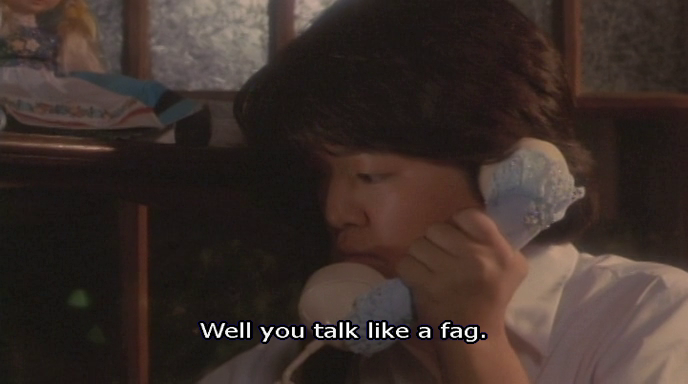
Yeah, it’s just kinda like that sometimes. 1982, ladies, gents, and those beyond the binary.
Tenkōsei is a film of its era, and it has some content warnings attached to it. Namely casual homophobia, repeated use of the slur ‘fag,’ and a fair bit of underaged nudity. As in, the lead actress, who would have been 16 when filming, gets topless several times throughout the movie, and multiple male characters show their bare asses. I don’t know how this was okay in 1982, but it’s pretty uncomfortable whenever this shows up. It really makes one wonder what was happening on-set. …Or maybe I don’t want to know.
Disclaimer aside, the movie follows third-year middle schoolers Kazuo Saito and Kazumi Saito. Characters who sound like they should be twins of some truly dastardly parents, but they’re distinctly not family members, they’re childhood friends. The two reconnect after Kazumi moves back to her hometown of Onomichi, and things start off antagonistic. Kazumi regularly teases Kazuo with embarrassing childhood secrets, while Kazuo tries to maintain a dominant position around her, as he’s not the boy she used to know, he’s a young man. Their bickering sends them wandering across their mountainous hometown, chasing after each other in a cute credits scene, only for the two to get into an accident at the local shrine, falling down the stairs.
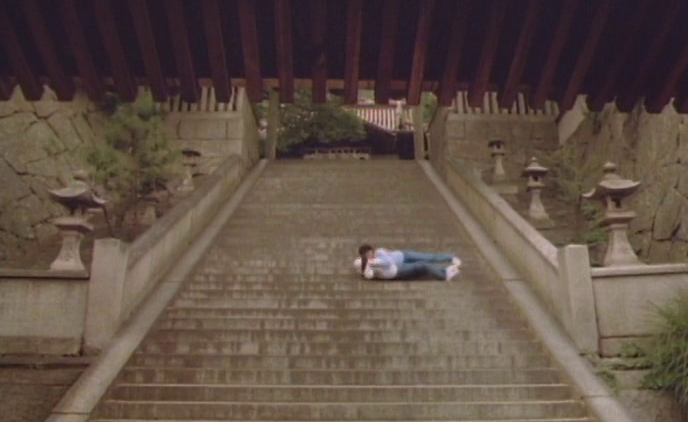
In Japanese media, a semi-common cause for a body swap is two people falling down a set of stairs together, particularly the long stretch of stairs leading up a shrine. I always thought this was just some spin on characters bonking their heads together and swapping their brains, but I’m pretty sure the concept originated here, or in the original book. Although here, the trigger is not definitively caused by falling down the stairs. Rather, the two fall after a can is kicked, and as they fall, the can falls simultaneously. It down the steps and bounces up to a gate at the bottom of the stairs in a way that defies gravity. Maybe it’s the can that’s magical, and not the steps! …Or maybe it was just included to make the scene more dynamic, or add a pinch of symbolism. Symbolism for what? I have no clue.
As the first, at least the first mainstream, example of this, I was curious how they would handle the reaction and… they go for the weirdest call possible. Rather than having either party react to this swap with shock, disgust, horror, anger, arousal, or bliss, they both just… get up from the ground, no worse for wear, and walk away. Kazumi, in Kazuo’s body, looks down at her face but she doesn’t think to wake up her passed out body, or pick up her school bag, before leaving.

Meanwhile, Kazuo, in Kazumi’s body, gets off the ground, fails to notice his long hair, long dress, shorter frame, or different muscle strength as he gets up, grabs both his and Kazumi’s school bags, and walks home. He does not say anything, and he does not realize he swapped bodies until he gets home and looks in his bedroom mirror. I can only assume this was due to production reasons or perhaps a scripting mistake, as this is just not how humans work. If someone became someone of the same sex and build, maybe I could buy this. But humans are very perceptive of their own bodies, and should notice things like the length of their limbs.
Kazuo then rushes over to Kazumi’s house— because I guess she just moved back to her old house after her family abandoned it for a few years? And their reactions are pretty archetypical. Kazuo is a perverted teenage boy, so the first thing he does is feel up his boobs. While Kazumi is more fragile and becomes a sobbing mess as she realizes she’s in the body of a boy. A sensible reaction… that seems at odds with the Kazumi presented during the first ten minutes of the film.

Kazumi is introduced as a loud and cunning woman who actively enjoys teasing Kazuo. I mean, she gets him to spill secrets about his past over the school intercom system. She’s a second-wave feminist gal with bold ambitions painted on her face! Yet, when she is divorced from her body, she becomes a fragile flower. Someone who needs normalcy to be restored to function, and cannot bear to make herself act masculine. Heck, she can barely even speak to anyone beside Kazuo during the first night. I’m not saying there’s anything wrong with the former approach, losing your body sucks, though it is another bizarre writing quirk.
Around this point in watching the film, I wondered if it would continue feeling like a bizarre pre-conventional relic that never did familiar concepts in an unconventional way. Like 1911’s An Exchange of Souls. However, after the 20 minute mark, the film… becomes far more conventional, and all the better for it.
With the swap established, Tenkōsei focuses on Kazuo and Kazumi living their lives, working together to get through this, forming bonds, and bickering about how they should live each other’s lives. Kazuo is routinely scolded or reprimanded for being too boyish with his behavior— he’s more concerned about doing what he wants than trying to be someone else. Kazumi is unable to achieve the expectations people have from her as a man, while clinging to the life she can no longer live, lacking the strength to take up the mantle of someone else.
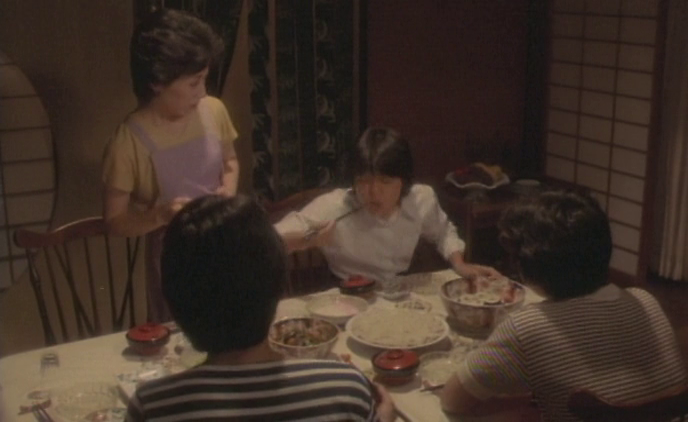
There are a lot of little chapters, positioned as more vignettes than anything else, that are made to illustrate these differences. Such as how Kazuo shovels food into his face during dinner with Kazumi’s family, while Kazumi is too unnerved around her new family, and shirtless dad, to even eat. They are simple in execution, yet they thrive with a certain personality. Just the awkwardness of the framing and ambient silence of most scenes helps instill a sense of discomfort that matches both the protagonists and the people around them. They feel like something’s not right, and there are bits of this eeriness sprinkled throughout the entire film.
…For better or for worse.
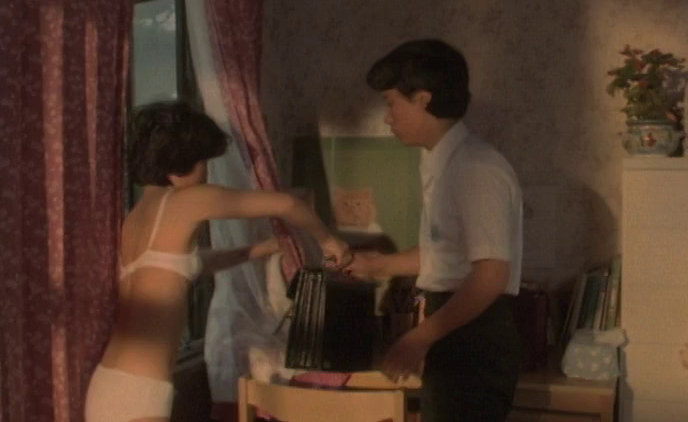
To highlight an example of both extremes, take the scenes where Kazuo is in Kazumi’s bedroom right after getting her body. His actress, Satomi Kobayashi, does a wonderful job of selling the mannerisms of a boy in an overly girly bedroom. Just the way she moves and positions her body, looking over it, makes it very easy to buy her character, especially with the long, static shots used for these scenes. Yet, there is also a lot of time spent looking at an actual 16-year-old girl prancing about in her underwear, changing her clothes, getting naked, and eventually inviting an actual 15-year-old boy into her room through her window. There’s nothing glaringly lecherous about it— the camera doesn’t zoom in on bare girl child ass— but knowing that real people had to do this… just makes it feel icky.
On the other end of the spectrum, I think this realism angle strongly enhances the bouts of violence seen throughout this movie. When attending school on the first day of school, Kazuo gets his skirt flipped by one of his buddies, and immediately rushes at him, taking him out to the fields and knocking him down into the sand. Their actions are jumbled, clawing, and imprecise. Just like real fights, especially between teenagers. Kazuo is acting like a boy with traditional ‘male aggression,’ but it’s channeled through a body where that type of aggression looks wrong.

There are a lot of scenes that capture this feeling of wrongness and unease. Like when Kozou punches his young female teacher in the face, knocking the wind out of her with a single hit. Or when Kazuo and Kazumi get approached by a ‘greaser’ and Kazuo is still the one to do most of the fighting. Kazumi just gets kicked in the dick and needs to jump around to fill it with blood. Which… sounds like some bullcrap a 14-year-old would believe. And then there’s the time where Kazumi gets sexually assaulted by her peers for acting like a ‘fag.’ …This movie doesn’t just aim to go real hard, it feels real.
This realness is also mirrored in how authentically the film manages to capture its setting. Tenkōsei is part of Nobuhiko Obayashi’s ‘Onomichi trilogy,’ a series of three 80s movies set in the same small seaside city of Onomichi, and the film does a wonderful job of capturing how life in this city must feel. It’s basically built on a mountain, so elevation and verticality are key elements in the design of the city. A lot of conversation scenes see characters climbing up or down steps, or looking off into the urban sprawl, leading to the natural harbor and lush green island on the other side.

People are always moving about in the background, easily traveling wherever they need to via bikes, public transit, or just their feet. Homes are very lean wooden structures with open doors and windows, inviting in the crisp southern breeze, and almost all of them have a gorgeous view to call their own. But aside from single-family homes, the architecture… feels very much like the product of a post-war economy. While some more traditional and older structures remain, much of the architecture looks like it was built in the 50s and has stood two or three decades. Not quite long enough to become worn, but long enough to look dated.
The school in particular feels like a government produced building. With dreary off-white walls, cheap desks, and uniforms lacking the pizazz emblematic of Japanese school uniforms. It’s just a white dress shirt and black slacks/skirts. However, it is also a building constructed with the environment in mind. While rooms can be sealed, the hallways have open walls, inviting in a sea breeze and humidity every day of the year. Because AC is expensive, and it doesn’t get that cold in Onomichi.
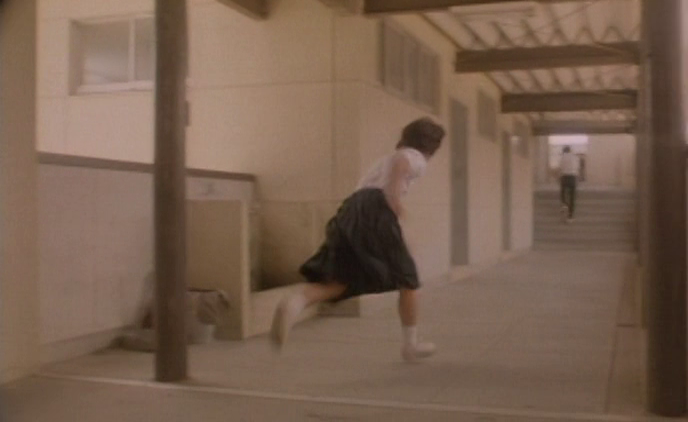
Open air buildings, with water stations, ‘cos kids gotta stay hydrated!
If I had to describe the setting in one word, it would be honest. It does not aspire to glorify the reality of 1980s Onomichi, but to capture it, and make the viewer feel like they are actually there. From the stretch of urban sprawl to the traditionalist shrine, temple, and housing, to the snippets of nature that remain captivating even in potato-quality resolutions.
However, this wouldn’t work if the 14/15-year-old characters didn’t act like kids and… they do. Like, more than any other piece of Japanese media I have ever seen. The students are not obedient or terrified of authority. They’ve juvenile, abrasive, casual, and do things like sneak in early lunch. The boys, despite their age, are crass, perverted, violent, rude, and feel like members of a vastly different post-war generation. And while the girls are quieter, not wanting to rock things too much, they rightfully recognize their male peers as the kinda shitty dudes they are. It weirdly reminds me more of American middle school in the late 2000s than… any anime or manga I can think of.
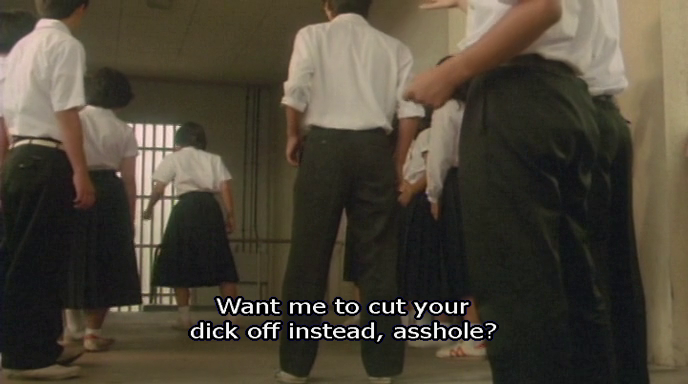
Does that mean I think that Kazou and Kazumi are grounded and realistic characters? Well, yeah! They’re maybe a year older than the characters they’re playing, and do a good job of capturing what it would be like to be a body swapped teenager. Which, for the record, is something I think often falls flat in most live action depictions. Maybe it’s just the fact that it’s harder for me to judge acting outside of my native tongue, but I found both to be shockingly convincing in both their delivery and body language. No wonder they’re both still working in the industry…
Going back to the plot, a lot of it is truly devoted to little scenes that build up the relationship of the two leads, encountering differences in their lives, their bodies, and bopping between events. But the clock starts ticking after Kazumi learns that Kazuo’s family is moving to Yokohama (halfway across the country, near Tokyo). This looming timer— combined with her getting stripped by Kazuo’s ‘friends’— leaves her distraught, hopeless, and clinging for something to latch onto.
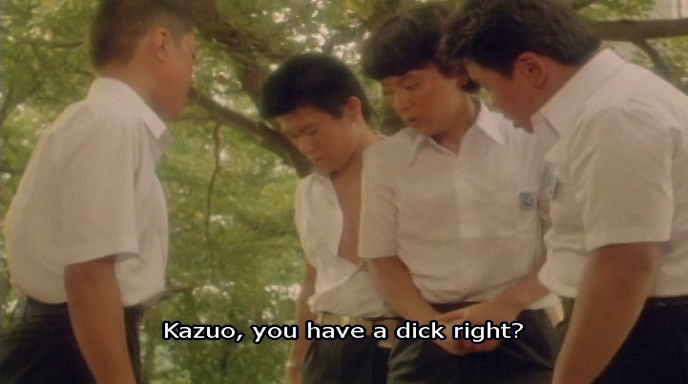
Side note, but this movie really likes talking about dicks, despite never showing them.
This leads into a subplot involving Kazumi having a crush on a boy from out of town named Hiroshi and her telling the truth to a friend of hers, Akemi. It’s built up for about ten minutes, the scene lasts five minutes, and it has little bearing on the rest of the story after that. I guess it’s meant to show how desperate Kazumi is for connections, for maintaining the last vestige of her life, and how miserable she is like this. However, that was already established beforehand, and Akemi disappears after this scene, despite being the one third party who knows the truth. I don’t think it works, but it at least lays some groundwork for a body swap romance and the ‘trusted third wheel.’
The final act sees Kazumi become… suicidal. She does not think she can live as Kazuo and after… getting one last look at her breasts (yes, really), she decides to run away. But with Kazuo on her trail, she instead gets on a boat that is being rented by a group of… office workers, who are going on a vacation to a neighboring city.

Yeah, I could see how some boards could classify this as child pornography. I don’t agree but… I can understand the argument.
Yeah, this part of the movie is where I started getting lost, as the office workers just seem to accept the two teens tagging along on their boat while they get drunk and play party games. Same when at the hotel. They just tag along in the background, looking sad over the situation, slowly accepting that, after several weeks, they are stuck like this. They join their traditional rooms, hold hands while they sleep, and say that they have never seen their faces quite like this before. This is meant to be a touching moment, though I think there is some nuance not quite captured by the translation team.
Regardless, the next morning, after taking a boat back to Onomichi, Kazumi states that she wants to kill herself— again— and begins going to where this whole swap all began. The shrine. As she makes her way there, Kazou reassures her that this situation is not so dire, and says that if she dies, he’s dying too, and that if they stick together, they can get through this. These words ring true given the bonds they made over the runtime but, despite his reassurances, Kazumi still cannot accept that she can never go home, never go back to normal.
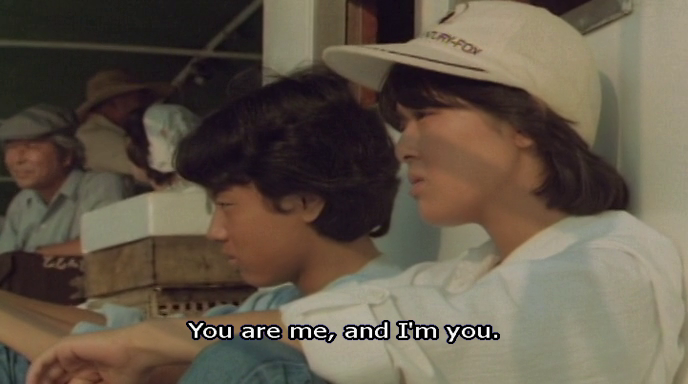
Kazumi begins to walk down the steps of the shrine, aiming to run into the incoming train at the bottom of the steps, only for Kazuo to kick a can, and grab her, throwing the two down the steps. Naturally, Kazou and Kazumi end up returning to own bodies. They hug, they kiss, they feel their chests and crotches as they gawk at how “it’s back” and “it’s gone.” Like this is bloody Misogyny Conquest And the first thing Kazuo does with his body, with his manhood reclaimed… is take a long, hard, 25 second piss. All while Kazumi watches, a smile on her face. …No, I am not kidding. And yes, I will, one day, take this scene and recreate it, because it is hilarious.
After the two say goodbye, Tenkōsei then does something that I didn’t mention during the introduction. The movie opens with 8mm footage, shot by Kazuo on his camera, as he is an aspiring filmmaker. Then it shifts over to black and white, and the film only gains color slightly after the body swap. Similarly, shortly after the body swap is undone, the film goes to grayscale. I would comment on the purpose of this… except it’s a bit beyond me. It’s not looking into the past, not really showing a fantastical world beyond the gray doldrums of reality, and not directly tied to the body swap.

In the epilogue of the story, Kazuo says goodbye to beautiful Onomichi, goodbye to Kazumi, and after getting into the moving truck, with his camera in one hand, he says goodbye to me. Because even though they only spent a few weeks as each other, in that time, part of him became Kazumi, and part of Kazumi became him.
There are definitely things that I could nitpick about this movie, like pointing out how 30 minutes of it lacks much of a point and how odd the first 10 minutes of body swapping is. However, for a movie that was, in many ways, breaking ground in exploring how to depict a body swap on screen, I think it did an incredibly respectable job. I glossed over a lot of details, but there are some absolute gems sprinkled throughout this movie. Small scenes that, while probably not the first example of a body swap concept or trope, are rendered in a grounded and genuine way.
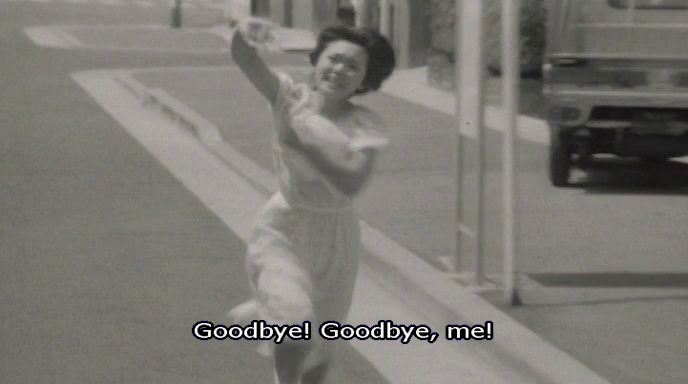
For such an early example of the genre in this medium, it’s surprising to me how well it handles the subject matter. Most body swap movies I’ve seen, or movies featuring body swaps, have treated the concept cheaply. For shock or gross-out humor, easy sexist commentary, or just to be silly without offering much of any substance. But Tenkōsei? As a body swap fan, there’s a lot to love. It, generally speaking, gets it.
While I cannot definitively state this is where concepts began, I think I can say this movie did a lot to spread many staple body swap concepts. It genuinely impressed me and, even without considering its importance to a particular fixation of mine… I still think it’s a good movie.

But, as always, do not just take my word for it. I do these showcases with the intention that they will both provide a resource of information via critique/summary/analysis and encourage people to check things out. So if you like body swapping, download this movie, bear with the quality, and learn how this all got started!
I would say that this is the end of it, possibly pointing to various other adaptations of Ore ga Aitsu de Aitsu ga Ore de. Like this 42 minute TV drama adaptation somebody subtitled back in 2009 (it’s blasé and unremarkable). Or asking if anybody knows a Japanese to English translator I can commission to get an English language version of the original novel. Even though that would be expensive. However, I don’t need to close things out just yet.
Because there is a 2007 remake of Tenkôsei from the same director, Nobuhiko Obayashi, dubbed Tenkôsei: Sayonara Anata. Also known as Switching: Goodbye Me or Exchange Students: Goodbye Me. I was planning on covering it in this installment… but I think 3,000+ words discussing a 2 hour film is enough for now.
Besides, if you are that desperate, you can just watch the 2007 version on YouTube.
…Actually, maybe don’t do that. I watched it before getting this post all ready and it’s… nowhere near as good as the 1982 version. I’ll explain why next time.
Nintendo’s Miami Shiver is Ret-2-Go!
(Nintendo Acquires Shiver Entertainment From Embracer Group)
…What? I talked about the dissolution of the Embracer Group a while back, how they planned on splitting off into three oddly shaped companies. I sorta expected a few studios to divest, go independent, get bought up by bigger companies, or get axed in the process. But you know what I never would have predicted? That Nintendo would buy a support studio from Embracer.
Nintendo has acquired Shiver Entertainment from Embracer Group. With Shiver being a Miami-based studio that started making mobile games for Nexon, at least based on this old version of their website. But since 2018, they have worked exclusively with Warner Bros.
Shiver developed Scribblenauts Showdown, an unsuccessful multiplayer-driven reboot of the series. Ported the HD Scribblenauts games to modern systems. Before being assigned to work on Mortal Kombat 11, the wizard games about saving the world from international bankers, and Mortal Kombat 1 (2023) as a support studio. I can tell that they did the PC and Switch ports of Mortal Kombat 11, and they presumably played similar roles in their later projects.
Now, why did they do this? Why would Nintendo, a company so insular and against acquisitions of anyone beyond their closest collaborators, buy a studio in the fool’s country that is Florida?
Nintendo says that “Shiver’s focus will remain the same, continuing commissions that port and develop software for multiple platforms including Nintendo Switch.” So I guess they will help with ports and other support services? But why acquire a new studio for that, especially one so small? Nintendo has established offices in Washington and Japan, so why establish one on the opposite side of the contiguous US?
…Is this for Super Nintendo World? They’re opening a Nintendo theme park in Orlando, so maybe there’s some synergy to turning a Florida-based company into a support studio? I’m not sure what they would do there, or if there would be a significant business benefit to having more Florida staff on Nintendo’s payroll. Maybe Nintendo was impressed with the Switch ports of the games they worked on, but… I wouldn’t be.
The easiest way to figure that out would be to go to Shiver Entertainment’s offices at 9350 S. Dixie Hwy Suite 930 Miami, FL 33156 and ask them what they do. But I’m trans, so I think I’m legally not allowed to step foot in Florida.
…Also, I’m not doxing Shiver Entertainment by stating their address. You can find most businesses’ addresses by using a business entity lookup— Florida has the pleasantly named SunBiz— and download their annual reports.
Also, if you know someone’s name, the county they live in, and that they own a home, you can sometimes figure out their address via a property tax lookup! Though, there’s a real tossup for that. Some counties let you look up taxes by the payers’ name, like Fulton county, Illinois. But others, like Fulton county, Georgia, require an address, parcel number, or account number.
…Why am I giving people doxing tips?
Akumako: “Because, deep down, you want everybody’s address and date of birth to be public information?”
…I’m going to be honest. I thought they were until I was, like, 19. I mean, my elementary school used to have birthday calendars and give out little phone and address booklets, so I thought that was just how the world worked. …I also thought that Yellow Pages included everybody’s addresses when I was little, because I was too small to reach those books in the closet.
The Accursed Consolidation Continues!
(Ziff Davis Acquires Eurogamer, GamesIndustry.biz, and More)

One of the worst things about the current media and journalistic landscape is how much of the field is dominated by corporations. Fiefdoms who acquire and build media empires that have resources beyond anything an independent and standalone entity could hope to manage. This has been the case for most prominent gaming news sites, and it’s honestly sad how few companies control this important corner of the industry.
Fandom is a monolithic and fundamentally evil company that looked at the passion and dedication of early fan sites and decided to pillage that shit to become a dauntingly powerful entity. They have basically committed themselves to decaying off the concept of fan sites with their own ‘one size fits all’ homogenized mobile-first fan wikis. And they are the current owners of major gaming sites like the old guard that is GamesSpot, the bastion of knowledge that is GameFAQs, the much beloved Giant Bomb, and the third-party Steam key store Fanatical.
Gamur’s Group has Destructoid, Dot Esports, The Escapist, Siliconera, Prima Games, Twinfinite, and Pro Game Guides. Meaning they’ve worsened at least three sites I used to visit routinely.
Gamer Network is a holding company for Eurogamer, Rock Paper Shotgun, GamesIndustry.biz, and VG247. Gamer Network was independent from 1999 to 2018, when they were bought by ReedPop, the company behind New York Comic Con and PAX, who themselves are just a component of RELX, a billion-dollar British analytics firm.
Ziff Davis owns IGN, which is still the biggest gaming site, despite being more of a pop culture site. The interactive map database MapGenie. The quintessential gaming resource that is HowLongtoBeat. And the ‘cheap games for charity’ depot that is Humble Bundle.
I could look into this more, as I’m sure this rabbit hole goes way deeper, but I think I’ve made my point. As for why I’m making this point? Well, look at the headline. “IGN” went and bought Gamer Network. Meaning that Ziff Davis now owns IGN, Eurogamer, Rock Paper Shotgun, GamesIndustry.biz, VG247, HowLongToBeat, MapGenie, and Humble Bundle.
This is just horrible. Acquisitions like this are always followed by layoffs of ‘redundant employees,’ meaning that even more people who tried to make it in this insanely unstable environment are going to be out of work. When smaller sites are acquired by shit firms, they are given orders or incentives to lower their quality standards, and publish cheap, high-engagement articles designed to rack up SEO. When sites have owners like this, they are subject to more oversight, less freedom, and a stronger commitment to not upset stakeholders.
News sites should not be treated as commodities to be bought and traded around, but they are and… I think the information landscape of the world is all the worse for it. Yes, I know capital is needed to make it in a capitalist world. But I’m so sick of sites being bought by new owners and going to shit that I would almost prefer hearing that Eurogamer, Rock Paper Shotgun, GamesIndustry.biz, and VG247 all shuttered. Yes, that would be disastrous for the folks working there. But if groups like Easy Allies, Kinda Funny, and Second Wind are any indication, a bunch of people can just leave a gaming site, launch a Patreon, and make an independent gaming site. By site, I mean a Twitch and YouTube channel, because personality spreads better through video.
Abrazar La Muerte, Amico
(Atari Acquires Intellivision Brand)

…Should I even be surprised at this point? I said last month that I have no love for the modern incarnation of Atari, and view them as a company largely profiting off of nostalgia. I hate the fact that they own wonderful studios like Digital Eclipse and Nightdive. And I loathe to imagine the terrible things they could do to MobyGames. Here however? Here, I think they’re somehow the good guys by acquiring a brand from a worse home.
For those who are not familiar with the disaster that is the Intellivision Amico, here’s a 4 hour video essay I watched a year ago. For those who want a short summary, here you go:
Alleged video game composer Tommy Tallerico made a shitload of money off of game soundtracks and concerts in the 90s and 2000s. So much so that he decided to buy the name of Intellivision. A niche early Atari 2600 competitor that I remember for B-17 Bomber and little else. Tallerico tried to muster together a company to create and produce a new game console, but the entire idea was kind of terrible from the get-go. Let me just count a few reasons why!
- This modern console, meant to display three screens at once, had specs comparable to a budget smartphone from several years ago.
- The controller was unconventional, consisting of a touch screen, a navigation wheel, and gyroscope. Which sounds like someone tried to mash the WiiMote, a phone, and the terrible original Intellivision controller into one entity.
- It was only going to exclusively be home to family-friendly games.
- It would require every game developed for it to be original or unique in some way.
- Every game would need to have two-player support.
I won’t even get into how the people behind the project lied, scammed thousands of people out of funding, or other things that Harris The Bomber Guy mentioned in his grand expose.
The point is that Intellivision’s name was dragged through the dirt, associated with a shit product pushed by a pathological liar, and unless it wanted to fall into infamy, it needed a new home. Also, the people who inherited Tallerico’s wet, hot, feces-flavored mess, needed money. So they sold the Intellivision name and related IP to Atari. A company whose bread and butter is… video game history.
I want to be sad about this, as I think Atari has too much power but… it’s better than the alternative.
I doubt they’ll do much with it, at least now while the Amico stink is still pretty pungent, but I’m sure that there will be a proper Intellivision collection release on modern systems sometime soon. It has been twenty years since Intellivision Lives! hit home consoles.
Progress Report 2024-05-26

So my SapphireFoxx Beyond subscription lapsed this week, and while I was checking things I realized that the site basically tells you how many subscribers it has. From February to May 2023, the site maintained roughly 5,000 subscribers a month, and between April 2023 and April 2024, there were about 63,000 orders processed. At $15 a month and assuming fees of $1, that means the site is making $70,000 a month, or $840,000 a year. Just from the 18+ subscriptions, and not from the smaller $5 or $6 monthly subscriptions.
This sounds like a LOT of money… except not really. For one, this is assuming that there are no bad orders with invalid cards or cancelations. And as an 18+ subscription service, I’d imagine that a good chunk, maybe 10%(?), of subs could be subject to that.
Also, this is all just revenue, before any expenses. Voice actors cost money, a staff writer costs money, audio licensing costs money, animators and artists cost money, and of course maintaining a business tier commerce WordPress site also costs money. I have seen a lot of small companies bring in revenue comparable to this… but a lot of it is just eaten up by expenses. You need to spend money to make money, and I cannot imagine there is that much left at the end of the day.
…That being said, I would imagine that Sam Mogel is making good money off of SapphireFoxx. If I were to make a wild ass guess— a term of art among tax accountants— he might be making somewhere in the range of what I make in a year (~$75,000) and $120,000 as a high watermark. But I also imagine that they work well over 2,000 hours a year. I mean, they took a photo of themselves at 30 two years ago (backup) and… they look like someone who puts in 3,000 hour years.

Gosh, I sound so mean when talking about them like this, and I really don’t mean to. I respect the shit outta Sam, and while I wish they could release more stuff from the vault to keep them relevant to non-subscribers… they are making animated TSF movies. Not great movies, but movies that are fun to talk about. And may Christina bless them for that…
2024-05-19: Wrote the 3,400 word TSF Showcase, watched the 2 hour film, and took notes that added on an extra hour. I like to take notes to help my reading comprehension, aight? Delayed the second part to next week, because you people get enough goodies from Foxy Momma Natterz.
2024-05-20: Oops. I was supposed to draft the re:Dreamer review today. Sadly, my work schedule was spotty and when I was done, I had to deal with a bunch of household stuff. Stolen ID documents, bathroom renovations, the usual adult shit. I wound up editing/revising the first 2,500 words of the re:Dreamer review and did the 500 word section for the Nintendo acquisition. I spent an hour just looking stuff up for that.
2024-05-21: Did 500 words for the Ziff Davis bit. Finished the first draft of the re:Dreamer review. Selected 40 images before knocking off to bed. Draft is about 7,000 words, waiting for a Patreon update before doing anything more.
2024-05-22: Did the 400 word preamble, and was so busy with work that I decided not to start working on PS 1988’s proper outline, as outlines are really more of a ‘dedicate a day to it’ thing. …Also, I just wanted to play more PokéRogue.
2024-05-23: I had a weird work schedule today, and had to do bathroom renovation stuff (White people problems), so I only did little things. I edited this Rundown, did some initial review of PS 1988 notes, wrote the 450 word Atari bit, and watched Tenkōsei (2007).
2024-05-24: Wrote a 3,800 word section for next week’s Rundown on Tenkōsei (2007). The more I thought about that movie… the more I realized it was shit.
2024-05-25: Finally got off my bony ass and started work on the PS 1988 outline. It will be 14 chapters long, and I outlined the first two of them. Which will be the easiest to outline. Actually, make that three. But the third one is missing key information and lore. I need to listen to more prominent rap music from 1988 to really grasp the culture. Now I gotta brush up on the Apartheid stuff…
Psycho Shatter 1988: Black Vice X Weiss Vice
Progress Report:
Current Word Count: 0
Estimated Word Count: 88,000
Words Edited: 0
Total Chapters: 14
Chapters Edited: 0
Header Images Made: 0
Days Until Deadline: 163
Still working on that outline! Hope I can fill this section with something sometime soon!
Wow, have never heard of anybody having a bank box cleared out! Hope replacing documents doesn’t prove to be as hard as I’m thinking it could be.
Glad you liked the movie! Agree with much of what you wrote – the quality of the leads’ performances, feeling grounded, the city’s life being captured.
Following the fall down the stairs, my sense was that they were in a state of shock that put them into a sort of dissociated autopilot mode, and the color comes in kind of Oz-like symbolizing when they actually awaken to their new reality and literally perceive the world through different eyes. Having never experienced a body swap, I can only say… *maybe* that would happen? And with the boy being an aspiring filmmaker, maybe if he were telling this story autobiographically, he would make that symbolic color shift choice?
The girl’s depression after being swapped did seem somewhat surprising given she’d presented a strong personality prior. There again I can only speculate. Conceived of herself as a confident young woman, but taken from her body (and her home, family, etc.) experiences severe dysphoria and loneliness, and doesn’t get emotional support from anybody anymore except the boy with whom she’s swapped. Who does for his part try to help as much as he can, standing up for her, bringing her some of her mother’s home cooking (or was that the remake?), indulging her perhaps odd request to see her breasts again (but also the understandable desperate need for a moment of intimate connection with another when feeling so disconnected in every way), and so on.
The nudity was surprising but didn’t seem to have perverted intent. I’m hoping it’s something the filmmakers presented as an option, and the actors agreed to, understanding the context (yeah, I guess a boy in a girl’s body would touch himself pretty quickly, and if it’s not dwelt on, ok), and that there was some parent or guardian on set. Seems a generally more common element in films across Asia, maybe especially in the 1980s.
I did like Tenkôsei: Sayonara Anata, though going into it I did not know about the huge emotionally manipulative change it makes to the story of the first film. I started seeing it being telegraphed, yet despite that it still gave me an emotional walloping. I think just hearing the theme song again would probably get me going.
Some of the little changes between films – I remember thinking early on, hey, dark dysphoria hoodie! And the businesspeople’s excursion being replaced with the traveling theater troop, possibly meant to connect Japan’s history with gender bending of various kinds? The grandmother bit was odd, but I gather possibly had been in the novel. The person who’s called for a ride – didn’t really make sense.
I can see rewatching both of these films and am really curious to see others by the same director (the very weird, surreal House being the only other I’ve seen). Lots of thoughts about both films and I should probably pull them together and write something for IMDb, where there’s surprisingly few reviews.
Looking back at where the color came in, what I wrote doesn’t quite work. It may help symbolize the change for the audience, but the character hasn’t awakened to the change yet. It’s a subject a student could write a paper on for an undergrad film class, why that particular spot.
The long pissing scene was a pisser for sure. Kazumi having not cared to handle that need while in a male body any more than she could avoid doing, I suppose it makes sense she’d have been testing the capacity limits of a male bladder. Why she then was so enthusiastic “Go for it! I’ll watch!” when he declared “I’m gonna piss standing up!” – some kind of vicarious relief? I don’t know, but definitely funny, and helping demonstrate how bonded the characters have become, that he doesn’t need to entirely excuse himself, and she doesn’t need to retreat to give him complete privacy.
1988 in rap… I was slow to get into it, but I think some of the earliest I bought was The Beatnigs’ “Television,” hiphop/experimental/industrial/punk stuff.
https://www.youtube.com/watch?v=D9jcQ6_-oZA
Staccato, not the easiest of listening, lacks the polish and accessibility of their later reinvention as The Disposable Heroes Of Hiphoprisy in 1990 with an entirely new musical take on the song.