

This Week’s Topics:
- Rundown Preamble Ramble: Fatalie’s Festive Feast
- Natalie Muses About Progression Systems (Written Half Past Midnight on Wednesday)
- Natalie Complains About Falcom’s Localization Practices (Ys X: Proud Nordics Announced, Trails in the Sky 1st Global Launch Confirmed)
- Sony X Kadokawa Business Alliance Announced (Better Than An Acquisition!)
Rundown Preamble Ramble:
Fatalie’s Festive Feast
…And now I know why people do not start diets in December. Because the feasts are too plentiful!
When people Americans typically think of feasts and eating a lot during the holidays, they think of Thanksgiving. But in my experience, every family that celebrates Thanksgiving and is not explicitly non-Christian, has a big Christmas dinner. Often it is basically the same as the Thanksgiving dinner, while possibly switching out the turkey for another animal. Like a pig! Or if they want to be funny, they’ll just get Chinese or some other Asian food because of A Christmas Story brain rot. But no matter the circumstance, people eat big during Christmas.
New Year’s is also a time for decadence and slight excess, often with alcohol, but with plenty of extra food and snacks too, though it’s typically not a family event. It’s a place to pack on extra calories and just stop caring. So I consider it to be a feast too.
…And then there’s the workplace holiday luncheon! I have only ever worked in offices or worked from home— including when I was a janitor. But with office jobs, you almost always have a big holiday lunch. If you don’t, it’s ‘cos you work for dickheads! It’s such a routine and established part of American office culture that I even used it as the basis for TSF Series #006-1, which owns by the way. I wrote it almost 5 years ago, and it still slaps! (Cripes, I need to get back on the TSF Series saddle, because I love that horse.)
This is before getting into every other holiday party that people have during this time of year. And while I haven’t been to a big one since my paternal great grandmother passed away, I know they are a staple. Especially for White people. And I remember three things from those parties. The confusion of being in a big one-story house with 20+ people I don’t know. Getting terrible to dope presents from the bingo games she used to host. And eating a plate full of cookies and other treats, because there was so much food. And even now that I’m an adult who is working from home, I am still getting bombarded with food.
My aunt was in this week, so my family got Armenian together. Which means we got good meat, rice, hummus, and bread. My old workplace at ‘the doctor’s office’, which I still technically do some work for every day, had their annual holiday lunch at their main location, where things were catered by Hub’s. They’re a ‘fast-casual Greek and American restaurant.’ So a lot of chicken, beef, rice, and fixings like spinach pies. Though, I just got some good chicken broth rice and one serving of chicken. And my neighbors, who my mother is friendly with, ordered an extra serving of Indian food— lentils, chickpeas, and rice— that my mother and I split.
There are all sorts of food-based gifts and treats coming in, in addition to the culturally mandatory Christmas cookies, Salerno Santa’s Favorites anise-flavored cookies. They aren’t that good and I don’t even know what anise is supposed to taste like, but they are Christmas, damn it!
And I, of course, have an obligatory family dinner at my paternal grandmother’s house on Christmas proper. Which is just going to be precooked stuff she got from Jewel, because she’s 80-years-old and doesn’t want to cook for seven. But there’s going to be pig flesh, and those goldarn Danish butter cookies. Gosh, if they wanted to make a tin of those the new Illinois state flag, I would not even front it. They ain’t shit next to the Maurice Lenell pinwheel cookies, but those have been discontinued and sparsely produced for like 12 years.
Akumako: “Natalie sounds like such a fat kid when she says stuff like that.”
Hey! I was never a fat kid! Heaviest I was as a minor was when I was 129 pounds at age 16, when I was like 170 cm tall! Then I stopped eating as many cookies and lost 12 pounds in six months.
Akumako: “Whatever you say… Are we done with this preamble, because you still have a helluva lot of work to do with the year-end Ramble.”
Yeah… but I’m going to need some extra energy before I get started on that, and all this talk of food is giving me… urges.
Akumako: “Why does she get like this every winter?”
*NOMS*
Natalie Muses About Progression Systems
(Written Half Past Midnight on Wednesday)

Well, it’s Wednesday night, technically Thursday, and I need to figure out some topic I can quickly throw together. Let’s see, what games have I played lately? …Well, out of curiosity and a desire to better understand the medium, I recently dabbled my toes in three popular roguelikes, and examples of the genre that forced me to assess something of an ideological difference amongst the genre. Roguelikes built around universal progression and objective benefits that apply across runs, and roguelikes that focus on unlocking more options as the player accomplishes tasks, yet lack a true progression system.
Some might look at this and say I identified the distinction between a real roguelike like Balatro (2024) and a fake roguelite like Hades (2020). To which I say, your genre names are dumb, and if you cannot even capitalize the key letter differentiating it, you’re doomed to fight a losing battle. Which is why I make my own dumb terms. I call roguelikes with permanent progression as progressive roguelikes and roguelikes with only an unlock system as static roguelikes.

Personally, I view this distinction as being so significant that the games should have a more formalized means of differentiating them, as they appeal to vastly different preferences. Progression roguelikes are ones where problems can be solved by amassing and accumulating resources needed to make characters more powerful, durable, or equipped with more skills. All things that give the player an objectively better ability to circumvent challenges and turn every run into something that bears progress. Similar to most games with a stat boosting leveling system and challenge can be circumvented by grinding, though ideally the player’s skill at the game will raise proportionately with their upgrades.
Meanwhile, static roguelikes are games with a far stronger fixation on planning, luck, and mastery. One might unlock more options over time, but success or failure relies on the player’s ability to strategize and react. To win, you need to know how the game works, understand what you need to succeed, and get lucky or at least not unlucky. Which makes these games typically more difficult and prone to ‘bad runs’ where the player is put between a rock and a hard place, without ideal options before them. Or at least it will feel that way until they achieve some greater understanding. But, unlike with progressive roguelikes, slamming one’s face against a rock only brings with it the tacit promise of increased knowledge and a thicker skull.

From my descriptions, you can probably tell I prefer the progressive approach to the genre, and I do. However, this preference actually extends well beyond the veil of roguelikes. Hell, this entire discussion does, as what I am actually encroaching on are two different ways in which games can be designed.
There are games where the character, player, or resource-based upgrades are prevalent and a core part of the game. Which encompasses games that place more than tacit emphasis on leveling, equipment, loot, checklist completion, most ‘RPG elements’, and a narrative hook to keep them engaged during a campaign. Games that are less about getting better and more about getting further. Meanwhile, there are games that focus on either offering experiences that are fixed on shorter, more directed experiences, or games that emphasize skill, like most competitive multiplayer games. Street Fighter, Counter-Strike, but also ‘arcade-style’ games like Pac-Man, score attack games, etc.
There is naturally no superiority of one over the other, and while I am presenting these as two scenarios, these operate more as a spectrum, rather than a boolean. However, I do feel that this is an important distinction to make, as I believe many people are inclined to one extreme over the other. Some prefer games where you amass things, others prefer more direct experiences where they only need to worry about their skill. Gaming is a big medium, and it’s good that this variety exists. And for me, I tend to be someone who is very much fixated on progress.
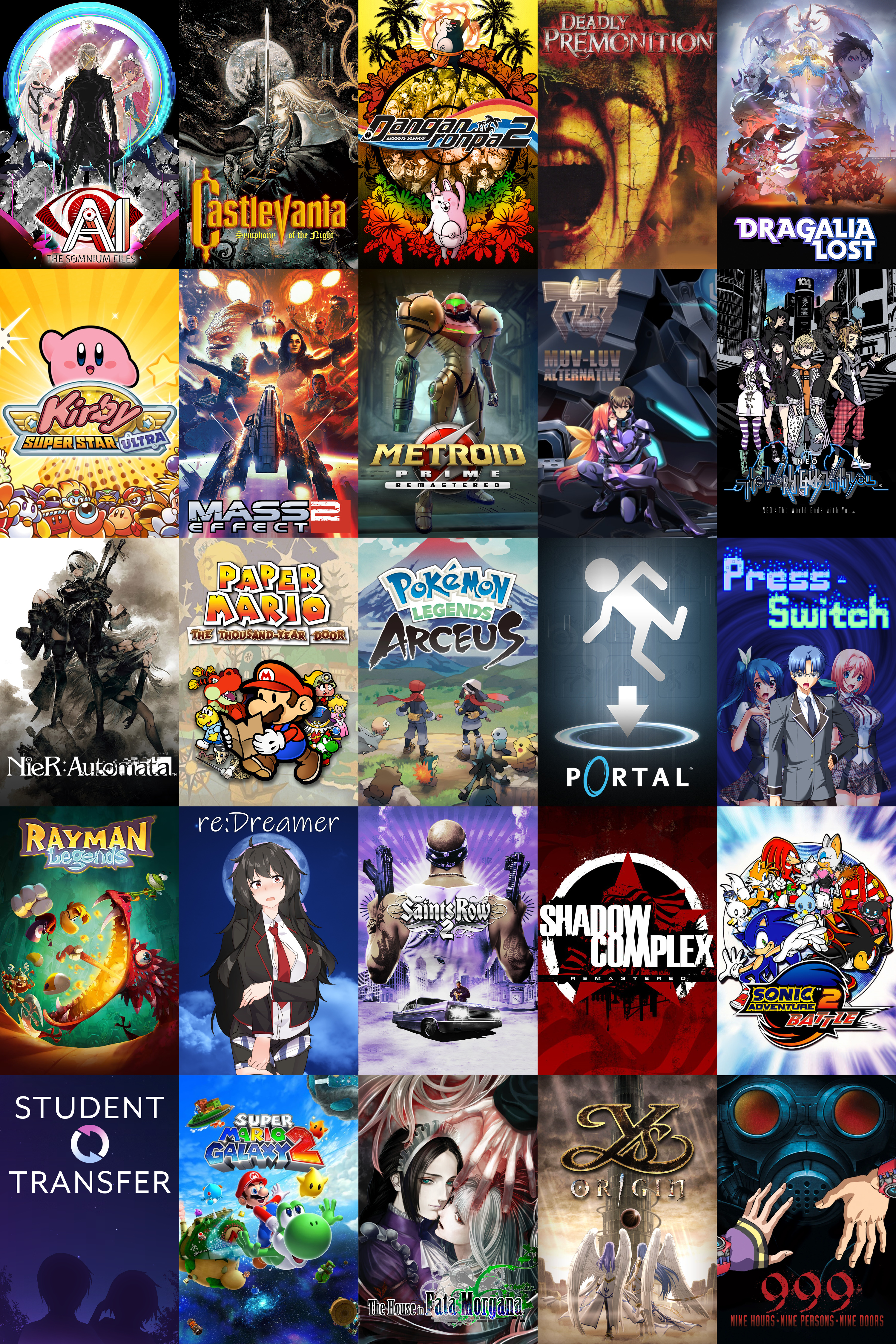
I like games where I, as a player, can achieve things while playing, and make considerable progress by clearing things, collecting things, and accumulating bigger numbers. It’s part of the reason why my top 25 list looks the way it does. Because Metroidvanias and RPGs are very progress-oriented games and visual novels… are about reading a story, so of course they are games all about progress! Why do you read a story? You wanna see what happens!
However, viewing progression systems in a more extreme context, I feel as if this approach to game design is far more easy to exploit than one focused on more static experiences. It is the ability to add fluff, add grinding, add restrictions and limitations that prevent players from making progress or doing things. This has eroded countless games with mediocre bloat, but none have been as affected than the world of mobile games.
A landscape where every big moneymaker has a multidimensional progression system. Characters to collect, energy to amass, craftables to craft, and timers to sit through before one can progress. These are the cornerstones for entire genres at this point, and… they took something good and innocent and corrupted the hell out of it.
They are almost always overly opaque, incorporate randomization to deprive players of resources, and are often deceptive designed to waste players’ time to boost engagement. Whether it be saving up to get resources via weekly bonuses like in my beloved Dragalia Lost. Using the promise of progress to lure people back in like Pokémon TCG Pocket every day, or hour during certain events. Or presenting the player with a debilitating amount of stuff to do, when it is all just stuff to do for the sake of doing stuff, a la Animal Crossing: Pocket Camp.
It all leads to a certain argument that games that prioritize skill and mastery without these pesky progression systems are better. That they cut away the bullcrap and offer more raw, distilled experiences, and while I would not fully agree with that, there is indeed an art to a game that keeps things simple and focuses on a honed core experience. And if that is all they want to do, then I think that is fine.
However, mastery is not always something that a game should encourage or facilitate either. I know that difficulty or stringent requirements have shied me away from games, or degraded the experience for me. I do like to be proficient in games, but mastery really holds no appeal to me. Mostly because… I know my limits. And these limits tend to only show up in experiences with low tolerances of error.
In short, I have a slight motor skill deficiency, some slight visual issues in recognizing things in motion. Nothing severe enough to be diagnosed, remedied, or hold me back in daily life, but I definitely have felt it crop up in a few games over the years, and it tends to just ruin my affection for the game. See my Celeste review for an example of that exact thing happening.
Also, if I wanted to feel a sense of accomplishment in honing a skill, I would focus on developing a skill that would more directly benefit me. I would start up my CPA exam review program for the first time in nearly 5 years. I would take a more serious look at my writing and try to assess and address the common pitfalls I encounter. Learn a foreign language I will only need to use if the United States breaks international law by deporting US born citizens with no ties to any other nation. Important shit.
I guess the point I am trying to wrangle together at 2:20 in the morning is ultimately just another opinion more than anything. While games that focus on mastery might seem like more pure and skill driven experiences, that is something that really does not gel as well with me unless the ‘skill check’ is at a level I can readily clear. Because if not, I will just grow embittered toward a game for telling me to do something beyond my abilities. Whether they be my physical abilities, or the confused helplessness of being presented choices when there is no good or clear way for me to overcome something. But if a game has a strong progression fixation, there’s always the option to grind and amass more stuff.
Akumako: “TL;DR, Natalie’s a salty bitch when she can’t do something in a game and has real bad skill issues.”
Sorry for being slightly disabled, I guess. …God, gaming is going to suck when my hereditary arthritis kicks in. Thanks parents. Not like my entire life is built around the use of my fingers or anything.
Natalie Complains About Falcom’s Localization Practices
(Ys X: Proud Nordics Announced, Trails in the Sky 1st Global Launch Confirmed)

So, Falcom had some manner of event this past week and had some announcements to make, two of them being a bit odd and noteworthy. The first of which is an upgraded and enhanced version of the 2023 title, Ys X: Nordics, dubbed Ys X: Proud Nordics. A release that promises to feature an additional storyline and setting, Aland Island, along with various upgrades and improvements over the original release. So… basically the same game, but with a new expansion baked in.
This is a rather strange arrangement where the best parallel is likely Atlus joints like Persona 5: Royal (2019) or Shin Megami Tensei V: Vengeance (2024). Because even though this could just be DLC, they’ll make more money if they release a new disc/cart copy and pair it with enthusiast bonuses.
Now, I am of two minds about this. On one hand, I played the demo of Ys X: Nordics for about 8 hours, and thought it was a bangin’ ass Vita game. A term that I use out of both love and criticism. Because while the game looks very good in many respects, it also feels like a remastered version of a game from a decade ago, with water effects from the PS2 era. Maybe even earlier. I mean, this is a game all about traveling on boats, and the water looks worse than it did in the 2003 Pirates of the Caribbean game!
As such, I am open to revisions and improvements… but I also doubt they are going to focus on that, and will, by and large, add things rather than improve them. I understand why they are doing this. Falcom, despite being an OG diehard developer, is still a pretty darn small company whose games are still pretty darn niche. To fund projects, they need to get as much money out of them as they can.
Though, I would argue that a great way to do that would be to take more of their operations in house and clean up their global releases.
Throughout the 2010s, the several month-long gaps between Japanese and western game releases began to close as technological and organization advances made simultaneous releases possible. Major Japanese publishers began pairing up with their western branches, finalizing scripts, and narrowing the release window. Which, in a globally connected world, goes to increase anticipation of games, encourages more pre-orders, and helps games do better overall while decreasing the amount of resources spent on marketing. Because you can just use the same marketing for worldwide releases.
Now, this approach has technical and logistical challenges and requires scripts to be finalized in advance, but it ultimately works and I think any sizable, established, Japanese publisher not doing this is a damn fool. It still surprises me that Idea Factory and Nippon Ichi Software cannot seem to get tent pole releases out in both Japan and the west at the same time, without a six month gap for localization. When both publishers have had western branches for over a decade. Meanwhile, Spike Chunsoft, who only established a western branch in 2017, is able to launch releases day-in-date or with shorter delays. …Except for games developed by Mages, because Spike Chunsoft does not own Mages.
With Falcom however, the gap between their releases has never gotten better, due to how text-heavy and lore-rich its games are. They put out a game about every year, barring re-whatevers, but it now takes over a year to get them out. Hell, Trails Through Daybreak II came out in September 2022 and publisher NISA still hasn’t gotten it out in English. That is such a large delay, I wouldn’t be surprised if the western communities for the game have built a spoiler wall. And this could have been avoided if Falcom was more agile with their development and targeted global markets.
Which could have been the case if they just established an international subsidiary. Yes, that would be an expense, but if they did things well or competently enough, they could have cut back on expenses and increased their overall profit. And it’s not like that would be impossible. Falcom is a big boy publicly traded company that makes millions in profit every year! If they just wrote things first, and handed off the script to the localizers, they could sell more games, which means more fans, which means more recurring revenue. It just frustrates me when I see companies delivering quality games who botch the releases with these unoptimized release plans.
…Gosh, that went on longer than expected. Next piece of news! Well, Falcom released a new trailer for Trails in the Sky 1st Chapter, a remake of the 2004 title that defined modern Falcom. Nothing special… except for the reveal that it will be released globally in fall 2025, with the western release being handled by… GungHo?
Yes, the publisher who is primarily known for Ragnarok Online, Puzzle & Dragons, and various online only games. A publisher whose only major console releases in the past decade were Grasshopper’s Let It Die (2016), HD re-releases of Grandia and Grandia II, and the upcoming Lunar Remastered Collection. They are not a big localization studio, and I’m surprised to see them chosen, when the original title was published by Xseed and became one of their biggest successes… before The Last Story (2011) in 2012. And if it wasn’t going to be an NISA production, I’d imagine that publishing duties would go back to Xseed.
However, the two studios had a falling out sometime in 2017 or 2018 when the publishing rights to Ys and Kiseki were handed over to NIS America, and they have been bad about re-releases ever since. I mean, they still have not released the 2021 Switch ports of the first Trails of Cold Steel games outside of Japan. And Ys Memoire: The Oath in Felghana, a remaster of a 2010 game that Xseed localized in six months, has an eight month gap between its Japanese and English releases. When, ideally, they just need to take the original translation files, rejigger them to the new release, make some new HD graphics for text, submit it for ratings and certification, and release the darn thing.
I understand that there are reasons, complications, and challenges with releasing games like this, but I also view this as a result of managerial incompetence. And if there is something I viciously dislike, it’s managerial incompetence. I deal with that enough in my day job…
…Anyway, I hope GungHo and Falcom find a good working relationship together, because I want Falcom to succeed and grow, rather than wallow in deeper and deeper obscurity. They are one of the few remaining game developers who do things the ‘old way’, manage to deliver these deeply robust RPGs every year, and make a profit while only selling a relative pittance. So anything that keeps them strong is good in my book.
…OH SHIT! The following day, they also announced that they are putting out Ys vs. Trails in the Sky: Alternative Saga on PS4, PS5, Switch, and PC via refint/games! Now I am extra confused, but also kind of thrilled! Because this shows that Falcom is basically willing to give their games to anybody who asks, which is both good and bad, and this kind of completes the list of desired games they put out for Japanese audiences in the 2000s that were never localized.
Sure, they still have Rinne (2005), which was part of the Relic series by Bothtec, and I could just be making all of this up and you would have no good way of knowing without MobyGames. Dinosaur Resurrection (2002), a dinosaur blobber RPG that I KNOW I have seen somewhere before. VM Japan (2002), which is a… uh… I don’t even know. And a re-release of Sorcerian (1987), which they ported to Switch, but only in Japan!
…Gosh, Falcom really needs to produce a proper Dragon Slayer Classic Collection with interviews and the like. Because the original developers and founders of Falcom are so old that they are just dying. Masayuki Kato passed away this past week at age 78, and who knows how much knowledge of Falcom’s legendary and influential 80s hits were lost with him.
…But anyway, it’s cool that a PSP crossover arena fighting game based on two series is indeed coming out, and not just via a fan translation.
Sony X Kadokawa Business Alliance Announced
(Better Than An Acquisition!)

Last month, the business world published that Sony was interested in purchasing Kadokawa, an 80-year-old juggernaut of a Japanese company with a truly extensive back catalog of IP. And they also own the guys who made Elden Ring (2022), I guess. This was allegedly in response to an attempted takeover by Korean company Kakao, and while I was not a fan of Sony being the owner of Kadokawa, it seemed like a preferable scenario. Especially in the eyes of the Japanese government.
I am used to these things taking months if not years to pan out, but then at 2:00 in the morning on Thursday, I read that they reached a conclusion. Rather than buying a controlling share in Kadokawa, Sony instead reached an agreement to become one of Kadokawa’s largest shareholders. On January 7, 2025, Sony will purchase 12,054,100 newly issued shares by Kadokawa, which will increase Sony’s existing 2.01% of ownership of Kadokawa to 9.68%. Thus making them the third largest shareholder of the company, after Samsung and The Master Trust Bank of Japan, Ltd. This will all be done for the low, low price of 49,976,298,600 yen, or $316,945,587.66 USD. Money that Kadokawa will use to create more IP and distribute it across the world. Because that’s kind of their whole company.
This new stock purchase will be paired with a new “strategic capital and business alliance” which just means the companies will work together more closely so they can make more money. The exact details are beyond the scope of this announcement, and likely still being worked on in backroom deals and bars across Tokyo. But I can safely say that many of these will not strictly be related to video games. While gaming is a key pillar for Kadokawa, and their most profitable one by far, it is not even close to all they do. And Sony’s gaming division only represented roughly a third of their total revenues, and a sixth of their profit. So a lot of this is likely going to result in collaborations between Kadokawa and Sony Music and Pictures. (Sony lumps in their anime ventures with the American film studio Sony Pictures. While Sony Music is both an American and Japanese juggernaut.)
At the very least, this should lead to Sony getting more involved in game development based on Kadokawa IP and featuring them in more marketing materials. They won’t be able to outright direct, approve, or cancel projects, but there will likely be a Sony guy attending more meetings and more Sony money being shuffled around to make things happen.

Also, side note, but there’s something strange going on with the reporting of this story. Sony released a press release saying that Sony would own approximately 10% of the shares, when I’d say 9.68% is a bit short of that, and that Sony will be the largest shareholder. But Kadokawa published a more detailed notice showing the exact figures of the owners and that two shareholders are higher than Sony. I’m going with Kadokawa’s information here, as it seems far more official and like something that was filed with a government body. But the fact there is any discrepancy between these two sources is weird.
Also, while this idea sounds good on paper, I just saw a story from Bloomberg that paints a pretty bad light on Crunchyroll, Sony’s big international anime branch. I have heard only bad things about Crunchyroll over the past few years. While, to me, this looks like a call to inject the company with cash and well fitting staff to course correct and improve the quality of their offerings, I doubt Sony corporate would really see it that way.
Progress Report 2024-12-22

God, I am so tired of rushing to these year-end goals. I am going to just need to spend a few days playing video games during the time of festival. In the meantime, enjoy these tasteless abominations I created for my friends.


2024-12-15: Edited 18,300 words of The Wotch showcase. Wanted to do it all in one day, but I had to watch Birdy The Mighty Decode with Cassie and visit my grandmother again for dinner, which took 2+ hours.
2024-12-16: Wrapped editing on The Wotch showcase and revised a bit of the ending. Then it was time to grab screenshots for the review… and by CyberFront Korea, this thing is the most image dense post I will ever release, with over 100 screen grabs. Get rekt Metamorphosis. You legit inspired the entirety of TSF Showcase. Just like Atop the Fourth Wall and Ross’s Game Dungeon.
2024-12-17: Got distracted by Pokémon TCG Pocket— I’ll uninstall this game in February, after the trading update, I promise. I re-read the comic for TSF Showcase 2024-51 and wrote 3,500 words for it. Wanted to get a bit more than that done, but I should be able to get this 100% done by Friday. So that’s goody-good!
2024-12-18: Wrote 4,400 words for TSF Showcase 2024-51, wrapping up the draft, but rather than start editing or grabbing images, I decided to make the header for this week’s header, just using the same base but having Fatalie gobble up some new food friends via polar inversion. Also, I got distracted by challenge quests in Pocket and making abominations for Cassie and Shiba. Got 1,000 words into the roguelike segment before I started dozing off. Then added another 400 words because fuck it, it’s done.
2024-12-19: Worked from like 14:00 to 21:30 today with an extra hour or two in between. Edited this Fundown, wrote 1,700 words for the final segments. Did some stuff for the TSF Showcase headed and got 1,000 words in before I realized it was bed time. I got some Rain in my DMs and got distracted!
2024-12-20: Wrapped up TSF Showcase 2024-51, finishing the editing and grabbing 40 screenshots, full of Akumako face edits. Also started work on the 2024 Ramble. The first main section was wrapped up, maybe, at 2,770 words.
2024-12-21: My damn boss slept through a 2 PM meeting and I wound up working until 22:30, while taking a break for dishes. And I had my chores in the morning. Wrote 1,300 words for the Ramble. I was also dead tired after staying up too late last night, so I decided to work until 1:30 in the morning after I realized Koinly wasn’t recognizing some transactions. as if dealing with a 64k transaction dataset wasn’t bad enough… And Koinly apparently only bills you per transaction if the transactions are billable… So the client pay hundreds of dollars more than he needed to. MOTHERFUCKER! Not my fault though… How was I supposed to know he had 10k in junk transactions?
I made one of those top 10 games list a number of years ago, and mine haven’t really changed much in years. Of course, my list also makes it painfully obvious which era of gaming I grew up in. Anyway, https://www.deviantart.com/nixaff4/art/LightsolPhoenix-s-Top-10-Games-Meme-292688174 .
As for physical abilities holding one back, I know what you mean; I’ve been playing Guitar Hero-likes for two decades now, but thanks to my extreme ADHD, I’ll never be able to advance to Expert. Moving my hands to hit the buttons the way they need to be hit in the higher levels just isn’t something my brain can do, and I knew that years ago.
That list is very emblematic of an era, and a bit isolated in terms of genre but if those are the games you grew up with, then it makes complete sense. ^^
As neurodivergences continue to be recognized and the gaming audience continues to grow older, I hope accessibility will be a greater priority and more reflex-driven challenges will be relegated as options. We kind of see that now, but there is not yet any true standard and the applications are uneven.
on rogueliXes: as the sort of snob that knows and uses the term “roguelixe”, my opinion is that *any* sort of gameplay meta-unlock leads to a situation where you struggle through a worse game in an effort to actually start playing the real game
unfortunately, simultaneously being the type of non-snob who can enjoy things like “real time roguelixes” there are very few people who care to categorize for me
Categorization is a mess, and roguelike is generally just seen as a mode or method that can be attached to any genre imaginable. I mean, is God of War 5: Ragnarok a roguelike because of its post-launch update? Or is it just an element of Ragnarok’s gumbo-like mesh of genres? And when does something stop being an element? :P
have you made a mini review or something on the tcg mobile app?
Yep! https://natalie.tf/2024/11/07/auto-draft/#natalie-rambles-about-pokemon-tcg-pocket-this-poison-takes-like-fruit-punch
But I hope to have a real review of the game come out when trading is implemented. I am shooting for a review on February 12, 2025.