

This Week’s Topics:
- Rundown Preamble Ramble: Acknowledge All of Gaming History!
- Metrics 4 Gamers (Gimme All The Sales Data!)
- Oops! An Unhinged Rant About Controllers (The Astro Bot Mind Virus Strikes Again!)
- Level-5 Is Still Alive(?) (TGS Rundown Part 1)
- Inazuma Eleven RE(make) Announced (Also Victory Road Looks DOPE!)
- More like Yok-AI Watch! (Yo-Kai Watch Next: Holy Horror Mansion Announced)
- Let’s Play Down State of Play! (TGS Rundown Part 2)
- Bring Back ALL The Great 90s RPGs! (Lunar Remastered Collection Announced)
- The Legacy Must Be Retold! (Legacy of Kain 1 & 2 Remastered Announced)
- Look Into The Horizon And See… A Pretty Game (Horizon I: Zero Dawn Remastered Announced)
- That’s Not Ghost of Two-shima! (Ghost of Yotei Announced)
- Behavior Gets Their Hooks In Another One! (Behavior Interactive Acquires Red Hook Studios)
- Every Day I Wish For The Live Service Industry’s Collapse… (Persona 5: The Phantom X is Coming to Japan)
- Classic Dungeons Are The Best Dungeons (Cladun X3 Announced)
- I Got Bamboozled by a Surprise Launch! (I’ll Review Class of ’09: The Flip Side Next Month)
Rundown Preamble Ramble:
Acknowledge All of Gaming History!
Something that frustrates me is how much of my understanding of gaming and its history is based on a rather narrow sliver of something far, far larger. In the Anglosphere, so many gaming history discussions and recollections are based on the North American console games industry. What games were most impactful and important, what games shaped history, and what platforms are worth remembering? It’s something I regularly see regurgitated or referenced in my daily purusings, yet it frustrates me. This is such a narrow sliver that ignores so many games and systems that all had their place in shaping the medium of gaming.
Now is where one might go on to talk about obscure Japanese-only games for enigmatic treasure troves of systems, like the PlayStation 1. But I’m not Sean Seanson— though you should check him out. He approaches obscure games with an open mind, a strong desire to love and appreciate them, and is both informative and personable in his delivery. Instead, what I’m talking about is more systems and their libraries, rather than individual games.
Pretty much every recounting of gaming history follows the same general set of major consoles. Atari VCS/2600, NES, GameBoy, Sega Mega Drive Genesis, Super Nintendo, PlayStation, N64, Saturn, Dreamcast, PS2, Xbox, GameCube, GameBoy Advance, Nintendo DS, PSP— Actually, scratch the PSP. (I love it, but it has a weird legacy.) This covers the hits… but they are ignoring thousands of games for dozens of systems, many of which sold millions of units.
European PCs like the Commodore 64, ZX Spectrum, and Amiga were home to thousands of unique games that hit various markets around the world. Yet there do not seem to be many big lessons or takeaways from this era, and the only people who remain interested in them are… those who grew up with them. Sure, the later one goes back in the life of these consoles, the more unique and interesting games appear. Such as Shadow of the Beast (1989) and Another World (1991). But even people deeply invested in the medium probably haven’t loaded up a Commodore emulator to check out something. Hell, I only know what I know about Commodore games thanks to old weirdos like Guru Larry and Ross Scott.
Despite being largely ignored next to the NES, the Sega Master System was actually a pretty successful system. But not in Japan, where it was made, or in America, where the culture hatched. Instead, it did incredibly well in Europe and Brazil. It does have some facsimile of a broader legacy due to series like Alex Kidd, Wonder Boy, Shinobi, Phantasy Star, or Fantasy Zone, but Sega has been very hesitant to capitalize on any form of nostalgia for the system. They are more inclined to reference the Game Gear— basically a portable Master System with screen crunch, when that was not drastically more successful… except for in Japan and America.
Between scattered collections and the Wii Virtual Console… I think that only 19 unique Master System games have been released, outside of Brazil, in the past 25 years. And this system saw over 317 game releases. …Most of which were only ever released in one region. …Maybe that’s why Sega never tried to re-release most of these games. Only 84 games came out in Japan, and only 62 of those were released internationally.
As for why Sega never bothered doing anything with the games released for the SG-1000, a 1983 console that only came out in Japan, Australia, and New Zealand, the answer is simple. It only had 80 games, only 20 were released internationally, and most of its games were just arcade ports. Nobody really cares about it. Not even Sega oldheads, because it predated them, so that avenue is just down the pooper, I guess.
Okay, okay, but I am just warming up, because there was an entire era where the console market was in a veritable clusterfuck. Everybody was throwing their hats in the ring and burning money like it’s 1923 in the Weimar Republic.
From… 1989 to 1996, there was just a downright disgusting amount of systems on the market, all vying to get rich and become the next big thing. And I don’t think people realize all the crap that was released during this era, how badly so much of it did, and how many games were actually released during that era. It really builds the case that there has always been a bombardment of games coming out all the time, rather than the idea that releases were ever sparse. You just had to look at all the systems and all the regions!
In fact, here’s a basic table of game consoles that would have been relevant during this era, just to really let the sheer numbers sink in.

This is not a complete list, just a collection of some of them. And not even more important ones like the Dendy. Because… it’s not an original piece of hardware, I guess?
From this, my next question is… why have so many of these games just fallen into utter obscurity. Now, the real answer is that nobody cares about these games beyond retro computer dorks and there is no money to be found in catering to them. Nothing a big company could do would be better than ROMs and emulation. From a broader historical perspective, they were just blips on the radar, not major players. And, most importantly, not relevant to the lives of the White early Millennials and Late Gen Xers who have shaped English Gaming Culture. …Is contemporary culture more defined by language than nationality? Eh, we’re getting there. That would explain why so many Europeans are turning toward Next Gen Naziism.
As such, these libraries and systems are just kind of thrown by the wayside, really only sought out by true lovers of the obscure and those willing to make prolonged voyages into assorted gulags. All in an attempt to gain historical knowledge and experiences that were not experienced by many, especially not in the past few years. …And play games that would have gone on to influence game developers. Because if there was any group who was buying every new system, it was game developers.
Going through some of these libraries is an idea I have floated around in the past, but, well, cue THE LIST.

And think about how many games I have been reviewing as of late…
Akumako: “Yeah, this bitch doesn’t play games anymore. But she sure knows a lot about ’em! She could have learned anything, but she chose to learn this!”
Yep! I screwed up my opportunity to get into science, programming, and other shit, became a tax accountant because it was easy, and spent way too much of my mental resources on this malarkey. I love it so much that I even tried rambling about every item on this list before going to bed and realizing… that was a mistake!
Akumako: “So, you gonna just post the rest of it or what?”
…Yeah. What can I say? I am without shame!
There is a lot of obscure stuff to love from this era, but the one system that always stands out to me is the PC Engine, aka TurboGrafx16. It was, by all accounts, a super successful console, and home to some highly influential titles. The original Tokimeki Memorial (1994), Castlevania: Rondo of Blood (1993), a lot of beloved Shooting Games (whatever that means), and an entire era of bomb-ass anime RPGs. Seriously, there were just SO MANY of these games, and they all look insane. CD audio, voice acting, colorful anime cutscenes, just constant wild shit.
However, the system’s background is also super complex. It was brought over to America, but was terribly marketed, only focusing on major cities, and pushed Bonk far too hard as a mascot. And the game library? Of its 673 game library, only 138 games came out in America. Oh, but that number is slightly misleading, as the PC Engine is the only console I can think of where more games came out for its add-ons than the main system. Way more than for the Diskun…
When it launched, the system used HuCards, a credit card sized proprietary storage technology that I think looked cooler than cartridges. But only 295 games were released for HuCards, while the remaining 378 were released on CDs via the 1988 CD-ROM² add-on. …What, you thought the Sega Mega CD was the first CD add-on for a console? Nope! That was just a copy of the PC Engine, whose CD add-on was so successful it got two upgrades over its life.
The original CD-ROM² only had 64 KB of buffer RAM, but its capabilities were expanded with RAM cards released during the system’s life. The 256 KB Super System Card released in 1991 and the 2 MB Arcade Card Pro released in 1994. Meaning that this thing… really was just like the Mega Drive. People like to point out how the Sega CD and 32X add-ons were life support, but they didn’t get the idea from nowhere. …I’d make a jab about the 32X, but I don’t think I need to. Everybody knows it was a bad idea, and the SMDG (1988) would have been just fine without it.
Akumako: “SMDG (1988)… Sega Mega Drive Genesis, originally released in 1988. …Why are you like this?”
Piss off, voice in my head!
Anyway, 107 games were released for the regular 64 KB CD-ROM², 244 for the 256 KB Super CD-ROM², and 27 released for the excessive 2 MB Arcade CD-ROM². That is a downright excessive number of games, and most of them have just been left to rot. …Though, I can’t say that preservation efforts haven’t been made. Konami released the PC Engine Mini in 2020, featuring a total of 60 titles. Collections for series like Valis and Cosmic Fantasy have repackaged games like this for modern systems. And 119 games were released on the Japanese Wii virtual console. That’s a lot!
The PC Engine also had two failed successors. The PC Engine SuperGrafx, released in Japan in December 1989. It was rushed to market, software was not ready for it, and the system only wound up with a library of five titles and lifetime sales around 75,000. It was a disaster and was promptly written off as a failure.
And on December 23, 1994— a mere 20 days after the launch of the PlayStation and a month after the Sega Saturn, the PC-FX was released and cost a brisk ¥49,800. …¥5,000 more than the Sega Saturn, and for… what? A console with a library of 62 titles, no 3D capabilities, and games that looked somewhere between upgraded PC Engine games and early 2D titles for the PS1? It, somehow, lasted until 1998 and sold 300,000 units. Which might sound like nothing, but… it absolutely is. Just skimming through one of those ‘every game released for X’ videos shows a number of titles that people put a lot of time and effort into. While they might be weird, niche, or based on wackass anime, that’s what makes them cool and interesting.
Oh, but if anybody ever wanted to position NEC as an important figure in the world of Japanese gaming, they cannot ignore the importance of their PCs. I shouldn’t need to introduce the PC-98 or PC-88 at this point. Screenshots from games in the series have gone viral time and time again, and its aesthetics are evident just by looking at them. Sadly, most of the games are only in Japanese, and no major efforts have been made to preserve them beyond emulation. Side note, but if you want to play a PC-98 game without futzing with emulators, there’s a website where you can emulate a few dozen PC-98 games in your browser, The Asenheim Project, and it’s pretty sweet. Thanks for the info ShadohFyre, and the grab bag of adventure-length random-ass game reviews of titles like the super influential EVE: Burst Error (1995). Which was actually given a localization in 2000, and spawned the stupidest timeline of any game series ever made.

Hell, Japanese PC gaming from the pre-Windows era is a potential gold mine of experiences, as a lot of developers developed games on computers, and played games on them too. And there were so many different types of Japanese computers around at the time. The pre-Windows 95 days were terrible like that. The MSX had its heyday from 1983 to 1993 and saw over 1,000 games. 1981’s PC-88 had 494. 1982’s PC-98 had 1,228. The Sharp X6800, which ran from 1987 to 1996, had 823 games. And FM Towns, 1989 to 1997, had 638 games.
However, the most insane thing about any of them is the fact that FM Towns computer got a console spin-off. 1993’s FM Towns Marty was the first 32-bit system to hit the market, backwards compatible with some existing FM Towns games, had a CD drive, an NES style controller, and a ¥98,000 price tag. It sold about 45,000 copies and had two revisions before being discontinued in 1995. As for what remarkable games the system had… I’m also not sure, but a lot of it was enhanced ports from other systems that made use of the system’s power and CD capabilities. Like the surprisingly good Ultima ports.
…Shit, I forgot to count all of the DOS, Apple II, Atari, and American computer games released for the relevant machines. Screw it, not going back. That list already took WAY too long to make!
The sheer potential significance of this era of gaming is very hard to grasp. And while most of the important titles have been cataloged and highlighted by intrepid adventurers, I keep thinking that there has to be things that were missed. Because who the hell is going to go through hundreds of games and only select the most important ones?
That being said… There are definitely systems on this list that I think are largely unremarkable and not quite worth much examination.
The CD-i, released in 1990 and discontinued in 1998, is a console known mostly for its technically licensed Nintendo games that were a foundational element of internet humor during the 2010s. Well, there were a total of 208 games for the thing, and… I don’t think any of them are particularly great. The system was designed for multimedia before games, and pretty much every game I saw was either very basic and a far cry from other titles on the market at the time, or a port of a PC game. And not a great one. I cannot think of a CD-i game that is best on the system as… even the port of Ms. Pac-Man (1982) just looks deeply wrong to me on some level. Still, it sold a million units and got a bunch of revisions by other companies who released the thing internationally, so… that’s something. And it also got a portable version with a built-in LCD screen in 1991. …That’s more than something!
Then there were massive failures from Commodore trying to enter the console market with their overpriced European exclusive CD-based consoles, the Commodore CDTV in 1991 and the Amiga CD32 in 1993. The CDTV failed to sell 50,000 units but got 62 games and the CD32 only sold 100,000 but saw 148 games. For systems that bombed this hard, that’s a lot of games, but like Commodore and Amiga games in general, it is considered a European thang. Except even worse because so few people owned it and it seemingly lacks the exclusive library needed to make a console seem worthwhile. Maybe some of them were better, but it’s hard for me to say.
The ill-fated Jaguar only ever had 63 games, the library has been examined by the curious time and time again, and the results are… pretty clear. It was a screwed up system, maybe had some potential, but a lot of games are just ports and there are precious few worthwhile titles, like Alien vs Predator (Jaguar) and Tempest 2000 (1994). Also, I want to add that the Atari Jaguar could have done really well, as it amassed 2.5 million pre-orders in Europe, but they could not manufacture enough to meet demand, so the system just DIED.
…Okay, that’s about enough for an intro. Video game history is wild, yo, and I’m never gonna fully understand the medium for as long as I live. Which is gonna be… until my body craps out on me with arthritis and shit. I wouldn’t want to kill myself right away— I’d get married to someone for at least a year so they can get my social security. I would aim for someone far younger so they could get more benefits when I die, but the SSA saw through my plans to benefit others.
Akumako: “…Wait, what, you planned on marrying someone a generation younger than yourself?”
Purely for financial reasons. I’d make it a point to never see them naked and sleep in different bedrooms.
Akumako: “Such a weirdo…”
…Also, support Project EGG, because they are porting old Japanese PC games for Switch and including tools for English speakers to play them. They also release games for PC, but I could not figure out the Japanese interface and it kept asking me to pay a subscription.
Metrics 4 Gamers
(Gimme All The Sales Data!)

Gaming enthusiasts love numbers. As they should, because games are mostly made of them. But what they love more than numbers are metrics. It genuinely is no surprise that video game nerds love collecting data considering what freaks like them do for fun. Give them scores, like with Metacritic and Steam ratings and they will flaunt that as a shorthand for the game’s quality. Give them the ability to measure the number of people playing any given game at a time and they will manufacture news out of it, often for the sake of basic rage bait or narrative forming. ‘Can you believe that a single-player 10-hour-long game lost 80% of its players in a month? It must’ve bombed and been terrible.’ Gosh, I cannot even mock them without exploiting the obvious holes in their logic.
However, there are three metrics that I have been thinking of every day for the past week. Units sold, total product revenue, and project budgets. The devout gaming audience LOVES getting their hands on these figures, and… I love it too, because these are such succinct and juicy morsels of information. And it’s not even that unreasonable to want something like this.
Nearly every major film has a disclosed budget that is at least close enough to ballpark how much money was spent on the film (before marketing). Similarly, box office sales have been tracked for decades. And while exact numbers for sales are spotty across various industries and nations, with some of it being locked behind pricey paywalls, I know the data exists. Hell, VideoGamesEurope works with a lot of video game publishers to collect sales data… but they make you pay to access it. I actually requested access, saying I am a video game accountant, which is technically true, but they did not get back to me as of publishing this piece. If I get this power… I WILL abuse it for the Greater Good.
If game likers had these tools, there would be a broad expansion in their understanding of the scope, revenue, and profitability of games. …But would they be able to understand how to process this information? Or would people use this math as a tool for destruction, to spread outrage, anger, and highlight games as failures? People have had plenty of dumb takes from box office results. Most Anglophones do not know how to read a financial statement. And while I like to think everybody is rational, the loudest voices are sometimes the dumbest. If I ever needed an example of this, it would be how some people genuinely believed that Concord (2024) cost $400 million to produce because Colin Moriarty said it. (I thought that dude was iffy in 2014 and in the past decade, he’s only gotten less credible.)
…Wait, no, what am I saying? Loud and confidently wrong people will never go away, they will always find things to be wrong about, and communities should focus more on stifling their ability to be heard. Not their ability to misinterpret data.
Oops! An Unhinged Rant About Controllers
(The Astro Bot Mind Virus Strikes Again!)

So here’s a thing that just set me off in a nasty way. Prior to its release, there was a story going on where the director of Astro Bot (2024) mentioned the possibility of the game coming to PC. Saying that they wanted to hear from people to gauge what they want. I did not take this story as any sort of confirmation, but if the game were to come to PC, it would definitely go on my overly long wishlist and I’d buy it eventually.
This topic then came up on one of the sometimes-weekly podcasts of Liam Robertson, where Liam said that he does not think the game should come to PC because of the reliance on the DualSense controller’s feedback issues. Going so far as to suggest that they should require the use of one, while he and his co-host Dan bemoaned how someone would just find a workaround for such a restriction.
Now, I like Liam, as evidenced by how I’ve been backing him for years and listening to his podcasts since 2018 or something. He does excellent documentary work, mostly on canceled projects, and has made many meaningful contributions to the chronicling of gaming history. But I’m not going to specifically argue with him. He has the right to be wrong and shouldn’t care what some jagoff like me thinks.
However, I do find this stance to be… contentious, and for several reasons.
Firstly, Astro Bot can be and has been played by people without using a DualSense. PlayStation released an accessibility controller in 2023, and I guarantee that there are disabled people, including many disabled children, who could only experience this game through that controller. They did not use the DualSense, they did not experience the game in the way that the designers intended. They did not feel the feedback effects of this game. Because either they could not, or they find this to be more comfortable and usable. And that is not a bad thing.
Secondly, there are countless games that were made for specific controllers or display interfaces that have been brought to other platforms. If you ever played a port of a Wii game for Switch, ranging from Super Mario Galaxy to Skyward Sword, then you have experienced this. A game deliberately designed for a control scheme only to have that control scheme be relegated to a mere option. So what does that make these releases? A bastardization born from capitalist avarice and artistic disrespect? Or a way to make a piece of art that was locked behind old hardware available to a wider group of people?
Thirdly… I simply do not see rumble, force feedback, or anything of the sort to be a feature that truly and fully warrants the use of a specific input device. I turn it off whenever possible. I do not like how it feels in my hands. I do not like the buzzing of machinery. I have been spooked by a controller vibrating on my wooden desk enough that I probably developed an aversion to the whole damn concept. Device vibration generally does not agree with my personal autistic sensory preference profile, and I tend to prefer things to be static and quiet. Some people like loud mice and keyboards, I do not. I view rumble as an unwanted element that pulls me out of the game rather than sucks me into it.
As an aside, I also dislike gyro aiming. I’ve tried using it, but always immediately nope out of it, as it only ever inhibits me, rather than help me. When holding a controller, moving sticks and pressing buttons, I cannot keep the controller still without conscious effort. My grip wavers and tilts around in a way that makes precise aiming virtually impossible. It was an issue for me in 2018 when I first got a Switch, and it has only gotten worse over time.
There’s also an artistic intent argument to be hard with these things, but as a creator, as a writer, as a bootleg novelist, that defense sucks. As an artist, you do not have any control over how people interpret, experience, or enjoy your work. You put something out into the world and that’s it. You can say what you want, explain your goals, and people can choose to seek that out, not seek it out, or dismiss it. The artist’s intent should be considered when trying to do critical analysis of a work, but nobody should ever be beholden to an artist’s intent. And I think that artists who do get uppity about this are a bunch of pretentious twats. The sort of people who tell entire sections of their readers or fans to fuck off because the work was not made for them. Or bastards who deliberately make their work difficult to catalog or enjoy.
Generally, I think people should be allowed to play games using whatever input devices they prefer. Controllers, keyboard and mice, a custom touchpad, motion controls, a wackadoo hybrid setup, whatever, it’s all good in my book. I understand that can lead to suboptimal experiences due to them using the ‘unintended’ or ‘wrong’ controller method, but I do not care. People should be allowed to enjoy things however they want. …Also we live in a world where people use DK Bongos and Guitar Hero controllers on action games for fun. There is no sanctity to gaming input devices.
Level-5 Is Still Alive(?)
(TGS Rundown Part 1)
It’s TGS season, which has historically not been a great source of gaming news for about a decade. However, various publishers have elected to have showcases this week, so let’s get started! First with the on-again off-again hit maker, Level-5! Level-5 was such a trailblazer about 15 years ago, aiming to become the next Square Enix multimedia megahit producer. But after the initial success of Yo-Kai Watch, they just failed to maintain the same traction and so many of their big multimedia ventures had tepid results or just took WAY too long to come out. Hell, they even closed their international branch for a few years. Things were that bad.
When they made their big revival back in that February 2023 Nintendo Direct, I was hopeful. But since then, they have been keeping their heads down, and the only game they released was the third rendition of their giant robot game, Megaton Musashi. It got pretty good scores, but they just did not know how to get the word out about it. Both in the Anglosphere and… in Japan too, I guess. When it first released in Japan in 2021, it sold under 12,000 units in its first week, and its April 2024 repackaging/update didn’t even track in the Famitsu sales.
I hope they can finally get their groove back and find success in the modern market, but… I’ll believe it when I see it. Before getting into the meaty stuff though, I do want to comment on two previously announced games that got new trailers and significant updates.
Fantasy Life i: The Girl Who Steals Time was re-revealed and given a release window of April 2025, which is a far cry from its original December 2023 release date. Much like the prior Fantasy Lifes, the game is basically a combination of a basic overhead action RPG and a life sim a la Animal Crossing. Except this time it features a larger map, thereby making it “open world.” It looks like the sort of girthy, cozy adventure that some people allegedly adore on Switch. However, I still cannot get over how something looks off as the series transitions to HD.
It has something to do with the head size relative to the rest of their chibi bodies— they didn’t copy Animal Crossing’s perfect ratio and they should have. While the lighting the game uses to simulate a day/night cycle does not look right to me. It looks modern in some scenes, and like a Wii game running in HD in others. Combined with the vaseline smear on the top of the screen, this makes me wonder if the game went through some sort of visual rework at some point. …Or maybe game art directors are going kooky again.
Professor Layton 7: The New World of Steam was given its first proper in-game story trailer and first look into how the game will play. With the crux of the story being built around mysterious going-ons in the burgeoning American city of Steam Bison and the enigmatic ghostly entity known as… Gunman King Joe. The world is fully realized in 3D, but rather than being a place the player can walk around or explore. Things are still presented in terms of point and click adventure screens as Hershel and Luke travel between fixed points to find goodies, puzzles, and conversations.
My general impression is that this is aiming to be a more direct successor to the original six games, and I think that’s a fair approach to reestablish the series, if not the best. Personally, I think it would be best for the series to re-establish itself with a collection or standalone re-releases for Switch. …Just like Touch Detective! That would let new players get a taste of the series and help lapsed fans become regular fans again. However, that would be problematic for certain puzzles, and only half the main series was given HD touch-up for mobile so… I kinda get why they are starting fresh with a brand new game. Professor Layton 7: The New World of Steam will release worldwide in 2025, exclusively for Switch.
Inazuma Eleven RE(make) Announced
(Also Victory Road Looks DOPE!)
Inazuma Eleven is one of those series that I do not understand. As an all-American child, I never liked international football, and when my parents signed me up for a soccer club, I just wound up climbing trees instead. I don’t really get the appeal of the sport, and the games were not even released in America aside from when they ported the first DS game to 3DS in 2014, so heard jack about it. However, I do respect the original games as a series of football simulation RPGs with cute sprite work and flashy 3D cutscenes that really exemplify how well Level-5 understood the DS’s hardware.
So Level-5 opting to remake the game would be a sensible move. Perhaps as some sort of HD-2D art style, or something more in line with their upcoming reboot of the series. …Instead, they tried to do Grezzo’s chibi doll look but just screwed it up in such a gross way.
Inazuma Eleven (2008)’s remake, dubbed Inazuma Eleven RE, looks like it was specifically designed to annoy me. The game uses a hyper detailed world with textures that almost reminds me of a model train landscape, paired with an HD lighting system that casts everything in this stark, exaggerated, atomic sunshine. Every defined object is casting a dark shadow at all times, there’s a strong tinting effect on everything, no matter the time of day, and the character models… frustrate me.
They are these pudgy little doll creatures that look like they were designed for a very specific camera angle, one less overhead and more toward the ground. When the camera lowers in dialogue scenes, they look okay. When the camera raises for world traversal, they look off, being too stout and moving far too robotically. And then the camera assumes a bird’s eye view for the football matches… it would be preferable if you were controlling colored circles. The visual language of the game just makes it too hard to tell who is who.
Oh, but the worst part… is a toss up. It’s either the gameplay, which was always designed for fast-paced and precise stylus tapping, yet was replaced with this huge circle that seems cumbersome to use and imprecise. Or it is the fact that the 3D cutscenes that play out when soccer-boys do their specialty shots look… WAY better than the rest of the game and completely different. They are standard anime style models with the proportions of a young boy, and transform the lighting in order to make the models look better. Why the hell can’t the rest of the game look like this? Sure, it looks a bit more generic, but I think the developers know this looks better, because these cutscenes are supposed to be a visual highlight… and they still are.
I get that a new coat of paint is necessary for the series to succeed and remain relevant. But even if this wasn’t a remake, even if this was a new game in a new series, I would still think Inazuma Eleven RE looks ugly. It uses its 3D models poorly, slathers everything in excessive lighting in a way that just hurts the image, and sacrifices visual clarity for fidelity. Just comparing this to footage of the original game makes me upset. But you know what makes me more upset? The fact that Level-5 clearly knows better. They have known how to do the series in full 3D since Inazuma Eleven GO (2011). They have been showing how Inazuma Eleven can play with a controller and behind-the-back perspective since they showed off Inazuma Eleven Ares footage back in 2018. Hell, even that Yo-Kai Watch Jam thing pulled off this presentation style better. This was not a bumble, this was an artistic choice. …And this choice sucks ass!
Inazuma Eleven RE is slated to be released for PS4, PS5, Switch, and PC via Steam in 2026. But Level-5 cannot be trusted with release dates.
Inazuma Eleven RE looks bad, however, this remake is small potatoes next to the next step forward for the series, Inazuma Eleven: Victory Road. A game that was announced as Inazuma Eleven Ares way back in 2016 that has been subjected to constant delays and reinventions. It has been nearly a decade since it was announced, and I doubt many fans have faith in it. But looking at the latest trailer they put out, and my first actual look at the game… it seems like the ultimate Inazuma Eleven game.
Victory Road has its own elaborate story RPG mode, complete with a small explorable town and school, new characters, social sim elements, stats to raise, and anime cutscenes. A robust online competition mode that focuses just on the hot-blooded football action. A scenario replay mod that lets players replay the competitions and matches of every prior Inazuma Eleven game with every character, amounting to over 5,200 playable characters. I also think this means players can manipulate matches, mix and match teams, and fulfill whatever wild fanfic desires they might have. Then there is the Bond Town, a mode where the player creates their own OC, populates a town with their own buildings, and forms a dream team of Inazuma Eleven characters. Oh, and they can also visit other player’s towns in order to compete in matches or play mini-games together.
It seems like a wild game that Level-5 put everything into, and they don’t seem to be done wither, ending the trailer by saying that “Inazuma Eleven will evolve into a game that can be played infinitely.” And while I think that is a terrifying prospect for an online-only game, I think that it’s appropriate here. I can only hope that the core gameplay is fun, as it seems to be balancing various different modes. The game can be played at a ground-level, a basic yet readable bird’s-eye view, and a distant yet readable hybrid mode of some sort. A lot of terms are being thrown around, but it’s not all that clear which is which.
Inazuma Eleven: Victory Road is slated to be released for every darn platform imaginable. PS4, PS5, Switch, PC via Steam, iOS, and Android. But not Xbox Series, because that console may or may not have been released in Japan. Nobody knows! And it is supposed to release worldwide in June 2025, right before the end of the Q1 2026 fiscal year! I think it has some real potential, but whether or not it sticks the landing waits to be seen.
More like Yok-AI Watch!
(Yo-Kai Watch Next: Holy Horror Mansion Announced)
I really need a Japanese person to explain to me what the hell happened with Yo-Kai Watch. It went from a juggernaut in Japan, spanning highly polished games, a stream of anime series, and numerous spin-offs. It got several movies, a darker, more serious alternate universe to keep the kids who liked the original hooked, and an ambitious fourth entry for Switch and PS4. And then the series crashed and burned with Yo-kai Watch Jam: Yo-kai Academy Y (2020). A game that sold only 42,000 copies in its first year on the market. And I get why. Because what the hell is this overhead chibi school brawler? I know it is based on an anime, but… that just raises further questions. Like… they transform into yo-kai in the anime? What? Is this like the Digimon Frontier (2002) of the series?
Level-5 has tried to keep the series relevant with Yo-kai Watch: Reborn, an anime series that ran from 2021 to 2023. But I think the series effectively stopped when that and the manga series both wrapped up last year. Well, it stopped in Japan. In the west though, it’s been pretty dead for a good while.
While the series allegedly did alright in Europe, it did not do well in North America, due in large part to how delayed the releases were. Yo-kai Watch (2013) did not come out until late 2015. 2016 and 2017 were both dedicated to different versions of Yo-Kai Watch 2 (2014). And Yo-Kai Watch 3 (2016) came out in Q1 2019, when the 3DS had its last gasp of life. Yo-Kai Watch 4 (2019) was announced for an English release, but the odds of that ever happening are basically nil at this point. Just play the English fan translation instead. You can find it on your own!
Meanwhile, the anime series was not successful. I don’t think it even fully finished its second season. The English dub was recast due to budget cuts. And information on this is pretty spotty, as whoever was in charge of the dub was reordering things around for no good reason.
So, what’s a Level-5 to do? Re-release the original successful games on Switch? Well, they tried that in with the notorious Yo-Kai Watch 1 for Nintendo Switch (2019). It actually cleaned up every well, but it sold less than 10,000 copies in its first week. That’s no good! Hell, maybe that’s why they are against re-releases. Or maybe they should have just partnered with Nintendo to port these games to Switch as basic international ports, because the translation was already done.
Anyway, Yo-kai Watch is in a bad spot, so Level-5 plans on doing a low-key reboot of the series dubbed Holy Horror Mansion. A game about a rich kid named Ten Lordland who lives in a penthouse mansion suite on top of an extravagant apartment owned by his grandmother. In searching through a locked room, he finds a magical Spirit Camera that… causes his nose hair to become a green ghost. This ghost is capable of possessing and transforming everyday objects into yo-kai, but there are other ghosts Lordland finds that let him do other things. Such as a blue ghost that lets him combine objects into yo-kai chimeras, and a pink ghost that turns objects into their own worlds, such as turning a cake into a cake world.
With these ghosts, Lordland fights against corporate ‘bad apples’ who run the De Ville Corp and the… Darkarymen who are filling the world with monster items. Like a scale that sends his mother to the Shadow Realm (Hell). With his cameras and ghosts, he must uncover conspiracies and take down the bad capitalists, while retaining his personal, generational wealth because he’s a good rich.
Okay, I’m being too subtle about this. Who the hell thought it was a good idea to make the protagonist the rich heir to a landlord dynasty? You typically want the plucky young kids starring in these big shonen monster taming series to be relatable, average kids from humble backgrounds, or at least grounded backgrounds. But not only is this little twerp richer than you’ll ever be by age 10, but his name is 10-year-old Landlord. He is the one allowed to go on this magical journey with monster friends. You want to go on a journey with monster friends, little Gen Alpha kid? Fuck you! You’re too poor for that shit!
This is just a bad idea, and the fact that the creative team did not see this… speaks to a certain level of privilege. Amongst the working class, landlords are a bane, a disease, as they are people who profit off of the fact that other people need to live, routinely abuse their powers, and ignore their responsibilities. It is so common it is a cliche, and the very concept of rent is a capitalist scam meant to keep the poor in their place and allow the rich to harness passive income. Don’t get me wrong, passive income is dope! So dope that the governments of the developed world should give it to every citizen. A couple hundred dollars a month at the least.
Now, unlike cops, who should all be turned into literal pigs and eaten alive— because it hurts more— there is a way to be a good landlord. And that is to be a bad landlord who ‘undercharges’ people and maintains quality living conditions. Like many of the clients I do taxes for. ($18,000/yr, utilities included, for a two-bedroom townhouse in Hoffman Estates is cheap. Meanwhile, I live in a two-bedroom condo and my mortgage and assessments are $32,000/year.) But the overwhelming majority of people HATE landlords and dealing with their shit, so why on Earth would you make the protagonist a landlord brat?
Oh, but that’s not even the bad part. This trailer is one of the first big examples of a major games studio using generative AI in their trailers, and it does not look good (shocker, I know). It can be a bit hard to tell, because the English video quality isn’t great. But if you pause on almost any 2D background on the full resolution upload… you can see it. Though the worst example is when showing a city landscape and a shadowy eye of Souron tower in the middle. The way that buildings shift and shimmer, the fact the entire city background moves as the camera pans up, while the tower stays static, I thought it looked strange when watching the trailer casually, but looking at it closely… this is AI. No ifs, ands, or buts about it. Hell, it doesn’t even match the, possibly AI generated, shot of the Eye or Souron looking down at Lordland ten seconds later.
Now, it is no secret that Level-5 uses AI for certain things. There was an article about it in December 2023, showcasing a slideshow provided by Level-5 to the Japanese government, showing how they are using AI.
They use Stable Diffusion, a popular AI image generator tool, to experiment with layouts for things like title screens and logos, creating references for a human artist to use. To create images of 3D models based on 2D illustrations to see how they could or should look like when turned into a 3D model. And to fill in background elements, such as crowds. Which… Okay, fine. Drawing and modeling crowds is super intensive, and it’s all just noise next to the actual focus of the game. This is using AI to substitute visual noise.
They use SwinIR as an image upscaling tool, which works way worse than Waifu2x— which is NOT AI. It is machine learning and just a more sophisticated, intensive, version of resampling using an image editing program. A technology that has been around for decades.
They use GhatGPT to create character proposals, which I kinda get for spitballing purposes. However, I could make 30 200 word character bios in a day if need be. A 100 person dev team could probably deliver a thousand. And the end product is going to need to be reviewed anyway, so this seems… pointless?
They use VOICEVOX as a text-to-speech program to generate temporary audio that is later replaced with human voice actors, a fairly common industry practice and just practical. Game devs have been using placeholder audio for decades and this is easier than having random members of the dev team do placeholder voiceovers. Also, text-to-speech is OLD and not AI.
They use Github Copilot and Genie AI to generate code for them, polish game descriptions, and create websites. Things that… I’m inclined to say they are okay. AI code rarely works out of the box, and just replaces the well-trodden practice of programmers searching online for code they can copy. Descriptions are important and require careful wording, which programmers might not be adept at, so using AI as a grammar checker is just a supplemental tool. As for website generation… sure. There is an art to a good website, but most corporate game-specific websites are pretty basic, require a lot of routine busywork, and still need to be polished and assembled by a human being.
…But clearly this is not the full story, and they are now using AI for, at the very least, trailer assets and, most likely, in-game assets for a product they will sell for money. And… I simply do not agree with that.
I’ve said this before, but I view AI as something that should only ever be used as a tool to assist humans. You cannot trust its end product. It cannot be an artist and to even call AI images art is wrong. While it has its uses, it is also incredibly energy hungry and runs into the POW crypto problem of ‘this thing that has some value is ripping through fossil fuels like crazy.’ Use it for conceptual work. Use it to find things through the garbage search system of the internet. Use it for tasks humans cannot do. However, for the love of god, never include an AI export in a final product, because people will find the flaws and it makes everything else look suspect.
In conclusion, Holy Horror Mansion does not look very good. I think the landlord angle, ‘bad apples’ approach to capitalistic woes, and use of AI in the game’s reveal trailer are all big red flags for this project. Sure, there is some good animation work and artistry here. Humans clearly made the vast majority of this, and they did a good job. The ghost critters look neat, I like the whole Bugsnax (2020)-like monster making mechanic, and I can tell there is some vision here. But I consider the use of AI assets in a final product to be a form of theft… unless the database is fully licensed and ethically produced.
I said before that AI should be akin to those licensable sound samples and texture CDs that defined the look of many games during the early 3D era. If you buy a bunch of art assets, throw them into an internal AI, and then export things you are, as far as I am concerned, not stealing things from anyone. The problem is that every big AI company chose to not license or buy anything and instead took petabytes of data that its AI references and uses, without any form of compensation, credit, or consent. This means to use anything generated by an AI in a final product is to use something one does not have permission to use, because the permission simply cannot be granted.
I am not saying everyone needs permission to use something. If so, every single fanwork would be a problem. But to take something that was taken without permission, and an AI sift through it, and throw the output into a monetized product, without transforming it in some way? No. That is not okay. THIS is not okay. And because of this trailer, I simply cannot trust Level-5 as a developer.
Let’s Play Down State of Play!
(TGS Rundown Part 2)
After the surprise bummer of Level-5’s showcase, it’s time for Sony!
I have been on a bit of a tear in pooping on Sony as of late (1, 2, 3, 4), even when they have hallmark successes like Astro Bot (2024). However, contrary to how often Rundowns are more like Fundowns, I truly prefer praising something over criticizing it. I want everything to be good for as many people as possible, and I get upset when dysfunctional systems and managers prevent that from happening. Unfortunately, Sony had a lot of dysfunction this past month.
With that out of the way, let’s start with the small stuff before getting into the segment-worthy pieces!
A Stellar Blade X Nier Automata collaboration was announced for Stellar Blade (2024), a game that I mostly know for being part of some dumb ‘culture war’ nonsense. Right wingers tried to claim it to be their game because it featured a sexy woman with skin tight clothing. The game was from South Korea, one of the most sexist countries where women can vote. But relative to most other Korean developers, Shift Up also made Nikke, and if you know how to read, Nikke is pretty fuckin’ woke, as it is ultimately about respecting women as people. Still, I recognize it as a good game, a bit bloated and not always the most focused, but if that’s the worst thing about a studio’s first venture into AAA development, that’s pretty darn good.
The choice to collaborate with Nier Automata (2017) makes all the sense in the world. Not only was it a cited inspiration, but Nier Automata has been a common collaborator with other IPs, and manages to remain relevant despite being 7.5 years old. However, its ubiquity does make me concerned over the lack of a sequel or follow-up. Yes, series mastermind Yoko Taro has been busy with the 2021 remaster of Nier Replicant, the Voice of Cards trilogy, and a bunch of gacha games and spin-off media. However, I don’t get why Square Enix wouldn’t be eager to greenlight a sequel to one of their better performing console RPGs. …Or maybe they’re just worried that, without a developer like PlatinumGames, Nier 3’s not going to be a hit. And I think Square burned their bridge with Platinum after Babylon’s Fail (2022).
Palworld (2024) received a stealth drop on PS5 in a move that makes sense given the trajectory of the game, but feels a bit hubristic given the ongoing lawsuit by Nintendo. It’s something I mentioned last week, but I wanted to add that unless the discovery phase reveals clear examples of theft or plagiarism, two words that even smart people still don’t seem to understand. I’m certain that Pocket Pair will be punished, but I think it will just be a multi-million dollar fine and Palworld will still be available for sale. Nintendo does not intend on pulling the game from stores just for a patent violation. They are just doing this as a way to protect their IP, because they own some of the most valuable IP in the world. …Also, it seems that the PS5 version of Palworld is not coming out in Japan until further notice, due to the Nintendo lawsuit. Huh.
Sonic X Shadow Generations also got a spiffy new trailer that… further convinces me that this re-release of Generations with a 60-90 minute campaign attached. One that is good, yet not as good as the 2011 stages because of a lack of level designers, and features lore that really only appeals to diehard Sonic fans. Also, it’s getting some tie-in DLC with the upcoming Sonic the Hedgehog 3 movie featuring a new skin, Keanu Reeves VO for Shadow, and a Tokyo level. Which I think is remarkable, if only for a seconds-long snippet where Keanu-Shadow looks down at his body and remarks “I’ve taken on another form.” Yeah, there’s definitely some isekai TF lore going on with a line like that, and definitely not Shadow just TF-ing into a different version of himself.
…Part of me really wants to stream this game with Cassie, but I don’t think she’s all too fond of backseat gaming.
Bring Back ALL The Great 90s RPGs!
(Lunar Remastered Collection Announced)
Gosh, there are so many re-whatevers of beloved 20th century RPGs that have come out over the past few years.
- Suikoden I&II HD Remaster Gate Rune and Dunan Unification Wars (2025)
- Dragon Quest I & II & III HD-2D Remake (2024-2025)
- Romancing SaGa 2: Revenge of the Seven (2024)
- Super Mario RPG (2023)
- Star Ocean The Second Story R (2023)
- Tactics Ogre: Let Us Cling Together Reborn (2022)
- Live A Live (2022)
- Chrono Cross: The Radical Dreamers Edition (2022)
- Final Fantasy Pixel Remaster (2021-2022)
- SaGa Frontier Remastered (2021)
- Legend of Mana (2021)
- Trials of Mana (2020)
- Grandia HD Remaster (2019)
- Moon: RPG Remix Adventure (2019)
And probably a bunch more I am forgetting! But now we have another one to add to the pile with the Lunar series! …Or at least the first two games, which are being remastered as part of the… Lunar Remastered Collection. And you know what that means? Time for a history lesson!
Akumako: “Not again!”
Lunar: The Silver Star (1992) was a Sega CD RPG belonging to what I call the CD Anime RPG genre. A niche collection of games released for the PC-Engine CD-ROM² and Sega CD that made full use of the power available to them and used it to create games that… blended JRPG and anime. Cutscenes, voice acting, CD audio, more robust visuals, all paired with the look, feel, and structure of 16-bit RPGs. It was a highly underrated genre in the west, because so few of these actually came out, and so few people played them. I mean, I think that something like Dragon Slayer: Legend of Heroes (1991) should be remembered. Because it is a predecessor to the Trails series, came out in English, has endearingly amateurish voice acting, and a downright banging soundtrack. Falcom always delivers dope music.
Focusing on the game itself, I have never really watched a big retrospective on it, let alone played it, so I am a bit ignorant. However, I do know that The Silver Star is a traditional yet refined RPG about a bunch of plucky teens saving the world, and was one of the most beloved titles for its platform, especially in Japan. With… some guy saying that it was the first mega hit for the platform. This was before Sonic CD (1993) came out and became a game owned by about half of all Sega CD users in the world.
Lunar: Eternal Blue (1994) was a big budget sequel to the original, and one that aimed to do everything the first game did, but bigger and better. The story was still rather stock and at a glance— an exploring teen stumbles into a great destiny and goes on a globetrotting adventure where they make friends and amass a party of like-minded heroes. In a sea of RPGs with similar premises, many of them likely derived from this, it does not seem like anything immediately special. But everything it did, it did well, being a triumphant, grand, yet lighthearted tone. …At least based on a glance.
The biggest problem with these games was that they were on the Sega CD, limiting what the developers could do with them and the potential audience to only about… 2.24 million units? Wait, that’s it? Seriously? …Meaning that if they wanted their games to be a bigger success, they would need to remake them for new hardware, namely, the Sega Saturn. I’d make some joke about the Saturn’s sales, but the Saturn was a mostly Japanese system, as most of its sales and games were Japanese only. So it was a fair approach, as sales between it and PlayStation were not drastically different at the start of the generation.
After it became clear the Saturn was, well, losing, they chose to bring the games to PlayStation, where they didn’t do particularly well in Japan, likely selling less than 100,000 units. At least based on what I can gather from this sales tool. However, they did surprisingly well in North America, with the two games cumulatively selling just under 400,000 units in North America, which was a lot for a fairly niche game like this. Especially for a 2D RPG in a post-FF7 world, because this was when it was cool to be classist against 2D games.
Also, I feel that I should mention something… contentious about the North American versions of the first two Lunar games and their PS1 remakes. These games were localized by Working Designs, a publisher with a rather mixed reputation. On one hand, they released games like Popful Mail, Alundra, Magic Knight Rayearth, and the Arc the Lad trilogy, none of which would have been localized without them. On the other hand, they were keen on adapting games for American sensibilities. Adding pop culture references, slapstick, fourth wall breaks, and some brazen character changes to their scripts and sometimes rebalancing the game to make it harder or more grindy. Hell, in Lunar 1 for Sega CD they introduced a system where you had to pay EXP to save your game. As such, there is a lot of hate toward these versions, and numerous translation groups have developed ‘Unworking Designs’ patches for these games that rewrite parts of the script to remove these elements.
I agree that Working Designs went too far with the transformative nature of their translations, but I do find the hate they get to be overblown. You cannot go into a single discussion about their games without someone spitting fury at them for how they translated games… 25 years ago. Truly, the past never dies, it only grows stronger.
Anyway, between the Japanese and western sales, I think these two, or four, or six, games sold maybe a million units across all platforms and regions. Thanks to this relative success, combined with a lot of critical acclaim, the Lunar series became a certified classic RPG. And one that was expanded upon with two more titles… and two remakes.
The third title in the series was an obscure Japan-only release featuring magical girls. It was originally released for Game Gear in 1996, and while I can admire its ambition, it looks horribly claustrophobic and the battle screen is… something to behold. However, it also got a remake for Saturn in 1997, which had good graphics, good music, and… horribly drawn out battles. Like, I get that was a feature at this time, but still. Regardless, it might be worth checking out the Saturn version if that fan translation ever gets finished.
While the fourth game in the series was the BAD one. A Nintendo DS prequel called Lunar: Dragon Song (2005), or Lunar: Genesis. I can tell it had some ambitions, but all it takes is a glance to see that this game just sucks. It’s the type of RPG that could make someone swear off the genre, and I wouldn’t even blame them. It’s slow, has no style, no grace, and I really want to know how it was made, as the credits only list 17 people, four did the audio and the writer went seemingly uncredited. Wild.
But before Dragon Song, The Silver Star was remade for the GBA with Lunar Legend (2002), though that version was widely seen as inferior, a ‘good for GBA’ compromise. It’s brighter, more optimistic, and a bit simpler than the original, a compromise that was accepted for the time, but nowadays? Nah. There are too many better options to play this game.
Then, in 2009, they tried doing an enhanced remake with Lunar: Silver Star Harmony for the PSP. It kept the same anime cutscenes of the Saturn version and character designs, but… changed a lot of things. The in-game art, environments, sprites were completely redone, certain things were expanded or changed along with the script, and the combat was also reworked. Some fans prefer it, but the general consensus is that it deviated too much and the PS1 version is superior. It also did super badly in Japan based on dubious sources I found— only about 30,000 units— so I can understand why a remaster would focus on the PS1 versions. If people really want this version, they can just load up PPSSPP.
The actual story here is that the PS1 versions of the two main Lunar Games, Silver Star Story Complete and Eternal Blue Complete are both being remastered. Which begs the simple question of… how do they look and did the developers muck around too much for their own good? …Well, they chose not to do things the simple way and made a couple changes, much to my frustration.
Everything is brighter and lighter, attributable to some filter put over all assets. It simulates lighting and I don’t think it looks bad— it emphasizes the fact that this is a vibrant and classically styled RPG adventure. It looks considerably better than the murky Sega CD originals. But they also added that gross vaseline filter to the top and bottom of the screen to imply a depth of field. Thanks, I hate it.
I also think they spruced up certain visual elements, such as the glowing caves in the trailer, which I could not find on Spriters Resource or by skimming through a longplay. Various UI changes were made, including using a worse non-pixelated font for battles, while opting to not show the characters’ max HP and MP capacity. Yes, that was permissible in the 90s, but we, as a society, have grown past that. The game now runs in widescreen and as a result the 4:3 battle backgrounds appear to have been put through a filter, with the giant toad boss being a pretty glaring example of this. They could have preserved the pixelated backgrounds in their entirety— and added an alpha channel to character shadows— but they didn’t!
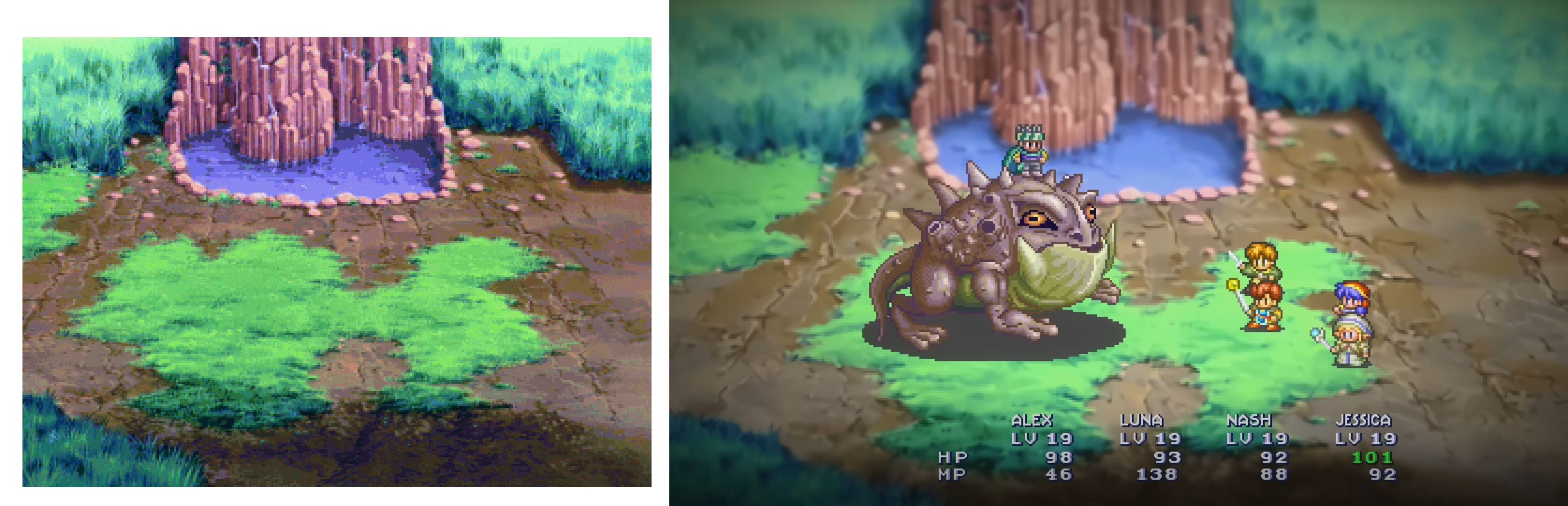
Actually, some official comparison shots were uploaded and… yeah, the original does look better, because it doesn’t have these dumbass filters.

Now, there are good things, such as a new dub, a new or perhaps just updated translation, a speed up option for combat, and the cutscenes look… pretty good. But the type of good where I cannot tell if they are transfers from the original tapes or lower-res copies thrown through an AI upscaler.
Yeah, I’m a bit torn here. Some of these changes just do not make sense to me, and the biggest draw is honestly the new dub, new translation, widescreen support, and QoL improvements. However, I should not be surprised at this mixed approach. Game Arts did a lousy job with the remaster of Grandia II in 2015, not even converting this fully 3D RPG into widescreen. …Though they did eventually patch it into something more acceptable. Like 4 years after release. And their Grandia 1 HD remaster was full of these odd texture mistakes and missing visual details.
I always have to ask why it is so damn hard for remaster teams to stick to the original release and only update things that SHOULD be updated. Retain the original assets, focus on QoL improvements, and make the game look the same, but widescreen and a higher resolution. If the goal is to redo the originals, make it so that if, at any time, you switch between the original and new visuals, the art direction stays consistent.
…Lunar Remastered Collection will be released for PS4, PS5, Xbox Series, Switch, and PC in spring 2025.
Wait, hold the fridge! In getting this post ret-2-go, I found that I talked about Lunar coming to PC WAY back in 2015 as part of a Steam helpdesk leak. Hell, you can even see the update history on SteamDB. These bastards have been planning this remaster for nine years! And this is all they managed to do? What the hell?
The Legacy Must Be Retold!
(Legacy of Kain 1 & 2 Remastered Announced)
Finally, I get to talk about this one! It was leaked during San Diego ComicCon this past summer and leaked again a day before the official reveal during State of Play. But now that it is finally out, time to talk about Legacy of Kain! A series that could have been one of the greats, was brimming with potential, but suffered from the financial problems plaguing Eidos and later the corporate mandates of Square Enix.
Let me start from the beginning. Legacy of Kain: Blood Omen (1996) is an overhead action game with a gothic setting, morally dubious protagonist, and mature content. I always considered it to be a proto-Diablo-like, despite being designed for the PS1 instead of PC, and being more focused on deliberate methodical exploration and combat. Mechanically, it’s more of a lower-paced, more open, A Link to the Past like.
It was also a showcase for the original PlayStation, featuring detailed sprites, environments, and just oodles of effects. But it’s also the sort of game where I cannot imagine someone playing it on a CRT, given how messy it looks on a modern display. Overall, a solid, if not classic, title that only gets ignored due to how stacked the PlayStation library was and how the game was plagued with licensing issues, to the point it wasn’t re-released until 2021. This was a Silicon Knights project and… that’s a story for another day.
However, Legacy of Kain did not become a prominent series until the series rights were stripped away from Silicon Knights by Eidos and given to the minds behind Gex, Crystal Dynamics. Building off of the existing framework and mythos, they created Soul Reaver (1999), a title praised vividly during its heyday for its… everything, pretty much.
A mature story with robust lore, worldbuilding, and voice acting that were all more than a step above console games of its era. Gameplay that, in many ways, was positioned as a retaliation to 1998’s Ocarina of Time, showing that the PlayStation could do a similar 3D puzzle-based action adventure game. Except this one had better textures, voice acting, and a dual world mechanic. Soul Reaver was an impressive, beloved title that simply lacked the opportunity to expand or reach a new audience. Sure, it’s on Steam and GOG… or it was the day before I started writing this. But just throwing an old game out there does not do much unless there is buzz or it’s part of an ongoing series.
Soul Reaver had a good story… but it also ended on a cliffhanger that would not be resumed until Soul Reaver 2 (2001), an early PS2 release… that got a bit shafted upon release. Partially because the PS2 was packed during holiday 2001, and partially because Soul Reaver 2 was just the second part of Soul Reaver. It lacked the next gen innovation or replay rich experience that game critics of the era demanded. Much like the original, it was a good… 5 to 14 hour story-driven action adventure romp.
From here, the series briefly became annualized, starting with Blood Omen 2 (2002). A sequel in the sense that it took place after the first one and starred the titular Kain, rather than the blue dude Raziel, but from a gameplay and setting perspective, it was quite… different. It kept the same action adventure puzzler core from Soul Reavers, but was also a vampire stealth game set in a borderline steampunk setting, rather than a more gothic otherworld. It was far from a bad game, yet it was made by a different team, was trying to do a lot, and did not come together with as much grace as it could have. It still did well, just not as well as it could have if given a bit more time and expertise.
Legacy of Kain: Defiance (2003) is the entry in the series that I know the least about, which is a shame, as it seems like the coolest, most ambitious game in the series. A dual protagonist action puzzle story-driven affair about Kain and Raziel going on parallel journeys to correct a time paradox that devastated the past? Sounds great! However, critics at the time were not crazy about the combat, and I can kind of see why, as it never was that great, being fairly basic and featuring two characters with similar movesets. My counter to that is that the game is about 10-12 hours long. How samey could it really be?
Unfortunately, Defiance did not meet expectations, despite selling between 500,000 and a million units. This, combined with the failure of Core Design’s Tomb Raider: Angel of Darkness, meant that something had to be done, and their solution was to close down Core Design and give the Tomb Raider IP to Crystal Dynamics. From there… the rest is history.
…Actually, no, there are two more Legacy of Kain titles that were… attempted during this era. The first publicly known attempt was Nosgoth, a team-based multiplayer shooter game set in the same universe as a dark character-rich story-driven series. Basically, everybody who played the series hated this idea on its face. It was revealed in 2013, had closed alphas and betas in 2015 and 2016, before being canceled. Either due to negative interest from the core community, a surplus of shooters in the market, or the fact that the developer, Psyonix, just self-published Rocket League (2015) a few months ago and didn’t need Square Enix’s shitty contract. In the end, it worked out great for everybody except Square Enix.
However, the next title… actually hurt. After purchasing Eidos in 2009, Square Enix shopped around the Legacy of Kain IP to Climax Studios. A British publisher who I swear has a list of canceled games longer than games they actually shipped. This resulted in Legacy of Kain: Dead Sun. An intended PS4 launch title that was canceled in 2012, after three years of work. I would go into a history lesson, but… listen to the funny skeleton man instead.
Admittedly, Dead Sun was meant to be more of a reboot of the series than a direct continuation, but it still strung, and you know what stings even more? People learned of Dead Sun’s cancellation in 2013, just shy of 10 years after the last Legacy of Kain game. And since then… 11 years have passed! It’s been 21 bloody years since this series saw any significant love, and the OG fans are all probably dead at this point.
However, there is still enough interest for Embracer, Crystal Dynamics, and Aspyr to rub their hands together and bring the series back with a remaster of its two most successful and beloved titles. And… I think the results look pretty good.
Aspyr impressed earlier this year with Tomb Raider I-III Remastered Starring Lara Croft. A remaster that retained the look and feel of the original game to a tee, while offering modernizations and optional visual enhancements. It was not perfect, as a perfect remaster is surprisingly hard to pull off, but the remastered trilogy succeeded in being both a quality updated port and a faithful touch-up of the original games.
Unsurprisingly, Legacy of Kain: Soul Reaver 1 & 2 Remastered looks to be another faithful remaster. An updated port of the original with built-in support for widescreen 4K rendition where, if you want, you can switch to an updated look with higher resolution textures, more detailed models, and more sophisticated lighting. Any change on this level will be contentious to some people, but looking at the comparisons seen in the trailer… Aspyr did a lot of work here. Raziel lacks the same edginess of his original model, yet was clearly designed after the model used for the game’s cutscenes and promo art. The flesh monster showcased is dramatically transformed, yet remains true to the spirit and intent of the original. And the environments have very smart lighting changes from what I can tell. Making things a bit brighter and more clear while preserving the architecture. I’m sure superfans could find more to nitpick, but by my metrics, and based on the developers’ track record, it looks damn good.
Legacy of Kain: Soul Reaver 1 & 2 Remastered will be released for PS4, PS5, Xbox One, Xbox Series, Switch, and PC on December 10, 2024.
Look Into The Horizon And See… A Pretty Game
(Horizon I: Zero Dawn Remastered Announced)
When I last talked about Horizon three months ago, I was dismissive and ignored how immensely successful the game was. As of May 2023, the first game sold 24.3 million copies and the second sold 8.4 million. Which is nothing to snuff at… even if I am convinced that a significant portion of the PlayStation audience just buy every first-party AAA release on instinct. Otherwise, I’m not sure how Days Gone (2019) would have surpassed 7 million circa January 2022. Horizon clearly has an audience based on those numbers, and while it might not resonate with the core highly-online gaming community, I cannot get mad at the robot dinosaur game for doing numbers.
That being said, I really am not fond of Sony’s continued re-releasing of games less than a decade old that are still perfectly playable on their flagship console. Combined with the diminishing returns of modern graphics, these ventures just seem… unnecessary to me. Marvel’s Spider-Man (2018) Remastered (2020), The Last of Us Part I (2022), The Last of Us Part II Remastered (2024), Uncharted: Legacy of Thieves Collection (2022), Ghost of Tsushima: Director’s Cut (2021), it just seems excessive. And with the announcement of Horizon I: Zero Dawn Remaster, I have to wonder what will be next. …Perhaps God of War 4 (2018). Just not Bloodborne (2015). Never Bloodborne.
This growing trend was continued this past week with Horizon I: Zero Dawn Remastered. A remaster of a 7-year-old game playable on modern consoles and PC that is aiming to do a bit more than usual. The announcement boasted how it has over 10 hours of re-recorded conversation and mocap, along with “countless graphical improvements.” Though, it did not show off these improvements with a side-by-side, which was a misstep, as the graphic improvements are actually quite significant. It’s more subjective, but I think the remaster looks better with brighter lighting, more colors, and a generally more vivid, less grungy world.
Horizon I: Zero Dawn Remastered will release for PS5 and PC on October 31, 2024 and will be available as a $10 deal for owners of the original. Which is a helluva lot better than charging $70 for a re-whatever of The Last of Us Remastered (2014) with less features.
That’s Not Ghost of Two-shima!
(Ghost of Yotei Announced)
…I have had five years to get over the fact that Sony’s marquee samurai game is developed by a bunch of dudes in Seattle rather than people who live in Samurai-Nihon-Land. And I still think that is sick and wrong. However, Sucker Punch’s Ghost of Tsushima (2020) was a sizable hit with good legs that went on to sell 13 million copies. …Meaning that a sequel was obviously going to happen. Or rather a successor, or a new Ghost game, but that’s just splitting hairs and being pretentious.
Set over 330 years after the original and on basically the opposite side of the country, Ghost of Yotei was revealed via a mostly pre-rendered and in-engine scenery trailer. One with imposing mountains, lush fields full of horses, the elegance of northern lights, a dimly lit rest stop for weary travelers, an aggressively red forest leading to a fog-drenched pagoda. It’s all striking and highlights both the artistic intent of the developers and, presumably, the immense level of detail this game will feature as one of Sony’s first in-house PS5 exclusives. It’s definitely a strong-looking game, and for an announcement trailer for a sequel in an established IP, set to release in a year, with a marketing lifecycle ahead of it, I think that is enough.
Personally, the biggest point of intrigue for me is the choice in setting, specifically the choice to set the story at the start of the Edo period and on the island of Hokkaido. While I don’t know as much about Japanese history as I should, I do know that this was still when the idea of a Japan under a single ruler was still rather new. And I know that this was before Hokkaido was fully part of Japan.
If you look at any map of Japan in the 1600s, or played Sengoku Basara: Samurai Heroes (2010), you’d notice that the northern island of Sinnoh Hisui Hokkaido is missing from these renditions. This is because only the southern tip of Hokkaido was under Japanese control during this time, and the island was largely the domain of the Ainu people. A similar yet distinct people who have their own history, their own culture, and their own language, and spanned across the highly valuable (for military purposes) Kuril Islands. However, they were assimilated by Japan during their colonial stint in the 19th century, and the Ainu people became, in the eyes of Japan, Japanese. I’m sure there is a lot that I am glossing over here, but it is an interesting part of Japanese people that I would not know if not for doing basic-bitch research for this segment.
Also, I guess the Diamond and Pearl clans in Pokémon Legends: Arceus (2022) were both Ainu people, given how they are presented as warring tribes who have divided their lines for themselves. …And the Galaxy team is just a bunch of sanitized colonizers who are trying to annex their land in the guise of research.
…Okay, now I’m actually really interested in how an American game studio and American publisher tackle this era and concept.
Ghost of Yotei will launch exclusively for PS5 sometime in 2025.
Behavior Gets Their Hooks In Another One!
(Behavior Interactive Acquires Red Hook Studios)

This is a busy week so I’ll try to make this short. Behavior Interactive has been on a steady acquisition tear over the past few years. …And it has not been going great. They acquired Midwinter in 2022, and shut them down two weeks ago after canceling their Dead by Daylight spin-off. They bought Sock Monkey early last year, a support studio who presumably provides Behavior with just that, development support. And about a year ago they snagged Codeglue, another support studio.
Based on that track record… I don’t think they should buy studios with solo developed games behind them. I mean, they shut down a subsidiary after less than three years. That’s a red flag for a bad owner if I’ve ever seen one. Unfortunately, Behavior has set their sights on a successful indie developer Red Hook Studios. A name you might be familiar with, as they are the minds behind the hit maddeningly oppressive survival RPG, Darkest Dungeon (2016) and its 2023 sequel.
…Yeah, nothing about that adds up. Behavior should not be buying them up. Behavior is not and has never been an indie developer or publisher, and the only similarity between the two is that they are known as ‘horror game’ developers. Also Canadian, but Vancouver and Montreal are basically the LA and New York City of Canada. In a sane timeline, they would be parts of different countries.
I ultimately wish them the best, but expect the worst from the lot of them. Like a Darkest Dungeon sequel full of DLC for all manner of horror IPs, even though that goes against the breed of horror that made Darkest Dungeon so successful.
Every Day I Wish For The Live Service Industry’s Collapse…
(Persona 5: The Phantom X is Coming to Japan)
I think Atlus should make a game… and then have some random-ass B-tier developer develop a follow-up that builds upon the character, setting, and vibes while also doing some weird shit for fun. Actually, let me amend that. I think most successful games should have a weird lower budget sequel that weirods will insist is actually the good one. Instead, we get publishers like Perfect World licensing the Persona 5 IP (deliberate wording) in order to make a live service… that is also a robust JRPG that either recycles a bunch of assets or legally copies them.
Persona 5: The Phantom X is a prime example of the type of game that I would be psyched to see exist… if it were a regular-ass console game, i.e. real game, and not a live service. Because the character designs, the concept of a Persona 5 indirect sequel that does something different, is about as exciting as a new Persona game to me. It’s a helluva lot more exciting than something like PST: Persona 5 Tactica (2023) (deliberate wording). Because this is a wholly new experience with new, well-designed characters, and some series firsts, like a 44-year-old gyaru housewife party member. Which is just… perfect.
Anglophones have been suggesting college-aged Persona characters— so they can jerk off to them with a clean conscience— but screw that! I want a cast of 30-somethings and 40-somethings with careers, kids, and debt to take the lead. I want real people with real problems to go through real shit. Defeating demons of many flavors, fighting the ills of society, and growing as people through the power of bonds! I know that unimaginative bastards like to say that’s kid shit, but no, it’s not. Bonds are the force that builds and destroys societies/cultures, and growth only stops when you’re dead. If you don’t believe that, or if you close yourself from bonds or from personal growth, you may as well be dead! If you need help with that, try jumping out a fifth-story window!
Akumako: “Focus!”
Right, right. Persona 5: The Phantom X was announced for a Japanese release. Which is good, as that increases the changes that this game will not be locked behind a veil of mystery for years to come. Hell, it may even get an English release if it does well enough and Sega recognizes the power of a global launch, which they really should by now. However… I keep running into this dichotomy where I want games that do cool things to be released to a wide audience, and I want the games to be free of predatory live service bullshit. I want there to be good games, and for them to be preserved and accessible for the foreseeable future.
As such, I perk up whenever a remaster is announced, and get peeved if it is mutating the original too much. I get excited when I see a new game with cool characters, art direction, or design elements, and then feel cheated when it winds up being an online-only product, quite literally born to die. I am just so sick of encountering this same scenario over and over again, and keep getting fooled into thinking that things can or could change, when… that’s just not going to happen.
Classic Dungeons Are The Best Dungeons
(Cladun X3 Announced)
I’ve beaten this drum before, but the PSP’s library is wildly underappreciated in the Anglosphere. It was home to a treasure trove of experimental Japanese games that remixed genres, made up their own rules, and brought forth creator-led innovations. The problem was that many of these games were isolated in Japan, as that’s where the PSP did the best. Many of these creative games were localized, but digital sales were low at the time, physical was the go-to approach, and many publishers only produced fairly small batches. As such, many games of this era developed strong niche followings. From What Did I Do to Deserve This, My Lord? (2007) to Brave Story: New Traveler (2006) to Jeanne d’Arc (2006) to… I’m just reading from my ROM list at this point.
Cladun: This is an RPG (2010) was one of these games. A neo-retro dungeon crawling action game with an irreverent sense of humor, penchant for absurdity, online multiplayer, and vast pick-up-and-play replayability. It was the sort of game that I believe could really succeed if it was put in front of its audience. People who want a big girthy yet simple roguelike action game with dense dungeons— a Mystery Dungeon with more emphasis on reflex and stat growth over strategy and survival. But sadly, it was relegated to the PSP, came out after its prime in the US, and despite trying again with Cladun x2 (2011) and Cladun Returns: This is Sengoku! (2016), it just did not take off. They did try with some PC ports, but a lack of name recognition, and spotty port for Cladun x2, prevented the series from gaining much ground. But if you bring it up to the right person, they will just gush about it.
As such, it is pleasantly surprising to see the series return with Cladun X3 which… is another Cladun! Same level of surprising depth, same robust character creator, same deeply replayable gameplay, and same surprising level of mechanical depth to it. That is not to say it is just a rehash— I never played these games, so I don’t know. I’m just saying that it is doing what the series did well previously, but on new platforms and in a climate where indie games like this are far more common. Which is both good and bad for its future prospects.
Cladun X3 will be released for PS4, PS5, and Switch on February 27, 2025 in Japan, with no international release announced as of writing.
I Got Bamboozled by a Surprise Launch!
(I’ll Review Class of ’09: The Flip Side Next Month)

This past week, the latest SBN3 venture, Class of ’09: The Flip Side, came out, and having reviewed the first two games, I feel I have a certain duty to review the third one. However, it came out during the worst damn time possible for me, as I am trying to finish up a novel and survive tax season at work. As such, for my own sanity, I will not be reviewing the game for a month, tentatively targeting October 24th. I know it would only take me about 10/12 hours to go through it, review, flowchart, and all, but I don’t want to rush myself when I have stuff I would rather focus on at the moment.
If I knew it was coming out on September 23, I would have planned for its launch. But I didn’t… so I didn’t! I just saw its announcement trailer two months ago and thought there’d be a second trailer.
Progress Report 2024-09-29
Oh shit, I forgot that PlayStation Japan sometimes does these songs to celebrate every TSG. I have not seen one since 2016’s banger, and this one is pretty darn good… except for these stupid Astro Bots. They look so much worse when they are together, because they are just copies of the same thing. That is not endearing, it just looks wrong. At least give them funny hats… like I did with the Lunalous!

Akumako: “More like Astrolou!”
Yeah! This voice in my head gets me!
Anyway, it’s tax season and my firm’s biggest client DIED this past week, so things are a mess. For the record, the client was very old, in memory care for years, and experienced a bad fall just a few days earlier. It was time for them to go, and now I get to bill a LOT of hours to their estate.
Akumako: “Natalie!”
What? They had nine figures at the peak of their wealth and there’s a LOT of shit that needs to be done to clean up and organize their estate. Imma do the work, and Imma bill hella dochy for it!
Akumako: “Dochy is Natlish for money. It is derived from the Japanese word ‘Docchi’, meaning ‘which one’. But because Natalie was stupid, she thought it was some Japanese-ified version of the British slang for money, dosh.”
Personally, I blame gammaflux for showing me this OP. In my defense, why would you choose between happiness and luck? I want them both and some money!
2024-09-22: Drats! Only 4,300 words today too for PS 1988. What was I busy with aside from that? Well, I fell down an abandonware collecting rabbit hole and spent over an hour looking for a program to do a specific thing. Make a 640 x 480 window look like it is 1280 x 960. The obvious answer is to try using Windows Magnifier, the built-in software, and setting things to 200%. Well, that almost works, but it applies this ugly blur effect to everything, rather than just making the pixels twice (or 4x) as big. So I tried looking into other solutions, but none of them worked. Sizer just did not run. Resize Enable just broke things. Magnifixer and Zoomit were both designed to follow the mouse, and is not what I want.Also, I fell down the rabbit hole of looking into Windows 95 ports of PC-98 games, knowing I’m not going to play any of Himeya Soft’s releases. Well, unless I justify a VN deep dive as part of research for Psycho Shatter: Vice Novus.
2024-09-23: Wrote 3,400 words for PS 1988. Only three chapters are left! And they should be shorter.
2024-09-24: 7,500 fucking words for this Rundown. Damn it! I got WAY too into the weeds with some of these topics!
2024-09-25: Wrote… maybe 2,500 words for this Rundown? I was busy with stuff, had to make some header images, and started editing what I could before bed.
2024-09-26: Finished editing this one-eyed monster that is also a giant penis. ProWritingAid does not like GoogleDocs GoogleDicks this big. Then got the TSF Showcases for the next two weeks ret-2-go. Then decided now would be a good time to start work on the 10/15 and 10/22 TSF Showcases. 10/29 will be a 750-ish page comic that is not really horror, but has a serial killer, so that’s close e-nuff!. Read through the 10/15 Showcase subject.
2024-09-27: It was Cassie’s birthday so I spent my afternoon with her watching Zombie Land Saga (2018). Good times~! But then I got distracted by other stuff (PokéRogue got an update) and only wrote the 2,200 word 10/15 TSF Showcase. It’s kind of a bummer.
2024-09-28: Chore day! I was busy in the morning. I had to do three hours of work with my boss. And then an asshole client finally got back to me after waiting three weeks for them to explain some transactions. That pissed me off, as we are working on THREE years of crypto information, and somebody had to make the corrections, generate the reports, squash the errors, and begin work on the amendments before making a comparison sheet. It kept me busy until 21:30. Wrote 2,300 word TSF Showcase for 10/22. Now I JUST need to edit these and then I can work on PS 1988 and try to finish it in 15 days. …And do the Rundowns. ARGH!
Psycho Shatter 1988: Black Vice X Weiss Vice
Progress Report:
Current Word Count: 96,982
Estimated Word Count: 110,000
Words Edited: 0
Total Chapters: 16
Chapters Outlined: 16
Chapters Drafted: 13
Chapters Edited: 0
Header Images Made: 0
Days Until Deadline: 37
♫Pu-Pe-Pu-Pe-Pa-Pi-Pu-Pap!♫ I am sooooo fucked~! But Imma gonna try sooooo hard~!