

This Week’s Topics:
- Rundown Preamble Ramble: An Impromptu Vita Retrospective
- ♫FREEEEEDOM WAAAAARS!♫ (Freedom Wars Remastered Announced)
- So Long Touch Arcade (Massive Gaming Publication Shuts Down After 16 Years)
- Playtika Acquires SuperPlay for $700 Million (We Need Better Reporting on Mobile Games…)
- Starlight Re:Volver and the Financial Landscape of Games (You Can’t Fund a REAL Games Nowadays…)
- Interest Rates Dropping Affects The Gamindustri, You, and Natalie (♫Cash Rules Everything Around Me, Gotta Get The Money!♫)
- Another Console Data Tangent! (You Gotta Have One Every Week!)
- Who is the REAL Master of Pokémon? (Natalie Talks About A Video Essay She Watched Twice)
- Pokémon v Pocketpair – A Palworld Patent Panic (Nintendo Sues Pocket Pair for Patent Infringement)
- How Do You Solve The Final Fantasy Problem? (Or Why Didn’t FFXVI and FFVIIR2 Do Well?)
- Like a Dragon: Pirate Yakuza in Hawaii Announced (Yar Har, Fiddle De Dee! Being a Pirate Is What We Wanna Be!)
- The Annapurna Interactive Exodus Explained! (IGN Reveals The Full Story!)
Rundown Preamble Ramble:
An Impromptu Vita Retrospective
I originally had another segment on retro gaming written for this Rundown… but then I got some killer news and decided to do an impromptu retrospect on the PlayStation Vita. Why? Because context is key to this bitch we call life, a certified Vita hood classic just got revived via a remaster, and it is important to explain the significance of certain video game releases.
The PlayStation Vita, originally released in December 2011, is a curious little system that developed a strong reputation as a niche doodad during its most relevant era, but is generally written off as a failure. Sony was putting all their weight into it, expecting another PSP-level success, and tried to really push the title for its first year. …But the system completely failed to meet its sales targets. While all the industry pundits and Michael Pachters of the industry were favoring it over the 3DS for its better power, screen, resolution, and specs, they failed to account for one teensy thing. What made the PSP successful.
The PSP was a rather curious system in terms of its lifetime sales and what people actually played on it. The system was sold on its portable 3D spin-offs to PS2 games that were their own fully-fledged experiences. Stuff like GTA, Ratchet & Clank, Final Fantasy, Metal Gear, and God of War, and other things topping the system’s best-selling games list. A deluge of RPGs, including both enhancement ports and originals. A robust back catalog of PS1 games, playable in the palm of your hands. A smörgåsbord of Japan-only visual novels, including a lot of sex-free eroge, the cool kind! And… Monster Hunter. Namely Monster Hunter Portable 3rd (2010). A late release in the system’s life, it sold just shy of 5 million units— 4.7 million in the first 7 months— and was only released in Japan.
You know how big Monster Hunter World (2018) was to English speakers? Well, MHP3 was WAY bigger than that. Like, on any decently full train car in Tokyo, from 2011 to 2012, there was probably one person playing MHP3. People grouped up to go on hunts together, enjoyed the Wi-Fi of local shops to play with their friends, and spent hundreds of hours on this game. Point is, there were various core competencies of the PSP, and the Vita… kinda fucked them all up.
Back when it was known as the NGP and the 3DS was struggling to make up for its maladroit start, Nintendo casually just won the handheld race before the Vita even launched. All thanks to one single announcement. Capcom just released the best-selling PSP game in Japan, a cultural phenomenon. Many assumed it would just go to the NGP… but then Nintendo came in and announced that the next Monster Hunter was being made for the 3DS as an exclusive. And not just a new portable entry. Hell no! This was Monster Hunter 4!
This eliminated one of Sony’s core competencies with the PSP, and the only Monster Hunter Capcom would bring to Vita was Monster Hunter Frontier G (2014). A game that no longer exists, and might all be an elaborate hoax. I don’t know. You can pretty easily just fake a game into existence these days. And as for the rest of them… it’s more of a mixed bag.
There was a concentrated effort to replicate the past success. Games like Uncharted: Golden Abyss (2012), Killzone: Mercenary (2013), Assassin’s Creed III: Liberation (2012), and LittleBigPlanet PS Vita (2012) were all good. They took popular console games of the era and made unique handheld versions that fit well on the platform. Games like Persona 4 Golden (2012), Final Fantasy X / X-2 HD Remaster (2013), Tales of Hearts R (2013), and Ys IV: Memories of Celceta (2012) were all quality re-whatevers of beloved RPGs. Tearaway (2013), Gravity Rush (2012), and Soul Sacrifice (2013) were all great original titles built for the system in mind. It had the only portable version of Minecraft for a good while, allegedly its best-selling title. And the system was… weirdly good for fighters? Mortal Kombat (2011), Marvel Vs Capcom 3, and PlayStation All Stars: Battle Royale had really solid ports. (Though the system could have used Street Fighter and Tekken, and Cross Tekken does not count.) And it had visual novels out the ass.
Hell, it even got ports of a lot of HD PS2 collections. Jak and Daxter, Ratchet and Clank, Sly Cooper, God of War. Sure, they were worse than the PS3 versions, but that’s the price of portability, bitch!
However… the Vita just wasn’t selling super well, and the reasons why are fairly complicated.
Part of it had to do with the steep price of $250 compared to the far cheaper $180 3DS. This was knocked down to $200 with a 2013 price cut and LCD remodel. But that happened right before Nintendo released their $130 budget version of the 3DS, the 2DS. Which launched a day before the next Pokémon game, and a month before the $400 PS4 and $500 Xbox One. Price was an obstacle, and there were simply a lot of new systems on the market at the time.
Part of it had to do with the proprietary storage, something that was the bane for PSP fans, as memory cards were stupid expensive. (It’s also why the PSP Go failed.) The PS Via could have supported MicroSD cards… but Sony made their own dumb fake MicroSD cards instead and charged an obscene premium for it. As in, $110 for 64 GB. And the cartridges didn’t save your data either, so you were screwed without a memory card!
Part of it had to do with a weak launch and a lack of must-play titles. The Vita had a positively stacked launch, but the titles just did not resonate with critics at the time. The tent-pole title of Golden Abyss was not quite what people wanted after playing through Uncharted 3 just a few months ago. So sales slumped, publishers chose to reduce support, and Sony… tried to keep pumping out more promising games, but never had a real ‘wow’ factor. Never a killer app or exclusive from a coveted series that would drive people to buy a system. …Like GTA did in 2005. (Gosh, can you imagine a GTA IV spin-off running on this thing? I can’t!)
Contrary to the popular sentiment, Sony tried to make this system work… but it’s telling that two of the most allegedly successful titles on the system were the port of Minecraft— which is huge around the whole dang world. …And Call of Duty: Black Ops: Declassified. Cripes… Declassified was a truly dogshit game, not even good enough to be a kusoge. Yet Sony was pushing it as the big holiday 2012 title for the Vita. Because of this, it had relatively good sales, but it was such a mess it brought an end to its developer, Nihilistic Software. In all fairness, they probably shoved the game out in six months after ending the Resistance series with decent Resistance: Burning Skies (2012). And even if you have a good foundation, nobody can shove out an FPS like this in six months.
Then history repeated itself with the terrible port of Borderlands 2. A game that Sony announced was terrified to show off, because it ran at a truly abysmal frame rate. Games like these did not inspire confidence in the Vita, made it seem underpowered, yet were big enough to warrant official bundles. Combined with a library stuffed with a lot of PS3 ports and… it begged the question of why spend so much when a PS3 would cost about as much and had cheaper games?
Another problem was the way they introduced backwards compatibility with PS1 and PSP titles. I cannot remember the details— articles like this only tell part of the story— but I know it was a clusterfuck to determine what games were compatible. Compatibility only launched in late August 2012, MONTHS after the Vita came out. Some games to be downloaded from a PS3, bought on a PSP store, and other inane crap. There were just SO MANY hoops to jump for, and for zero reason. They could have launched the system with over 1,000 backwards compatible games, but they chose not to. Also, this thing could not play the proprietary media for PSP, or use their memory cards, so it was not even a replacement for a PSP. If you had a physical collection of PSP games… Sony told you to just piss off and buy them again. …Except not every PSP game was released digitally, like Crisis Core, as that was a feature introduced later in the system’s life.
In light of these many, many issues, Sony attempted to reinvent the PS Vita with the PlayStation TV. The idea was that it would be a console version of the Vita, retail for a mere $100, do video streaming, and facilitate Remote Play with a PS4. A feature that would let someone play PS4 games while in another room. All SICK ideas… but Sony fucked it up!
The PlayStation TV had the Vita’s system UI, which was always designed for a touch screen, rather than buttons. It was a problem with the base model, and I did not care for it, like, at all. But when put on a TV screen, navigating these bubbles with a controller, it just felt cheap and hacky.
They released this system two years after the Vita launch, but its lack of a screen introduced many compatibility issues, so some titles could not be played. I thought it was only a few dozen… but no, it’s 589 of 1,732 games, with an additional 22 having their own compatibility issues, mostly based on region restrictions. With that many incompatible titles… it was basically impossible to retrofit all of them to work on the PlayStation TV. What a mess.
The name PlayStation TV was terrible, as it launched at the same time as the PlayStation 4— a console you plug into a TV— and when Sony was talking about PlayStation Vue, a TV streaming service. (Yes, that is real. Yes, I absolutely forgot about it until right now.) The PlayStation Vita TV, the name used in Asian markets, at least makes it more clear. It’s a Vita for your TV. But I guess that was too wordy for Americans.
If Sony released the Vita and released the PlayStation TV as a $150 microconsole, I think it would have sold WAY more units. If they made this clear, developers would not have shoehorned in touchscreen controls and the games… would have been better for it. And if they actually treated this as a streaming box and included Netflix support, at launch, with other services coming later… I guarantee that it would have sold an extra 5 million units. Probably an extra 10 million!
Despite being so negative up to this point, the Vita was not a total failure. It sold around 16 million units by the time it was discontinued. Compared to the Wii U, that’s pretty good! But what I find interesting about its sales is how many of them happened after Sony stopped supporting the system. By the end of 2015, it sold about 10 million units. So, where did the extra 6 million come from?
Well, that’s the funny thing about the Vita. Even after major publishers abandoned it, it consistently got support from independent developers. So many small games got Vita ports, and for many people, this was seen as the preferred platform for these smaller 2D games. In their hands, fully portable, able to be played anywhere. Indies loved the Vita, people loved the Vita for indies, Minecraft, classic game libraries, solid ports, and unique titles that were not ported to other systems either ever or for a few years.
A lot of smaller games were seen as ‘perfect for Vita’ in the same way that people used to say games were ‘perfect for Switch’ back in 2018. And… actually, The Vita was relevant up until the release of the Switch, let people play console games portably, was home to a slew of great indies, and… screw it. I said it before, and I’ll say it again. The Switch is basically the PlayStation Vita 2.0. Not a Wii U successor, not a 3DS successor, but a PS Vita and PS TV hybrid done way better. The Switch is what the PlayStation Vita should have been!
And that’s the Straight Dope!
Akumako: “Oi! Ya stupid fuckin’ bitch! You forgot to talk about YOUR experiences with the Vita!”
…Oh, right, I owned two of them and played six games on it.
Akumako: “Explain, Miss Turd-Brain!”
Okay, okay. I bought a PS Vita in March 2014— a used original model for a brisk $130. It had an indent in the edge of the screen, but it worked just fine, and I put a good 250 hours into it. Playing Persona 4 Golden (2012), Danganronpa 1 (2012), Danganronpa 2 (2012), Castlevania: Symphony of the Night (1997), Freedom Wars (2014), Danganronpa Æ: Absolute Despair Girls (2014). I loved the system, got a cheap $50 PlayStation TV on an Amazon sale that I only used for Absolute Despair Girls, and the Vita my first and so far only PlayStation.
Akumako: “Your only PlayStation? Oh, right! This brat hasn’t even seen a naked PS4 with her eyes!”
Yeah, and do I NEED to in order to talk about gaming?
Akumako: “There are minimum standards to uphold, and you CHOOSE not to meet them!”
Gosh. I thought the PS4 looked lame after E3 2013 as the highlight of the show was their choice to NOT release a parole box. You can find the receipts in the Natalie.TF archives. So I got into PC gaming and never bothered futzing with consoles other than handhelds.
Akumako: “You sure sound like a fake Gamer™…”
Well, I’d rather be a fake White Supremacist instead of a real one.
Akumako: “And that’s the joke! We out! Later fuckerz!”
♫FREEEEEDOM WAAAAARS!♫
(Freedom Wars Remastered Announced)
Oh shit! I thought this day would never come!
So, I just went on a PS Vita retrospective in the prior section simply because I could not stop myself from talking about the Vita in the context of this game. Freedom Wars (2014) was Sony’s attempt to create an all-original and exclusive hunting game for the PS Vita. The title was commissioned some time after God Eater (2010) became a hit Monster Hunter competitor, selling 295,000 copies in its first week. I’d ask why, but having sank over 100 hours into the remastered release, God Eater Resurrection (2015), I get it. That game is FUN!
Sony reached out to the game’s developers, Shift Inc, to secure an exclusive Vita title. Unfortunately, Shift was preoccupied with the sequel Bandai Namco was demanding, God Eater 2, so they could only offer conceptual, character, and mechanical help, not the core development itself. Which led Sony to recruit Dimps, developer of Street Fighter, Dragon Ball, and Sonic games. They’re one of those multifaceted developers who I would trust with any game. Kinda like Tose!
Some might think that this would result in Sony snagging two big hunting game exclusives, but it didn’t. People expected God Eater 2 to be released exclusively for Vita… instead it came out in 2013 for the PSP and Vita. This proved to be great for Bandai Namco, as the game sold 378,350 units in its first week of Japanese sales, but it really did not do much for Vita sales.
Anyway, Freedom Wars came out just seven months later and while it carried the same general DNA of God Eater, it was also its own thing. A dystopian and oppressive hunting game set in a world where every human is born into servitude, and must toil away for the state in hopes of securing freedom. With the game taking this idea so seriously that you cannot even run for more than a few seconds in the hub world without getting a penalty. It had a cool aesthetic, a deluge of nifty ideas, some crazy detailed character creator for a game of this fidelity, and was all based around gameplay that… has a lot of great ideas.
Combat consists of going on hunts with four others players, or AI controlled characters with a melee weapon, ranged weapon, and a versatile magic grappling hook. It can be used to zip across battlefields, latch onto monsters, yank them down, create a healing bushel, walls, and other stuff I’m probably forgetting. This can lead to some truly hectic battles, and was enhanced by up to four other AI controlled allies, who only had guns because… the game would be too hectic otherwise.
The enemies are these hulking abominations who range from skeletons to dragons to giant mechanical monsters, often armed with firearms and additional appendages that need to be severed. Severing appendages weakens them, making them more susceptible to damage or less able to deal it, and… there is something satisfying about toppling a giant limb by limb. It iterates on the breaking system of God Eater and Monster Hunter, adding a new creative dimension to combat, and a greater sense of spectacle and achievement with each monster felled. At its best, Freedom Wars is frantic and fun, a different yet equally engaging take on the hunting genre… but if memory serves, it was also rather slow.
Enemies took a while to kill. Characters moved a bit too slow given the size of the environments. The ally AI were too conservative with their attacks. A lot of missions involved picking up and slowly carrying people to certain locations. For as cool as severing enemy limbs is, it was done by mashing a Vita face button for a looong time. And while the game prioritized gunplay, it felt a bit too… loose. The Vita thumbsticks were never that great, and using them to shoot specific targets on a quickly moving target was never ideal.
Looking at my old review, I… I did not really like Freedom Wars. But I think that was a time and place problem. 2015 was not a great year for my mental health, mood, and life in general. It’s when I accepted I was trans, when I was feeling listless with my life, and just wrapped in depression I have long-since slaughtered in my shed. Thanks HRT! And I think that I was just not in the right headspace for that. Neptunia though? That was EXACTLY what I needed.
After playing God Eater Resurrection, I thought about going back to Freedom Wars, this time with a controller in hand, but I never did. Instead, I sold my copy and my Vita, fully knowing that the game would likely never be re-released. …So imagine my surprise when, out of nowhere, with no rumors leading up to it, I saw “Freedom Wars Remastered announced for PS5, PS4, Switch, and PC” pop up in my feed.
Published by Bandai Namco, Freedom Wars Remastered appears to be… just Freedom Wars in HD, with a few additions. IGN states that the game will have a reworked weapon crafting system and additional difficulties, both of which are welcomed. Beyond that, there appear to be no new features, no specified tweaks, and no new content mentioned. It’s just the game with up to 4K resolutions, better textures, and not much else. No lighting changes, no new models, just the same ass game, but looking like it’s running at higher settings. Which is… visually, exactly what I want. I’d rather have a safe ‘HD port’ than something that mucks up the important stuff… but I kind of wish they did more to spruce up the combat. Such as making the AI companions more bold and aggressive, making hunts a bit quicker, or just increasing the speed of certain actions.
Actually, looking at the gameplay uploaded by Famitsu, I think they did something to make the limb severing process faster. And I do not remember being able to make my robo-buddy carry civvies to safety, which would have saved me a LOT of frustration. However, I am working with almost decade-old memories here, and games this open make it hard to tell what one can and cannot do just by scrubbing video footage.
Going back to that same IGN article, Dimps— who I think are handling this remaster— predictably express interest in pursuing a sequel if this remaster does well. Which just strikes me as ambitious given the economics of modern games. Don’t get me wrong, Freedom Wars did very well considering its audience size, but there’s a reason why Dimps has only worked on major IPs since Freedom Wars. Making a brand new game would likely mean making something that has the production values better than Monster Hunter Rise, and I don’t think a Freedom Wars 2 could recoup the development costs required to do that. Especially with Sony’s licensing fees. This is still a niche-as-hell series with no multimedia expansion.
…Wait, so if this is being handled by Dimps, then what have Shift Inc been doing all these years? They did God Eater 1 and 2, their remasters, Code Vein (2019), some modeling for Pokémon Legends: Arceus, but what have they mainly been working on the past five years? Are they working on God Eater 4 after handing God Eater 3 it to Marvelous First Studio? Actually, God Eater 3 did okay at best, so is Bandai Namco even continuing the series? Is Code Vein 2 in production? Because God Eater never broke a million, while Code Vein sold 3 million units after nearly 4 years. That probably translates to at least $50 million even accounting for platform fees, and it got the Game Pass stimulus back when it was good, so it would make sense to greenlight a sequel. …Or are they making edgy street fashion Elden Ring? Because that would fuck so hard.
Regardless, Freedom Wars Remastered will release for PS4, PS5, Switch, and PC on January 10, 2025.
So Long Touch Arcade
(Massive Gaming Publication Shuts Down After 16 Years)

The mobile game scene is one that needs to be reported on, analyzed, and followed by journalists and writers, as so much of it is spoken of casually, in dedicated communities, or merely discussed financially. Which is why it sucks that one of the most prolific and dedicated sites for mobile gaming, Touch Arcade, is shutting down.
Why is it shutting down? Because money. There is just not enough money in banner ads on websites to keep them going. Many sites require subscriptions or Patreons to keep the lights on, and any form of multimedia expansion is another expense. Writers need to eat, need to get paid, but in the current climate, writers are seen as more disposable than ever before, as generative AI and algorithmically abusive listicles make more money.
Nothing in lieu of a tidal shift in online monetization could really change this. I sadly don’t have much to offer but best wishes for those affected… and a warning for everyone else. Gaming journalism, reporting, and writing is at risk of falling into a damn abyss as web economics become unsustainable, and that will hurt everyone. I know some Gamers™ like to treat gaming journalists as the enemy, but they aren’t, and that’s just Gamergate propaganda talking. At their worst, they are just press release aggregators. At their best, they are publications that exist to stir conversation, stir discussion, and help advance the cultural understanding of games. Which is good, as things get better when your brain gets smarter!
When a publication dies, gaming as a whole suffers, and… there’s obviously no reason why you would want that. …Unless one is doing a psy op in order to destroy culture and breed discontent that can be redirected toward one’s political enemies.
Playtika Acquires SuperPlay for $700 Million
(We Need Better Reporting on Mobile Games…)

Oh wait, what is this? An example of why outlets like Touch Arcade are important as it is hard to immediately find information on mobile games and developers due to a lack of articles being written about them?
Playtika announced plans to acquire SuperPlay for $700 million, with another 1.25 billion locked away depending on performance milestones. With Playtika being an Israeli mobile game giant with thousands of employees around the world. And SuperPlay being a fairly new mobile game studio who made it big with its puzzle game Dice Dreams (2019) and its sorta successor Domino Dreams (2023). The two games have an insane daily active user count of 1.7 million, and per a March 2024 article by PocketGamer, Dice Dreams has made over $300 million from in-game spending alone, not counting ads.
Clearly, these games are doing well, and there are a lot of people playing them. …But this is a prime example I have with the mobile games industry, as there are so few writers discussing them as games, and so little information about them. Hell, most of the results I found when searching it were more… financially driven. About how to make cash playing the game, get free rolls, and analyses of how the game is generating money. With much of the game only being explained through the context of tutorials. Hell, I could not even find a damn review of Dice Dreams. (Though I did find one of Domino Dreams.) And that’s just insane, right? There are no professional quality critic reviews of a game played by millions of people that has made an enviable level of money.
This is why I feel so blindsided by a lot of mobile gaming hits, because they are simply not treated like big, important games, and are viewed as financial instruments. What they play like doesn’t really matter beyond business purposes, and their primary allure is tricking people into spending money. It sucks, and I hate it! But clearly, people see value in this. Playtika is a giant company with a market cap of $3 billion, and games this simple do not cost that much to produce. Even with all the iterations and polish.
This makes it all too easy to other this type of game, view it as something different and divorced from ‘core’ gaming. While also being just deeply frustrating to see. Because basic puzzle games like this, with all their bells and whistles, are achieving a level of success that 99% of games could only dream of. …Pun not intended.
I’m just upset that this is where the money is floating in the industry, in games meant to compel and lock people into feedback loops above all else.
Starlight Re:Volver and the Financial Landscape of Games
(You Can’t Fund a REAL Games Nowadays…)
I have not been discussing the rampant layoffs that have plagued this industry for the past two years, and not for great reasons. I find discussions of layoffs to be cyclical, as there are only so many things that can be said, and if I were to highlight them every time they happened, they would warrant their own section in nearly every Rundown. Just like acquisitions did in 2021/2022, but even more generic.
This is all a result of the destructive boom and bust cycle of capitalism, exacerbated by shifts from a global pandemic, overly greedy investors, a resurgence in war, and other baddy bad bullshit. It vehemently sucks that people are losing their jobs, as that is just fucking up their whole lives and the lives of their families. However, it is also doing long-term harm to the games industry. There is a trend among modern game companies where a lot of people work on a game or two, then just leave the industry. All because the work is hard, hours are long, job security is shite, and even a basic-ass job at any big tech company would pay considerably better. Or, if they are sick of working at a desk for 20 years, they can say screw it and become a line cook, making just over minimum wage while standing in a hot room full of ovens and stoves. At least they’re on their feet and developing a highly marketable skill.
People leaving the industry after years or decades leads to rampant brain drain, a lack of people able to fill senior positions, and a lack of true experience. This will ultimately hurt games in ways that will be felt. Especially if games keep being so big, pushing so much fidelity, and going through so many iterations.
Back in the 2010s, there was this idea that any batch of laid off developers could just get some funding and start up a new indie studio. This was a decade where interest rates were low, stagnant, and money was, to quote many finance people, ‘free.’ This made loans cheap, investors more lax, and kept inflation rather stable.
…But that dream really is not possible in modern times, because investors are so sheepish, demanding, and interest rates are so high. This is all meant to curb inflation, prevent a recession, yet it also makes it harder for companies to make big investments and for smaller companies to establish themselves, as while inflation may be reduced, the borrowing rates are high. …Or some shit. I literally don’t remember a single thing from my macroeconomics class.
As such, whenever I see a new studio from industry crop up, I will get suspicious… and this is one such instance.
Pahdo Labs is a New York based indie developer established in 2021 that eventually gained at least 17.5 million in SEED financing. SEED funding can vary in how it is treated. Sometimes it is ownership, sometimes it is a liability, sometimes the people get a lot, other times they get paid out for pennies on the dollar as the venture fails to prosper. But, at the very least, they make it a lot easier to operate without worrying about shareholders, share dilution, ownership, and other fussy things. Trust me, I’ve worked on a few corps that got SEED funding. It’s messy, but a manageable mess, and it’s preferred by a lot of younger entrepreneurs.
To get the funding, they need to make a pitch, examine the market, and fill it with various buzzwords to get investors interested. It is a particular breed of writing that makes almost anything sound cynical and corporate as hell, because it needs to be.
This background combined with the way this studio was presenting their game on their website was being pitched on the website really made me feel… paranoid of whatever this game would be. Particularly after this bit on their about page:

This immediately throws me for a loop because it uses the term “10,000 hours” to describe, presumably, the games’ length. Which is a downright diabolical amount of time. That is the amount of time a full-time staff member typically works across 5 years… and you are trying to get people to invest that much time into one game?
Next is the shared world comment, which I just view as a dead giveaway that a game is a secret live service. A trend I have noticed from certain games, and one that I hate. If your game is online only, tell me from the start so I know to ignore you. And this game’s announcement post at GamesRadar mentioned that it had online servers and emphasizes co-op, so… I guess this is just another darn live service. Which is a shame, as the game is from a scattering of industry veterans and actually looks… really promising.
The title, Starlight Re:Volver, features a gorgeously bright art style, a bubbly ‘electro-citypop’ soundtrack, overhead action combat, banger character designs, various weapon classes, and flashy yet readable combat. It gives me… Dragalia Lost vibes, and if you’ve read enough Rundowns, you knew that comparison was coming.
It looks like a game well worth getting excited about, and has a lot of small touches I appreciate, such as the deliberate choppiness of character movements and the hangoutable hub world. It looks like the work of passionate creatives, because I think it is, but I simply do not trust another live service entering this market. Gaming simply has too many of them, and they are such a drain of resources, time, and money that I would be inclined to say, get rid of them. Just repackage them as best you can, and go back to shipping single-purchase affairs.
And I know why they are going with this approach. Because they have 17.5 million in SEED funding to pay back eventually, some of which came from Zynga founder Mark Pincus and King.com founder Riccardo Zacconi. I’m just upset that this is the way games get funded. That this is the form they must take. And that this will probably be more profitable than only selling 25,000 units of a $20 game despite critical and communal acclaim.
…Cripes, can I just have a week without thinking ‘maybe they should just stop video games. They had a good run, but the economics have fallen off so bad that we should just repackage what was done and call it quits.’
Interest Rates Dropping Affects The Gamindustri, You, and Natalie
(♫Cash Rules Everything Around Me, Gotta Get The Money!♫)
Akumako: “Yo! The Fed just cut back interest rates by 50 basis points! And they’re gonna cut it by 25 points two times before the end of the year!“
Akumako, talk like a human and say they cut Federal interest rates by fif-ty per-cent. It saves a syllable and makes more sense. The hell is a basis in a point? The basis is what you pay for something you later sell.
Akumako: “But doesn’t this mean that you’re wrong in saying that game devs can’t get start-up money for single-player games anymore?”
…My comments about the current climate were proven wrong— hours after I initially wrote them— But overall and broadly speaking? Nah, I’m right. Packaged games have such variable profitability because of rampant sales, platform fees, and rampant competition that it takes a smash hit that sells hundreds of thousands of units to pay the devs. 84% of total revenue from gaming comes from live services, so how many investors will want to get into a 16% niche? Especially when that niche seems to only be getting smaller. Live services are addictive by design and we now have an entire generation who was raised on them, who think this is what gaming is and what it should be.
However, this shift WILL see more VC money spread around to move start-ups and projects. Which is good, as it is good when people are paid for their work. This won’t be a paradigm shift, though. Most of these developers will just either shut down or get acquired after a few years, and it is part of the long-term business plan for them. …I say as if start-ups ever have long-term plans. Capitalism works in a boom and bust cycle, and this is just the start of a new boom phase. Or at least that’s what the Fed is planning. I hate it… but the only way I could get rid of it is if I could solve capitalism and… buddy, I can’t even solve myself.
Also, on a personal level, this is good news for me. This should help my Roth IRA performance, especially if I deposit my year-end bonus at the right time. (Yes, I use a retirement account to manage my investments, as it requires less maintenance than a typical portfolio.) I just bought a $10,000 12-month CD while I can, because it’s going to be hard to find 4.5% interest rates over the next year. And if this trend continues, then I can get my mortgage cut down from 7.5% to something crazy like 3.5% when I refinance in 2028.
…Gosh, look at me. Getting excited about my retirement account performance, CDs, and refinancing my mortgage.
Akumako: “Natalie’s an old bitch!”
Yep! And I’m not even 30 yet. But I will be in two months!
Another Console Data Tangent!
(You Gotta Have One Every Week!)
This past week, the Wall Street Journal posted a video on Xbox, Microsoft’s current plans to grow via Game Pass, and the challenges they face due to their large scale. A pretty standard, well produced, video meant to be understandable to both game likers and people who view gaming as more of a financial instrument.
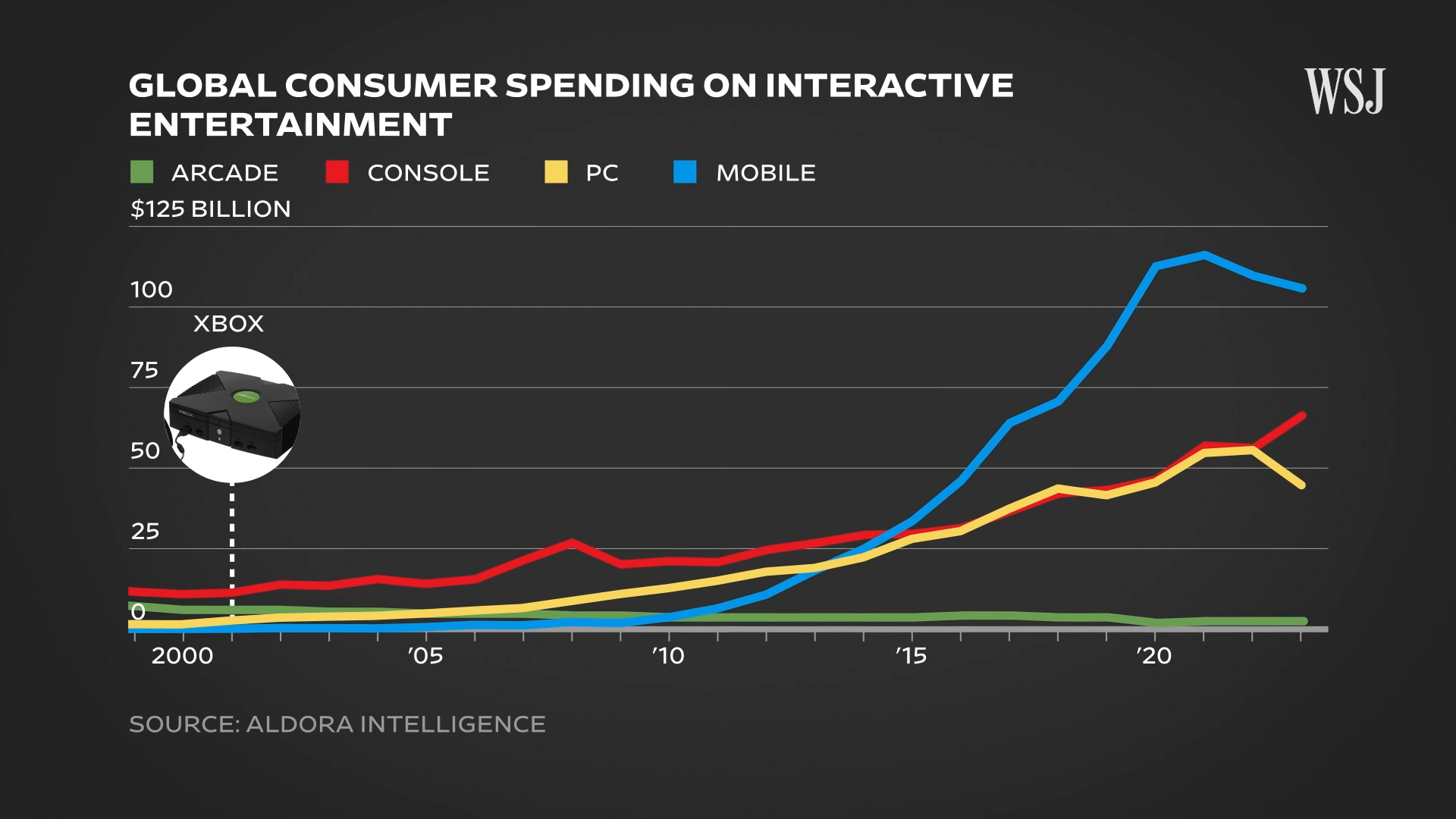
However, what brought this video to my attention were two big data points from Aldora Intelligence. One showing the lifetime sales of Xbox consoles, something Microsoft has been iffy about disclosing. And one showing global customer spending depending on the main segments of gaming.


Something I find interesting about the sales figures of the last two Xbox systems is that they have been maintaining an almost 2:1 ratio of adoption compared to PlayStation. This was something known during the PS4 and Xbox One generation, and I always figured things were worse for Xbox, as there were simply so few reasons to own an Xbox compared to a PlayStation or Switch. Particularly during the latter portion of its life.
In March 2018, analysts estimated the Xbox One sold 39.1 million units. …And I have to tilt my head at the idea of the Xbox One garnering an additional 18.8 million units, roughly a third of its lifetime sales, from 2018 to 2024. This was after the Xbox One X came out, and the system really did not have much of a driving force for adoption other than the niche backwards compatibility, promises of games, and Game Pass. …So are people actually just buying these systems for Game Pass? Honestly… I think so.
The same question would apply for the Xbox Series console, which I expected to do badly based on all the estimates I’ve seen thrown around since launch. It managed to get about 8 million by September 30, 2021, so I figured it would be closer to 15 to 18 million units, rather than 28.3 million. What led people to buy the console? Game Pass? Senua’s Saga: Hellblade II (2024)? Halo Infinite (2021)? Starfield (2023)? …Actually, Starifled was probably the big one. It was written off as undercooked and blasé in about a week after its Game Pass launch, but it did get a helluva lot of players.
There are, as of February, 34 million Game Pass subscribers, and while Xbox Cloud gaming is a thing (albeit in beta), I think it is safe to say that most of these subscribers are using a PC or Xbox, playing games locally. It would be far too rash to say that all of the Xbox Series owners are using Game Pass given this figure… but I think it would be safe to estimate that around 20 million are, and that many of them just use it as a Game Pass machine. Which is good for Microsoft. It means that people who buy their consoles become subscribers. But it does circle back to a major problem with Game Pass.
Game Pass devalues games and encourages people to buy fewer games overall. For $240 a year, a Game Pass Ultimate subscriber has access to an excessive number of games, and a significant portion of these subscribers… simply do not buy games unless they are on deep discounts, and maybe not even then. This has caused certain publishers to stop supporting Xbox or delay their releases, as the practical market is far smaller than what 28.3 million users might indicate. Don’t believe me? Just look at an upcoming games list and see how many are hitting PlayStation and Nintendo but not Xbox
Considering how much Microsoft is pushing Xbox Cloud for Game Pass, and the rampant uncertainty around the brand after the Activision Blizzard acquisition, I think this speaks poorly for future Xbox Series sales. And… I cannot see the Xbox Series even reaching the sales figures of the Xbox One. There is simply not quite the same need or desire for the console, and even though it has a long life ahead of it, there is not much to draw in an additional 20 million owners. If they want Xbox games, they can get Game Pass on their phone, TV, or laptop. If they want modern games, the PS5 or Switch successor would be a far better investment.
I don’t see the Xbox Series reaching 50 million units… but I do see the PS5 selling over 100 million. It has maintained comparable sales to the PS4, which reached 60 million lifetime sales by June 2017.

As for the second graphic, it just shows the revenue of the game industry, broken down by the four elements. Arcade, consoles, PC, and mobile. And this data… looks about right. Consoles and PC start melding into the same amount of consumer spending around 2016 while mobile rapidly grows to overtake both of them combined. Things only get iffy during the 2023 figure, where consoles spike up while PC gaming spikes down. When… that does not make a lick of sense to me. PC gaming has not gotten less popular, people are still spending a bunch on it. While console sales were pretty good throughout 2023 and the GeForce 40 series GPUs were underwhelming, that should not have represented a swing of millions. Was something allocated wrong, or am I just missing something?
Regardless, I just like graphs like this and how it shows the fact the shift of revenue, and how gaming has basically plateaued after spiking up in 2020/2021. Which… makes a lot of sense.
Who is the REAL Master of Pokémon?
(Natalie Talks About A Video Essay She Watched Twice)
Something of a contentious issue among the barely connected group of Pokémon likers is the blame game. You don’t need me to remind you that people have been less than pleased with the series since the start of Pokémon games on Switch. Let’s Go, SWSH, BDSP (Bruised Dick Sucker Punch), Scarred and Violated, all have had many a controversy around them. Well, except for PLA. That just had one trailer with ass-tier frame rates but was pretty well liked before it was swept under the rug as a pseudo-spin-off by wrong-heads.
The common target for these frustrations has been the developer, Game Freak. Because the Gamers™ have been trained to ignore publishers depending on the Frequency Vibrations of the scenario. However, I often blamed The Pokémon Company for this, the company established and jointly owned by Game Freak, Creatures Inc, and Nintendo. I viewed them as an entity responsible for managing the IP in all its facets, including when games are released, how the hype cycle should run, when new Pokémon should be added, etc. However, I never had great evidence for this, and just assumed it based on what I know about American business ownership. This, however, was kind of the wrong idea.
I say this after watching the latest video from Moon Channel. A purveyor of thoughtful video essays on various gaming topics that include myriad cultural and business insights from a Real Lawyer. The general gist of this hour-long video is that while The Pokémon Company exists to manage the brand, it is ultimately being controlled by Nintendo, the biggest of the three companies, by far. Nintendo got Pokémon out the door via Creatures Inc., a company largely formed, and likely partially owned, by Nintendo. Nintendo has continued to do an incredible amount of work to keep the IP relevant. And, most damningly, Nintendo are the owner of Pokémon’s trademark, the most valuable component of the IP.
In terms of mainline Pokémon games, Game Freak are the devs, for both the good and ill that entails. Creatures does support work including modeling, while Nintendo is the one who has the most leverage… but they are also not controlling things by mandate. It is a very Japanese arrangement that goes against what I learned in business school. They will not tell Game Freak that games need to come out by X date, but they expect certain things based on conversations had between higher-ups and a mutual understanding.
Moony uses the analogy of Nintendo being the Dodrio head with the thickest neck… but I think that a more understandable analogy is to say they are like a family business. One where two siblings or cousins of a similar age and a member of the prior generation, a father or uncle, all join to form a company. They might say they all have equal shares, but in most societies, especially Asian societies, age dictates authority, so the member of the older generation has the most sway. The eldest can say things that the younger ones cannot, especially when the eldest provides the most capital and uses their established business connections to help the business grow. The eldest might work the fewest hours… but they are the most valuable of the three members.
This is a more complex situation, and one that I dislike because of how murky it makes things. It becomes harder to attribute successes and failures to any given entity, as there is not a rigid, militant chain of command. It is hard to say who does what… and that is partially by design. Nintendo is a public company. Game Freak and Creatures are not. So there are benefits to maintaining a level of ambiguity. It makes it hard to say who was responsible for the technical mess of Scarlet and Violet, and with Game Freak now working in a Nintendo office…. I expect the lines to only blur further.
Pokémon v Pocketpair – A Palworld Patent Panic
(Nintendo Sues Pocket Pair for Patent Infringement)

…Well, this was a wild thing to see when wrapping up this Rundown. The kerfuffle around Palworld being a ‘blatant plagiarism’ of Pokémon earlier this year was wild, kind of embarrassing, and filled with people with strong feelings. Pretty much just because they did not like the vibe of the game. I played the game earlier this year, had a lot of fun with it, and while there are a lot of designs that are similar to Pokémon… I did not really care. I subsequently wrote off these accusations after the Pocket Pair CEO, Takuro Mizobe, said that after five months they have not been contacted by Nintendo. Which to me indicated that Nintendo didn’t have a case against them.
However, Nintendo, and The Pokemon Company, have found a way and is suing Pocket Pair for… patent infringement. …Wait, what? Patent infringement is about the last thing one would expect, given how Palworld plays nothing like Pokémon. Beyond generic ideas like throwing balls at critters to catch them, putting them in a box, and breeding them, the similarities are slim. What sort of patents could Nintendo have? Well, I guess we’ll wait and see. …Or maybe Nintendo is using this as a lawsuit to show that they mean business, to scare others from ‘ripping off’ their games. Maybe they want to find something incriminating to plagiarism or theft in the discovery process. Or maybe they actually do have patents that were infringed.
Either way, Pocket Pair is going to fight this lawsuit. They put out a statement saying they do not know which patents have been infringed, and positioned themselves as an indie developer going against one of the biggest gaming companies in the world.
It’s a legal case, so it will (probably) take years for things to progress, but this will be something to keep an eye on. It could be nothing, or it could turn out that Palworld is the greatest asset flip ever made. I don’t know! …But I should probably get back to Palworld sometime soon. Cassie and I haven’t played the big June 2024 update, and I had a LOT of run playing that game with her.
…Actually, this is Nintendo. They’re going to sue Palworld for a couple million and try to get a percentage fee for every copy sold going forward, if not force Pocket Pair to delist the game while they remove the ‘patent infringements.’ I forgot about what they did to White Cat Project (2014) a few years back, and this will probably play out about the same. And not because Nintendo feels that they were wronged. This is just to make them look big and litigious.
How Do You Solve The Final Fantasy Problem?
(Or Why Didn’t FFXVI and FFVIIR2 Do Well?)

Something I have not talked about until now is the fact that Square Enix’s latest marquee AAA titles, Final Fantasy XVI (2023) and Final Fantasy VII Rebirth (2024) commercially underperformed. I was inclined to write this off as classic Square Enix business incompetency, as they do this all the darn time. But after the discourse was waved again, sparked by the likes of Eurogamer and GameIndustry.biz, I felt the need to actually discuss this question, as I think it is… complex.
Now, I get why Final Fantasy XVI did not do so well. It was a major departure from the series aesthetically, mechanically, and tonally— taking more cues from Game of Thrones than it should have. Its story was a contentious one filled with casual racism and abuse toward magic users, to such an extent that it was less of a tragedy and more of a nonstop bummer. There was little for regular people to relate to in its setting or world, and only a few characters who were really likable. The series lacked the comradery and party-based that has been a one of the few unifying elements of the series since 1991. And the gameplay was less of a typical action RPG and more of just a character action game. A genre that has never been a top seller. (Yes, Devil may Cry 5 (2019) has had great legs, but that is largely due to good word of mouth and steep discounts.)
It simply did not connect with the lineage of what Final Fantasy has been, and lacked the sense of place and hype that other games had. Final Fantasy XV benefitted from a decade of hype. XIV had some of the best word-of-mouth of any game I have ever seen. XIII was riding high on the series’ lineage and legacy before ignorant gaijin decided not only was it bad, but JRPGs and Japanese games were bad, actually. The series has had a fraught 15 years, and the brand lacks the trust it garnered after its international boom during the PS1 era.
…But I still do not understand the muted reception to Final Fantasy VII Rebirth. Because it was Final Fantasy VII. More of it, an excessive amount of it, representing a title overflowing with value and character and things to delight in. The game was lavishly praised by critics, yet just did not meet the expected sales targets. I might have missed some of the discourse— some people might have just not liked the open world or thought it was overwhelming. I mostly heard people saying they would wait for the PC release instead, but I think that is just due to where I get my information.
The easy answer is that some were displeased by how Final Fantasy VII Remake (2020) was not, in fact, a remake of the original, and was an alternate universe sequel. But I think it might be more that the first game gave a lot of more casual fans what they wanted. The most iconic parts of Final Fantasy VII recreated. Because when people look back at FFVII, they look back at the beginning hours first. Being a middle chapter, released for a new console, and coming off of a title like XVI does create some brand confusion. …But I still feel as if there is something missing here. I can think of reasons why Rebirth might not have sold as much as Remake, but only enough to account for a decrease, given the sales of Remake, of about a million units. There’s something I’m missing, and it might just be a lack of hype or interest when the game came out.
This all makes me wonder what the future of Final Fantasy has in store. Honestly, I think that the best thing Square Enix can do are the following:
- Make Final Fantasy VII R3 a more scaled-back linear story-driven title comparable to Remake, rather than Rebirth.
- Go backwards and have Final Fantasy XVII be a far more youthful and optimistic title with a proper party system. An action RPG combat system a la VIIR would be fine. New characters should be put at the forefront. And the tone and iconography should draw a lot more from Final Fantasy XIV. It should look like part of the same series. …And it should be released for all systems, including the Switch 2, to maximize profits and cap fidelity.
- Port Final Fantasy VII Remake and Rebirth to the Switch 2.
- Port Final Fantasy XIV to the Switch 2.
Now, none of these are inspired recommendations. They’re fairly safe yet basic— teetering on blasé— ideas. But sometimes a basic plan is just what you need when a series is in a surprise slump like this.
Like a Dragon: Pirate Yakuza in Hawaii Announced
(Yar Har, Fiddle De Dee! Being a Pirate Is What We Wanna Be!)
Goldarn it, you bastards! You were ONE DAY off from announcing this on International Talk Like a Pirate Day! Have you no shame? Have you no soul?
Anyway, the Like a Dragon Open Parenthesis Yakuza Closed Parenthesis series has blossomed into a key pillar for Sega. And Sega has not gotten the memo that annual releases probably just hurt your series in the long run, especially if they are ass long. As such, they are committed to putting out regular installments until sales slump.
If you consider things in terms of The Financial Year (the joke is that your financial year can be whatever the hell you say it is, but the de facto FY ends March 31st), this pattern holds pretty well.
- Like a Dragon 8: Infinite Wealth – FY 2024
- Like a Dragon Gaiden: The Man Who Erased His Name – FY 2024
- Like a Dragon: Ishin! – FY 2023
- Lost Judgment – FY 2022
- Yakuza 7: Like a Dragon – FY 2020 (FY 2021 for gaijin)
- Yakuza 3 to 5 Remastered – FY 2020
- Judgment – FY 2019
- Fist of the North Star: Lost Paradise – FY 2018
- Yakuza Kiwami 2 – FY 2018
- Yakuza 6: The Song of Life – FY 2017
- Yakuza Kiwami – FY 2016
- Yakuza 0 – FY 2015
- Like a Dragon: Ishin! (2014) – FY 2014
- Yakuza 5 – FY 2013
- Black Panther 2: Like a Dragon Ashura Chapter – FY 2012
- Yakuza: Dead Souls – FY 2012 (June 2011 is 2012, deal with it)
- Black Panther: Like a Dragon New Chapter – FY 2011
- Yakuza 4 – FY 2010
- Yakuza 3 – FY 2009
- Like a Dragon Kenzan! – FY 2008
- Yakuza 2 – FY 2007
- Yakuza – FY 2006
Now that’s what I call consistent! However, with game budgets and scale ballooning, things naturally need to be done to maintain the annual releases. Assets must be recycled and reused, narrative progression must be stifled, and new gimmicks must be pursued. Which is why Fiscal Year 2025’s Like a Dragon game is going to be… pirate themed! Like a Dragon: Pirate Yakuza in Hawaii. And it is exactly as wild and ridiculous as it ought to be!
The story follows series icon, and dual protagonist from Yakuza 0, Goro Majima as he finds himself washed up on an island near Hawaii with no memory of who he is. Through mishaps, happenstance, and fortune, he becomes a pirate and a captain of his very own boat! …But not a modern boat. Oh no. He becomes captain of a wooden galleon, uses curved swords and flintlock pistols, and wears a tricorn hat. There is no time travel involved, no antiquated alternate universe. People here just so happen to use giant wooden ships, stocked with full crews, because it’s cool!
Based on the trailer and synopsis, the game appears to be considerably more jovial and loose than about any other game in the series,while still retaining its identity. Hot drama, interpersonal relationships, characters forming bonds, and fighting against large conspiracies. It’s just that this time a good chunk of that takes place in an underground cave city called Madlantis. Which sports a metal tanker ship, embedded into a wall, with a damn skyscraper built on top of it.
Combat similarly sees things veer into a more extreme direction, with Majima featuring swords as part of his arsenal and more action gamey abilities. Such as throwing spinning swords around as a form of crowd control in 30+ person ship battles and introducing launchers and air combat. The only thing I’m not sure on is if the game will have ship combat, which is kind of mandatory in a pirate game after Assassin’s Creed IV: Black Flag (2013). Especially when that game nailed it so well.
It’s Like a Dragon, so it’s going to be solid at worse, and I’m just impressed at how well Sega has been maintaining the series for… almost 20 years at this point. Huh. Makes me wonder how they’re going to celebrate its anniversary next year.
Like a Dragon: Pirate Yakuza in Hawaii will be released for PS4, PS5, Xbox One, Xbox Series X|S, and PC on February 28, 2025.
The Annapurna Interactive Exodus Explained!
(IGN Reveals The Full Story!)

This is a last minute Friday evening addition, but you remember how the entire staff of Annapurna Interactive resigned last week? Well, Rebekah Valentine of IGN spent the past week digging up the details on the happenings and just released an article about how this beloved indie publisher collapsed. I won’t recite the full details, and just simplify the narrative. In short, Annapurna Interactive’s staff were all competent and diligent people, but the company’s owner, Megan Ellison, had earned herself a less than favorable reputation. She did not keep her promises, staff did not trust her, and she also disappeared from public life for two years, largely letting the studio operate as it pleased. This caused animosity toward her to develop, and employees preferred when she was acting as a hands-off leader who let them do their damn jobs and do what works. And if Annapurna’s catalog is any indicator, there was no need to interfere.
But billionaires like Megan Ellison have broken brains and in March of 2024, she decided to shake things up by firing co-founder James Masi and, in response, Annapurna president Nathan Gary also left. This did not go over well with the staff, but attempts were made to remedy the situation by bringing back Gary and Masi, and spinning off Annapurna Interactive, as it currently was, into a new company, dubbed Verset.
The idea was that Verset would be co-owned by Annapurna Interactive and the new leaders of this spin-off. Verset would take on existing Annapurna Interactive projects, publish these titles, split the profits in favor of Annapurna, and have the ability to take on new projects. Basically establish it as a subsidiary with the long-term goal of buying their independence after forming a new for themselves. Meanwhile, Annapurna Interactive would begin handling larger AA and AAA titles, including a deal with Remedy Entertainment, via a new venture led by Hector Sanchez, a former manager that Ellison quietly hired back.
This was, in my opinion, a great idea, but then, per IGN, Ellison screwed everything up. She stalled plans for Verset, confusing and frustrating the staff of Annapurna Interactive, and after months of delays, they decided enough was enough and turned in a joint letter of resignation, signed by all 25 employees. Thus leaving only Ellison, Sanchez, and a newly hired executive to run the division. Ellison could have just committed to giving the people who made the company valuable what they wanted. But she chose to not do that, allowing this well experienced and trained team to walk out on her, seemingly intent on starting up Verset on their own.
In conclusion, it’s all a damn billionaire’s fault because she insisted on involving herself in an operation where she was neither needed nor wanted. Which I’m going to highlight as a problem with billionaire avarice. In the long-term, billionaires do not create jobs or value, they destroy it. Because they lack humility, lack the ability to see their own faults, and do not value… anything, especially when it comes down to the skilled and specialized work of human beings.
Progress Report 2024-09-22
I REALLY need to change something with these Rundowns, as they truly do take up too much of my free time and are getting so, so very long. However, I also LOVE writing them. Love talking about gaming bullshit. Love talking about the news, infusing and intersecting my knowledge, opinions, and eccentricities with the topic at hand. It’s also, most of the time, really bloody easy for me to do, as I’m just talking with my fingers, fact checking stuff when I come across it, and throwing in a few links for citation purposes.
However, I also recognize Rundowns as an inhibitor to my more creative ventures. Millions of people on this Earth do the shit that I do, and while I’m primo defos smarter than a lotta them, there are others who get shit that’s on a whole ‘nother level compared to me. This is not something only I can do. TSF Showcase though? That’s my jam, and if somebody has done a better job of it than me, lemme know! My novels? TSF Series? Those are 100% Natalie Neumann Jointz and nobody can do it but me!
I already sorta abandoned game reviewing beyond TSF VNs and misc oddities, because… game reviews are just better when they are videos. Sorry not sorry. And I don’t want to make videos. It takes up too much time and I do not like video editing. Rundowns should be the podcast I record with da gurlz on a Thursday afternoon to go live on Friday. But it simply takes longer to write, fact check, and edit 5,000 words than it does to record and listen back through a podcast to ensure nothing got fucked with the recording. And I have lifelong speech issues, so I cannot just make it a podcast!
If you forgot what I sound like, hit the thingy-ma-bob above. It ain’t that purdy!
2024-09-15: I’m working 7 days a week now. Yaaaay~! Managed to squeeze in 3,400 new words and re-read/re-worked the 3,000 words from my outline, condensing a few things for good measure. This completes Ch 11, meaning I only have to do the prep for the final battle, the final battle, the Titular Genocide, the epilogue, and epilogue 2. …Which will have to wait until after I do more TSF Showcases.
2024-09-16: Long work day, busy with work until 20:30, then had to do dishes, then exercise and shower. Wrote 1,800 words for this preamble about… game consoles older than me.
2024-09-17: GOOD DAY! BAD FOCUS! Some-fucking-how, I wrote 4,800 words for this Rundown. Also wrote 1,000 for the preamble I wrote yesterday and made a table for it. The table took ass-long to make. The original preamble was moved to next week. It’s about retro gaming bullshit for losers. Like meeee! Still, 5,800 words in a day. Dat’s good eats!
2024-09-18: Wrote 2,500 words for this Rundown, and called it good enough unless I get more BREAKING NEWS! Edited everything for this Rundown, getting it ret-2-go early. Spent the wee hours of the night finally digging through my TSF backlog.
2024-09-19: Wrote the mobile acquisition bit (450 words). Wrote 4,700 words across two upcoming TSF Showcases. Would have grabbed images, but I was waiting on Chari to publish the final translation. My boss was out with the illness, and I wanted to do more, but I just didn’t. Will go back-2-work on PS 1988 tomorrow. I hope!
2024-09-20: Added another 1,500 words to the Rundown, the pirates and Efu Efu bits. Added 500 word Annapurna bit. Edited two TSF Showcases as best as I could— I need to wait until next week for updated scans. And FINALLY started work on PS 1988 again. Wrote 1,600 words for CH 12. Again, I should have done better since my boss was out sick, but fuck it, it’s something. Also, I spent ~3 hours watching Haruka Nogizaka’s Secret with Cassie. That show is not particularly original… but it does everything it does so damn well, and the titular protagonist is a gosh darn creamcake.
2024-09-21: Had an impromptu anime sesh with my gurl Cassie the Kitsune and her artist buddy, Shiba the Dawg. Also got busy with another friend for like an hour because they were having computer problems and wanted to show me a video in a shared streaming site. So I did not write as much as I wanted to. That, and I had to redo the execution for a few scenes after realizing they were too wordy. Blarg! 300 words for the next Rundown and 4,200 words for PS 1988. Chapter 12 is going to be ass-long and will need to be split in twain at a later time. Same with chapter 7. But not chapter 9. That one lacks the location change to be a new chapter despite being almost 12k words long.
Psycho Shatter 1988: Black Vice X Weiss Vice
Progress Report:
Current Word Count: 89,298
Estimated Word Count: 100,000
Words Edited: 0
Total Chapters: 16
Chapters Outlined: 16
Chapters Drafted: 12
Chapters Edited: 0
Header Images Made: 0
Days Until Deadline: 44
I would say the issue with Final Fantasy is that it’s never really recovered from Sakaguchi leaving both the series and SE entirely. Since then, the series has been largely directionless, with either Tetsuya Nomura doing all the writing (and reminding everybody he’s not a very good writer) or having guest writers come in for an entry, which is what resulted in games like FFXII not feeling like they fit in the series. The first nine entries in the series worked mostly because Sakaguchi was there; even if he wasn’t doing the writing and producing himself, he was still overseeing things and the series still fit his vision.
Also, Kingdom Hearts. SE has been trying way, way, way too hard to bring the KH gameplay style into the FF series because of all the praise the KH games get for the way they function, but it’s always been a bad match. Fact is, longtime fans of the series don’t like the push from trad-RPG to action-RPG, and I don’t think that’s going to change much no matter how much SE tries to force things.
As for the FFVII remakes, I think the low sales of the second one reflect on how PISSED the traditional fans were about the first one. Not the gameplay style change (again, a lot of people don’t like the change to action), but Nomura’s changes to the storyline and his lying to people’s faces saying “This is how we intended it in 1997.”. I have strong suspicions that this WAS suggested in 1997, but Sakaguchi said “No way”, and now Nomura, untethered by upper management, sees an opportunity to get the stuff that was rejected back in the day into the official storyline.
I think that putting that much weight in Sakaguchi is not really warranted. Sakaguchi did have a major role to play in the first nine FF games, but he was just one person out of many and it is easy to correlate his departure with a shift in the series’ identity. However, it is more likely that the series direction changed due to general managerial shifts as Square Soft became Square Enix. He also was not resolute on it being his series and adhering to his vision. The games were made by many people and he understood that, wanted them to put their own ideas in, and was openly not a lead on many FF games when he was at the company.
Nomura’s unchecked ambitions have ultimately hurt the series, and Square Enix, in pretty drastic ways. He can be a very passionate and skilled developer when given restraints, but his vision is not strong enough for him to oversee things on a company level. However, many Nomura-isms that are present in Square Enix titles are not actually Nomura. There just happens to be people who think or want to do things similarly to Nomura, which is both a good and a bad thing. It is good that he has people who get his vision. But every big time creator needs to have somebody to tell them NO when they get out of line.
I have seen the argument that FF should have stayed turn-based before… and I simply do not agree that is the best approach. Final Fantasy is trying to be a pillar of the industry and has always been experimental with its systems. And the reason why they shifted to an action RPG system is because, per their own analysis, that is what the market and what younger game enjoyers want, as they find it more engaging and enjoyable. Yes, series like Dragon Quest and Pokémon are huge and have always been turn-based, but those are series with a bedrock of tradition, and Final Fantasy has been reinventing itself since FFII. Would I like to see a turn-based system return? Yeah, I think that the battle systems are underappreciated. But turn-based combat, generally speaking, is niche outside of Japan and outside of a few exceptions.
Also, if turn-based is the best approach, then I have to ask why the many turn-based titles put out Square that are classic FF in all but name, like Bravely Default and Octopath Traveler, not sell comparably to a Final Fantasy title? They did well, sure, but not well enough to really convince Square that this is the direction that the next numbered FF game should follow.
While I can understand there being thousands of people who were upset by VII Remake, I have to ask if they make up more than, say, 10% of people who bought the game. Especially in online communities, it is VERY easy to see a vocal outcry and assume that it is an opinion held by millions of people. But I simply do not think that is the case. I think that the more casual, less online, fans were less enthused after Remake wasn’t what THEY were expecting (a remake) and mostly remembered FFVII for the Midgar stuff, so, in their minds, they got what they wanted.
I’d also need to ask what interview or statements have you upset by how Nomura is portraying their original desires in 1997. (Which really should be 1995/1996, as the game was in bug squashing and polish stages in 1997.) Because that sounds very specific.
There are a lot of potential reasons why FF is not doing so great at the moment, and there is no true single cause, just a lot of factors that compound. However, something that I DO want to add is the Japanese audience, who tend to be ignored due to the language and cultural barrier. I only have loose numbers that lack a proper source for this— THANKS GAMINDUSTRI FOR MAKING EVERYTHING HARD— but FF7 Remake sold about 1.4 million copies in Japan. FFXV sold about 1.2 million copies. FF7 Rebirth and FFXVI both sold less than half a million copies in Japan. Now, that might be skewed because people in Japan are probably slowly switching to digital. But I think this is more due to a lot of Japanese players just not being interested in the most recent two games, or just not getting a PS5. …But the PS5 has sold about 5 million units in Japan, and the PS4 sold a bit under 10 million.
Huh. Maybe that traditional RPG argument you made is more common in Japan…
I was surprised to see you not mention it, but to me that “missing factor” in FFVIIR2’s sales decline is simply the fact that FFVIIR1 got lucky and was a *peak* COVID release: April 2020. The rest of it you mentioned: the casual fans already getting their remake hype out of their system, some players being dissatisifed with the experience (dissatisfied old fans as *well* as the natural percentage of newcomers who didn’t care for it), and the fact that FFVII2 is a (relatively) early-gen game compared to FFVIIR. (Also, is it just me or does that title *suck?* Like, even the *acronym* sucks. That couldn’t have helped).
Anyway, all of that is secondary to the main perspective I’d like to offer, based on absolutely *nothing* but personal anecdote and *vibes* from my own online circles: Final Fantasy has failed to grab Gen Z. The main cast of FF7 may be super recognizable even to non-fans, but like you said, many of those casuals already got their fill with FFVIIR, and the big problem is that that notoriety just does not translate across the brand. From the outside looking in, FF as a franchise in the past decade has had literally *no* consistent throughline of genre, narrative, presentation, or even guarantee of minimum quality. Half the series – the half that gave it its cultural respect in the first place – is pixelated, turn-based “boomer shit”, and then everything since XI has been seemingly random in every measure. There are big communities for 7 and 14 individually, but there’s really no encouragement for players of one to try out others at all. So to make it big with a brand new game like 16 is basically as much of an uphill battle as doing so with a fresh IP, only with the instant debuff of that big number in the title being… *uninviting.*
… I’ve tried to tell people about this for a while now, to basically no avail, but one thing I’ve noticed is that Persona has actually dethroned the place people *think* Final Fantasy holds firm as *the* core-JRPG brand, at least among young people, and probably has since at *least* 2022-23, if not the beginning of COVID (which Reload’s safely iterative success only further cemented). I see its three “main” games, as well as at least *some* of the very closely-tied spin-offs, included basically by default in Gen Z gaming communities, as if its mainstream-ness wasn’t such a recent development, and I point this out in relation to FF because it succeeds in doing exactly what modern FF has failed to: encouraging players to start with any game, regardless of number, and move onto any of the others at their leisure because of a reliable turn-based, party-centric gameplay formula, and guarantee of quality experience with a consistent artistic identity. Or, basically, what FF *was* in the SNES and PS1 era.
(P.S. – I know they’re not the most exciting to report on, but I very much appreciate and enjoy reading your general gaming industry segments, even if I don’t always have something to say about them, as they keep *me* up to date with whatever I may have overlooked, and there’s comfort in knowing I’ll actually be able to *find* them one day if I ever need to dig them back up.)
Right, right, I forgot about the COVID factor. I remember back in March 2020 when there were stories about COVID potentially delaying when VII Remake was being released physically and assumed that it might have led to reduced sales. But I think you’re right in that it probably helped them if anything.
Calling Part 2 Rebirth was a bad call, as Rebirth is just another synonym for remake or something thrown onto the end of revivals, like Contra Rebirth from WiiWare. I get what they were doing with it, but I would have just called it Final Fantasy VII R2. Which is probably ALSO a bad title, but… it worked for Dot Hack and Code Geass.
Yeah, it makes total sense for Gen Z to not be into it. They first saw the series with XIII, and XIII was a mess. I have come to appreciate it, and think Lightning Returns is, on paper (AND ONLY ON PAPER), one of the best RPGs ever devised. But every game is full of problems. XV is a miracle, but also made of problems and it basically launched in early access and before it could be complete, an announced season of DLC was cancelled aside from one episode. I think I talked about that a few months ago. Then, 7 years later, XVI comes out and it is a character action game full of casual slavery and racism all about killing gods and making a world without magic. …What? Though, I do think that the ‘intimidated by a big number’ thing is silly. It’s an anthology and every one is made to be someone’s first. …Except for XIII-2 and XIII-3. X-2 though? That’s confusing but fiiiine, as the battle system OWNS.
…I want to be confused by Gen Z favoring Persona, but no, it makes absolute sense. The games have always appealed to high schoolers, and while I still remember watching a review of Persona 4 before starting high school in 2008, I get why these games would be seen as the BIG JRPG series. They are games about connections and forming meaningful bonds with people, hanging out with friends, dealing with high school stuff in a gamified and simplified manner, and have a mixture of exoticism and familiarity by being set in realized Japanese high schools. Also, Atlus FINALLY listened and ported everything to modern systems after trying with P4G and getting, what, half a million sales in a month for an 8-year-old niche game they stealth dropped on a begrudgingly watched PC gaming showcase? Meanwhile, if you want Final Fantasy on Switch, you can get it, but everything’s basically from 2006 or earlier.
Also, part of me struggles to find Persona to be super relevant, because the last fully new entry came out 8 years ago, and I remember thinking we were LUCKY to get localizations for games like Q and Q2. Now Persona 5 went and sold 10 million copies between the base release and spin-offs. And Persona 3 Reload probably sold more than P3 did across the original, FES, and PSP release in its first month. This is what happens when you find a zeitgeist and cater to them on every platform you can. …Except for P3R on Switch. I have a feeling they’re going to release a complete version as a Switch 2 launch title. Atlus knows the power of a good double dip!
…Shit! Final Fantasy Type-0 was ALMOST an attempt at making Final Fantasy X Persona! But instead it wound up being the least approachable FF game I have ever played. You’re better starting off with FFII, and that’s a game for crazy people! And SaGa fans!
Not sure what type of segments you mean by “general gaming industry” but I do like to keep myself up to date and when I see an interesting article cross me by, and I have something to say, I spin it off into a segment.
NATALIE!!! You got to review The Thing on the Doorstep by H. P. Lovecraft. I don’t want to spoiler it, but it’s… One of the earliest examples I can think of when it comes to a ‘Dark’ (well duh it’s Lovecract lol) Bodyswap TSF story.
THANK YOU! I love getting recommendations! I was looking for something spooky to showcase this October, and that will do just swell! I already wrote the next two showcases, so I’ll try to get it out for October 15th.