

Because I fell down a rabbit hole, and all I found was a bunch of dope gaming history…
Over the past few years, the topic of video game remasters and video game remakes has become an unavoidable topic for anyone invested in the medium. As someone who runs an extensively video game— and TSF— website, it’s a topic that I know all too well and have brought up dozens of times at this juncture. I’ve talked about the subject over and over again, restating my views as I examine the latest “re-whatever,” and it has gotten to the point where I feel this subject warrants its own essay.
…Or rather essays, so long that they practically amount to a novel.
This is because, I do not want to just talk about the modern trend of remasters and remakes. I want to say pretty much everything I can about them. I want to talk about what they are, where they came from, what they mean, and so forth, so that whenever this ever-shifting topic crops up— and it will— I will have a comprehensive piece I can point at.
So, welcome, and join me as I ramble on about remasters, remakes, and the nebulous in-betweens that come with the vast field of re-whatevers.
- Part 01: What’s The Difference Between A Remaster and a Remake?
- Part 02: When Did We Start Getting Video Game Re-Whatevers?
- Part 03: Re-Whatevers in the 90s
- Interlude: What About The Remasters?
- Part 04: Re-Whatevers in the Early 2000s
- Part 05: The Final Fantasy VII Remake – 2005 – Contaminated The Ground Water
- Part 06: The Systemic Reissues and Backwards Compatibility of the PS3, 360, and Wii Era
- Part 07: The RPG-Filled Re-Whatevers of the Nintendo DS
- Part 08: PSP – The PlayStation 1 Ver. 2
- Part 09: Wii-ttle Wii-Makes and Wii-Masters
- Part 10: 720p HD Classics Remastered for PS3 and Xbox 360
- Part 11: MORE Re-Whatevers Research!
- Interlude: What About PC Gaming?
- Part 12: The 3DS Remastered Itself to Death…
- Part 13: The PlayStation Vita’s Ports, Remasters, and Like 6 Remakes
- Part 14: The Totally Whatever Wii U Re-Whatevers
- Part 15: The Great Reset of Game Libraries – 2013 and 2017
- 1st Conclusion: Entering the Modern State of Gaming
Part 01: What’s The Difference Between A Remaster and a Remake?

Before we begin, I should make sure that we are on the same page on what these things are. So, what’s a remaster, and what’s a remake? Well, I have done a fair amount of historical research for this piece and I don’t think people have ever been good at distinguishing between the two. The terms sound similar, the term remaster is relatively new, so it should not be surprising that I’ve seen people call a remake a remaster, a remaster a remake, or simply used the term remake as a shorthand for a game being reissued for modern systems.
However, the general technical understanding, per my purview, is this:
A remaster is when you take a pre-existing game and alter it in various ways. You take the original files— the master— alter them, and re-master them. This is often done to add features, increase the resolution, improve the frame rates, or improve the original game in various ways.
A remake is when a pre-existing game is used as a basis for another game, made again, recreated, mostly, if not entirely, from scratch. Sometimes they can follow the original game beat-for-beat, but other times they can serve as a dramatic departure, changing the story, gameplay, aesthetics, and so forth.
These are still broad definitions that, on their own, don’t explain very much, and instead refer to a broad spectrum of things. A remaster can have replaced visuals and environments and keeps the underlying gameplay and game feel the same, see Saints Row: The Third – Remastered (2020). A remaster can have the same audiovisual assets but meaningfully transform the gameplay, see the remaster of the first game in Mass Effect: Legendary Edition (2021). Or a remaster can just be the same old game but rendered in higher resolutions, a wider aspect ratio, or a better frame rate, see Ratchet & Clank Collection (2012).
A remake can fully recreate a game as closely as possible, adhering to its story, perspective, environmental design, structure, and overall gameplay, see Secret of Mana Remake (2018). Or a remake can deviate dramatically to the point where it only abides by the broad strokes, world design, characters, and overall story, like Resident Evil 2 Remake (2019). A remake can change as much or as little as possible, as long as it is a recreation.
This is all my understanding from researching this topic, discussing it, reading others thoughts, and pursuing so much discourse about it. However, as much as I hate to say it, the terms remake and remaster are ultimately marketing labels over technical labels. They are used too inconsistently to have a stable reliable definition. Every company has a private definition. Every database has a private definition. Some are referred to as both remasters and remakes. Because of this quagmire of inconsistency, I have taken to dismissively calling them re-whatevers. Is it a remake, a remaster? I don’t know, it’s a re-whatever. One of them, maybe even a bit of both of them!
This distinction is made more complicated with the subject of ports, which reintroduce and re-releasing titles to new platforms via reissues. That’s a lot of “re’s” if you ask me! Sometimes these reissues, which is the term I’m going to be using for ports, as it pairs well with remaster and remake, can contain improvements. These include but are not limited to bug fixes, higher internal resolutions, uncapped frame rates, scrubbing away copyrighted imagery, changing button names and icons, and other emulator features like save states or a rewind function. The approach almost always varies, with different applications being seen, as every release does things slightly differently, unless it is part of a series.
Generally, even basic re-releases, such as the GameCube games released as Nintendo Classics for Switch 2 and the Fighting Force Collection (2026), let you increase the internal resolution. This adds a layer of ambiguity to even what determines a re-release, as certain games benefit more from these features and there is such deviation in how far a reissuing can go. Accordingly, I throw reissues of games in with remasters and remakes as re-whatevers.
Reissues, remasters, and remakes are an unavoidable part of gaming nowadays, something you are going to see or hear about, and trying to categorize them is a nightmare due to a lack of consistency and the fact that… they’re not even distinct entities. All three of them exist within the murky re-whatever spectrum. A spectrum that is only complicated by marketing teams who just LOVE to call things remasters, even if others, correctly, consider the game to be a remake.
For example, Raidou Remastered: The Mystery of the Soulless Army (2025), is a supposed “remaster” of Devil Summoner: Raidou Kuzunoha vs. the Soulless Army (2006). Remastered is part of its name, when I would argue that the game is actually a remake, as it recreates the original game in so many ways. Pre-rendered backgrounds are recreated in 3D, textures are replaced and altered in ways that give the game a wildly different feel.
What was subdued and moody is recreated to be more vibrant, and what was a narrow and claustrophobic perspective is often wider and more inviting. Which is before getting into the plethora of underlying changes to the gameplay, its perspective, and how it works at a base level. They looked at the original, and did a good job by most accounts in recreating it, but they are fundamentally different experiences.
While it has not been released as of writing this, I feel similarly in saying that Dynasty Warriors 3: Complete Edition Remastered is not a remaster, but a remake. Why? Literally look at it, and then look at the original Dynasty Warriors 3 (2001). Koei Tecmo did not take Dynasty Warriors 3 and port it to Unreal Engine 5 before reworking every facet of the game’s visual identity and reworking it to play like Dynasty Warriors: Origins (2025). Instead, they clearly used their modern tools to recreate a beloved title from scratch.
Gosh, this sent me down a rabbit hole looking for these. Crash Bandicoot N. Sane Trilogy (2017) is officially considered a remaster, same with its sister title, Spyro Reignited Trilogy (2018), is also considered a remaster. The first year Nintendo 3DS re-whatevers of the Nintendo 64 classics, The Legend of Zelda: Ocarina of Time and Star Fox 64 are both considered remakes on just about every aggregator site I can find, yet I cannot parse instances of Nintendo officially using these terms beyond a few exceptions.
I checked their official press room site, and they are called “re-mastered.” Same for Ocarina 3D on their New Zealand site. …And on YouTube. …And on the official website. Nintendo Power writers and IGN called it a remake though. All of which is especially odd to me, as all three of these four games are extensively the same type of thing. They aim to faithfully retain the gameplay of a title, add a few extras, and completely redo the visuals. They are all marketed as remasters, yet have earned a different reputation across information aggregators.
…How did we get here?
Is the terminology just sludge? Where did this come from? These questions, and more, have been wracking my mind for a while, so I’m going to go back, way back, to try and figure out where the heck these terms even came from. This is going to be a long and bumpy ride, so… buckle up, bucko!
Part 02: When Did We Start Getting Video Game Re-Whatevers?

So, where do we begin? Most likely, you might be thinking, with the very first video game remake ever made. That sounds promising enough, simple as pie, so let’s just look up some lists and try to figure that out. …Except it’s not even quire that simple.
Bargain-basement step above Pre-AI Google, Wikipedia, has a seemingly robust list of video game remakes and remasters. However, it says the first remakes were in 1988, when I know for a fact that there were remakes well before that, specifically the remake of Ultima I, released in 1986 for Apple II and then ported to other computers. Wikipedia even has it flagged as a remake, so this list is a loose reference at best.
What about MobyGames? They’re a great games database and resource to view company history, game credits, and search for games in aggregate. I used them all the time! They seem like the best place to start for a project, in lieu of going the manual route. Well, after paying for their subscription, Moby Plus, I was able to get the data in a usable format. While it’s fuller, it’s also not comprehensive either, missing quite a few easy examples I could spot, it’s just wrong in others, ignores some obvious instances, but it’s a start. They even broke their re-whatevers into analogs for my chosen terms with Enhanced Remakes, Remastered Releases, and Enhanced Ports.
MobyGames’ first remake is Hi-Res Adventure #3: Cranston Manor (1981), which is an early graphic adventure game remake of The Cranston Manor Adventure (1981), a text adventure game. A decent enough starting position, but I know of earlier examples that are well worth interrogating, except… I’m going to need to add another qualifier to this whole thing. We’re not out of the definition dungeon yet, kids.
In this modern world where everything has at least 4 GB of RAM and computers can all talk to each other, it’s easy to forget how different computers were in the 1980s. Back then, there were oodles of different machines on the market, earning prominence across the world, and each ran its own software that was custom-made for that machine. You could have something written in BASIC for an Apple II or IBM, but the code was written specifically for that computer. To get that program to work on another machine, someone had to look at the software, preferably the source code, and recreate it. Every version of a program, every port, had to be rewritten.
This is, to an extent, still true. Developers need to create different builds, or SKUs, of every version of a game they are shipping. However, modern tools, engines, and homogenized hardware has made this relatively seamless. Most ports wind up being pretty much the same, and have been since the PS2, GameCube, and OG Xbox days. Before then though? Buddy, it was the wicki-wicki-wild-wild west.
To make a game for one computer run on the other, you had to understand the original hardware, understand the hardware you were developing for, and understand the game very well. It was a complex task that took weeks, preferably months, and frequently did not result in very good versions of games. Sometimes they were near identical, other times they were crude approximations of the original, and other times they were better in particularly novel ways.
This process was also very common. Popular computer games were routinely spread across multiple systems as they were picked up for other markets, or wished to expand to more people. Any popular arcade game was going to be targeted for home versions, such as with the 1978 release of Breakout for Atari 2600. Or Video Computer System if you want to be a pedant. Heck, the pack-in title, Combat, was just a version of Atari’s 1974 arcade title, Tank.
…But in giving this history lesson, I’ve buried the lead. What exactly are these games? Was Space Invaders for Atari 2600 a remaster or a remake of the original 1978 arcade game? Well, going through some of the oldest documentation I can from the Video Game History Foundation— whose archive has been a HUGE help in all this, the answer is… neither.
Back then, the terms remake and remaster were not really used. “Remaster” only became big after CDs were reissued and the Star Wars Special Editions were released. (At least based on the one database I’m using.) Meanwhile, remake was not really used all too often in the 1980s. Instead, these games were often referred to as conversions. Which… makes sense, as the programmers were converting software from one system to another. This intensive process was how games were ported to other systems, and it rarely produced exact copies.
Just looking at some of these games, their different graphics, different UX, and the different play experience that would facilitate, I think they would graft somewhere beyond just a reissue of the game on new hardware with different capabilities. Seriously, there are remasters that have fewer differences than these versions. Just look at how different Portopia Serial Murder Case (1983) looked when it was re-whatevered to different PCs and consoles!
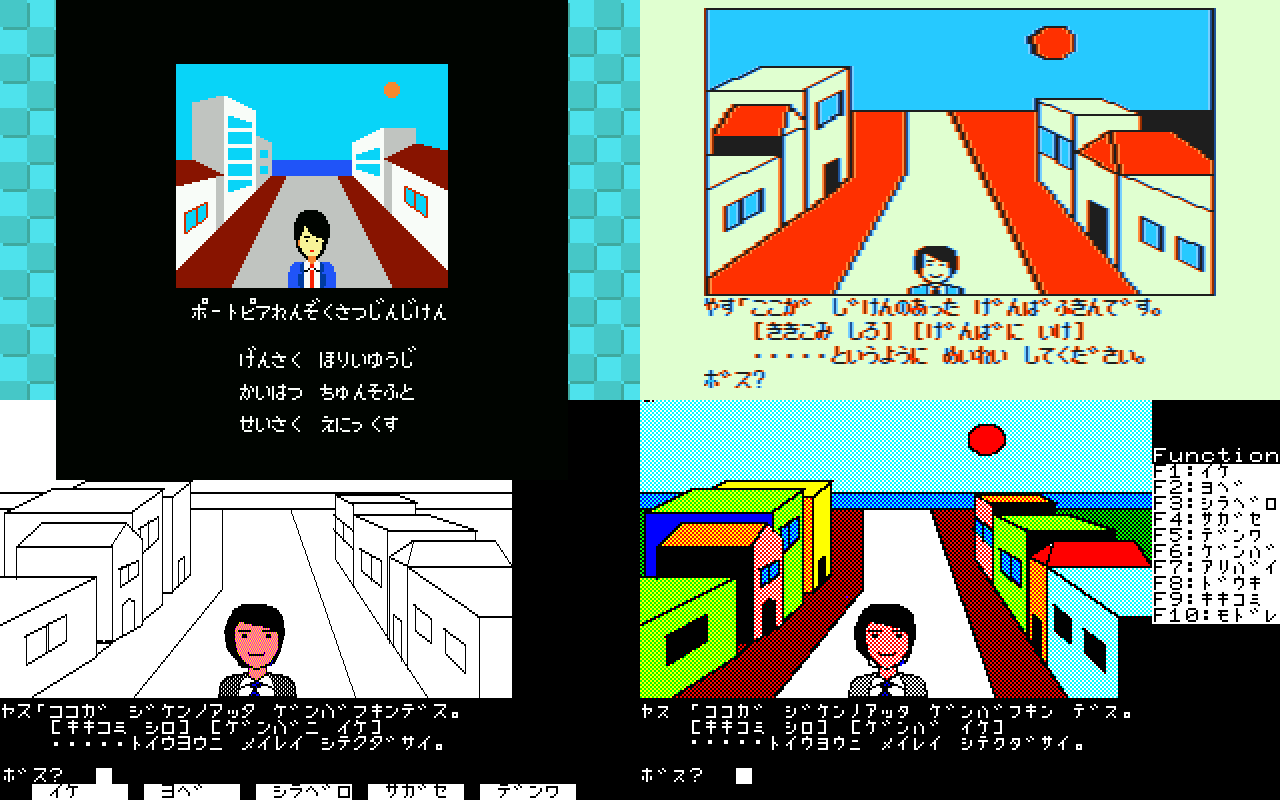
I could go on for hours highlighting examples of this and how their visual mechanical differences make them what we would call remasters or remakes in a modern context. Everything from the half-finished version of Pac-Man for Atari 2600 to the veritable smorgasbord of different versions of Donkey Kong (1981). (There were like 17.) The sheer fact they are different, that they have such radically different interfaces, visuals, sound effects, and likely game feel, to me, makes me feel they need to be considered something more than a port or a reissue.
It does sound silly to call Intellivision Donkey Kong a re-whatever of the original, because it looks like they took the original and made it horrifying. However… they did recreate it. They did alter it for their own purposes. It’s so different that I would not consider it to be just a port. Which is a line that only gets messier when looking at games that… just kept being “converted” to different systems. The best example I can point at to illustrate this phenomenon is likely Ys: The Vanished Omens (1987), a game that, along with its sequel, Ys II: Ancient Ys Vanished – The Final Chapter (1988) have been recreated… too many times.
Ys was originally a PC-88 title developed by Nihon Falcom that was ported to basically every system the developers could for the ensuing decade. MSX, Sharp X1, FM-7, Master System, PC-98, NES, DOS, Apple IIgs, Sharp X68000, Japanese feature phones, Windows, Nintendo Switch via EGGCONSOLE. Then, alongside Ys II, it was released on TurboGrafx CD, Sega Saturn, Windows… three distinct times, PlayStation 2, Nintendo DS, PlayStation Portable, iOS and Android. …Then in 2021 they ported the PC-88 version Ys II to the Sharp X68000, because they thought it’d be funny, I guess.
If you want to know more about the ports and re-whatevers of Ys, check out Kevin the Bash’s excellent video on the subject.
It’s tempting to dismiss most of these as mere conversions or ports due to how incredibly similar they are, and many of them are. Most of the ones from the 1980s clearly belong closer to the reissue end of the spectrum, being recreated with the goal of replicating the original as best as they possibly could on newer hardware, graphics and all. However, not all of these versions of Ys are the same. Even beyond the evident visual or audio changes. The map, gameplay systems, feel of the game’s combat, ways its systems work, how you can move throughout the world, et cetera.
When two versions of the same game are made, but look radically different, and are for different hardware, while still being identifiably the same game, with the same story, layout, and gameplay style, I don’t see how you could call them anything other than a remaster or remake. The developers behind Ys Book I & II (1989) for the PC-Engine CD clearly looked at the originals, which were one to two years old, and did what they could to recreate them for new hardware, and how is that any different from any transformative remake that succeeded them? Want to see the differences for yourself? Well, just scope out two longplays or buy the original on Switch and acquire a copy of the PC Engine version. …Or wait for the PC Engine version to be re-released by Edia.
Whether it be arcade games being brought to consoles, console games being brought to computers, computer games trading spit with other computers, or games just switching from one console to another, stuff like this happened all the time in the 1980s.
So, to answer the question this part is asking, when did they start re-whatevering video games? Since there was hardware to re-whatever them on. Video game remakes were never anything new. They’re practically as old as video games themselves. We just didn’t call them remakes or remasters and accepted that they could be basically the same or wildly different, because it was the wild west.
I could spend hours going over what happened in this wild west, but do you really want me to describe the dozen different versions of Double Dragon?
I thought so.
Part 03: Re-Whatevers in the 90s

So, I explained a loose history of how games were brought over to multiple platforms back during the go-go years of the 1980s, even the 70s, and I think the reasons why are obvious. Because if you went through the trouble of making a game, you want to get the most out of your return, you want your brand to be known across multiple users, and want to make money in a product-driven industry.
Arcade games were popular, but you could not take them home with you, so arcade ports were a no brainer since, uh, probably when Atari released a home version of Pong in 1975. Porting games to and from computers was a good business in and of itself. And with home consoles established, killed, then revived by the end of the 1980s, becoming capable of new feats, gaming now had enough history for people to look back at older titles and think “we could do this so much better today with modern tech.” Thus ushering in a precipitous wave of remakes.
As Microsoft DOS grew as an operating system, Sierra On-Line took their hugely successful King’s Quest (1984) and remade it for DOS and Amiga as King’s Quest I: Quest for the Crown (1990). As VGA graphics exploded the number of possibilities of what you could display on a computer, the “open world” space trading simulator Elite (1984) got a remake in Elite Plus (1991).
For the Super Nintendo, Super Castlevania IV (1991) was a narrative retelling of the original Castlevania (1986), which can be considered a remake if you consider games like Resident Evil 2 (2019) to be remakes. Though Castlevania Chronicles (1993) is definitely a re-whatever of some flavor, recreating Castlevania (1986) for the Sharp X68000.
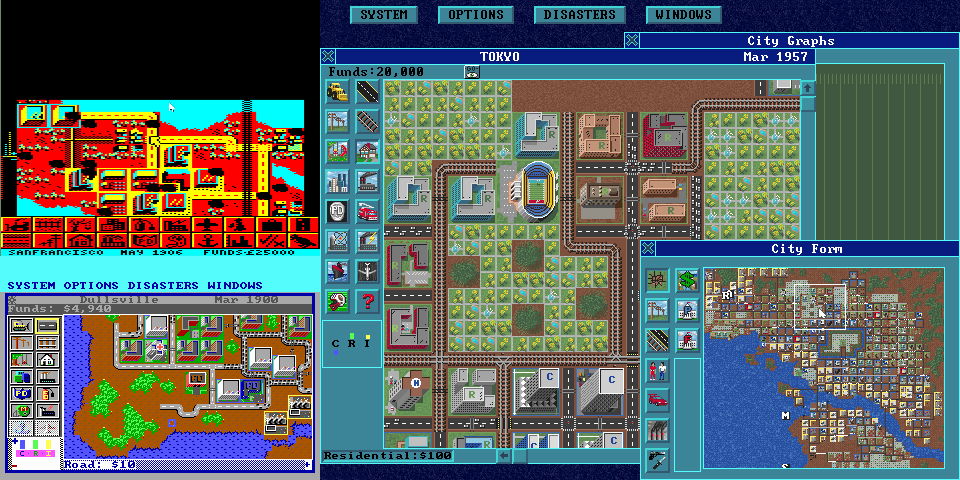
SimCity (1989) for DOS was re-whatevered in 1993 with a new interface, graphics, and FMV cutscenes with SimCity: Enhanced CD-ROM. That is in addition to all the times that game was “converted” to other platforms via re-whatevers, like with the… Acorn Electron. Whatever that is!
Though, I think the most prominent instance of a remake of this era is easily the release of Super Mario All-Stars (1993). While also a compilation, the title featured four fully featured remakes, all bundled together into a single package, selling over 10 million units. That’s an impressive number today, but it was the second best-selling game for the Super Nintendo, a system that sold less than 50 million units. This was an insane level of success, and it assuredly went on to further normalize the idea of recreating and repackaging a bunch of older games in a new, updated, form.
This bundling approach was actually strangely common across the Super Nintendo. We had Dragon Quest I & II (1993), whcih is self-explanatory. Kyuuyaku Megami Tensei (1995), a remake of the first two Famicom Digital Devil Story: Megami Tensei titles. Fire Emblem: Mystery of the Emblem (1994) was roughly half a remake of the original Fire Emblem, retelling the story before expanding it with a second half. I would also throw in Ninja Gaiden Trilogy (1995), which some sources seem to consider just a compilation. I say that they remade it, but did a half-assed job. Wizardry I•II•III: Story of Llylgamyn (1999) was late, but it also counts!
There were, of course, plenty of other compilations for other systems, such as Mega Man: The Wily Wars (1994), and various 80s games were brought forward to newer systems through the use of remakes. We saw this when Space Invaders was remade for Game Boy and Super Nintendo and oodles of other systems in 1994. How (Ms.) Pac-Man… was released for anything with a button. Or how Tetris was released on anything with two buttons. Or how Nintendo, late into the Super Nintendo’s life, went all out with Japanese-only remakes.BS Zelda, Metal Slader Glory: Director’s Cut, Wrecking Crew, Famicom Detective Club II, Super Famicom Wars, really, I could list off niche novelties of this era for an hour.
However, as the latter half of the decade played out, the way games where re-whatevered began to change. I am of the mindset that conversions of the 1980s are on the sunnier side of the re-whatever spectrum because the games had to be effectively recreated to their systems, and were often more than just simple one-to-one ports. One-to-one ports could be done, but where not commonplace… until this pivotal juncture in gaming/technological history, where it became possible to emulate prior machines. This can be attributed to growing technological understanding, the power of modern hardware, and the magic of the CD-ROM medium suddenly made it very plausible to play and resell older games on new hardware.
In a funny bit of poetic timing, the next generation of gaming was ushered in with the 1994 debut of the PlayStation along with its first licensed title, Ridge Racer (1994), a re-whatever of the 1993 arcade hit. Anyone who has played the PlayStation version knows, as the game boots it greets players with a version of Galaxian (1979). For the next couple of seconds, they can move their spaceship around, shoot at some alien bugs, and wait until the screen transitioned away into the attract mode, showcasing the hottest racing action on consoles. It showed both how far video games had come, yet that did not change the fact that the first thing lord knows how many PlayStations ran was none other than a game out 15 years ago.
While obviously not the reason for any trend, this decision symbolically represented that PlayStation was not only a home for the latest and greatest, but it could be home for faithful conversions of classic games from a prior era. No longer did games need to be recreated from the ground up for a new system, now you could just bundle a bunch together, press them on a disc, and sell them. I don’t have a great number for these, as MobyGames’ tagging system is in no way comprehensive, but these were decently common.
To name some of the higher profile compilations on PlayStation, the platform was the birthplace of the Namco Museum series, and was home toa whopping six entries. Capcom re-released five compilations, including a compilation of compilations, and the first seven classic Mega Man games. Konami put out a bunch of MSX collections. Square Soft re-released five Final Fantasy games, with only nebulous changes— most of them bad.
Sunsoft did the same with a bunch of NES games. Atari was pumping out compilations while being shuffled around between new masters. Activision gave it a whirl with some of the most descriptive game names of all time, like A Collection of Activision Classic Games for the Atari 2600 (1998). Williams and Midway had their Arcade’s Greatest Hits two-pack, because they could. Sega, on their little planet that could, was starting up their long-running and confusing Sega Ages line that would persist in waves for the following 30 years.
Stuff like this was happening in the background, seemingly lessening the need for any typical remake by introducing an alternative. If you wanted to play a classic game but only had a PlayStation, then you could pick up these collections and enjoy them. They were not always perfect, or great, but they were a way to play games that were no longer being sold in most stores, and acted as a way to preserve these games without imposing too many changes on them. Ms. Pac-Man on Mega Drive is not the same as Ms. Pac-Man from the arcades. However, the version of Ms. Pac-Man on Namco Museum Vol. 3? The emulation might not be perfect, but it’s the arcade version, no doubt.
All of this actually related to a trend that magazine writers were mentioning during the era, highlighting how “retro gaming” was becoming big right as modern games were shifting over into 3D.
Next Generation, in their second issue was pretty enthusiastic about the return of many older games, largely espousing the virtues of late 70s and early 80s arcade gaming: “What do these old games have in common? They all offer players a rigid task (survival), a rigid set of tools to complete it (typically control of your ship and one or two weapons), meaningful rewards (points, extra lives and new levels) and then, and this is the Kryptonite, freedom to play the game exactly how you want.”
All of this was positioned in contrast to how linear games have gotten or how they rely on cutscenes and FMVs to make their point. …Which are exactly the same type of arguments I remember hearing back in 2010, and that can easily be found today. Time really is a flat circle.
The British Super Nintendo magazine, Super Play, in issue 37, similarly hosted a segment about how retro gaming is becoming a craze, yet was dismissive of the notion that it could go on, writing: “Ultimately, retro gaming is, unlike any other type of game, something that cannot conceivably go on forever. There are, after all, only so many confirmed classics that can be deemed worthy of excavation. Don’t get me wrong, there are legions of classic games out there, and, whenever I get the opportunity, I play my own old favourites. But I play my newer favourites much more often. And anyone who doesn’t is either blind, stupid or, more probably, currently making quite a decent living out of being an authority on video games.”
Little did they know, retro gaming would never die out, and would merely shift as time goes on, only becoming bigger as more things became retro.
I particularly liked how PSExtreme put it in issue 6. They wrote, in a Buster Bros. Collection review: “Retro-gaming is becoming a genre unto itself and it ain’t no surprise – video games have been around for 20 years, more than enough time to build up a nostalgia and mythology all their own. Plus, it doesn’t hurt that today’s home game systems can effortlessly emulate ’70s and ’80s gaming technology.”
Straight to the point, enthusiastic about modern technology, and recognizing that people of course want to experience oldies
I could go on, but I think you get the idea.
Despite this boom, plenty of games still conducted proper remakes on this brave new hardware, ranging from further refined versions of games that were already created. The cult classic sci-fi RPG Linda³ Again (1997) was a refinement of the ideas present in the PC Engine CD original, but with better graphics, more cutscenes, and additional scenarios. The adventure game granddaddy Zork was given a Japanese only remake, Zork I: The Great Underground Empire (1996), that added graphics and music, because Kohei Ozaki at Arc System Works had a VISION.
The Mega Drive CD RPG two-hit-wonder, Lunar, received a lavish remake that expanded on just about everything the original games were attempting, becoming the de facto versions. Spike Chunsoft’s sound novels were given new life through the power of the CD-ROM, offering higher quality backgrounds and music. And Feda Remake! (1996) was… Feda Remake!. It’s right in the name!
Namco: Anthology was launched as a series to remake eight classic arcade games with a fresh coat of paint, with some going further than others. They took a 2D golf game, made it 3D, and added anime girls, so that’s like four times better.
Following their run on the Jaguar and under Hasbro’s ownership, Atari put out a bunch of revivals of their classic IPs, Tempest, Defender, Asteroids, Missile Command, Q*bert, Centipede, Galaga, Frogger— No, I don’t know how Hasbro got the rights to make a Galaga game for PC that nobody’s ever heard of. Though, despite being classified by blokes as remakes, these are clearly sequels, or reboots, but lack the qualifiers for a remake. There’s no significant story, world, or character in any of these, and the gameplay is often radically changed, so different that they have a remake of the original as… wait. If you include a remake in your reboot, does that make it a remake? I guess, anything with a full recreation of something inherently contains it! …My head’s starting to hurt.
Looking at the handhelds, the Game Boy Color was home to an odd little cottage industry Nintendo established, where they made the Game Boy Color fertile ground for publishers to resell Game Boy games, now with color. Tetris DX, Wario Land II, The Legend of Zelda: Link’s Awakening DX and… uh… those were the only major examples, but that did not stop them from trying to remake games for the Game Boy Color. Examples include Donkey Kong Country, Rayman, Super Mario Bros. Deluxe, Crystallis, the first three Dragon Quests, and the Game and Watch Gallery titles. It showed the power of the Game Boy Color, but as a handheld mostly propped up by Pokémon at the time, these efforts did little more than satiate the appetite for its successor.
There are also a few special remakes that I want to highlight, which might be part of a larger trend, but it’s super easy to overlook games this old, and unlocalized. Regardless, my favorite example of a remake from this era has to be Virtual Hydlide (1995), a remake of Hydlide (1984) using cutting edge tech that, uh, the developers were still halfway through learning. It had everything! A procedurally generated 3D world. Muddy environmental sprites. A protagonist who is just some photos of a White guy. Pre-rendered enemy sprites Fully 3D dungeons with simulated lighting effects. A timer and score system for the high score system this game inexplicably had. It’s an extreme remake, borderline unrecognizable to the original in terms of everything, but it sure was using the Saturn’s technology in a way that few games ever attempted.
Others, such as The Journeyman Project: Pegasus Prime (1997) really exemplify just how rapidly technology was evolving in this era, as it was a full remake, released four years after the original. What was initially a harshly innovative game for its early use of pre-rendered graphics and FMV was transformed into something more in line with what PC games were doing in 1996 specifically. The title was at a far higher resolution, had oodles of voice lines, more video, fully animated 3D cutscenes rather than index card sized video feeds, but it also considerably changed the tone and certain plot threads. Much of the optimism about the future had been faded away with a more realistic art direction, while the tone was further skewed by the infusion of certain comical performances.
Which one was better is ultimately a matter of opinion, but I am making specific note of this game because it took the developers four years to radically change their vision for a game they made, and then they made another version they were so confident was better, they were originally going to call it a “Director’s Cut.” Oh, and take a guess as to what version is available on GOG and Steam. It’s not the original! Gee, I hope that we won’t see THAT happen in the future!
There were other transformative games of this era, like the Dune II (1992) remake Dune 2000 (1998) or Tex Murphy: Overseer (1998) the remake of the first Tex Murphy detective adventure game. However, due to all the lighter remakes of this era and the influx of game compilations, I guess there was not as much of a need to remake oodles of 2D games in 3D, beyond the handful I mentioned. The fact that compilations were commonplace was a remarkable shift, painting this idea that older games could be brought over emulated, and resold, keeping them alive, keeping them available.
The foundation was made, and come the 2000s… things were about to get crazy. I’m talking about remakes up the wazoo, compilations up the bunghole, and the introduction of something that has been strangely absent since I started this history lesson.
Interlude: What About The Remasters?

You may have noticed that I have not really been talking about remasters, and the reason why is pretty simple. The term remake has been around for a long time, as the art of a remake has been around for pretty much a century. Silent films were remade as talkies, films were re-adapted, and as the decades compounded the notion of a remake was gradually integrated into the cultural lexicon. The term remaster, by comparison, is a comparatively modern.
Remastering did not really enter the cultural lexicon until the advent of the CD era, and the term is largely lifted from the music industry. There, a master of an album or song is produced and the releases— the records and cassettes— are derived from there. As time went on, the technology used to master music became increasingly sophisticated. CDs brought new challenges to the field of recording and transferring music, as what was once a field of analog sound suddenly shifted over to digital. The technical details are a bit beyond me, and not too important, but the gist is that this new medium gave way for a line of “digitally remastered” albums.
The remastering process for these referred to the very real act of re-mastering an album years after the fact with modern technology for a digital landscape. Though, at some nebulous point, the term remaster gradually shifted into becoming a marketing label of sorts, a way to sell people on something. Why? Because a remaster sounds cool, it sounds sophisticated, it sounds quality.
From there, albums continued to be remastered and the term was picked up by the film and TV industry as it shifted from VHS to DVDs and Blu-rays. For those, the mastering process was a bit different. You basically had to scan every scrap of film, correct for scratches, while preserving the original intended color and sound, and I can only describe the people who do this as wizards. Well, the people who do it well. Those who remove film grain or color things wrong, out of ignorance of laziness, should never be invited to a party for the rest of their life.
Video games have their own equivalents of masters— their source code— which was historically treated without much care. People would throw it out, toss it in a drawer that moved offices thrice, overwrite it, or just lose it, as video game preservation or anything of the sort was not on their mind. So long as they could ship more carts and discs, what did they need it for? Well, they needed it for releasing updated versions with bug fixes, difficulty adjustments, et cetera. …A process that was confusingly called remastering.
Okay, yes, there are two definitions of remastering in video games. The original version meant to apply a patch to a disc or cartridge to replace a problem or error in the original master. I am bringing this up purely for the same of completeness. Please forget this alternate definition because it will NEVER come up again.
The idea of remastering these older titles, in the manner we are more familiar with nowadays, did not come into prominence until the latter half of the 2000s, the Wii, PS3, and Xbox 360 era. This is when games started sporting the subtitle of remastered and HD to indicate that they were adjusted for modern hardware requirements.
In case you are curious, and I know I am, I noticed that the term remaster was “correctly” being used for games sometime during 2007. GamePro, issue 222 called Tekken 5: Dark Resurrection for PlayStation 3 a 720p remaster. Official Xbox Magazine issue 72 called The Chronicles of Riddick: Assault on Dark Athena a 720p remaster of Butcher Bay for Xbox 360. Though, it took until around 2009 for this to be thrown around semi-regularly across magazines.
Also, yes, remasters of the PS3 and Xbox 360 era were often not 1080p, as the systems just couldn’t do that with most games. We’ll get around to the limitations of that era in… about nine thousand words? Gosh, I really am a blabbermouth!
Part 04: Re-Whatevers in the Early 2000s

And lo, after the boom of retro gaming, after the establishment of the three-dimensional future, we are finally here at the era where the games industry looked back, smirked, and said “it’s re-whatever time, bay-bee!”
While I am not putting much stake in MobyGames’ dataset, as I know it’s full of gaps and some questionable classifications, I still want to bring something to your attention, a quick and dirty graph I whipped up showing the remakes, remasters, and reissues released per year. And per this data, edited to remove fangames, 2003 was a banner year for remakes with 29 titles, before peaking with 37 in 2008. Now, you might be asking how that’s possible, and the answer can be attributed to five key factors.

One, after cutting their teeth on 3D the prior generation, game designers had a far better, more standardized, way of delivering fully 3D experiences. After some initial struggles, consoles were good enough to do pretty much whatever if you make a few compromises.
Two, after the PlayStation domination of the prior generation and consoles all being horses of different colors, the three main consoles were all pretty similar. With some compromises, any PS2, GameCube, or Xbox game could be made to run on the other system, and multiplatform titles became common like never before. This meant any game was being marketed toward more people, a wider group of people, which went on to boost the sales ceiling of games overall, leading to the most bestsellers yet.
Three, the median age of the gamer was growing. NES kids were now adults, or getting there, had more disposable income, and were both more eager to spend money and fond of games they remembered from their youth. Atari kids were, I dunno, 27 or something, so they had money to spend as well, and if they had been following gaming this long, they were probably nostalgic for late 80s gaming as well. There was more money in retro gaming! This was the Atari Flashback era!
Four, the games console market was expanding. While the PS1 had a disgusting amount of games released worldwide, the market for games was only growing better as folks didn’t “grow out” of it and an influx of kids came in. To illustrate this, roughly 150 million home consoles were sold in the PS1 generation. PS2 generation? About 200 million. Not the 270 million apex of the next generation, but we’ll get there.
Five, the Game Boy Advance. Just… the Game Boy Advance. It’s a system notorious for its deluge of re-whatevers between compilations, reissues, remakes, and rejiggered versions of Super Nintendo titles. I wanted a definitive list of how many of theses there were, but time and language barriers prevented me from going all the way. However, I was able to determine some minimums, based on the North American library and some other games I could recognize
The Game Boy Advance had AT LEAST 33 game compilations. 32 reissued Famicom games, and at least 100 Re-Whatevers. That last one is a bit loaded, grouping remasters, remakes, and certain ports that had to make changes to run on the GBA, along with odd ducks like Zero One SP (2004), an updated and expanded version of Zero One (2003). But the exact number’s not the point. The point is that, of the 1538 Game Boy Advance games, over a tenth of them were just old games.

This is not too surprising, as the Game Boy Advance is somewhat notorious for its lacking original library— less than 20% of the North American library is a non-licensed non-sports, non “handheld spin-off of a console game.” But I think it wonderfully indicates that things have shifted. Retro gaming was growing in the mid-90s, but following the turn of the millennium, the industry entered a re-whatever wave that… has pretty much kept on going for 25 years.
Looking at the information I’ve accrued, outside of this article, in my spreadsheets… I’m not even sure where to begin without just spewing out the laundry list of beloved re-whatevers that were in this era of gaming, as it was full of major successes and a lot of oddball oddities.
Super Mario World (1990), Super Mario World 2: Yoshi’s Island (1995), Super Mario Bros. 3 (1988), and Super Mario Bros 2: Doki Doki Panic USA (1987) were all used as the basis for the Super Mario Advance series. This effectively set the tone for other developers to treat the GBA as a platform to explore old ideas again. I mean, if Nintendo’s going to treat this as a portable Super Nintendo, then it can stand to have another 40 or so ports/remasters.
Though, I’d sooner say that SMB2 was remade again with Super Mario Advance. The other three titles are largely mapped to their originals with only a handful of changes, while Super Mario Advance (2001) has full on new mechanics compared to the original game, reworked visuals, and even voice clips, just to flex. To tell developers hello there, this hardware’s come a long way, but this is as far as it will go, and if you don’t use it, they’ll remember this. Why didn’t they spruce up the other games? Probably because they didn’t need to!
Nintendo set a standard with these releases, and far, far too many developers heeded, bringing over oodles of games. Just some highlighted remakes include: Sword of Mana, Shining Force: Resurrection of the Dark Dragon, Double Dragon Advance, River City Ransom EX, Harvest Moon: More Friends of Mineral Town, Kirby: Nightmare in Dream Land, and Metroid: Zero Mission. Remasters and reissues included everything from Contra III, Doom, Earthworm Jim, The Lost Vikings, two Street Fighter games, ChuChu Rocket!, the Donkey Kong Country trilogy, even SimCity 2000 for some reason. But I could go on all day just listing these oddballs. Like, I don’t know HOW they squeezed Wing Commander: Prophecy (1997) onto a GBA cart, but they did. They sort of did.

Moving, sort of, past the GBA, classic Japanese RPGs were a prime target of re-whatevers across the board. The Final Fantasy series received a string of remakes to introduce the earlier titles to a new generation. The first two were remade on the WonderSwan Color, which was the basis for the PS1 versions. These were drastically remastered for the GBA (charges 4 chumps, MP for lyfe) which then saw remastered versions of FF 4, 5, and 6 with new features in tow.
Dragon Quest IV got a full remake for the PS1 before the console phased out. The 2004 PS2 remake of Dragon Quest V has been routinely praised as the best version of the game. While the favorite cult classic that Sega doesn’t want you to play, Skies of Arcadia, became one of GameCube’s few RPGs with its Legends remaster.
The first two Shin Megami Tensei titles were enhanced with PlayStation releases, then dehanced with GBA ones. They even remade Lunar for the GBA, changing things just ‘cos they could. Tales of Phantasia (1995) was remastered for the PS1 in 1998, then brought over to the Game Boy Advance with some cut features in 2003, before getting a 2006 PSP re-release that added voice acting and some new game plus features. …Because someone at Namco loved selling this game.
Oh, and Front Mission (1995) was remastered for Wonder Swan Color in 2002, featuring some graphical and mechanical changes. It was then remastered and given a new campaign in Front Mission 1st (2002), before it would be given a UX rework, color change, and various script alterations with its DS release in 2007. …Afterward, it got a 2022 remake from the remake factory at Forever Entertainment.
Rent A Hero No. 1 (2000) remade an already fascinating 1991 superhero RPG / fighting game / life sim hybrid into… that, but with a fully 3D world to explore, characters to talk to, and a more robust mission. It became a cult classic when it was remade for a reason, offering such a level of freedom and robust world that I think many don’t even realize it is a remake.
Romancing SaGa: Minstrel Song (2005) and Wild Arms Alter Code: F (2004) were both quality remakes of their original RPG counterparts that used the power of the PS2 to do things differently. The general experience roughly maps, but the games have a different, not necessarily better, character with their PS2 incarnations. The original Wild Arms (1996), while heartfelt, was still in the murky transition period between the SNES and PS1, so the remake feels a bit more cohesive, if overly standardized. While Minstrel Song is just another game next to the original Romancing Saga (1992), which looks like Final Fantasy IV’s (1991) table scraps.
Oh, and I love Tales of Destiny: Director’s Cut (2008) for the sheer gumption behind it! The original Tales of Destiny (1997) was the first international Tales game and struggled to stand out in a post FF7 America, being a souped up SNES game on the PS1. However, it was enough to earn a cult following for the title, before it would boost with its 3D era during the PS2 and GameCube titles.
Then, at the end of the PS2 generation, November 30, 2006, days after the PS3 came out, Namco released a full remake of Tales of Destiny, with 3D backgrounds, more proportional character sprites, voice acting, and a revised version of the rapidly deprecating 2D battle system. The series was taking a damn near retro approach to a console remake at the time… then they updated the remake two years later, adding extra events, challenges, and some extras, because they could. …Then they released an updated version over a year later, because they could!
Okay, okay, that’s enough RPGs— for now.
I simply cannot talk about remakes of the era without giving specific attention to Resident Evil Remake (2002). This is often considered the gold standard of remakes, as it drastically expanded upon what the original was trying. RE 2002 delivered drastically more detailed backgrounds, sound design, enemy AI, and a more focused, confident, horror experience. It’s by no means a replacement of the 1996 original, as it has qualities all its own, but by taking a step back, it two steps forward for the survival horror genre as a whole.
Metal Gear Solid: The Twin Snakes (2004) could have been to Metal Gear Solid (1998) what Resident Evil Remake was, but Denis Dyack just had to pee in the soup. Twin Snakes was basically Nintendo’s lone attempt at aping their competitors’ series with an exclusive made for their system. However, its attempts at backporting the gameplay of one title into the design and levels of another, combined with the racist voice acting decisions, and hyperbolic Kojima-approved cutscene direction, make this remake an oddity.
Conker: Live & Reloaded (2005) is easily one of the most lopsided remakes I’ve ever seen, as while it is one of the most gorgeous looking games from its console generation, its also a downgrade in many ways. The animations were carried over from the 2001 Nintendo 64 original, the gameplay feels even sloppier than the original, and it’s censored to the point asshole is blurted out. I always thought the game was a rushed last gasp before Rare released two Xbox 360 launch games, and I still think that’s a plausible theory.
Half-Life: Source (2005) was a great idea to upgrade Half-Life (1998) with more advanced physics, lighting, and water effects, bringing it in line with the hotness of Half-Life 2 (2004). However, it ultimately degraded in its reputation over time, its attempts to be modern made it ultimately feel more dated, and less whole. This eventually led it to be officially removed from sale, from Valve’s own store, and sunset in favor of the original. …Over 15 years after it came out!
However, my favorites of this era are when developers remade old 2D games in 3D.
Hudson Soft returned with some fully featured remakes of the original games, but with a hefty number of asterisks attached. Tengai Makyou II: Manji Maru (1992), one of the best-selling games for the Hudson’s PC Engine, was remade in 2003, but the mixture of flat basic 3D and 2D character sprites made the game look… kind of unpleasant. Other games are more complicated, namely the Hudson Selection series, which contain “remakes” of some of their earlier titles: Lode Runner (1983), Star Soldier (1986), Bonk’s Adventure (1989), and Adventure Island (1986).
Lode Runner is actually a reimagined 3D sequel called Cubic Lode Runner, which looks like a predecessor to Captain Toad’s Treasure Tracker (2014). Star Soldier is actually a new game in the series, bearing such little resemblance to the original that I cannot even call it a remake, it’s just a new game. The original was entirely in space, and in this one you stop being in space after stage 3 of 10.
Bonk, or PC Genjin, is a looser remake of Bonk’s Adventure, with redesigned stages and bosses, yet still close enough to be deemed a remake. A remake of the NES or PC Engine version? Uh… both? Yeah, it’s a remake of both! Meanwhile, Adventure Island starts with some one-to-one stages, but gradually shifts its presentation and structure around, and it also had unique bosses, unlike the original. …Crap, did I forget to mention that Adventure Island (1986) is itself a re-whatever of Wonder Boy (1986)? I did!
None of this information is logged in any obvious place by the way. MobyGames, fan wikis, and Wikipedia all call these games remakes. Nobody’s categorizing this crap properly! They are not playing these games! …Or even looking up a YouTube video on them.
However, an even more complicated series of classic remakes were the Sega Ages 2500 series for the PlayStation 2. These were never released outside of Japan outside of their Sega Classics Collection (2005), which contained 3D remakes the following: Monaco GP, Fantasy Zone, Space Harrier, Golden Axe, Bonanza Bros., Columns, Virtua Racing, OutRun, and Alien Syndrome. This was roughly only half of the remakes though, as Sega also remade Phantasy Star I, Gain Ground, After Burner II, Black Belt for Master System (originally called Hokuto no Ken), Phantasy Star II, and Dragon Force.
None of these looked particularly brilliant, the 3D work was basic and these all have a perceptible flatness to them. Even back then, reviewers like EGM, in issue 189, were pretty harsh towards the need to remake these titles. Today, these would be considered pretty toothless remakes that replicate the gameplay faithfully, or at least attempt to, while throwing away the art direction.
However, around volume 18 of 33, Sega fully pivoted away from remakes and toward collections, re-releasing the following games: Decathlete, Winter Heat, Virtua Athlete 2000, Virtua Fighter 2, Virtua Fighter 2.1, Fighting Vipers, SDI: Strategic Defense Initiative, Quartet, Advanced Daisenryaku: Deutsch Dengeki Sakusen, Borderline, Congo Bongo, Doki Doki Penguin Land, Head-On, Tranquilizer Gun, Last Bronx, Alien Soldier, Dynamite Headdy, Gunstar Heroes, Dynamite Deka (Die Hard Arcade), Tetris (Arcade), Bloxeed, Flashpoint, Panzer Dragoon, Galaxy Force (Master System), Galaxy Force II (Mega Drive), Galaxy Force II (Arcade)
Then there were series-wide collections for Space Harrier, Monster World, Phantasy Star, and Fantasy Zone, and not content with making this complex enough, Sega also produced at least three remasters: Galaxy Force NEO Classic is a remaster of a 1988 behind-the-ship shooter that replaces a few sprites with higher fidelity versions and ups the resolution, smoothing out the 3D elements of the game. Cyber Troopers: Virtual On added modes, an additional playable character, a backported feature, and 16:9 display, because they saw the future. While Puyo Puyo 2: Complete Set is just Puyo Puyo 2 but with some new features, music, voice-overs, and options added.
…And while talking about Sega, I am legally obligated to mention their two diametrically opposed remasters with Sonic Adventure DX: Director’s Cut (2003) and Sonic Adventure 2: Battle (2001). DX opted to replace models and tweak environmental designs to make the game appear more modern, but much like Conker. The end result simply looks more awkward than anything else, with assets of different eras melding together in a game that lacks the visual cohesiveness of the original, and with it the same charm. Oh, and they also added a pretty bad mission mode for cheap bonus content while introducing a bunch of errors that made the game play materially worse than the original. Sonic Adventure 2: Battle, however, was just a better and fuller version of SA2 now with a battle mode and some visual tweaks. Funny how you can nail a remaster and then botch another in the span of a year.
Xbox’s attempts of swaying developers to release PS2 bangers for their platform resulted in quite a few remastered titles that had small amounts of additional footage and arguably better visuals. Genma Onimusha (2002), Silent Hill 2: Restless Dreams (2001), Metal Gear Solid 2: Substance (2002), Fatal Frame II: Crimson Butterfly – Director’s Cut (2004), Tenchu: Return from Darkness (2004), and probably some more I’m glossing over. They also had Treyarch whip up a recreation of the first two Tony Hawk games with Tony Hawk’s Pro Skater 2x (2001). Koei Tecmo almost did the same thing with Dead or Alive: Ultimate (2004), but that was mostly a port of the first DOA and a remixed version of the second. You might insist that these are enhanced ports or what have you, but I’m calling them remasters!
I also want to talk about one of the oddest instances of a remake in this era, which pertains to my beloved Ys series again. The series’ lone side-scrolling pivot, Ys III: Wanders from Ys (1989) is notable for being one of the few times a game received two remakes in the same year. Series developers Falcom developed an overhead 2.5D action game, dubbed Ys: The Oath in Felghana (2005). Felghana expanded upon the original story and characters but effectively remolded the black sheep of the series into something that resembled the latest entry, Ys VI: The Ark of Napishtim. I played it twice, reviewed it a few years ago, and think it’s DOPE.
Meanwhile, Taito, the Space Indavers guys, developed a more faithful adaptation of the original that largely kept the level design, gameplay, and general boss design were, opting to mostly add to the story and possibly some side content. (This PS2 remake has no English patch.) Though, there is something very cheap to how the artwork of the game looks, with the sprites, portraits, backgrounds, and effects not quite looking right. The painted backgrounds with 80s game level geometry combined with the detailed character, old school UI, detailed character sprites, and off-looking enemy sprites never made the game seem particularly appealing.
This was then followed up with remakes of Ys IV from Arc System Works, the Zork guys, and V, from Access Co., the Devil Children guys, both of which were significant departures by comparison. Both of these remakes were modeled closer into the mold set by Ark of Napishtim, rather than the original games. The world was now 3D, characters used 2D sprites, the game has the same jump, slash, and build up a combo gameplay as what Falcom was doing at the time. However, the team did not seem to quite get the nuance of what Falcom was doing, with their fat damage numbers and often ill-fitting enemy designs. Still would love to play them, if only for my own sick pleasure.
Okay, okay, that’s enough indulgences, let’s get back to some relevant history! …The Three Stooges: Digitally Remastered Edition (2002) was a remaster of the original licensed NES game that released for PC and Mac, but is most notable for being the first game I could find to contain the word “remaster” in its title. Well, that or Defender of the Crown: Digitally Remastered Collector’s Edition (2002), put out by the same company, Cinemaware Inc. However, using Three Stooges is funnier to me.
…And then Defender of the Crown was remade a year later as Robin Hood: Defender of the Crown (2003). Just goes to show that you can do both a remaster that radically changes the look of a game and a full modern remake.
Around this time, there was also a trend of games that rebooted their original incarnation, changing things so radically they cannot be considered the same game, and may as well be a new IP. Spy Hunter (1983), an early arcade driving combat game, was followed up with Spy Hunter (2001), a comparatively bombastic driving action game inspired by 1990s action movies. But it is so divorced from the original that it’s effectively its own thing, and is less a remake and more a reboot, as it’s not using anything but vague ideas from the original. Rygar: The Legendary Adventure (2002) was a reboot of Rygar (1986), but it was a title clearly crafted in the mold of a 3D action game of the era. It did not have any buff bearded dudes with no shirt on who offered you advice, nor did it have Ligar. How can you have Rygar without Ligar? Accordingly, not a remake.
The same with the Shinobi and Defender reboots trotted out like they were hot stuff. Dragon’s Lair 3D: Return to the Lair (2002) though? That was a remake! Dragon’s Lair (1983) was actually first remade in 1990, one of the first instances of a game being marketed as a remake, and was remade again in 3D! …I’m only giving attention to as it is an example of a highly homogenized, if not modernized, remake. They took an FMV game, tried making it a deliberate precision platformer, and then made, again, as an action adventure platformer with occasional puzzles that’s more Medievil (1998) than anything.
Along with all of these remakes, there were plenty of compilations, but… what do I need to say about them? Atari, Intellivision, and Activision were all given large semi-representee collections of their classic libraries. Capcom had at least six collections, Midway had three, Namco had their Namco Museum line established, I already mentioned Sega, but they also had general Mega Drive and two Sonic collections, Taito also put out six collections depending on how you count, SNK put out, like, eight collections on their own! Even Nintendo got in on the fun with The Legend of Zelda: Collector’s Edition, because the GameCube needed help badly and the legacy of Zelda had to be pushed forward.
If you wanted retro games on these consoles, you had OPTIONS! This is before counting cheats like Animal Crossing (2001) debuting Nintendo’s Famciom emulator. I’m not even getting to the oodles of games that had extra games, like Narc (2005) having the arcade version of Narc (1989) and Final Fight Streetwise (2006) having a teribad version of the original Final Fight (1989).
Sorry, sorry, I am gushing throughout this entire segment, because there was just SO MUCH going on during this 6, or 7, year period, and this is kind of the game this whole article novella is built around. But before moving onto the next generation, where retro continued to ker-splode, I should talk about how people were viewing these re-whatevers.
In Electronic Gaming Monthly issue 154, they actually gave this question to their readers, who gave a pretty expected spectrum of responses. Some were younger and “never got to experience the joy of classic gaming,” viewing remakes as a substitute. One was just straight up enthusiastic, saying “I love seeing old games being remade for newer systems.” Another responded by pointing out contemporary trends in remakes, stating “that all remakes don’t have to be done in 3D” and highlighting duds like Mortal Kombat Advance (2001). While another stated that “Newer systems need unique characters to love and base games on.”
Official U.S. PlayStation Magazine issue 60 hosted a very similar questions a few months later, and got similar responses. Though, I especially love how direct Jonathan was with “who needs the classics when you have Grand Theft Auto?” Quite.
This was 2002 by the way, and discourse, the overall state of remakes, really has not changed as much as you might have thought, or hoped.
Xbox Nation issue 12 couldn’t help but knock the entire premise of arcade revivals in their Spyhunter 2 review, writing: “You’re not going to find many people rallying behind remakes of arcade classics and defending them as examples of top-notch videogame [sic] creation. After all, most of the appeal of these classics is their simple, addictive gameplay. When companies ‘update’ the gameplay to appeal to modern gamers, the result is often an awkward mix of old and new sensibilities.”
However, no amount of discourse I could dredge up changes the fact that critics still praised many of these remakes, expressed the same excitement towards them that they were obligated to express before most things. Most bold refutations of the notion of remakes would have probably shifted online at this time, but as we all know, if it’s on the internet, it’s very easy to lose.
On a somewhat related note, Computer Gaming issue 139 highlighted a lesser discussed yet still notable trend around the time that I’ve omitted. Fan remakes and recreations of games with the goal of keeping games both available on modern hardware and recreating them to more digestible standards. Back in 2002, this was a growing industry, featuring remakes of Ultima, King’s Quest, and Aleph One’s ports of Marathon, which became officially sanctioned. Also, a System Shock remake that petered out a few months after this article’s publication.
This is an area that I am choosing to omit from this discussion, but should be acknowledged when discussing this topic. With the rise of the internet and widely accessible tools, loads of people began creating fan games based on titles they loved. Some were original sequels or spin-offs. Some were ROM hacks that expanded an original game in a new way or turned it from one series to another. Others were remakes of their favorite games, made on more powerful technology, because they wanted to shine a light on the design of the original and expand what it was trying to do using BASIC and a dream.
I think these people are incredible, and these games are often remasters or remakes, but… this topic is already too big! Onto the next generation! And BOY did it begin with some REMAKE HYPE!
Part 05: The Final Fantasy VII Remake – 2005 – Contaminated The Ground Water

Circa 2005, the “retro gaming craze” has persisted for a decade without a notable decline, only growing bigger, as gaming had grown bigger than ever. As technology rapidly advanced, there was a palpable optimism around what the next generation would bring. The Nintendo DS was already out, promising whole new ways to view and play games. The PlayStation Portable was making its worldwide release, offering “console quality” experiences. The Xbox 360 was coming in hot and fast to begin the next generation early. While the Wii and PlayStation 3 would be subjected to a prolonged period of speculation and mystery.
More things than ever were possible in the world of video games. New IPs that would go on to define this era in gaming were cropping up in concept teasers. However, the games industry did not fall out of love with bringing back its older titles. In fact, as the games industry reached this new generation, the nostalgia bug was running rampant, and I think nothing exemplifies that better than this trailer of myth and legend. Final Fantasy VII: Technical Demo for PS3.
This E3 2005 trailer was revealed before E3 was commonly watched by the gaming masses. You had to pick up the latest gaming magazines for the hot scoop or check out gaming websites. Despite this… I think this just kind of broke people. Hell, it was bad enough for the first person who ever bought Final Fantasy XII on March 16, 2006 to ask Square Enix executives to remake Final Fantasy VII. Rumors about remakes of a Final Fantasy VII remake had been a thing since at least April 2001— along with remakes of FF8 and FF9— but this was more than just some blurb about how… Rondo of Blood is coming to GBA. This was Square Enix, trying to get you to buy a PS3, showing you what a game that over ten million people would realistically want.
It did not matter that this was labeled a “technical demo.” I did not know what that meant when I first saw the trailer. And to make matters worse, the games press encouraged paranoid behavior. In Electronic Gaming Monthly issue 196, staff was pretty clear in saying that “we believe that FFVII will eventually be remade, but it probably won’t be Square Enix’s first PS3 effort.” In Game Informer issue 148, staff said that there are no plans for a remake, but then hinted that this might be something bigger. “Creating such impressive visuals is a lot of work – work that it doesn’t make sense to waste on one short tech demo,” before going on and saying that the Unreal Engine 3 trailers ultimately gave way to Gears of War.
While not a sole factor by any means, I do not think you can discount the influence that the hype around a Final Fantasy VII remake had on a certain facet of the gaming community. Why? Because for as innovative as it was, while FF7 is a great game, it’s also kinda ugly. Its low res backgrounds can be hard to adjust to as they are representation of long-lost high quality renders that would look dramatically better. Its overworld models are charming, but crude above all else, and compared to the games that came after it, its presentation of events feels a bit like a puppet show. FF7 was easily outdone years after its release and lacked the “timeless” aesthetic of certain sprite-based games. In the 2000s, before the retro appreciation cycle had crystallized, people loved everything about FF7… except looking at it. …And a bunch of people felt shame as they showed it to someone whose first console was a PS2, where it looked positively archaic by comparison.
With a game like FF7, it’s unsurprising that some people developed such Graphic Lust, but I’ll get more into that in the second part of this Ramble.
Part 06: The Systemic Reissues and Backwards Compatibility of the PS3, 360, and Wii Era

Up until this point, the only way game developers could sell games was to print discs and assemble cartridges. Physical media was the only viable option, but game publishers and developers alike had been eyeing digital distribution as a concept for a while. While game companies have been eyeing online play since the early 90s, the push to online came with a second benefit: The ability to sell games that don’t require physical production, shipping, storage, or the risk of dead stock.
There were plenty of experiments. XBand, Sega Channel, Satellaview, SegaNet for Dreamcast, whatever crap the Sega Saturn tried, Final Fantasy XI Online for PlayStation 2, even bloody SharkWire Online for Nintendo 64! However, Xbox Live was pretty much the gold standard in this pre-HD era, bringing online play to oodles of games, and introducing a marketplace. It was not much of a marketplace, with just 28 games, in total, and the occasional bit of downloadable content.
These were all tests of some sort, and from it, the future was clear. Game consoles would no longer just be boxes that could play games. Instead, they would be connected online gaming devices with their own storefronts, letting people buy smaller games, retro games. This would radically shift both the types of games that could be sold and introduce a low-cost way for publishers to sell their games.
…But focusing things narrowly, this led to great opportunities for reissues, remasters, and remakes alike. While game compilations were pretty cheap to produce, they came with the risk of any physical product. If you don’t make enough, your revenue is capped. If you make too many, you are stuck paying warehouse fees. Why bear that risk when you can just releases these classic games digitally for no costs and 70% of the revenue?
Nintendo had their Wii Virtual Console, which slowly but steadily built up a library of over 700 titles across all regions, spanning 9 systems. (If you even want to count Master System and Commodore 64.) Sony took until late 2006 to release original PlayStation games on the PSP and PS3, but they did a respectable job, releasing almost 800 PS1 games! …Well, in Japan. In North America, they released a pathetic run of 265 games out of, what, over 4,000 games? They literally re-released 12 NA PS1 games in 2008, and the fact they released some PC Engine and NeoGeo games didn’t make a damn bit of difference.
PC platforms like Steam and GOG were able to serve the retro PC crowd by re-releasing a harder to track number of good old PC games. While Xbox… had their Game Room platform, I guess. Basically, it was meant to be a virtual arcade where you could buy Atari arcade and 2600 titles, Intellivision games, Activision games for Atari 2600, and Konami arcade games. It lasted for nine months, put out 188 games, and few people cared about it. I bought two games for it as a lark, and they were decently emulated.
Still, this combined with standalone compilations, both physical and digital, was a boon for classic reissuing, but it was not the only one. After the PlayStation 2 went off to a rolling start by being backwards compatible with PS1 games, turning the PS1 into a hand-me-down for younger siblings the world over, Nintendo and Microsoft wanted in on that user retention.
Nintendo hit it out the park with both the Nintendo DS and Wii, which were backwards compatible with 99% of Game Boy Advance and GameCube games respectively. Some odd exceptions applied to this list, but it was close enough, and all games ran off of native hardware, so emulation issues were rare.
Microsoft, meanwhile, worked from 2005 to 2007 to get almost half the Xbox library compatible on Xbox 360. The emulation was spotty, but they got most of the heavy hitters. However, they could not be arsed to released more than a handful of original Xbox games. Only 30 original Xbox games were re-released digitally, from December 4, 2007 to sometime in spring 2009. They did not even re-release most of their published titles. Hell, they did not even re-release Halo 2! Why?
PlayStation 3 was also a mess. Initially, it was the ultimate PlayStation, compatible with PS1 and PS2 games, but the PS2 emulation was always spotty and, in an effort to get this blasted thing under $500, they gutted the PS2 backwards compatibility from the system. This meant that every PS3 released after August 2007 retained the ability to play nearly all PS1 discs, but could not natively play PS2 games. …However, this second wave of PS3s could emulate some of them… only via digital downloads.
Ah, grief, now I need to explain this again. Starting in October 2011 Sony launched this terribly marketed and incredibly forgettable line of PS2 Classics for PlayStation 3. America, Europe, and Japan all had different releases libraries, different release dates, and while they technically spanned 333 games, 123 came out in North America, Europe got 160 games, and Japan received 118 games, so we know where the bias lied. DAMN YOU EUROPE!
Now, these sorts of things are very clearly not a remaster or remake, they’re just reissuings with few frills added, but their existence complicates the need and desire for both standalone re-releases of games, remasters, and remakes. If you can already play a game on your game console, why would people pay $60 for a slightly spruced up version when the other one costs, like, $10 or $20?
This is, of course, not counting the fact that compilations were still released for PS3 and Xbox 360 in particular. Midway Arcade Origins (2012) was a repackaging of 30 80s arcade games. Capcom Arcade Cabinet (2013) was basically the predecessor of Capcom Arcade Stadium. Sega kept it simple with Sonic’s Ultimate Genesis Collection… before complicating things with their five-part Vintage Collection line in 2012, which contained games that were missing from the collection, and games that were already bundled. Very confusing.
But I’m getting ahead of myself. In order to not lose my mind, it’s probably best to go through the systems in order, as they had such varied libraries of re-whatevers that it warrants specific attention.
Part 07: The RPG-Filled Re-Whatevers of the Nintendo DS

From moment one where this system was revealed, the Nintendo DS was selling itself on being able to handle the big 3D game Nintendo had a claim to: Super Mario 64. Not only that, but it could do more, facilitating multiple playable characters, legendary minigames, and more “traditional” platforming multiplayer mishaps. Super Mario 64 DS (2004) is a re-whatever of many flaws… but it is damn impressive and realistically should have set a tone for the DS. That this is the place to bring remakes of the first generation of 3D games. But, uh, that did not really happen.
Rayman 2: For Nintendo DS (2005) and Ridge Racer 64 DS (2004) came out in the launch window, offering solid reprisals of games from 4 to 5 years ago, but with various concessions and some expected visual departures. Diddy Kong Racing DS (2007) brought the contrarian’s third favorite kart racing game to the platform with an updated visual style, but it was largely forgotten under the weight of Mario Kart DS. Resident Evil: Deadly Silence (2006) was a remaster of the original 1996 Resident Evil for the platform, but I cannot see it as much more than a novelty. While it had new features, Capcom was making some curious decisions on what to put on each handheld in this era. Why not put this on the PSP?
Though, generally speaking, there was not an overt desire from a lot of publishers to remake games for the DS, and that kind of makes sense. While it could have realistically done workable versions of anything from Star Fox 64 to Ocarina of Time to Sin and Punishment, it was never the best at displaying 3D. Plus… fully 3D games on it always looked dated next to the higher resolution and higher fidelity and higher res PSP, which was a far more popular destination for many developers.
When Nintendo remade games on DS, they remade older 2D titles like the Fire Emblem: Mystery of the Emblem (1994) and Kirby Super Star (1996). Which led to the shockingly ugly Fire Emblem: Shadow Dragon (2008) and the masterpiece that is Kirby Super Star Ultra (2008).Though, the big one for a Pokédork like me are the Pokémon Gold, Silver, and Crystal remakes, Pokémon HeartGold and SoulSilver (2009), which did a lot to even out the rough patches of the original… Well, some of the rough patches. I still don’t know what they were thinking with the learn sets or level curve, especially without any more badge boost.
In terms of offering meaningful re-whatevers, I would actually say that Square Enix was pulling a world’s weight on the handheld. Not only did they offer oodles of original games, but they also brought back some of their best. Even though the PSP got its own re-whatevers of Final Fantasy I and II, the DS was the first to receive fully 3D remakes of Final Fantasy III and Final Fantasy IV. The DS is where they decided to remaster Chrono Trigger (1995), delivering one of the best RPGs for the platform and giving it controls so intuitive you’d swear it was always a DS game.
The second and third SaGa games were given their own oft-forgotten 3D remakes— I guess they still considered the WonderSwan remake of the first game to be modern enough. I already mentioned the Front Mission re-whatever. Kingdom Hearts Re:coded (2010)… exists. Square Enix also published a bad remake of Lufia II (1995) with Lufia: Curse of the Sinistrals (2010). Though, their crown jewels are going to be the Dragon Quest IV, V, and VI remakes for the platform. …Actually, I think that IV might be a remaster of the PS1 remake only released in Japan but— screw it.
…And if I’m already showing my ass as an RPG stan, I should probably highlight how so many oddball JRPGs left their original platform with remasters. Hoshigami: Ruining Blue Earth Remix (2007) as a remastered version of a not-so-well-known PS1 tactical RPG. Disgaea DS (2008) is all in the name, an attempt to spread the PSP version around, but with less features and new touch controls.
The first two Summon Knight games also received a DS port, and if you don’t know what those are, I cannot blade you. The Tokyo Majin series, which you may know from Kowloon High-School Chronicle, also had its first game come to the DS in 2008. For reasons that have never added up, Monolith Soft decided to remake the first two Xenosaga games on the DS. This cut out the lavish production values of the PS2 game for a simpler experience that, according to weirdos, is in some ways better than the flawed second step in the trilogy.
Mystery Dungeon: Shiren the Wanderer (2006) was also a remake of the original 1995 installment, giving the wider world their first taste of pure Mystery Dungeon, after being weened on the Pokémon variant. While the Ace Attorney games were updated and expanded from the GBA to the DS, giving them the production values, cartridge space, and audience for them to introduce Japanese adventure games to a new generation. Hirameki and Himeya Soft tried, but PC gaming wasn’t ready for VNs yet.
…Oh, and how can I forget the seminal From Software hood classic, The Adventures of Cookie & Cream (2000), was brought over to the DS, with all the backing Agetec could provide. It was a nifty co-op PS2 game where they shoved in touch screen malarkey for the sake of it.
All of this might sound like a lot, but I want to emphasize that these are the only semi-notable titles that I found, in a library of 3,255. Say what you will about the DS, it was not a derivative console like its predecessor.
Part 08: PSP – The PlayStation 1 Ver. 2

I pulled most of the re-whatevers I could from The Cover Project. The Cover Project is not a comprehensive source, but 20 is enough for YOU PEOPLE!
The PlayStation Portable’s library is absolutely unhinged when it comes to ports and re-whatevers. It had 1,921 games in total, not counting digital downloads, but so many of them were oddball Japanese exclusives or repackaged RPGs that I have no good way to differentiate a port from a remaster from a who knows what! Did To Heart Portable and To Heart 2 Portable have any unique features? I don’t know, and I don’t really care.
I can’t really give a comprehensive overview of what this system did. I’m already in too deep as it is, but I can try to loosely describe the madness. I’d compare this to the GBA, but the PSP is on a whole new level. The GBA could not run games from any other console (except the Game Boy) and had stripped down spin-offs of console games sputtered through its library. Meanwhile, the PSP had the unique ability to play just about any PS1 game and stripped down versions of PS2 games. These capabilities shaped the library of the game, making it both diverse and a little confusing to grasp.
A lot of PSP games fall into a few buckets that, without proper categorization, can be hard to parse. The distinction between an old, new, derivative, or unique game was not clear, and games were just presented as… games.
Due to the lack of online store at launch, and the desire to sell games in a store, plenty of PS1 games that were re-released on the PSP as their own standalone titles. Sometimes, in converting them around this console, they would barely change anything. Other times, they would make considerable changes. Some examples include Ape Escape: On the Loose (2004), which removed dual analog control from Ape Escape: The DualShock Experience (1999). MediEvil: Resurrection (2005) had plenty of new stuff, but it was ultimately based on the original MediEvil. Parappa the Rapper was just Parappa the Rapper (1997). Shin Megami Tensei: Devil Summoner (2005) was just Devil Summoner (1995) with maybe a few extras thrown in. While the three PS1 Persona games all had varying levels of changes, but were not drastic alterations.
Similar to this, various PS2 games would be brought over to the PSP as well and feature relatively few changes beyond a downgrade to their visuals. Sometimes these would be simultaneous releases, like with… Pac-Man World 3 (2005), Thrillville: Off the Rails (2007), and Dante’s Inferno (2010). (Not the best examples, but they are examples.) However, other times they would be a reissued version of a few years old title but for a newer system with a different audience. Some easy examples are Gitaroo Man Lives! (2006), Disgaea: Afternoon of Darkness (2007), and Warriors Orochi (2008).
When it was not getting ports though, the PSP often got sequels, prequels, and spin-offs of PS2 games. These off-shoots were often pretty good, they among some of the PSP’s most lauded games in the west, but they suffer from something unique to this era of gaming, when new games were shoved out every year or two. I call it side game syndrome.
Side game syndrome is where the game is an original creation, but the title feels incomplete or like a spin-off without familiarity with the “mainline” game. They are not bad or poor imitations, but as games from different dev teams, on weaker hardware, they were generally seen as lesser. These spanned everything from Grand Theft Auto: Liberty City Stories (2005) to God of War: Chains of Olympus (2008) to Daxter (2006) to Burnout Legends (2005), and while all of these games are good, none of them are quite as impressive as the games they are so clearly inspired by.
…Though, uh, these side games, similar to all the “GBA versions” of PS2 games, are not reissues, remasters, or remakes, they are just different games, period. This complexity makes it hard to focus on little games, especially more obscure Japan exclusive games, so I’ll just cover some of the bigger names.
Capcom gave the platform quite a lot of love for remakes, putting out the downright bizarrely situated Mega Man Powered Up (2006) and Mega Man Maverick Hunter X (2005). These were two failed attempts at rebooting their respective Mega Man series that really should have been made for the DS, not the PSP. The, at the time, latest and most feature-rich versions of Darkstalkers and Street Fighter Alpha called the system home. And they somehow managed to get the Power Stone games running on the system through a remastered collection, all within two years.
Square Enix gave the handheld a similar amount of love as they did to the DS. They remastered Final Fantasy Tactics (1997), remade the first two Star Ocean games, created the definitive version of Tactics Ogre before it was given a gross filter in the latest release. …And then they remade Final Fantasy IV, after reissuing it, remastering it, and remaking it, in order to include its forgettable 2008 phone game sequel. A sequel… they then went on to remake, again, this time in low poly 3D. …Also, they brought back Valkyrie Profile (1999), which was neat.
Konami, spurred on by some desire to bring back classic Castlevania, decided to remake the beloved Rondo of Blood in 3D with Castlevania: The Dracula X Chronicles (2007). While the effort was not bad, the low fidelity 3D lacks the timeless appeal of the PC Engine CD ROM², and I think most people just used the collection to play the lightly updated version of Symphony of the Night. …I think that was their only remake or remaster, with the rest of their efforts being a lot of compilations and ports for titles like Gradius, Parodius, Suikoden I & II, and the beloved Tokimeki Memorial: Forever With You.
Lunar got its third remake with Lunar: Silver Star Harmony (2009), and I think everybody wishes that they just ported the PS1 version instead. Not because the game was bad, just different in a way that was not better. Corpse Party broke free from Japanese PCs and hearsay as the dark edgy RPG Maker game, with the production values to make it feel like something more. Crazy Taxi: Fare Wars (2007) was, for some reason, Sega’s obligatory PSP remaster, combining the first two Crazy Taxi titles while adding in online play. …Which is basically what they’re trying to do with Crazy Taxi: World Tour, but infinitely more respectable due to the lack of generative AI usage.
Oh, and I CANNOT forget about Falcom, who basically became the underdog PSP MVP, mostly because of XSEED’s localization of their PC to PSP ports. The Trails series first breached international waters on the PSP, Ys became a series western JRPG fans actually recognized on the platform. Brandish: The Dark Revenant (2009) was a remake of a classic PC action dungeon crawler that no longer hurt my eyes because of its weird camera system, and Falcom also remade the three Gagharv trilogy The Legend of Heroes games. A series of games that kept Falcom relevant during the murky mid-90s and basically gave them the template to follow for the Trails series. Too bad Konami bungled the western release so badly that these games are completely memory holed.
Again, I am probably missing some big ones, but when half your library is Japan only, things are going to slip through the cracks.
Part 09: Wii-ttle Wii-Makes and Wii-Masters

The prospect of remaking and remastering games for the Nintendo Wii was always a strange one. The system was more comparable to a New GameCube Pro than an entirely new system and the key reason many had to make games for it was to use its dead-end novelty of a controller.
Various games were “enhanced” with the addition of motion controls with their Wii version, with the go-to example being Resident Evil 4 Wii (2007). That game went from a genre shifting horror action game into being a jovial shooting romp with a version that people still don’t shut up about to this day. A modest amount of arcade rail shooters made their way onto Wii, including House of the Dead 2 and 3, the Mad Dog McCree series, and, uh Gunblade NY: Special Air Assault Force? It seems like a perfect fit for the console, but it didn’t even get a Virtua Cop or Time Crisis, let alone a Point Blank collection.
However, the easiest to quantify “WiiMasters” that added motion controls were easily Nintendo’s New Play Control series of games. These titles were all GameCube games that were given varying levels of changes to run on the Wii and use the Wiimote. Chibi-Robo! and Mario Power Tennis received more lateral additions, arguably worsened by the motion controls in some respects. I know many people still swear by the motion controls of Pikmin and Pikmin 2 for how easier it is to point at your target in an RTS offshoot such as this.
Metroid Prime and Metroid Prime 2: Echoes were considered the de facto versions of their games when released stateside via the Metroid Prime Trilogy, as pointing is more intuitive than using the lock-on for some. While Donkey Kong: Jungle Beat was an expanded and remastered version of the original game with new stages, story, and some rearranged levels.
Other conversions were made outside of this label, such as Harvest Moon: Magical Melody (2005) and Bully (2006). Though the oddest attempt at making a “Wii-Master” was the double pack of Resident Evil (2002) and Resident Evil Zero (2003), which did not get any material upgrades over their GameCube originals, not even widescreen or motion controls.
Some comprehensive remakes of note did hit the platform. Klonoa (2008) was a more technically cohesive remake of the original Klonoa: Door to Phantomile (1997), and is one of the surprisingly uncommon remakes of a game with pre-rendered sprites being remade in 3D. Most would say that the original is where it’s at, but I scoured GameStops for the $30 remake and always preferred its vibes.
Silent Hill: Shattered Memories (2009) is technically a remake of the first Silent Hill, featuring the same setting and characters, and I think it’s one of the better remakes to imitate. It only used the original as a jumping off point, and is largely its own creation, for good and for ill.
GoldenEye 007 (2010), was a remake of the seminal 12 frames per second innovator that was GoldenEye 007 (1997), and one of the more prolific examples of a remake conforming an original game around modern trends. While level design similarities were there, it was molded as a Call of Duty game, and was deeply forgettable as a result. People still gas up GoldenEye N64, nobody is gassing up the Wii version beyond saying ‘it was a pretty good game.’ This is especially true after a near complete remaster of the original for Xbox 360 was sent floating around the internet a few years ago.
Fatal Frame II, or Project Zero 2, was remade from the PS2 to the Wii following Nintendo’s co-ownership of the IP with Fatal Frame 4, though it’s one of the easier to ignore remakes. It’s not the original, it’s for the Wii, meaning motion controls are present, and it’s not the latest or most accessible version of the game, as it was remade again in 2026.
Castlevania: The Adventure ReBirth (2009) was a full reimagining and remake of a pretty middling Game Boy game, and the last classic style Castlevania game we got until the Haunted Castle remake in 2024.
A Boy and His Blob (2009) was NOT a remake, and if you think so, you clearly never experienced David Crane’s NES nonsense. Sure, it had eponymous Boy and His Blob, but nothing about the gameplay or world were even remotely similar. You’re going through forests, not sewers.
I remember Punch-Out!! (2008) being called a Wii-Make, but in a series like that, either everything is a remake, or nothing is. I’m of the belief that the latter is the case.
Compilation re-releases were also not an uncommon sight on the Wii, with some being ports from the PS2, but the only ones of note are probably the repackagings of Dragon Quest and Kirby games along with the ROM on a disc that was Super Mario All-Stars: Limited Edition (2010)
…And I think that about covers it. Considering the control scheme, you’d imagine there would be more pointing games brought over to Wii, but I guess devs were too busy spending more money developing shovelware that would sit in a WalMart bargain bin.
Part 10: 720p HD Classics Remastered for PS3 and Xbox 360

We’re here, where the remaster craze finally came into its own, but before getting there, I need to talk about the Xbox Live Arcade in more detail.
For Microsoft, their biggest defining feature this generation was, to me, not the online, but the fact it had such a robust digital library of odd and interesting games, many of which just so happened to be re-whatevers of classic titles, recharged for a new generation. Remasters, remakes, re-whatevers aplenty and galore, all were coming onto the storefront with a few choice entries every year, treated as mini events warranting a nostalgic gushing. I just didn’t stop! It didn’t stop! I would know, because I was there, just lapping up these games, checking out their demos, and feeling elated as the games kept on rolling in. I don’t know how to express all the games that were these other than to, well, list them out:
- Prince of Persia Classic (2007)
- Jetpac Refuelled (2007)
- Alien Hominid HD (2007)
- Super Puzzle Fighter II Turbo HD Remix (2007)
- Super Street Fighter II Turbo HD Remix (2007)
- Rez HD (2008)
- Bionic Commando Rearmed (2008)
- Banjo-Kazooie (2008)
- 1942: Joint Strike (2008)
- SoulCalibur (2008)
- Teenage Mutant Ninja Turtles: Turtles in Time Re-Shelled (2009)
- Spelunker HD (2009)
- Serious Sam HD: The First Encounter (2009)
- The Secret of Monkey Island: Special Edition (2009)
- R-Type Dimensions (2009)
- Serious Sam HD: The First Encounter (2009)
- Banjo-Tooie (2009)
- Marvel vs. Capcom 2: New Age of Heroes (2009)
- Perfect Dark (2010)
- Earthworm Jim HD (2010)
- Tecmo Bowl Throwback (2010)
- Monkey Island 2 Special Edition: LeChuck’s Revenge (2010)
- Serious Sam HD: The Second Encounter (2010)
- Resident Evil 4 HD (2011)
- Resident Evil: Code Veronica X HD (2011)
- Radiant Silvergun (2011)
- Street Fighter III: Third Strike – Online Edition (2011)
- Oddworld: Stranger’s Wrath HD (2011)
- Guardian Heroes (2011)
- Beyond Good & Evil HD (2011)
- Another World – 20th Anniversary Edition (2011)
- JoJo’s Bizarre Adventure: HD Ver. (2012)
- Tony Hawk’s Pro Skater HD (2012)
- Rayman 3 HD (2012)
- Karateka (2012)
- Soucalibur II HD Online (2013)
- Flashback (2013)
- DuckTales: Remastered (2013)
- Darkstalkers Resurrection (2013)
- Castle of Illusion Starring Mickey Mouse (2013)
- Double Dragon II: Wander of the Dragons (2013)
…And that’s just the Xbox Live Arcade stuff! That’s just the stuff that they couldn’t charge more than $15 for! That’s not even ALL of them. I didn’t even count Sega’s seven game Dreamcast Collection, because most of the ports were bad. But I think that this list succinctly illustrates that HD re-releases of prior gen, and older, games were in. They were happening, they were hip, and retro gaming was not just thrivigng in the background. Retro was IN, and it was nicely mingled with modern gaming.
In doing my research I happened upon a segment in Hardcore Gamer Magazine issue 8 that neatly reflected the billowing optimism felt during this era: “‘What an awesome time to be a gamer!’ I’ve been hearing that phrase a lot lately, and with good reason. The Nintendo Wii, PlayStation 3 and Xbox 360 are ushering in the next generation of gaming while a plethora of PC and portable games along with the resurgence of retro gaming are adding tons of variety (and plenty of spice) to the budding culture of video games.”
Gaming was thriving, and these re-whatevers were a part in it. New school and old school were co-existing. There were so many different ways to play and platforms to peruse that it was easier than ever for people to both get into and get back into gaming. Don’t even get me started on the spree of post-college burnout dudes looking to make a living were hosting online shows that did wonders to educate the masses about old games. From retrospectives to top ten lists to critical postmortem reviews meant to show how older games both sucked and owned. They were my real uncles~!
In case it’s not abundantly obvious, this is when I really started getting into gaming, and this is why I am… like this with gaming history. Because I was spending my teens playing stuff from the 80s, 90s, whatever, because I know that video games, no matter their age, never lose their capacity to be awesome!
…But after a while, you really started wishing that older games could be as crisp and clear on a 19 inch 900p Philips HD LCD TV as the latest hotness. Plus, with backwards compatibility spotty on the Big Boy HD consoles, generation old games were a bit out of reach for whose who didn’t snatch a $100 PS2. So, Sony decided to bite the bullet and kick off a trend that we saw in spots, but had not been solidified. Compilations, HD remasters with low ambition, these things were both known quantities, but on November 17, 2009, they decided to begin their Classics HD series of re-releasing last gen classics as discounted double, or triple, packs for modern consoles.
Few new assets were created, the games were often sold for discounted prices, they often only went up to 720p, which is embarrassing, and calling this a collection is a bit loose. Sony of America has always been disappointing at any venture involving older games, and determining which of these games were encouraged by Sony and which were chasing a trend is hard to tell. However, a Classics HD logo could be found on the European covers of several games, indicating they were considered part of the line by Sony. …Also, Japanese PSP games ported to PS3 had some quirky sticker on their boxes that just had to be added by Sony.
Now, not ALL of these collections were PlayStation 3 exclusives, just like how not all the XBLA re-whatevers were Xbox 360 exclusives. But I am convinced the following 19 remasters were part of this sloppy product line:
- God of War Collection (2009) – God of War & God of War II
- Hatsune Miku: Project DIVA Dreamy Theater (2010) – PSP HD Remaster
- The Sly Collection (2010) – Sly Cooper and the Thievius Raccoonus, Sly 2: Band of Thieves, Sly 3: Honor Among Thieves
- Prince of Persia Trilogy (2010) – Prince of Persia: The Sands of Time, Warrior Within, The Two Thrones
- The Tomb Raider Trilogy (2011) – Tomb Raider: Legends, Anniversary, Underworld
- Tom Clancy’s Splinter Cell: Classic Trilogy HD (2011) – Tom Clancy’s Splinter Cell, Pandora Tomorrow, Chaos Theory
- Monster Hunter Portable 3rd HD Ver. (2011) – PSP HD Remaster
- God of War: Origins Collection (2011) – God of War: Chains of Olympus & God of War: Ghost of Sparta
- The Ico & Shadow of the Colossus Collection (2011) – Ico & Shadow of the Colossus
- Metal Gear Solid HD Collection (2011) – Metal Gear Solid 2: Sons of Liberty, Metal Gear Solid 3: Snake Eater, Metal Gear Solid: Peace Walker
- Jak and Daxter Collection (2012) – Jak and Daxter: The Precursor’s Legacy, Jak II, Jak 3
- Silent Hill HD Collection (2012) – Silent Hill 2 & Silent Hill 3
- Devil May Cry: HD Collection (2012) – Devil May Cry, Devil May Cry 2, Devil May Cry 3: Dante’s Awakening
- K-On! Houkago Live!! HD Ver. (2012) – PSP HD Remaster
- Ratchet & Clank Collection (2012) – Ratchet & Clank, Ratchet & Clank 2: Going Commando, Ratchet & Clank 3: Up Your Arsenal
- Dynasty Warriors: Strikeforce 2 HD Ver. (2012) – PSP HD Remaster
- Zone of the Enders: HD Collection (2012) – Zone of the Enders & Zone of the Enders: The 2nd Runner
- The Legend of Heroes: Trails in the Sky HD Edition (2012) – PSP HD Remaster
- Hitman HD Trilogy (2013) – Hitman 2: Silent Assassin, Hitman: Contracts, Hitman: Blood Money
However, there other games that seem to belong in this collection yet never received the same branding. At least, not that I could find! These include Sengoku Basara HD Collection, Hatsune Miku: Project DIVA Dreamy Theater Extend, Like A Dragon 1 & 2: HD Edition, Ratchet: Deadlocked HD, and The Oddboxx.
I want to keep going, dropping names like Doom 3: BFG Edition and Dragon Ball Z: Budokai – HD Collection, Final Fantasy X & X-2: HD Remaster, Kingdom Hearts HD I.5 ReMIX, and Kingdom Hearts HD II.5 ReMIX. I could even go into the weird trend where lightgun games were remastered for PS3, but I think my point has been made abundantly clear by now. Xbox 360 and PS3 were chock-full of classic games, and that was DOPE.
However, there is one more re-whatever I want to share with you all. A very important game that shifted what people expected with these upgrades and, frankly, I wish it was never made. That’s right, it’s time to talk about the transformative, the destructive, and the inferior re-whatever that is…
Ever 17: The Out of Infinity (2011) for Xbox 360, BAY-BEEEEEEEEE! Characters are now 3D, all new animations have been added, we’ve got fresh voice acting, and a revised storyline too! What, you care about the story in a visual novel? Naaaah! It’s cool, it’s not like the original developer and writer weren’t even involved!
…Alright, alright, I’m just joshin’ ya, and you better hope I don’t start drakin’ ya. …Wow, you can tell I’ve been working on this project for this too long if I’m letting a “joke” like that slip through.
What I’m actually about to talk about is Halo: Combat Evolved Anniversary (2011).
So, something that was not particularly common on consoles this generation was taking an original game and redoing its visuals from the ground-up. Games like Banjo Kazooie and Perfect Dark got touch ups. Plenty of 2D games were given a 3D version, which is something history never looks back on fondly. Plenty of 2D games were given updated 2D graphics, for the people who don’t want Monkey Island to look like Monkey Island and those who thought Earthworm Jim needed to look less like a cartoon. But it was rare in this era for a 3D game to get a complete visual facelift while leaving the game underneath virtually unchanged.
Ah crap, Tony Hawk Pro Skater HD had entirely new visuals rebuilt from the ground up, but, uh, that game was a mistake, it came later, and we pretend it does not exist. …While the Serious Sam HD games changed the original models, textures, and lighting significantly— okay, okay, so this wasn’t unprecedented. However… who was playing Croatian boomer arena shooters for PC in the early 2000s? Not me!

Point is, Halo: Combat Evolved (2001) was the first BIG 3D console-to-console game that was given a remaster that changed the graphics completely. It did not spruce some things up, add slightly better lighting, or add HD textures. Those are transformative, yet far less contemptuous than what Saber Interactive did with Halo: Combat Evolved They took the original game, did not change anything substantive about how it played, but completely remade its visual identity. Every light source, every background, every model, every texture, every effect. It was a brand new game from a visual level, one meant to look more in line with the series’ modern aesthetic, but… it no longer looked like Halo 1.
This is something well known and documented— million subscriber influencer Julian Noodleman did a video on it five years ago that probably influenced me in even talking about this remaster. But to know what I was talking about, I played through the first few levels and… I hate the remastered visuals even more. Now, the good news is that these visuals are strictly optional, you can toggle over to the original visuals and never need to see what I call the “facelift remaster.”

From a certain perspective, it’s just an option, it does not matter that it’s bad, because the original is always there, free to enjoy. Personally, I think the game still visually holds up in 2026— beyond being too darn dark in certain areas, and that this look, as blocky and brutalist as it may be, represents both the era it was created from and has enough definition, enough intention, to be an art style in and of itself.
However, it must be noted that, by changing the visuals radically, the lighting of a scene, and even the type of environment one is in through the addition of grass and fauna, you are changing the game. I will address how these “facelift remaster” transform the experience in a later section, but for now, just be aware that this is another example of foreshadowing.
Part 11: MORE Re-Whatevers Research!

Now that I’ve talked about everything that happened during the turbulent years of 2005 to 2013, I need to pump the breaks and provide some quotes, as I’m trying to make this into a research paper, I guess. (I genuinely spent 10 hours reading through old magazines and looking for sources, having a blast.)
So, one thing that I want to note is that, whenever a new shiny technology comes into play, there are always a contingency of game-likers who will frolic to it and want to see everything they love conform to this new cutting edge standard. One of the earliest, and most succinct, examples I could find was from Game Players issue 82. A reader, Mila Short, wrote to the magazine, thrilled by the Nintendo Ultra 64, asking why Nintendo wouldn’t “remake a few old hits using the same graphics which supported and basically made the new hits? Can you image a few of your old classics remade with the new SGI graphics hits like Contra, Zelda, Metroid, or Megaman? I think you get the point. All with new stories.”
The writer, Patrick, responded by saying that Mila would “get a new Zelda early in ’97,” which… lol. lmao even. He then told Mila that these new games are “not going to be remakes of the old games, but they will be new versions of your favorites with awesome new sound and graphics. Trust me, it’s better this way.”
Which I just love. Even back in 1996, the gaming press knew that getting a new game, over a remake, was the better way to go about things.
It’s an attitude that was mirrored over a decade later in Game Informer issue 189, when Erich Minks wrote in and gushed about how much he wanted to see N64 era classics brought back with new graphics and unchanged gameplay. “Simply take the same game, don’t change the gameplay, and revamp the production values. Is this in the works anywhere? would cry foul because it isn’t staying faithful to the original.”
Staff tempered Erich’s enthusiasm though, saying that “at first, this may seem like a great idea. We all have games that we remember fondly, and we’d love to duplicate the experience of playing them for the first time. Unfortunately, old games are often best left as we remember them. By simply dressing up old mechanics, developers won’t attract a new crowd with the antiquated gameplay. Furthermore, companies run the risk of ticking off longtime fans by making unwanted changes to a classic.”
This is pretty much the other side of the argument. It’s better to get brand new experiences with familiar characters and concepts, and it’s better to leave games how they are, as old gameplay won’t attract new players and changing thing risks ticking people off.
And while I’m showing my research, I also tried to find examples of what I have generally called remake fatigue. Now, this has implicitly been a thing since the 1990s, when sequel fatigue was common among gaming enthusiasts and remakes were lumped into the pile. Old Electronic Gaming Monthly had some culturally relevant gamer rant comics about it. However, I still wanted some examples to seem professional. Unfortunately, that was a bit hard to find.
Shivam Bhatt, in PSM issue 125 from 2007, voiced criticism of Square Enix’s glut of remakes and overcommitment to Final Fantasy games, acutely highlighting how “When we’re given the same product over and over – new look or not – the welcome mat starts to wear thin.” Which was likely truer for the people covering this than anyone. The GBA remasters, PSP remasters, DS remakes, the Compilation of FF7 and the burgeoning Final Fantasy XIII trilogy— not the trilogy we got, it’s easy to say that Square was resting on their catalog without doing anything new.
I was hoping to find something from the middle of the generation to really highlight the thought process going on at the time, but gaming magazines were hit hard by the 2008 recession and think pieces went online. So, most of what I found searching through old magazines were using the term remake to describe a title as part of a preview, review, or general reference.
However, Joe Juba in Game Informer issue 219 made a passing mention about how the handheld JRPG scene in particular was being dominated by remakes and re-releases of prior titles, bemoaning how “the genre will probably never reach the home console saturation they enjoyed during the PS2 era” and “If we want more original JRPGs that retain the identity and appeal of their predecessors, we’re going to have to be okay with thinking small.” For context, this was the era where console JRPGs were “dead.”
In retrospect, this did not really happen to the JRPG genre, but it does highlight a persistent sentiment against remakes, remasters, and sequels. They can be great, you can enjoy them, but unless people want and support something new, we’re not going to get anything new. It’s an argument I’ve seen since I started getting into gaming news and reading articles, and one that hasn’t, and probably won’t, go away.
So, what did we learn from these quotes? Well, that these conversations about remakes versus new games have been going on for literally 30 years, and the discourse sounds pretty dang similar. Almost like this is a solved problem and we’re just bad at telling newcomers the answer we already agreed upon for the sake of discourse!
With that, you might be thinking that the PlayStation 4 and Xbox One era is next… but not quite. Those eras have not definitively ended, and I have four flavors of riff-raff to deal with first! …Actually, make that five.
Interlude: What About PC Gaming?

So far, this article has almost entirely focused on console and handheld gaming, barely acknowledging PC gaming after the 90s. My reason for this can be partially attributed to personal blindspots, and the fact that gaming console history is a lot more direct and straightforward. The simple version of PC gaming is that early computers were incredibly basic, yet evolved drastically during the 80s and 90s. Windows became dominant during the DOS era, before being transitioned over to Windows 95. Windows 95 was the main operating system for a generation, and was home to its own glorious age of PC gaming, where skilled developers made some of the most foundational, praised, and influential games of that era.
Eventually, Windows 95 was phased out, eventually replaced with Windows XP, then Windows 7, and now some mix of Windows 10 and 11. Accommodating all of these operating systems required changing hardware and required hardware to become dozens of times more powerful and capable than what came before. However, there were no clear generations after the dominance of Windows came into place. Yes, some old Windows 95 games only run on Windows 95, because they’re made of ghost. Some only run on Windows XP, because they’re made by ghosts. Some are so fussy they only run on highly specific hardware, because they’re full of dinosaurs!
There was a time in the history of PC gaming where certain games required certain hardware. There was a time when hardware and operating systems were absolutely a barrier, where upgrading to a new OS meant not being able to play games or run software for the old OS. Windows Compatibility Mode was meant to help with that, but it’s far from perfect. However, even back during the 90s people were finding workarounds, and this eventually led to the development of software emulation for older games. Dedicated emulators, virtual machines, along with the widely used DOSBox, allowed people to access Windows games on, generally, any Windows device if they . Plus, if a game had issues, someone could make a patch, fiddle with the settings, and alter it to work as they desired.
This versatility meant that PC gaming never had the same generational divide, backwards compatibility barriers, or the same limits as consoles. Sure, you could mod consoles, but a computer? You don’t need to mod a computer to get it to do what you want.
Let me put it this way: When I first got a Windows computer, a real PC, back in 2013, I was able to run and play a bunch of games from the 1990s with no problem, even running DOSBox to get oldies like Princess Maker 2 (1993) and Ultima: Worlds of Adventure 2: Martian Dreams (1991) up and running. It was harder than just putting the disc in the thingy, but it was very doable.
In part because of this, re-whatevers were not as necessary, as people kept old games alive and, if companies felt like it, they could release updates and patches for them to run better on modern systems. This was far from uncommon when many games were first picked up by the likes of Good Old Games, now GOG, or Steam.
Now, re-whatevers still happened. I already mentioned The Journeyman Project: Pegasus Prime, King’s Quest I: Quest for the Crown, and that Computer Gaming article on fan-made remakes. Though, the latter of which I think represents the culture of the time decently well. If fans wanted to make their own remake of games they were no longer selling, then many companies would look the other way.
Naturally, remakes happened and remasters happened, such as how Tales of the Unknown: Volume I – The Bard’s Tale (1985) was remade with The Bard’s Tale (2004) and later remastered in 2017 as The Bard’s Tale: Remastered and Resnarkled. These releases are nice, make various games easier to run, and gives them the ability to look cleaner or sharper through more modern techniques and robust features. However, it should be noted that many, many PC games shipped with the ability for people to remaster them.
It’s a running gag in the PC gaming community that the highest settings of any intensive game are made for a profoundly expensive supercomputer for the most power-users of power-users. Then, in 5 years, that same elusive tech will be available to people building a fairly modest gaming PC. (That’s no longer true, thanks to the RAM crisis, but it was a rule for like 20 years.) Who needs a remaster… when you ship the remastered version with the game at launch?
Part 12: The 3DS Remastered Itself to Death…

Much like the Nintendo DS before it, the best way Nintendo could come up with to sell the 3DS, gimmicks aside, was a scattering of re-whatevers, promising not only console games on a handheld, but in 3D. This made a lot of sense in 2011, as it would revitalize titles that had never been on a handheld before, present them to a wide audience, and show off what this system could do with a familiar title. In practice though… it just was not a good place for remasters in 2011.
Yes, people wanted their favorite games in multiple places, but the 3DS… it wasn’t even strong enough to decently emulate GameCube games. Any remasters that came out for it would inevitably be shrunk down to its 240p screen, see graphical downgrades if it was released for anything stronger than a Dreamcast, and need to deal with the 3DS’s controls. The launch version of the system lacked second shoulder buttons and a right analog stick. While this was not a problem for the PSP, well, not a huge one, it made it harder to bring various flavors of games to the system, and the re-whatevers we did get… made the limitations clear out the gate.
In a surprising move, the 3DS received a deluge of support early on, with plenty of publishers eager to make games for it. …The problem is not that they were bad, it’s that they often were more side-grades at best, handheld versions of these games that, while superior in some respects, were not as cohesive as their originals, and almost always had some flavor of fault. There were loads of these, but some of the most notable included the following, all from the system’s first year:
- Super Street Fighter IV: 3D Edition (2011)
- Rayman 2: The Great 3D Escape (2011)
- Tom Clancy’s Splinter Cell: Chaos Theory 3D (2011)
- Dead or Alive: Dimensions (2011)
- Tales of the Abyss (2011)
- Cave Story 3D (2011)
- Ace Combat: Assault Horizon Legacy (2011)
- Monster Hunter 3 Ultimate (2011)
- Metal Gear Solid: Snake Eater 3D (2012)
- Tekken 3D: Prime Edition (2012)
None of these titles were bad, they were fine at worst, but they were mostly seen as a way to play these games on a handheld, rather than the version to play. Especially the fighters. The 3DS could play them, but only half as well as a fight stick. You’d also rip off your nub if you tried hard enough. I know I did, and that was just from playing Pokémon.
This was also, unfortunately, some of the most significant support various publishers were willing to offer the 3DS, which quickly became home to very few noteworthy publishers. Nintendo, Atlus, Square Enix, Level-5… Sega and Capcom were also around, I guess. The 3DS quickly became a Nintendo and Friends system, and this also reflected in the re-whatevers that were being pushed out. Hell, Nintendo’s big pitch for the 3DS at launch was getting Ocarina of Time 3D in three months, a souped up game you could get for $10 on Wii. However, starting out, their re-whatever output on the 3DS was pretty reasonable.
- The Legend of Zelda: Ocarina of Time 3D (2011)
- Star Fox 64 3D (2011)
- Donkey Kong Country Returns 3D (2013)
- Ultimate NES Remix (2014)
- Pokémon Omega Ruby and Alpha Sapphire (2014)
- Xenoblade Chronicles 3D (2015)
- Rhythm Heaven Megamix (2015)
- The Legend of Zelda: Majora’s Mask 3D (2015)
- Hyrule Warriors: Legends (2016)
- Super Mario Maker for Nintendo 3DS (2016)
These remasters and remakes were more a way to supplement what Nintendo was putting out… but then it became the lion’s share of what they were releasing on the thing after the Switch came out.
- Poochy & Yoshi’s Woolly World (2017)
- Fire Emblem Echoes: Shadows of Valentia (2017)
- Metroid: Samus Returns (2017)
- Mario & Luigi: Superstar Saga + Bowser’s Minions (2017)
- Mario Party: The Top 100 (2017)
- Captain Toad’s Treasure Tracker (2018)
- WarioWare: Gold (2018)
- Luigi’s Mansion (2018)
- Mario & Luigi: Bowser’s Inside Story + Bowser Jr’s Journey (2019)
- Kirby’s Extra Epic Yarn (2019)
…This was too much. Aside from sporadic indie releases, the majority of games coming out for the 3DS at this post March 2017 were all some flavor of re-whatever. These are the main games that Nintendo was advertising at the time, Pokémon Ultra Sun and Ultra Moon (2017) were just remixed side-grades to Sun and Moon (2016). Etrian Odyssey Nexus (2018) was effectively a best-of collection of its series. Dragon Quest XI (2017) received its own 3DS version in 2017, but despite its commitment to quality, to being its own thing, it was a secondary version. And… wait, those series also received a bunch of re-whatevers on the system!
Dragon Quest was the de facto series to receive a string of annualized remakes for the 3DS, before they just gave a remastered port of Dragon Quest VIII, Monsters Joker 3 in 2016, and Dragon Quest XI in 2017. We didn’t get half of them, and didn’t get any until years later in the west, but these are four re-whatevers.
Dragon Quest Monsters: Terry no Wonderland 3D (2012)
Dragon Quest VII: Fragments of the Forgotten Past (2013)
Dragon Quest Monsters 2: Iru and Luca’s Marvelous Mysterious Key (2014)
Dragon Quest VIII: Journey of the Cursed King (2015)
Atlus decided to grace the 3DS with not only two wholly new Etrian Odysseys, the aforementioned Nexus, and two Mystery Dungeon spin-offs, but they remade the first two games. Etrian Odyssey Untold: The Millennium Girl (2013) and Etrian Odyssey 2 Untold: The Fafnir Knight (2015) were major deals that went alongside the Persona Q duology, the Shin Megami Tensei IV duology, and… another five re-whatevers, two of which were system swansongs!
Shin Megami Tensei: Devil Survivor – Overclocked (2011)
Shin Megami Tensei: Devil Summoner: Soul Hackers (2012)
Shin Megami Tensei: Devil Survivor 2 – Record Breaker (2015)
Radiant Historia: Perfect Chronology (2017)
Shin Megami Tensei: Strange Journey Redux (2017)
This all makes the 3DS a deeply weird system to look back on, as so many of its remarkable games are just re-whatevers of what came before, repeating the identity crisis that the Game Boy Advance experienced. Which… was NOT a system that was represented by the 3DS’s 300-something reissues of older games.
The 3DS was surprisingly limited in its retro game catalog during its godly life. The system was only able to play games from a few systems. Game Boy, Game Boy Color, Nintendo Entertainment System, and Game Gear. Also, Super Nintendo… but only on New Nintendo 3DS systems.
While the system got a decent chunk of Game Boy and NES games at its disposal, they were just kind of there, propped up by good enough emulation, but NES games will always feel a bit barren when on a flashy new handheld, and while it was cool to get official Game Boy re-releases, as someone who used this feature, they always felt like a novelty. A bonus. It was great that they were here, and it’s where I played various games for the first time, but after the Wii gave people everything, it was hard starting from zero, with a trickle of games.
Game Gear both less than 30 game releases across all regions, which is basically a single collection. PC Engine only got four releases… in Japan… so I’m not even counting it, just like how I’m not counting the 10 Game Boy Advance games they gave to people who bought the 3DS before its $80 price cut. They were great, I loved having them, and would have loved to see more, but that’s all we got! As for Super Nintendo, Japan got 49 games, and North America got 30.
I should also mention how the DS had an immense library right out the gate, able to play the near entirety of the DS library. This bolstered the life of these games, gave them a way to be played on newer hardware, and unlike with the consoles preceding it, Nintendo never took this feature away.
I also cannot talk about re-whatevers on the 3DS without mentioning the 3D Classics line of games. Early in the system’s life, Nintendo and Arika made 5 enhanced remakes of NES games, and Xevious, to show how older games could look interesting or impressive in 3D. While these efforts were admirable, these enhanced conversions were inconsistent and did not always make the best use of the 3D they were built around. They functioned, but they never flourished, did not really sell 3D as anything more than the dead-end innovation it was… and is.
Sega and M2 actually did a far better job at the same idea, releasing dozens of Sega arcade and Mega Drive games as their own 3D Classics. They were largely faithful recreations of these games that, based on existing layering and 3D elements of these games, could now be played in new ways. …The problem is that the novelty of the 3DS was already fading when the project started, and these ultimately amounted to three smaller Sega compilations for anyone who did not want to use the 3D feature.
As a system, the 3DS was a treasure trove for older titles… but it also felt like it was stuck in the past with what games it allowed to be re-whatevered onto the system, and committed a faux pas by over-relying on them during its sunsetting years. It should have been a tremendous place for older games. It should have had Super Nintendo games from the get-go. It should have replicate what the Wii Virtual Console had done, ditching the Nintendo 64 games for Game Boy and Game Boy Advance games.
Alas, it did not really do that. Combined with a lack of new IPs, sequels that relied on derivative or nostalgic elements, lacking general developer interest, and a deluge of indie port jobs… I think it falls in the same bucket as the Game Boy Advance for its handling of re-whatevers, but somehow less impressive all the same.
Part 13: The PlayStation Vita’s Ports, Remasters, and Like 6 Remakes

Much like how the PSP was a system overwhelmed with reissues, collections, and re-whatevers, the PlayStation Vita was one of the most frequent targets for game ports. Backwards compatible with some PS1 games through varying means and some of PSP digital library, the system was born with a hefty library. …At least, in theory. The backwards compatibility feature came several months after launch, and as a two-time Vita owner, I still don’t understood what games were actually compatible with the bloody thing.
Focusing on the re-whatevers however, the PS Vita’s library is very odd, as there were a bunch of high profile games for it, but few it could call its own. Sony was quick to support the platform with “cross-buy” releases of MANY titles for PS3 and PS4, allowing the Vita to function wonderfully as an extension of those consoles and letting players bring their games on the go. This also means the Vita got a lot of simultaneous releases on the system. Which simply cannot be a reissue, as they were issued at the same time.
Other titles were more laggard reissues that were scaled down for the Vita, which made up a good chunk of the Vita’s first year of support. Games like Mortal Kombat 9 (2011), Ultimate Marvel vs. Capcom 3 (2011), Disgaea 3: Absence of Detention (2008), Rayman Origins (2011), Ninja Gaiden Sigma (2007), and Oddworld: Stranger’s Wrath HD (2011) all made it to the platform as their own releases. Console quality ports generally ran well on the platform. However, none of these versions added much, they just made the experiences portable. Though, there were definitely some older entries that put in the legwork to make their versions unique.
Persona 4 Golden (2012) was THE reason many people, and me, got a Vita, as it was a way to experience a bigger version of the acclaimed Persona 4. It’s my main Persona experience, and one that I still look back on fondly to this day.
Danganronpa 1+2 Reload (2012) was the basis for the localized versions of the first two Danganronpa games, and similarly served as must-have titles for the system before getting ported. They were for me, some of the first games I played after Persona 4 Golden and, well, they shaped me in ways I am still trying to understand!
The Atelier series was subjected to six “Plus” versions for the Vita, released annually, keeping the time-sensitive crafting RPG series alive before it broke out to a wider audience with Ryza.
The Hyperdimension Neptunia games were given the opportunity to do a full do-over with the Re;Birth trilogy from Felistella, which served as many modern Nep-Heads introduction to the series. It was my introduction, but I bought the PC version.
Earth Defense Force 2017: Portable (2012) and Earth Defense Force 2: Invaders from Planet Space (2014) are both hilarious to me. The former showed that the PS Vita play a game that made Xbox 360s chug back in the way while looking better. While the latter was just a full remake of the first EDF game that really understood what it was doing, and would have been a banger if it ever came out in North America. Instead, we got this remake… that’s still trapped on the Vita outside of Japan. No!
Adventures of Mana (2016) was a funny one, being a remake of Seiken Densetsu: Final Fantasy Gaiden (1991), which was remade in 2003 as Sword of Mana, but was remade again, in 3D, as a largely faithful reprisal of the original Game Boy release. It was a pretty good way to make a 1991 game palatable, but nobody played it, because it was a 2016 Vita game.
Muramasa Rebirth (2013) was a stellar thing to behold, one of Vanillaware’s first remasters of their older games, this one coming with another game’s worth of DLC campaigns to make it a meticulous package. …A package I’m putting right in the trash, because we’re getting a 4K remaster of this on PC next year, BAY-BEE!
While New Little King’s Story (2012) was one of the most insulting remakes I have had the displeasure of ever encountering. Konami, the dastards, took a game full of a boundless amount of childlike wonder and replaced it with second rate RPG trite. The game looks materially worse despite having been a Wii game, with awful lighting, terrible visual clarity, a claustrophobic camera, and bad character models. The charming art of the original was replaced with a frustratingly generic style that would be more appropriate in a 2015 gacha game that lasted for 11 months. They took a colorful game, robbed it of its color, robbed it of its identity, and given goldarn dating sim elements for some reason. You’re supposed to play as a 10-year-old, morons. It sucks, I hate it, and I look forward to forgetting that it exists.
Ahem. In addition to the PS3/PS Vita dual releases, several ports of Sony’s Classic HD collections came out on the PS Via and its 540p screen— which is a higher definition than 480p. They were mostly compromised ports of a remaster that did not aim to do much extra. Examples include Jak and Daxter Collection, Ratchet & Clank Collection, Sly Collection, Metal Gear Solid HD Collection, God of War Collection, Final Fantasy X | X-2: HD Remaster, all of these were great to have on the system. However… that’s largely it for the PlayStation Vita, seriously.
It was a system full of great versions of games, but that was largely its identity for a lot of people. Not a place for new bold experiences, but a way to play console games portably. Sony tried with their wave of 7/10 launch titles, Freedom Wars, Gravity Rush, and Soul Sacrifice, but everybody was quick to identify this as a foundation not worth building anything fancy on, as it effectively collapsed in 2016.
…You know what else collapsed in 2016?
Part 14: The Totally Whatever Wii U Re-Whatevers

…Do I even need to say anything about the Wii U? It was a wet dud of a console whose best contributions were the fact Nintendo had a good string of games to re-release or remaster on Switch. As a platform itself though, it had original games, some ports and multi-platform releases, and only a relative handful of re-whatevers.
Much like with the 3DS and Vita, game publishers rushed to support the Wii U with launch titles, and they came in two flavors. One was with late ports of established games, many of which released a few weeks earlier: Assassin’s Creed III, Call of Duty: Black Ops II, Darksiders II, NBA 2K13. Others were incrementally upgraded versions of prior releases. The list includes titles such as Batman: Arkham City – Armored Edition, Mass Effect 3: Special Edition, Ninja Gaiden 3: Razor’s Edge, Tank! Tank! Tank!, Tekken Tag Tournament 2: Wii U Edition, and Warriors Orochi 3 Hyper. All of these were fine, even great, games in isolation, but none of them did particularly well. Why? Well, here are three easy reasons:
- They barely looked any better than the Xbox 360 or PS3 versions of these games
- They were for another home console, rather than a console to PC or hybrid handheld release
- They were for a system that people… just didn’t want.
People liked buying games on Vita, they like buying games on Switch, they like buying them on Steam, but the Wii U was not a good place to buy games on. The store was such an afterthought it was barely on the console out the box, so publishers didn’t release a lot.
Going through the Wii U library really exemplifies this fact as, while the other consoles were booming with re-releases, they seldom hit the Wii U, even if it would make logistical sense. Sure, they got Resident Evil: Revelations (2013), Deus Ex: Human Revolution – Director’s Cut (2013), and, uh, Legend of Kay Anniversary (2015), but it was pretty slim pickings.
Publishers were incredibly quick to leave the Wii U in the trenches, and Nintendo didn’t really bother with remasters beyond the Zelda ones. The Legend of Zelda: The Wind Waker HD (2013) was a great action adventure game that they mucked up with the addition of bloom while adding some handy dandy quality of life features. Well, unless you are a dummy who things that the existence of an optional sail that lets you go faster destroys the ambiance. Yes, because that’s what people crave more of after spending a cumulative three hours sailing and mindlessly setting the wind. Ambiance.
The Legend of Zelda: Twilight Princess HD (2016) was essentially just an HD texture pack of the original with a few marginal extras, one with textures made to look as unintrusive to the original as possible. It’s one of the instances of a facelift remaster that is so unintrusive that plenty of people did not notice any changes at first… and that’s a good thing!
Oh, and Like A Dragon 1&2 HD for Wii U (2013) was a collection ported from PS3 that should be ported to PC for all the pesky Yamheads who insist that “the original’s way better though.” (I’m not saying they’re wrong, I’m saying they’re revisionists.)
The more interesting thing about the Wii U, from the perspective of re-whatevers, is its Virtual Console, which ultimately developed a library of every goldarn game system Nintendo released circa 2010 except for the Virtual Boy… and the GameCube, I guess. Not like the Wii U didn’t have the tech needed to RUN GameCube games… (it absolutely did, it could have run them in 1080p if Nintendo weren’t cowards.)
The rollout of Wii U Virtual Console was bad. The system had the hardware needed to emulate the Wii, menus and all, and through a system transfer allowed players to access all their Wii, WiiWare, and Virtual Console games via Wii Mode. However, none of these were integrated into the Wii U’s main menu, and required jumping through hoops to access. This meant that the Wii U had to reassemble its digital library of games from scratch, one release at a time, one system at a time, over the course of over 5 years.
Now, was the end library impressive? …I guess, but the library of 500 or so games was mostly repeats. The new and novel releases were the over 100 Game Boy Advance games and thirty or so Nintendo DS games, both of which… most people would rather play on the 3DS. The publisher support was spotty as a rule, with Nintendo only getting a few partners to play by their rules, and the emulation itself ran from quality to terrible.
…So, yeah, the Wii U had some re-whatevers, I guess.
Probably could have skipped this section, but I’m a bit too anal to cut corners that thick.
Part 15: The Great Reset of Game Libraries – 2013 and 2017

So, why did I feel the need to stretch out an explanation of the seventh, and eighth, generation of game consoles, and their re-whatevers, across over 10,000 words? Well, because I want to acknowledge and illustrate how rampant the fixation on re-whatevers was during the before times. …And before everything got so much worse and re-whatevers became a damn necessity.
Enter 2013: The Great Reset of Game Libraries.
Since 2005, the broader games industry had been trying to get customers comfortable with buying digital games. Whether they be tiny retro titles, small indie games, or eventually full retail games. However, the systems that they put in place for their storefronts were… primitive is not a hyperbolic way to put it.
These digital storefronts were released in an era where a 60 GB hard drive was considered luxurious, and game storefronts had maximum file sizes measured in the megabytes. Xbox 360 downloadable games used to have a harsh size limit of 50 MB, then they went up to 2 GB. WiiWare games had a harsh 40 MB size limit. Full retail games did not become commonplace on game storefronts until the latter half of the generation. Microsoft waited until 2009 to launch “Games on Demand” and Sony did not commit to day one digital releases until 2012.
While their systems worked, they ultimately came with a lot of limitations. Communication and getting anything on any of their systems was often a nightmare, as the big three were all used to working with companies, not basement indie developers. It would be worth a flight to LA just to try to talk to a spokesperson and get their email so you could expedite the process.
Xbox Live for Xbox 360 lacked the necessary functions to allow users to rent or have temporary access to games, a pretty basic function for any online store. PlayStation Network’s online infrastructure was so fragile that, in 2010, the entire system went down for 24 days, costing the company $171 million. The Wii… the Wii did not have an account system. Your console was your account, and if it broke, sorry, maybe contact customer support!
The online systems that had been built 8+ years ago were no longer sufficient in the modern era. Furthermore, any attempt to get a digital, let alone physical, library integrated over to the new system would take a considerable amount of effort to make, let alone have ready by launch. However, it would be possible… if not for the fact that there was a leap in hardware continuity with the PlayStation 3 and Xbox 360 and the PlayStation 4 and Xbox One.
The PlayStation 3 and Xbox 360 both used PowerPC architecture, which was big in the 90s and early 2000s, but was outmoded by the early 2010s. This lead them to switch over to x86 architecture, which is what most Windows computers have been using for at least 20 years. This hardware shift would make any emulation tricky, would require looking at things on a case by case basis, and developing a sophisticated software based emulation framework. …For the Xbox 360. For the Cell processor of the PlayStation 3, you could tell me it was impossible and I would believe it. Developers already struggled to make games on it, and you expect me to think they could emulate it using a PS4?
Throughout the first half of 2013, the topic of backwards compatibility was a frequent question when it came to these consoles. Executives insisted that “If you’re backwards compatible, you’re really backwards.” Companies proposed that old games could just be streamed instead of owned, because that’s so much more efficient than running them locally. I even remember games press shills dismissing this as an inevitability, insisting that “you still have your old console and your games,” or something to such effect.
However, I viewed this backwards compatibly as a necessary part of what made me feel so invested in console gaming. My Game Boy Advance played Game Boy games, my DS played GBA games, by 3DS played DS games, and my Wii played my GameCube games. The assurance that games could be played on more powerful hardware, that you would not need to hold onto this old slowly decaying tech, was reassuring. It was normalized. It was standardized. …And I think that the premature end of this practice we saw in 2013 is one of the worst things to happen to console gaming. The continuity of backwards compatibility was reset, and these new consoles, rather than launching with libraries of hundreds or thousands via backwards compatibility, had libraries of, like, 25 each.
PS4 had no games. Xbone had no games. All the work that was done to bring back older games had to be reset from zero.
So, what do you do?
Well, I looked at this messy situation, saw that both the PS4 and Xbone were trying to deliver this awful product where you could not play your old games and could not play used games, and I said… no. I found no optimism or hope in the air for these new consoles during May and June 2013. I was wrapping up high school and starting community college, and I was looking for a change, for a platform I felt I could trust. So I built my first computer a week or two later, about $650 in total, and while I cheaped out in some respects— I didn’t have a job back then— I was pretty happy to be pursuing this new frontier of PC gaming, where I would not need to worry about backwards compatibility ever again~!
…Sorry about that, I just felt the need to vent. So, what’s a console customer to do? Well, you could just accept that you need old hardware to play older games, but that’s not the answer anybody seriously wanted to hear.
Instead, Sony and Microsoft opened the door to a new era of bulk re-releases of games. Every studio, and their dog, and their dog’s stick, putting out remasters, definitive editions, and incrementally upgraded versions of their most recent hits. How many games did they do this to, how many older games were re-released after the entire library was so abruptly reset? I. Do. Not. Know.
Going back to the MobyGames and Wikipedia list of re-whatevers for PS4, there are over 400 re-whatevers for the PlayStation 4 alone. Not GAMES that have been spruced up, but standalone products available for purchase. I’m not counting their PlayStation Plus thing, not counting their PS1, PS2, or PSP re-releases, I’m just talking about PS4 games.
So, why did this happen, why did this trend take off?
Well, there are several reasons. Going into the PS4 generation, there was a lot of doom and speculation that this generation might not take off. Analysts and executives feared that people had “moved past” consoles and not enough people would be willing to buy a game console to keep the industry going. This, evidently, made remasters and re-releases a great low cost way to support a system when you were unsure if they would succeed. Also see the approach developers took with Wii U, Vita, and even 3DS.
Bringing re-whatevers to these systems would get the dev teams familiar with how new hardware worked, put out a product quickly, and sell it at a reduced yet still very profitable price to an audience who may not have heard of the product previously. Furthermore, the product’s active life would extended by the lifespan of a new console. This means it would be one of the first games on the digital and physical storefronts and have a years-long shelf life to build up sales
In between major cross-generation releases, publishers released a slew of remasters, definitive editions, and other miscellaneous re-releases for PS4, Xbox One, and sometimes PC. Most of the time, these were glorified ports of the PC version, the original PS3 or Xbox 360 version bumped up to 1080p. Other times, these were more detailed remaster with redone textures, lighting, and so forth, while retaining the same assets for the most part.
As for what started this trend, that would go to Tomb Raider: Definitive Edition (2014), which I remembered being mocked for its insubstantial upgrades, a remaster released less than a year after the fact. In practical terms, however, this was simply a re-release that happened shortly after a console launched. Pretty normal, as was the few months delay, as some games prefer to launch in the launch window, not the launch date.
What was less normal was when The Last of Us Remastered (2014) came out roughly a year after the original game, where it went on to be one of the best-selling games on the PS4, moving more than 18 million units. As a remaster, it was mostly a mildly spruced up version of the original, running at 1080p, 60 fps, and tweaking certain visual effects. However, the fact that a remaster could sell this well, outselling Minecraft and every Call of Duty on the system, really emphasized how much critical acclaim and widespread availability can make a game soar in popularity and profitability.
I’m not saying that The Last of Us Remastered is the reason remasters took off, I’m saying that it’s a reason that probably helped convince many an executive. Because, from then on, we received an absolute deluge of remasters of last gen games being treated as new releases, as that was the only way to bring them back. As new releases.
This was true for the PS4, the Xbox One, and later the Nintendo Switch. Released on March 3, 2017, the Switch broke continuity with the Wii U and the 3DS due to pretty obvious hardware issues. The Switch could not emulate a Wii U, and it had a different hardware architecture, so there was no way to bring over its library in bulk, and the 3DS… had two screens. Even if Nintendo could have emulated it on Switch, they shouldn’t have.
So, much like its big boy console brethren, the Switch was home to its own complex web of re-releases, re-whatevers, and attempts to get games on the system. Because… it was the only realistic way to get most older games on the system.
Efforts were made to systematize this process with standalone publishers taking up the mantle of re-release powerhouses, the most famous of which is probably Hamster’s Arcade and NeoGeo Archives. However, small niche studios putting out retro games, with virtually no marketing budget, is never going to make waves. This, once again, made the Sony, Microsoft, and Nintendo responsible for their own system’s backwards compatibility catalog, and… none of them have done a great job.
Microsoft, at E3 2015, announced that they were going to bring Xbox 360 games to Xbox One, with a later announcement at E3 2017 bringing Xbox games to the system. From November 12, 2015 to November 15, 2021, the publisher brought over 700 games from these prior two consoles to the Xbox One. Not stellar for a library of over 3,000 games, but nothing to sneeze at either. Unfortunately, the program has since been sunset, with no realistic chance of ever coming back given the turmoil at Xbox nowadays.
In September 2018, Nintendo finally launched Nintendo Classics, née Nintendo Switch Online, as a way to distribute a drip feed of retro games every month, with exceptions. Eight years in, and it’s still getting beaten in nearly every category by the Wii U, 3DS, or Wii— except the Nintendo 64 collection, that’s way better. However, rather than be a series of purchasable products, players instead can only access these games via a subscription. This means these games can be rendered unplayable at the behest of Nintendo, or the publisher, and Nintendo has an economic incentive to drip feed games over a prolonged period of time. Access to… about 376 games for $70 a year is a value I will not dismiss, but anything that relies on a subscription is not a very good form of preservation.
Sony, by comparison had the worst showing of classic games by far. Despite having the hardware to emulate them via software them with ease, the PlayStation 4 was not able to play PlayStation 1 games. Hell, that bloody thing couldn’t even play CDs! On Dec 5, 2015, right after Microsoft brought the first wave of Xbox 360 titles, Sony began releasing a trickle of PS2 games on the platform, continuing the process by releasing 54 games through January 18, 2019, with only SIX coming out in Japan.
- On June 13, 2022, Sony began re-releasing PS1 games for PS4 and PS5, where they have released a total of 56 games
- On July 19, 2022, Sony began re-releasing PSP games for PS4 and PS5, where they have released a total of 22 games
- On June 11, 2024, Sony resumed re-releasing PS2 games on PS4 and PS5, where they have released an additional 26 games
…That is less than 160 games out of, what, 10,000? And they had a decade to build up this library?
Pathetic.
F Minus!
Because no smaller publisher had the resources and panache to arrange a line of comprehensive re-releases, and because none of the three major players were committed, games preservation is in a pretty dire state. Remasters, compilations, and the occasional straight port are some of the only ways we have to bring these games to the still important quadrant of console gaming. And… that’s pretty much the reason we see so many re-releases. Because otherwise they basically don’t bloody exist on modern systems. Because the options outlined by the big three are, in order: dead, suck by design, and are a damn afterthought.
This is why games need to be re-released, because it’s the approach that makes the most sense financially and within the system of modern game consoles. Because of the Great Reset of 2013 and its second wave in 2017.
1st Conclusion: Entering the Modern State of Gaming

…And with that, I think I have done a decently comprehensive history of re-whatevers in the world of gaming. I did skip over things I frankly do not care about, such as the mobile port rush, and the entire subject of mobile gaming. Though, I think I have, at least to my satisfaction, explained how re-whatevers got to the state they wound up in.
Naturally, I still have to explain where things went from here. In part two of this Ramble, I will discuss the merits, specifics, and modern fixation of re-whatevers in a lot more detail.
I hope you all learned something in the process— I certainly did— and I’d be happy to answer any further questions, or hear your two cents, in the comments down below. Until next part, coming next week, see ya.
The header image contains a large number of game covers from The Covert Project and Steam Grid DB. The exasperated Natalie in the center was originally drawn by Murgoten. I didn’t get permission from her or anything, I just made my own edit.