

This Week’s Topics:
- Rundown Preamble Ramble: Natalie Got A Switch 2!
- An Alt Girl For Skoof Review (Because A Reader Gave Me A Copy)
- Natalie Rambles About Japanese to English Localization (Because I Felt Like It!)
- I Also Played The Adventures of Elliot Demo (It’s Alright, But Needs Some Tweaking)
Rundown Preamble Ramble:
Natalie Got A Switch 2!
God, this stupid GIF took me a good two hours to make. Not because it’s original, it’s just a modification of this meme of a GIF. But I had to figure out how to edit a GIF for the first time in my life, tried using GIMP, and I had not used GIMP in years. I accidentally wound up erasing certain frames, so I had to hop between versions, fiddle with the background layer, learn that opacity in GIMP is sick and wrong, and that text does not work how I expected. But hey, now I have a header image and some better experience— finna cop dat EXP, bitch, ‘specially if you fixin’ to be a boss.

But yes, as the header and title indicate, I am now the proud owner of a Nintendo Switch 2 video game entertainment system. I was very much against getting a Switch 2 after the system was announced, thinking that Nintendo’s practices and obviously inflated price were objectionable. However, the promise of better performance, and better experiences, for a game I was planning on playing later this year— Pokémon Legends: Z-A – Zed’s Advent— softened my resolve into a squishy bit of soft served. I mean, what was I going to do? NOT buy a Switch 2 for Pokémon Gen X? I don’t think so!
Heck, I even got the Mario Kart World bundle— even though I did not pay for it. Somebody at WalMart just grabbed the wrong one and only charged me $500 for it. (I’m in Cook County, so sales taxes are over 10%.) I tried it out for a bit, doing some free roam, P****-Switch challenges, and tied with a baby for first place in a grand prix. And as someone who avoided the Canon delight of Mario Kart 8: Deluxe, who has not played a Mario Kart in 15 years, I have to say… it’s pretty good. I’m still bad at air control, drifting, and generally gauging timing or things, but this is the first time I’ve played a game with driving in 5+ years, cut me some slack!
As for the system itself… it really just is a Switch 2. Just another Switch, nicer screen, nicer, and LOUDER, Joy-Cons, better graphics, better performance. Better everything really. I have nothing original to say about the hardware itself, but I did run into some set-up issues that are unique to me. Much like with my Switch 1, the Switch 2 gave me all manner of audio issues.
I am a weird freak who likes to use the Switch on my computer monitors, but my monitors lack speakers, or headphone jacks. I just plug a 3.5mm extension cable into my PC’s audio jack, plug my beloved Panasonic ErgoFit Earbuds in, and use that for my audio needs. This means I had to get creative. The simplest option is to just plug my wired headphones into the Switch’s audio jack and listen to the system that way, but then I cannot listen to anything I have on my computer. No watching something in the background. However, my computer has a microphone jack that I can treat as in line audio. For those who don’t know what the means, I’m basically wiring audio from the Switch into my computer and out into my headphones.
This is a nifty solution, and one I used for some time, but there is a teensy little problem with this approach. Static and audio interference. Due to how audio systems work, just in general, when connecting multiple devices, you need to account for static. I don’t know why this is— I could ask my dad if I was really curious, as he’s an audio guy. I tolerate this with the Switch 1 just fine back at my old place and my old PC. However, nowadays, I have all my devices plugged into a UPC, and I think the change in electricity source is making things worse, turning a low, annoying hum into active static that makes something unlistenable. Also, I live in Chicago, and the power here is dirty because of all the damn data centers!
However, years ago, I found a better solution. Bluetooth! My PC, and the Switch 1 had Bluetooth support built-in, and they were able to communicate to each other just dandily. Well, mostly dandily. The dumb Microsoft Bluetooth Audio Receiver is not the most unreliable. But once you connect, it works. However, with the Switch 2, I am having a Windows 11 problem. Because while I can add devices to my PC, and my Switch can see my PC as a Bluetooth device, Windows 11 cannot detect the Switch 2 as a Bluetooth audio device. Why? I have no bloody clue! Probably because this is a weird edge case!
So, what is the solution? …Get a Bluetooth to audio jack dongle thing! Sure, why not! That’s what I need! Another fucking cable for something! Not like I’m already lousy with cables!
…And this damn dongle also has a notable latency, as it is a connection going from the Switch, over Bluetooth, into a converter, into an analog audio signal, into my computer, out into my headphones. I noticed it when testing things on the menu, but when playing Mario Kart, I genuinely did not notice. Just like how I won’t notice if a 60 fps game drops to 24 fps while playing it. I’m focusing on too much other stuff to notice.
I will be using my Switch 2 going forward, but not that much. I am already embarrassingly behind on my creative writing, and I’m mostly going to treat this as a Pokémon machine going forward. A Pokémon machine that has cost me over $600 before I bought a single bloody game. Because I panic bought a Switch 2 Pro controller! Ugh. At least I have the money to buy it… Not everybody’s that fortunate.
So, aside from that, I have nothing original to say, so I’ll just go into the mini-review I have lined up this week. Yay~!
Akumako: “Wait, that’s seriously it? You’re not even at a thousand words!”
I am TRYING to keep these Rundowns nice and svelte unless I deem it necessary. So shoo, shoo, let me get on with my contractual obligations.
Akumako: “Oi! At least let me tell the people that Chibi-Robo! is coming to the Nintendo Switch Online’s GameCube Nintendo Classics for Nintendo Switch 2!”
Hot tits! Now get the hell outta here!
An Alt Girl For Skoof Review
(Because A Reader Gave Me A Copy)

So, this is another unexpected surprise. Regular reader and commenter of Natalie.TF, Ouran Nakagawa, gave me another Steam gift after having given me Hello Girl a month ago. I played it, could give it a proper review, but it’s not really on-brand with me, so I’m just burying the review in this Rundown.
An Alt Girl For Skoof is a Russian visual novel that belongs to the burgeoning genre of what I call a fandom-birthing galge. A term I just made up that refers to smaller, typically indie, titles that are short, prominently feature attractive female characters, and use these characters as the basis for a devoted fandom. The best example is probably something like Helltaker (2020), a short puzzle game with a variety of sharply dressed and smartly designed cuties meant to immediately enrapture players. Yet, despite being a teensy game, the title went on to form a large fandom full of artwork, fan fiction, and content-based community. I mean, people are still commissioning TSF TG sequences of them five years later, so… that’s something.

Though given the fact that this is a visual novel where ‘the truth is not what it seems to be’ and all the girls are some flavor of cuh-razy, maybe Doki Doki Literature Club (2017) is a more apt comparison. …Shit, does Max Fields’s Class of ’09 count into this arbitrary categorization? Who knows.
Anyway, the concept is largely baked in its title. The protagonist is a skoof, which can be generally interpreted as the Russian equivalent of a fat ugly bastard. A pathetic unmarried man with no aspirations or prospects, who lives in trash, does not care for himself, and spends his days lazing about or playing tank games— tankge— whose only companion is his inner voice. After dredging through his squalor, he boots up his PC and happens across a government website that promises to give lonely single men mail-order brides, specifically alt chicks or altooshka. Basically a term for any woman who does not adhere to ‘normal’ fashion or is into a particular scene. This includes goths, girly pop gals, clown gals, wannabe catgirls, scene girls of all kinds, whatever you call ‘new age chicks’ nowadays, and pretty much any counter-cultural movement. But not trad wives, those are anti-counter-culture.

This sounds like an incel fantasy— because it literally is— and most of the game is spent navigating a government website with one of these altooshkas. In going from section to section, vamping with Mister Skoof as they try to get him to provide his government information, offering insights into their personality. Insights that are made all the more captivating thanks to a full Russian dub, instilling these single post characters with ample personality. The altooshkas are all firmly rooted into their alt chick archetypes, but between their commentary, their excellent designs and impressions, and effortful voice acting, there’s enough for them to capture the intrigue of certain players.
However, the real game begins after completing the first playthrough— which takes roughly 40 minutes— when the player learns these girls are not actually government sanctioned sex partners. Instead, they are something of a more nefarious purpose, meant to trick Skoof into providing information under the guise of a pretty girl who is willing to talk to them. Which… there probably should be a term for that. Phishing is too general, pig butchering is too long-term, but no matter how you look at it, a scam is a scam.

The primary draw, other than seeing what the growing roster of altooshkas are like, is to piece together the nature of this scam, with each girl offering something different that complicates the scenario. I won’t say it is particularly deep, at least per my playthroughs, but I did enjoy the ways the game found to add twists upon twists while keeping the underlying lore and rules consistent through each iteration. Each ending offers a new nugget of mystery, something to discuss with a small but niche community, or something to be expanded upon with a newly released trio of altooshkas. (The base game has three, and there are two DLC packs that both add another three.)
An Alt Girl For Skoof successfully establishes its characters in a surprisingly short amount of time, with runs being so brief the game does not even have a save system. It has enough humorous banter for me to think that pseudo-anime girl bureaucracy might be a burgeoning new hyper-niche genre worth exploring. I mean, Tax Heaven 3000 was already a good proof of concept. And I don’t really have anything negative to say about it other than how it just starts in Russian, lacking even a language selection option à la Palladium. That’s just a weird oversight. An Alt Girl For Skoof knows what it wants to be, is successful in its goals, and it’s a cute little game jam scale project indie project. Which, frankly, I love to see.
…Yep, and that about covers it. Next!
Natalie Rambles About Japanese to English Localization
(Because I Felt Like It!)
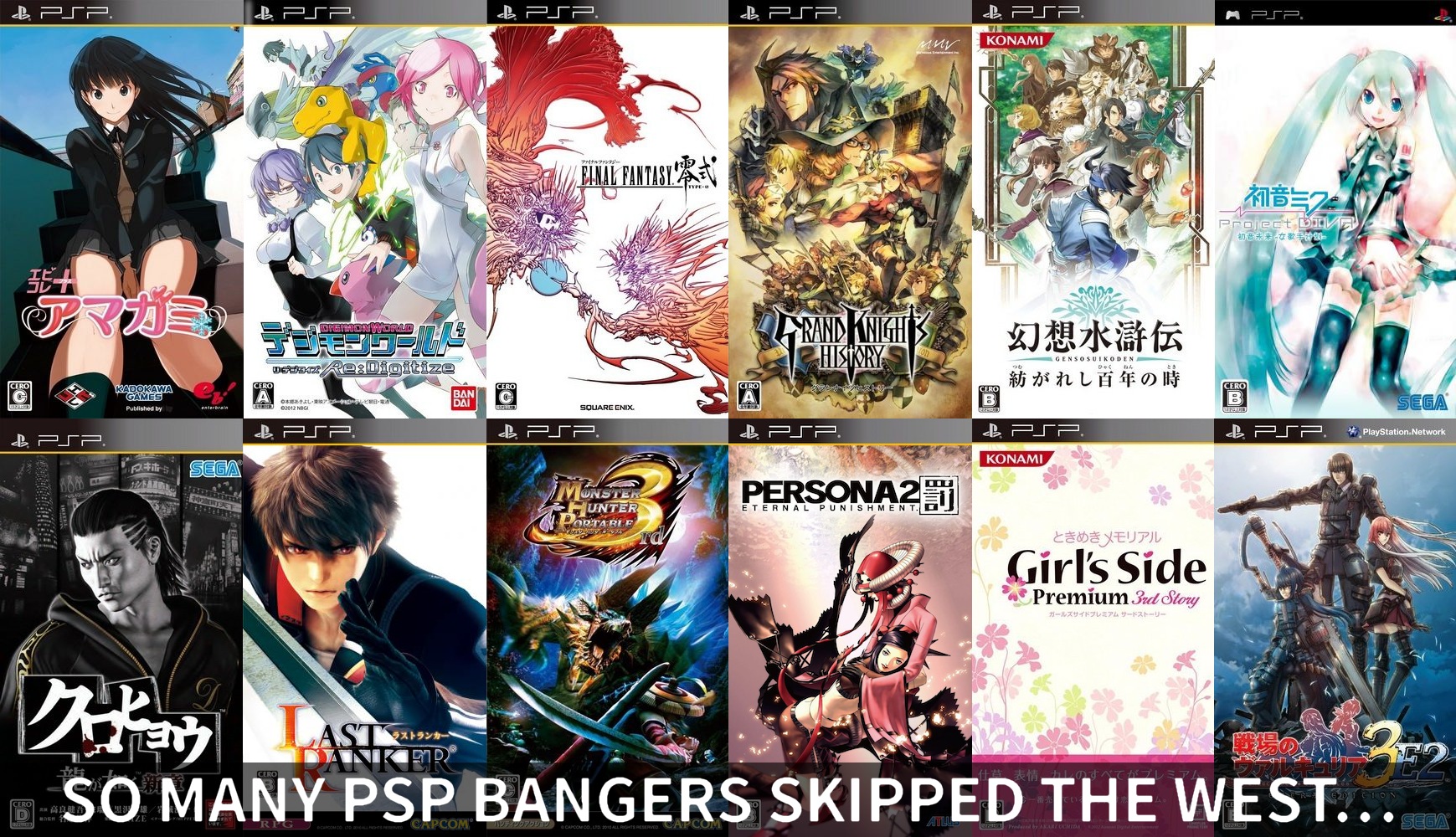
Okay, it’s a slow news week on account of Gamescom kicking off next week, and I don’t want to talk about politics, fascism, authoritarianism, or de facto martial law being declared to consolidate power. So, instead, I’m going to talk about a concept that was inspired by an Era thread and loosely related to the review I put out earlier this week. It’s time to talk about Japanese to English game localization and how spotty it was over the years. Not in regards to quality, but in regards to which games were localized and when they were released.
The thread creator made the mistake of trying to sus out history by looking backwards from modern day, and trying to figure out why the localization landscape was the way it was from around 2009 to 2014, before (roughly) simultaneous worldwide releases became the norm for games of a certain size or scope. When really, this was the tail-end of another era, and I think the best place to actually begin is with the establishment of Nintendo of America and the NES. Skipping past the arcade licensing era, as those were ultimately business-to-business transactions. I’ll try to make this segment nice and svelte, as this topic could fill a damn book if you tried hard enough, but this is me we’re talking about.
It’s 1985, the video game market in America, the center of the Canon video games industry, was not doing so well, and a plucky Japanese company named Nintendo thought they could make big money by entering the market. They had launched the Family Computer in Japan two years prior, and had the rather uncommon idea of localizing their products, rather than recreating them wholesale. While Japanese and US cultural exports had some history around this era, namely in the form of anime being localized, sanitized, and presented as just another slot filling block of content, this was uncommon at the time. In America, the WWII veterans were the grandfathers of the children who Nintendo was targeting, and anti-Japanese bigotry was high during the peak of the Reagan years.
Japan’s economy was booming, people feared it would keep growing, that Japan would take over the damn world, and their corporations would supplant US giants. You want to know why Japanese megacorps have been a staple of cyberpunk fiction since it’s inception? This is why. Economic anxieties that simmered down after the bubble years popped in 1988 and Japan became a nation that has spent 40 years in an economic quagmire that saw a decline in their industry and service export. However, they saw rapid increases in their cultural exports, thanks to a couple of aspiring localization companies who tore down the door and told them ‘give me all your anime.’ But that’s the story for another day, watch The Anime Business if you want to hear it straight from the source.
Nintendo understood they were operating in a complex, i.e., racist, marketplace and tried to minimize the Japaneseness of their products. They made new western oriented art for their titles, urged other publishing partners to present things to the American audience, and while they put out quirky Japanese as hell games, the graphics were too simple to often notice those elements. Their goal was to Americanize, to localize, these games for this audience, to turn the Japanese into something cartoony. They still wanted to put out titles that were popular in Japan, like Dragon Quest and Final Fantasy, but gave it more of an 80s fantasy motif over the aesthetics associated with both series today.
Games that had too much text, limited action, or were otherwise deemed too Japanese— such as The Mysterious Murasame Castle or Famicom Detective Club— they just were not localized, and for basic business reasons. The more text the game had, the harder it was to put on a cartridge and just localize in general. Games were not very profitable back then, due to how expensive cartridges were to produce, package, ship, and sell while giving the retailer some margin. Every title was a risk that could bomb the company unless they were smart about how things were sold or distributed. And this riskiness persisted throughout the cartridge era, games routinely burdened by low margins and the risk of producing 100,000 copies of a game that will only go to sell half of that.
From a technical standpoint, we are talking about games that had kilobytes or megabits of storage, so space was at a premium. Japanese text generally takes up less space than English text for reasons. And because of its higher density, there were harsh character limits in place. The process was not as easy as replacing text in a word processor bit by bit. Also, this localization was a niche and specialized field. Japanese to English translators were not that common, and it was harder to find ones who were willing to work in video games. Partially because video game work was fucking grueling (and still is), it was seen as low art, a waste of professorial talent, and just not popular of a field outside of literature or business translations.
Localizing niche Japanese games into English was a financial risk, took people of the right skill and talent, and involved navigating Reagan’s America. A culture where the cultural leaders, the people who control industry, were raised on cartoons of Bugs Bunny blow up [J-slurs], and shit like Tokyo Kid. This awful night terror meant to make Japanese people look to be demons. Frankly, the fact that we got what we did was a small miracle, and the result of people pushing against the grain, taking risks, and trying to make Japan cool in the burgeoning 80s and 90s.
The problem was that there was no real template in how to translate a lot of Japanese media to an unseasoned American mindset, which led to some more transformative changes. From altering character names to smoothing out the more overtly Japanese references or foods, to altering the script to something more palatable to American sensibilities. The forebears of this mindset were companies like the niche publisher Working Designs who, while a purveyor of some objectionable changes, was still a trailblazer that showed that you can put out successful titles based on these Japanese game series. However, the real watershed moment for video game localization and the power of bringing over Japanese games, just as they were, was probably Final Fantasy VII… followed by Pokémon.
But that’s just narrowing things on video games. Taken as a whole, the 90s were a decade of a dramatic change in Japan’s reputation across America. They went from an economy enemy into being the place where video games and these weird new cartoons came from. Japan had become cool. While it was met with some resistance— not every teenager was into anime, unlike nowadays— but it was growing from a niche zine culture thang into being part of a more mainstream culture, where it stands today. And if you don’t think so, then you are not looking at the YOUTHS, who are the real tastemakers of culture.
Okay, okay, so, then why were so many Japanese games of the PS1 era still skimmed over, skipped past, and never localized? Why weren’t the overwhelming majority of decent-sized Japanese PS2 games released internationally? Because the wheels of change turn slowly. It takes time for industry to react to cultural trends, and not everybody picks up on the same trends at the same time. For as many people grabbed onto Pokémon and Dragon Ball Z and begged for more of this good ish that speaks to their very soul, there were many others who looked at this trend and responded with a resounding ‘fuck that shit.’
In the parlance of the era, they thought everything anime was gay and retarded. That anime for emotionally stunted idiots who needed to be cleansed from society. …And I am not even exaggerating in saying that. Al-Qaeda did wonders to bring ethnic cleansing back into the American zeitgeist. …And strengthen presidential powers. …And pivot America into being more of a police state. …And make White Supremacy more palatable as Patriotism. (The towers falling wasn’t even in the top 25 worst things that happened because of 9/11. And that ain’t an opinion, that’s a fact, Gee-Gee.)
Bah! Tangents! In the early 2000s, anime was popular with the counter-culture of youths, and popular with small children, like Li’l Natalie, but it was not mainstream, not the biggest driver of game sales in most instances, and not always the most profitable. While disc-based manufacturing was way cheaper than producing cartridges, and PS2 games could make some serious dough, publishers still had the risk of ending up with a warehouse of unsold games, and localization got more expensive as games contained even more text and, often, voice acting that Sony really wanted companies to dub. And since most dubs used non-union talent, the quality of these dubs ran the gamut from genuinely good to endearingly quirky to boringly bad to Chaos Wars. Costs of production, costs of time and money to localize, and the fact that games were coming out rapidly, always competing for a spotlight, prevented publishers from releasing everything, but there was a notable uptick in game localization.
However, there was a specific genre of games that barely received any localization at this point, and had been largely unseen in the American gaming zeitgeist. Japanese adventure games. Visual novels, dating sims, games about chatting up pretty bishoujo anime babes on the computer. Even as Japan became cool, these things were still a no-go for most publishers, besides some less than successful ventures, such as Himeya Soft and Hirameki’s endeavors. Anime RPGs had become viable, but visual novels, a term barely even known at the turn of the millennium, were not. And by being mostly text, by having low All-American Action, they would have a relatively high localization cost, and very limited market viability, as this genre barely existed in the western market. At least, until the seventh generation.
The seventh generation. The era of the 360, PS3, Wii, DS, and PSP. Depending on your perspective, and also age, this was either the greatest generation of gaming, or the generation where everything started to fall apart. It represented the rise in so many modern trends, so many innovations, and so many titles that have unique elements tied to proprietary hardware. This is when indie games became a force to be reckoned with. The combination of handheld, digital, and retail console games truly gave way to a market of games for all sizes. This is when Steam came into its own, ‘saving PC gaming’ from an era of relentless piracy. When eSports giants made their debut.
…But this was also depressing era where games sacrificed performance for fidelity, where HD displays were graced with a death of art direction. Where many of the greatest titles were designed for obsolescence due to motion and touch controls, making all future generations jank as fuck. Oh, and this is the generation that truly birthed live services and sparked a rise in online-only games outside of MMOs. ‘Twas the best of times, ’twas the worst of time, and ’twas when I really got into gaming.
I could write a damn book about the seventh generation, but that would require me to collaborate with people and, quite frankly, fuck that.
In regards to localization, this generation was also home to both extremes. This is the generation when titles like Ace Attorney, Professor Layton, and 999 all came out, all did well, and introduced the concept of a Japanese adventure game to the broader audience. Where the success of these games, the cult hit Katawa Shoujo, and the Something Awful Danganronpa Let’s Play really showed that there is an appetite for English visual novels. When Ren’py was unleashed onto the world in earnest and many of the most famous VNs of all time received fan translations, which only went to heighten demand for officially localized Japanese visual novels. And where the fear of overstock and retailer relationships faded away, as online shopping took off in a major way and digital distribution became a growing way for people to buy games.
Even gaming dorks did not know what the fuck a ‘visual novel’ was at the start of this generation in 2004. But by 2013, every gaming dork knew what it looked like, even if they never played one. And a lot of them didn’t like that all of this [Nippon-slur] shit had the audacity to exist in their hobby.
Culturally, there was a subset of people who were openly anti-Japanese at this time. People who have seen the rise in Japan’s presence in American subcultures and wanted it to go away. They believe and bought into a narrative that Japan, while once the home of video games, had fallen off. Their lesser race was no longer capable of making good games, and that the Americans Caucasoid race had fulfilled their divine birthright as the makers of the new generation of video games. I’m radicalizing it and making it about race— because those who don’t are cowards and liberals— but this take is not entirely without merits. Japanese game devs were taken aback by the increase in costs and workload required to make HD games, the need to use middleware rather than build everything in-house, and they struggled to adapt as quickly as those in the Anglosphere. …But that was more of a cultural and planning shift, and Japan got their shit worked out by around 2017.
You’d think that would prevent anti-Japanese sentiments from lingering, but this is 2025. There are still plenty of over-30-years-old people who want to say anime is gay, retarded, and for wannabe pedophiles, but they know they cannot do that in polite society. Yet.
…Moving past this arbitrary aside, G-VII was also a generation where people had to fight to get games localized, and publishers stopped bringing out certain spin-offs, or mainline entries, in game series to the western markets. So… why was this the case? Well, again, localization still took a lot of time. It was typically done after the base game was already done, and most game sales were still physical. The prospect of releasing niche titles was shaken up after the Great Recession weakened consumer buying power and spooked game developers into making Gen7Core games like Mindjack and Inversion. ‘Safe bets’ meant to appeal to the influx of Call of Duty, Halo, and Gears of War fans the generation brought in, but really appealed to nobody. Still, companies would rather put money into that than, say, localizing a handheld spin-off with similar localization/production costs and lower profits per units sold, due to how handheld games went for $30 to $40 back then.
Furthermore, there was a shift in the Japanese game market. The PS2 was a ubiquitous part of a Japanese household in its day, the PS3 and Wii were not, and the Xbox 360 was the visual novel and The IdolM@ster Box. The audience shifted to phone games and dedicated portables like the DS and PSP, which were cheaper to develop for and had higher domestic user base. So, many smaller teams shifted over to develop handheld games. Meanwhile, larger teams making console games were generally urged to develop with a Western mindset. This was not a dedicated rule, but it was a trend that was unlike anything seen before.
Higher production costs moved RPGs and more distinctly Japanese games away from consoles and toward the likes of the DS and PSP. Maybe the Wii if they wanted a compromise and to launch on the most popular home console of the generation. However, from 2010 to 2014 or so, there is a perceivable uptick in Japanese games that were not localized, particularly for the PSP and DS. So, why was that? Well, the answer is simple. While the PSP and DS were continuing to do very well in Japan during this era, the systems boasting matured libraries and being staples of the Japanese games industry, this was not the case in international markets. PSP users were routinely hacking their systems to emulate games and run ripped ROMs distributed online. The DS was shaken by the rise in the R4 card, which allowed millions to pirate and play whatever games they wanted. And by being a tool used by enthusiasts, and kids in poorer countries, niche Japanese games were disproportionately affected.
Major publishers looked at declining DS and PSP sales for more niche properties and assessed that it was not worth it to localize, package, and release titles internationally. Localization, due to limited tools and communication, could take upwards of a year to complete, and people thought the PSP/DS was going to be dead in the west by 2011. So games like Final Fantasy Type-0 (2010), Monster Hunter Portable 3rd (2010), and Valkyria Chronicles 3 (2011) Ace Attorney Investigations 2 (2011)— major entries in established IPs— all skipped a western release, along with so many other titles.
This fear of piracy, and of releasing unsuccessful titles, similarly led Nintendo of America to not localize games that Nintendo of Europe already localized. Xenoblade Chronicles (2010), The Last Story (2011), and Pandora’s Tower (2012). Nintendo of America read the financial market, looked at sales projections of Japanese-ass Japanese games in a post-Recession market, and thought it was better to release nothing than to release these games. Were the analysts here wrong? Yes, as two of these three games are cult classics nowadays. But I cannot say that they would have been as successful without Operation Rainfall, and that certain other titles would not have been as successful if fans did not need to fight to see them localized.
Now, after this generation, after all of this turmoil, the localization of games changed. The once expected year-long or months-long delays in localization were gradually shrunk as game companies became better at distributing scripts, communicating localization needs, and establishing a workflow to release games internationally. (Also, the Japanimation generation reached adulthood, so there were more J-to-E translators around.) This was partially done out of necessity, as game production costs were so high that an international release was deemed necessary to make back the budget of games. But also out of an understanding that information spreads internationally online, and not releasing games simultaneously became a liability, as everything would get leaked before entire continents could play a game.
This was a decade-long process for studios to learn and master, and nowadays most marquee Japanese games launch simultaneously, barring oddities. Companies that still operate on the old ways of staggered localization, namely a lot of teensy VN companies that license their titles for localization. Oh, and AA staples like Falcom and Idea Factory. I’d said it before, but Falcom really should have established Falcom International in 2014 or so and finalized their scripts first so they could launch simultaneously in Japanese, Chinese, and English on all major platforms, rather than this staggered port and localization situation they have going at the moment. While Idea Factory International has had a decade to establish a good workflow, but they just haven’t! C’mon guys, work smarter and SAVE money!
Japanese to English Video game localization is as good as it has ever been, and as someone who remembers wondering why Nintendo wasn’t localizing Captain Rainbow back in 2008, I am thrilled to see where we are today. There is room for improvements. For more things to release simultaneously. But so much has been done these past 15 years that I feel greedy asking for more. We went from Japanese games being a big maybe in terms of an English localization to massive live services being localized into a dozen different languages. I love to see it, and… I hope that we can keep this up. That localization remains a core part of gaming, continues to spread games to people across pesky language barriers. That people recognize the magnitude of effort that goes into these sorts of things. …And that companies don’t just rely on machine translations over actual human localization. Because while machine translations can be serviceable, the idea of paying for something somebody dumped into DeepL is an insult. Hell, even e-hentai gooners hate seeing that shit!
…Okay, that was 3,000 words written in a bit over two hours, while listening to Dude Whatever It’s Summer 2020 of all things, and that’s the angsty rock one. So I was not being too irresponsible with my time here! Rundown is done-down!
I Also Played The Adventures of Elliot Demo
(It’s Alright, But Needs Some Tweaking)
As a super last minute Friday addition, I decided to try out the Switch 2 exclusive demo of The Adventures of Elliot: The Millennium Tales demo. That HD-2D Zelda-like and Mana-like that I talked about during the last Nintendo Direct two weeks ago, and won’t bother reintroducing. I gave it about an hour, saw pretty much everything it had to offer, and I have some… thoughts about it.
Let’s start with the presentation. I fully understand and appreciate what the developers are trying to do with these lavish production values and Unreal Engine effects. To make the most of the new and the old, and they seem to want the player to customize these details in the final game. But, as it stands, the bloom, depth of field, and lighting are simply too aggressive, washing out the image, and making it hard to appreciate the pixel art on display. And if you are blurring the pixel art, what is even the point of having it?

In terms of gameplay, the title is clearly trying to be an overhead action game with a key feature being a variety of weapons, but just about everything the game tries has a certain weird problem with the execution. Let’s start with the sword. The protagonist starts with a perfectly serviceable sword with a limited range but the ability to charge up a projectile for good measure. However, the sword also briefly locks the player in place, and in a manner that simply feels too committed. If any enemy is staggered, you can slash ’em repeatedly, but since you cannot move when slashing your sword, you need to sacrifice movement for damage. It’s maybe two to five frames of extra commitment, but it leaves the player feeling weirdly vulnerable and slow, which… is honestly the core problem that I have with Elliot.
The game does not want players to breeze through it, it wants them to take their time and slowly progress, chipping away at enemies, blocking, and building up a kill chain combo without taking damage. This is not inherently a bad thing, but it feels like the wrong direction for a game like this. This is meant to be a fairly breezy, accessible action RPG, yet the game seems adamant about not letting the player breeze through it like many other contemporaries of the genre. Elliot does not move slowly, but he feels like he should move at least 10%, probably 30%, faster than he does. His jump lacks much omph to it, and its only saving grace is that it offers more horizontal range than it initially seems. (The game better have a double jump.) The player gets a genuinely cool sickle weapon if they explore a bit, able to carve through grass and deal chip damage to enemies, but the movement speed is slowed to a crawl in a way that feels like a ‘fun tax’ rather than a balance choice.

I don’t mean to say that the game would be better if it were less rigid, moved faster, and encouraged a more rapid, aggressive, playstyle, but it absolutely would. This game should not just be looking at Zelda and Mana, it should be looking at the Ys ANOFO trilogy. Ys Ark of Napishtim, Oath in Felghana, and Origin. Three Zelda-like action RPGs that I appreciate for many reasons, but the big one is the speed, how your are constantly hoofing it, and just blazing through things, while solving basic puzzles and battling big bosses. Plus, as a game with 2D character sprites, 3D bosses, and 3D environments with pixelated textures, I cannot help but link this game to Elliot. Just looking at it reminds me of the ANOFO trilogy.
The control scheme also needs some work, and necessitates a lot of fiddling with the menus to equip your proper skills in a way that is reminiscent of the GameBoy Zelda games, but someone worse. Elliot can only have two of four weapons equipped and one of two fairy skills. This means a there is a lot of going into the menu, selecting the right selection wheel, selecting the right weapon or skill, confirming it, and then closing out of the menu. It is an ordeal, and with no real reason behind it, as all of the information present here could be fit on one screen, instead of the four it’s segmented into.

Continue having ZR be the button to pause the action and bring up the quick select menu. But instead of segmenting the menu into four parts, throw everything on screen at once and let the player sort through things using existing inputs. Weapons can be selected using the left stick, the one you control Elliot with, using the two action buttons, X and Y, to select which weapon they want in each slot. The fairy’s skills can be selected with the right stick, the one used to control the fairy throughout the game, and they can be selected using L, the fairy skill button.
For potions, have those associated with the D-pad, as I’m assuming you’ll only be able to hold four, the Zelda staple, and have players use them with A after selecting them. And for the magicite accessories used to give Elliot passive attack buffs, have the player filter through those using the R button, because it’s a free button. Now, it might be annoying to press R seven times to change their magicite, as the game supports eight magicite loadouts, but I honestly do not think people are going to need to swap out their magicite that often. Also, do not let players toggle into a magicite loadout with nothing in it.

…Actually, no forget the first sentence of the past paragraph. Have this greater weapon and equipment wheel menu be bound to ZL, a button currently reserved for the map, while the minus button brings up the control layout. Because that makes sense. Have minus be the map button and then have ZR become a third weapon button. This means you can have two standard weapons on the face buttons, R for the shield, and ZR for a peripheral tool, like the bomb. That would make for a far more comfortable play experience, and cut back on the amount trips to menus.
In fact, in fact, here’s a basic mockup I did on some scratch paper, not bothering to make it look nice. Enjoy my crappy handwriting that has not improved since I was 9!

Anything else I have to comment on? Well, some enemy placement seems random in a way meant to inconvenience the player more than challenge them. And the balancing of the first boss is pretty bad. Certain attacks just cleave through the player’s health, which is a little harsh. Especially when they involve a, technically, new mechanic to avoid a move that destroys half of the max health the player can accumulate. Yes, yes, I know I should know to jump on the lily pads of ascending height, and avoid falling rocks while enemies spawn in, but why didn’t the preceding dungeon have lily pads of ascending height? Why were there no falling rocks before this? And why would you make it so damn dark that I could barely see the falling rocks? Teach me this before you test me!
There’s also a second optional boss in the demo, who I encountered first. They are a shield covered mouse tank thing called a Rathomobile that fires an onslaught of bombs and missiles. And the game simply does not tell you how you are supposed to beat this thing. In retrospect, it seems obvious that its big red shield is meant to be blown up using bombs, like the ones he is throwing, but there are some problem with that. You only have a limited number of bombs and, prior to this boss, the game only teaches you how to use the bombs in one context. Blowing up walls, where you just drop the bombs and let them blow up. They are not presented as a tool for combat, especially against a moving target with no clear pattern. If anything, the preceding dungeon teaches you to avoid bombs thrown by enemies.

What you are actually supposed to do is drop the bombs and throw them at the Rathomobile, but I did not know you could do that. The game has a tutorial saying that you can pick up bombs using A, as indicated by a teensy button prompt that I still struggle to see, but it does not tell you that until you go to the required dungeon first. Maybe trigger this tool tip to come up in this dungeon, where this mechanic is very useful in fighting this boss? Maybe before making me fight a boss like this, have me unlock some pathway by throwing a bomb. Maybe have the little helper fairy tell me what I’m supposed to do? And maybe, just maybe, don’t have this demo boss be such an intimidating bastard, throwing out half a dozen missiles or bombs at me every ten seconds?
I know I’m just complaining, but these bosses really gave me a bad impression on the game’s general design, when pretty much everything else is solid, if a bit unremarkable. The world design is good, with small splintering off paths with treasure, goodies, and bonus challenges to pursue in exchange for permanent upgrades. Including an upgraded sword that kills even tougher mobs with a single charge strike. The two dungeons are short multi-floor affairs with their own cliche yet functional gimmicks. And I actually do like the fairy abilities. How the Nintendo DS-ass warp feature lets you travers through larger gaps in a way that feels like cheating, and trivializes some platforming. How the fairy actually does help in combat, dealing chip damage. And how the speed boost functions like the pegasus boots from 2D Zelda, which are always fun to use.

…Also, why does the mini map not show the layout of the environment around Elliot? It only shows key interactables on a black void. How is this the second game I’ve played this year that completely misses the point of a minimap?
I think the game has something, could be a promising title, but only if the developers are serious about refining some of the boss designs and making the protagonist feel faster. …And that is my demo feedback, Mister Square Enix.
…Also also, the developers here are actually Claytechworks, who made Bravely Default II. Not sure why they are doing this instead of Bravely Third or whatever.
…And this somehow turned into a 1,800 word scree. Oops.
Progress Report 2025-08-17

Yeah, I’ve got nothing for the endslate here. I’m just trying to get through the latest TSF Showcase, then I’ll start on the next one, then the next one. Just to have a good backlog of this shit before I can focus on Hundred Line and surviving taxes. I know it is crazy that this review will likely take me five months to prepare, but some games are just like that, yo. Twilight Princess took me months to play as a kid, and as an I-dult, I guess I’m running out of time for games.
2025-08-10: Played An Alt Girl For Skoof and wrote an 800 word review for this Rundown, as I did not want it to be its own post. Then I yapped with Scrumptious for a while. Edited the Doukyuusei review and grabbed the images. Then I realized I had to pick something for TSF Showcase this month. I tried Though You May Burn to Ash, read half of the first volume, and this is a veritable Natalie manga. However, it is just NOT a TSF manga. The characters could be funny animals and the comic would not change at all. Well, it would be funnier, but that’s besides the point! I also read A NEET’s Life Unraveled by Myra TSF, and thought it was a pretty good story up until the kinda half-assed ending. Then I read some smaller stuff in my back catalog, consulted the list, and decided that I really did not want to do another TSF Comics Ramble Repeat. And the results of a reading blitz were not good.
Skimming through Daily Life In TS School, I realized the series is not quite right and weirdly too narrow for something like this. And then I started re-reading Shishunki Bitter Change, before realizing why it never really clicked with me. It is a bit too slow and too invested in its damn side characters. Then I looked at Kanojo ni Naru Hi, another comic I’ve had on the list, and… no, it’s also not the right fit. It starts TSF, but becomes too fixated on its romance for it to really fit something I want to cover, at least right now. So… fuck it, we doing the skinsuit identity loss feminization comic on August 26.
…Actually, double fuck it, I’m just going to make it easy on myself after this. September is going to be some written work— still need to figure that out. October is Turned into a Breast Milk Fountain by a Beautiful Vampire. November is She is Me. December is Trans Venus. Yeah, I’m repeating some topics, but that shit is PEAK!
2025-08-11: Today was supposed to kick off another vacation for me, but instead I worked a weirdly paced 11 hour day from like 9:30 AM until almost midnight. But hey, I made big progress with a ‘5 years of returns’ client. I was planning on starting work on TSF Showcase 2025-10, but then the client got back to me and I was able to finish stuff. So, uh, good for that. I could have gotten started, but I have a personal policy against starting things at 01:00 AM. That’s just being mean.
2025-08-12: I woke up late because I was working on the damn header image. Switch 2 came in today, so I had to set that up, troubleshoot things, transfer my files, sort out my cables, play with my new toy etc. And I had a bit of work to do in the early afternoon. I managed to get 2,000 words into TSF Showcase 2025-10, but I was struggling to piece my thoughts together after my shower, as I got bad sleep last night.
2025-08-13: Broke 9,000 words on the TSF Showcase 2025-10, feelin’ like a boss ‘cos I met my goals and am most of the way done! 60 hours last week, that’s a hundo-hundo bucks, now I can down a sparkling water and rub one out! …It’s late, so of course I modified a line from the Peter Sparker Mixtape. Spose’s 2013 mixtapes live rent-free in my mind. I even like Dankonia more than Stankonia, and I’m sorry. It’s what I listened to first and what influenced me, so respect my opinion maaaaannnn! Uh, what else did I do? Fiddled with a backup solution that I think I like way more than the one I was flirtin’ on. Tried to update some stuff on my laptop, as I’m lending it to someone, and I do not like this bloody thing. It’s hot, loud, and cannot install my damn VPN. Lenovo really is a purveyor of trash. I should NOT have given them another change. Messed with the Switch 2 and wound up playing almost hour of Mario Kart World, because the game is fun and I am not good at it. And I think that’s all. Onto the morrow, young sailor. Oh, and FINALLY moved away from Google Authenticator. Now to wait for Proton to become Google V2 in a decade…
2025-08-14: Wrote 3,200 word localization segment. Edited this fish. Wrapped TSF Showcase 2025-10 with an extra 2,400 words. Will edit tomorrow and grab screenshots. Also, wrote the 1,800 word Adventures of Elliot demo impressions thing. Making this a 7.4k word day. Yay!
2025-08-15: Did what I said I would! Got TSF Showcase 2025-10 ret-2-go! Also, my tum-tum is having problems, which is rare. I am normally very healthy, but I’ve got some sort of bug inside me. Hopefully it’s not WORMS! :worm: Also, tried backing up Fictionmania, but WinHTTracker wasn’t playing nice with how it’s laid out when, bruh, look at this thing! Also, started reading TSF Showcase 2025-11. It is a 100k word story that somebody recommended. I got about 25% through it, and it is a goodie. Some real HOTMILK!
2025-08-16: Continued reading the 100k word story for TSF Showcase 2025-11, but it is hard for me to ‘lock in’ and read over 50k words in 24 hours when there is no visual element. VNs? I can probably do that. But just light words on a dark background, with the bad dialogue formatting of most books? It’s harder. Still, it’s my next objective, so I just gotta keep doing it! Also, I got bored and played Mario Kart some more, waste not and whatnot!
What’s your favorite Altooshka? :3 (seems like my comment got lost? D: oh well!)
My favorite is probably Kira, as her twist felt like a happy ending after the bad ends that came from pursuing other alt girls.
Holy shit, same for me! Honestly, who wouldn’t want to have a babushka- I mean uh, uwu neko girl as your state-mandated altooshka. :3
inb4 one of the art from the game drawn by Rikani (they have a pretty cool art style) is used for a TG caption :v