

The Lachlanverse Episode III: Axon in Ashes My Mad Scientist Roommate Turned Me Into Her Personal Robotic Battle Maiden?!?
Disclosure: The developer provided me with a review key of this game, but I purchased it nearly a year beforehand.
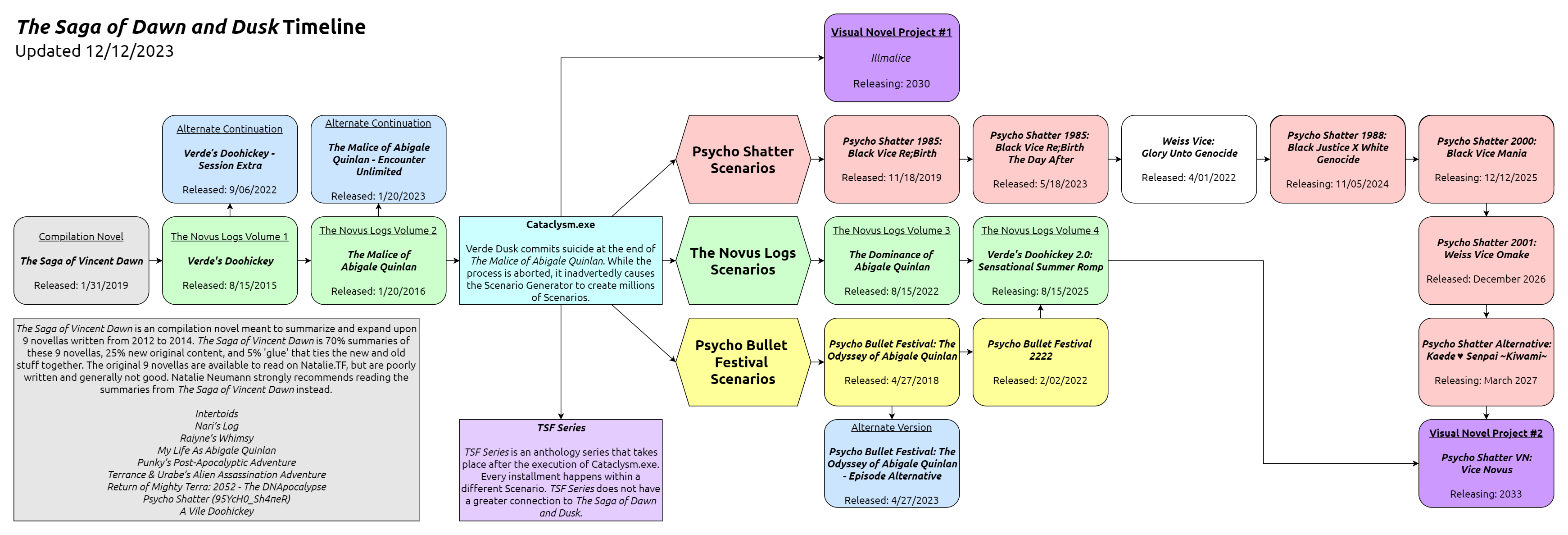
Notice 12/14/2023: I removed a comment saying that that Frag Games was uncredited for their work on this game. While the technology they developed for Alluna and Brie was used for this project, they were not involved in Robotic Battle Maiden. Also, updated the timeline provided by Jag.

Before we begin, allow me to regale you with a little history lesson, as Lachlan Snell has been making games for a decade now, and keeping track of everything can be a bit confusing without a centralized source.
It all started with 2014’s Gender Bender DNA Twister Extreme. A TSF driven and transformation filled visual novel with a massive scope, multiple playable characters, a deluge of endings, and oodles of both sprites and CGs. Needless to say, it was a super ambitious title for a two person team of an artist still finding their style, and a writer/programmer who hadn’t done much of either. The end result was… let’s just say sloppy. Since reviewing it in 2017, I’ve gradually come to better appreciate what the game was going for, in part because of how its ideas were refined in later titles.
Namely 2017’s Max’s Big Bust – A Captain Nekorai Tale. A good, if slightly unpolished gender bender/TSF visual novel with enough heart, humor, and creativity that I would still recommend it to this day. It is janky in various ways, but it’s a visual novel with adventure game elements, so a little jank doesn’t harm the experience that much.
This was followed up with Alluna and Brie in 2019. An “RPG social sim” that was so ambitious and chock full of mechanics and subsystems from minute one that I stopped playing it after about an hour. I would ponder giving it another go, but a remaster, Alluna and Brie: ReTentacled, is currently in development.
Then, in 2021, the series went back to its visual novel roots with Max’s Big Bust 2 – Max’s Bigger Bust. A not-so direct sequel to the first one that stapled on two games and two years of continuity. But it managed to be everything I wanted. A bigger, better, and zanier follow-up to Max’s Big Bust that improved on just about everything. …Though, you could really tell it didn’t have as big of a budget as the past few titles. Still, I fully recommend it to TSF and general transformation fans.
But the game I’m here to talk about today is the latest title from Lachlan Snell, My Mad Scientist Roommate Turned Me Into Her Personal Robotic Battle Maiden?!? A RPG life sim built off of the foundation of Alluna and Brie.
My Mad Scientist Roommate Turned Me Into Her Personal Robotic Battle Maiden?!? Review
Platform: PC
Developer/Publisher: Lached Up Games
Website – Discord – Steam – Itch.io
Part 1: The Lached Up Premise!

Robotic Battle Maiden picks up directly after the events of Max’s Big Bust, where the ultimate antagonist, the mad scientist Ellie, escapes from the Axon City police department by opening a portal to The Frakk. A region located deep within the center of the Earth that’s home to a deluge of magically adept monster girls who have been existing in secrecy for centuries. And also the source of every morsel of fantastical/transformation shenanigans seen in the cumulative Lachlanverse.
With this bold new frontier before her, Ellie sets about her plans to amass the resources of The Frakk, unify its perpetually warring tribes, take over the surface world, and bring an end to capitalism once and for all! But rather than play as the titular Mad Scientist— as was the plan when this game was called Axon in Ashes, MMSRTMIHPRBM throws the player into the boot-feet of her Sexy Electronic Robotic Assistant, S.E.R.A.
S.E.R.A. used to be Ellie’s roommate, an unremarkable twenty-something guy named Sam who had the audacity to (accidentally) use Ellie’s toothbrush. As punishment, their mind was ripped from his body and put inside a super advanced combat android. Now forced to obey their insane roommate and with no hope to get back to normal— because that would be a time paradox— S.E.R.A. must come to grips with her new body and do what a battle maiden does. …Which involves a lot of semi-random tasks that boost her stats, Persona-like social link building, and traveling through board game style dungeons.
Part 2: How a Cat Girl Terrorist and Her Robot Slave Conquered The Frakk

So, the story of Robotic Battle Maiden is… simultaneously its main draw and fairly underwhelming. I say that because there really is not much to the overarching plot of Robotic Battle Maiden. Ellie wants to conquer The Frakk, form allegiances with its leaders, and amass a mighty force… which is exactly what she does. With the aid of S.E.R.A., one-eyed weeaboo samurai Jasmine, and ‘armed and inebriated’ Kathy, she successfully defeats the leaders of The Frakk, and unifies them into the force seen in Alluna and Brie.
There really aren’t any twists, insights, or surprises between the beginning and end. I don’t actually think there are any characters not previously featured in MBB1 or MBB2. The world of The Frakk was previously explorable and well documented in MBB2, so you’re not really seeing a new location. And things like S.E.R.A.’s endgame design change and Ellie’s transformation don’t count as twists, as they were revealed in the first… two hours in MBB2.

On a macro level, the story does not really answer any questions or provide much need-to-know information that was not previously referenced. Instead, this ‘interquel’ chapter is vastly more interested in exploring things on the micro-level. This is mostly done through Heart Beats scenes, brief little bite-sized multi-part stories where S.E.R.A. hangs out with (mostly) minor characters from MBB1 and MBB2. They chat, bounce their personalities off of each other, embark on a slew of hare-brained schemes, and generally offer the player a lot of tiny insights. Insights about the deliberately ludicrous lore of The Frakk. Who its people are and how they live, the monster girls’ curious way of doing things, and… whatever idea Lachlan thought would be fun or funny.
S.E.R.A. helping Max Newling’s sister, Heather, get her succubus groove back by teaching her how to get laid as a purple person with leathery wings. Ilana, queen of the fairies, commissioning S.E.R.A.to help her conduct reconnaissance on the surface by visiting their theme parks, only to wind up rewriting reality in the process. The smart speaker turned sentient AI, Aisha, trying her hand at game development and using S.E.R.A. to test the MMOs she develops. …Only for things to break constantly, because that’s game development. Or showing how S.E.R.A. got her hands on a 5% stake in RezTech. You know, that resurrection service is run by that flamboyant dancing zombie ghoul bloke who wants to make death a temporary inconvenience. And who absolutely doesn’t want to usher in a new era of debt peonage. …But wouldn’t that be something?

There’s also the Max Heart Minute show that airs every day. Home to brief comedy skits following two wannabe idols pretending to be news reporters, Ash and Chloe. The two have their own game-long storyline where they try to survive and make sense of this monster world. Theorizing about whether any of this is real, promoting stores by announcing steep 50% discounts for sponsorship cash, and undergoing absolute trauma as they are subjected to the darker side of The Frakk. They get kidnapped, become bloody-handed warriors, make friends, make enemies, do crimes, and inject a dose of extra potent comedy into this already comedic game. You could very well make an argument that their story is more interesting and varied and the main plot… But this review is going to be long enough as is.
The Heart Beats and Max Heart Minute sections are what makes this game for me, and cater to what I consider Lach’s greatest strengths as a creator. Writing humorous conversations between a wide cast of characters with exaggerated personalities as they go through silly escapades. And building upon this unabashedly absurd world full of monster girls, transformations, and magical nonsense he has created over the years.

Lach is so good at these things that I consider him to be something of an inspiration— I did say he inspired me to work on my current novel project in my MBB2 review. However, while I think he is very skilled in this form of writing, these sections represent the vast majority of the game’s total story content, and probably about a third of its total content.
This seems like a good thing, as I like these sillier shenanigan-filled mini-stories. However, you can have too much of a good thing, and with 112 Heart Beats scenes and 70-ish Max Heart Minute shows, I found them to be a bit tiresome to get through at times. Partially because the game wants the player to mentally juggle up to13 side-plots at once. And partially because the connective tissue around them… isn’t that great.
Part 3: Friend Sim, Shopping Sim, War Sim

As a Life Sim, much of what one does in Robotic Battle Maiden is driven around time management. Following the prologue, every chapter is broken up into 14 days, every day has three phases— morning, afternoon, and evening— and every phase has eight time crystals that can be used to perform tasks. These tasks include venturing into dungeons and participating in combat encounters or doing various things to restore or upgrade S.E.R.A.’s morale. As S.E.R.A.’s morale is filled or increased, it boosts her combat proficiency, with 80 morale being acceptable for combat, 100 being the starting cap, and 150 being the final cap, and 140-ish being easy mode.
Morale is broken down between four sub-stats. Cheer, resolve, battery, and fuel. Each of which have their own ‘fullness bar’ and their own levels. These stats max out at level 5, leveling them up raises max morale, and slightly increases the size of the morale bar. Individually, there isn’t much purpose to a given stat in combat— or at least none that I could perceive— but certain Heat Beats scenes are locked behind having stats at a certain level.

Morale stats are depleted as the day goes on and by performing various activities unique to every region of the navigable map of The Frakk. These activities change depending on the time of day, but primarily offer stat experience in exchange for depleting the bar. An activity might boost resolve and cheer, but decrease morale by lowering battery and fuel. Some activities are more generous or rewarding than others, but figuring that out can be a bit tricky. It depends on RNG, the time of day (even if the activity name is the same), and the only way to know the results is to experiment.
The primary way to restore morale points is by eating food. Whether it be the free snacks in Ellie’s ute (Aussie slang for a pickup truck) or buying food at the myriad restaurants across The Frakk (there are like 10 of them). Eating always takes time and restores stats, but it also regularly confers some stat experience too. The experience offered is (seemingly) relative to how much the food costs, but once more, you need to experiment to see which foods fill which stats and by how much.

That level of experimentation wouldn’t be a big deal, except there are no clear mathematical gains on stat experience… or the morale stats themselves. Instead of using numbers, the game uses bars to represent both EXP and the percentage of morale stats the player has. A presentational choice that discourages the player from analyzing things, as it is harder to judge how much a bar moves versus how big a number is.
As someone who has a fixation on numbers (I’m an accountant), I’m not a fan of this. But while I could, and just have, criticized the morale system for its presentation, it also does not require that much attention. I managed to max out S.E.R.A.’s moral levels by chapter 5 of 6 (about 75% through the day cycles) so it can’t be that punishing. It’s messy, will likely lead the player to develop uneven stats, but you know what? It’s functional! And I didn’t need to do any ‘save backtracking’ to control it. Not even close.

Similarly, I was worried that the game would make it difficult to manage the Heat Beats sequences or dungeon exploration, but… it really isn’t. While it is stingy with Heart Beats early on, the player has over 200 day phases they can end by selecting a character’s Heart Beat. (Heart Beats do not consume any time crystals, but they do end the day phase.) The math isn’t totally in the player’s favor, as the game does not let the player access a lot of Heart Beats until chapter 5, but it’s not hard to get all Heart Beats in a single playthrough.
As a life-sim game, Robotic Battle Maiden is a bit unbalanced and opaque with some of its systems, but pretty lax with what it asks from the player. It does not require external resources to really understand, making it infinitely less stressful than trying to get a perfect run in stuff like Persona 4 Golden, Final Fantasy XIII-3: Lightning Returns, or Princess Maker 2. However, I should note that in my playthrough… Something really weird happened that might have made my experience far more lax than it should have been.
Part 4: Is It Weird to Raid Dungeons in Mech Suits?!?

Robotic Battle Maiden is a pretty standard turn-based RPG. You have four party members with skills that consume MP, every party member has access to a few elements that can be used to exploit enemy weaknesses, and healing is primarily done through the use of items. Dungeons are linear and board-game-like in their design, consisting of a few nodes over a large piece of art. Each node can represent a healing spot, treasure chest, or enemy encounter, and the player will not know which until they land on it. Once all encounters, optional or mandatory, are cleared there is nothing to do in dungeons anymore, and it is impossible to grind for extra EXP.
Conceptually, I really like this design. While limiting, it gives the developer a lot of control with these encounters, allowing for a more curated and controlled experience. And, to an extent, there is some of that. Every encounter features a different arrangement of enemies and the pacing between them never feels too repetitive. But the game can also be a bit… bizarre with how it balances its healing spots, as I regularly landed on healing spots at the start or very end of an eight move dungeon run. It’s an odd choice that made me wonder how Lach intended players to progress through dungeons and manage their own healing. Which is where we get into the weird quirk I mentioned in the last section.

In Robotic Battle Maiden, there really isn’t a typical healer character. S.E.R.A. has some healing skills, but many of those aren’t unlocked until later in the game and have high MP costs. Instead, players are expected to use items to heal. A fair enough concept on its own, except for a few teensy little problems. Items can only be used in battle, which I have never seen before. And not only can items be a bit on the pricey side, but money is a finite resource. …At least until the final chapter, where the game threw $30,000 monster bucks at me.
These limitations are supposed to encourage crafty behavior from players. If they are too conservative with their MP, they’ll lose more HP, and if they’re too liberal with spellcasting, they’ll need to use more MP restoring items. It’s a familiar approach, but one that has ample potential to evolve into something frustrating if the game is too stingy or strict.

Fortunately, Robotic Battle Maiden refreshes the player’s inventory after every battle. So if the player has 10 bags of chips, and uses two during battle, they’ll start the next battle with 10 bags of chips. But if they use all 10 bags of chips during battle, they’ll start the next battle with no bags of chips. I thought this was just some unexplained quirk of the battle system. It functions well enough, is reminiscent of things I have seen in other RPGs— Zeboyd’s Rain Slick titles come to mind— and feels right given the player’s limited access to cash early on. But I checked the Lached Up Games Discord after clearing this game, and, as I suspected, it was all a bug.
I have no clue how a bug like that even happens, but Robotic Battle Maiden is built on a quirky foundation developed by the Pakistani developer Frag Games (who were not directly involved in the creation of RBM). The game just works in weird ways like that. In fact, the game works weirdly in a lot of ways, but let’s stay focused on combat for a moment.

Judging the game as a typical turn-based RPG, I find it to be fine, yet rather odd. Everything is based strongly in genre foundations, combat is fairly straightforward and easy aside from more imposing bosses, who can represent some significant difficulty spikes. Like chapter 2’s main boss, whose stats probably should have been decreased by about 20%. Or chapter 5’s main boss, who consistently one-shotted two of my party members with his party-wide basic attack. I wondered how it was possible, or if I just needed extra equipment, but before I could get fancy, he decided to charge for two turns, letting me defeat him by the third round.
Yeah, it’s one of those games, where things quickly escalate into a test of seeing who can hit the hardest the fastest. It actually got pretty silly near the end of my playthrough, where I wound up beating most bosses in two turns by buffing Ellie and having her use her ultimate non-elemental damage move. It was able to deal over 13,000 to endgame bosses… in a game where the bulkiest boss has 16,000 HP. It emptied her MP, but that’s a small price to pay for a quick win. And sometimes winning quickly is what you want considering the game relies on a save point system, and you cannot save while in dungeons. So… make sure you plan your runs well!

Also, the game features one of the more bizarre implementations of class change I have seen in an RPG. It gives the static party of four mech suits at the start of chapter 5, replacing all of their skills while upgrading their stats. It is a… very early access decision, as if it was implemented to address criticisms about the game being too hard, without rebalancing earlier encounters. And one that features some questionable choices regarding skill distribution. Such as giving three characters access to a multi-target water skill, no characters access to a multi-target divine skill, and giving Kathy only access to fire and physical skills, in a game with six elements. Huh…
Overall, I would say I found the combat to be functional. It was basic enough to get through without too much fuss. It has some personality with the UI, character barks, and limited skill distributions. And does… genuinely one of the coolest things I’ve ever seen in a turn-based RPG with two of its latter bosses. Including presenting a scenario where mashing the attack command becomes a valid strategy. It has more than one layer of jank, and you can tell this game was made and tested by one guy. But it passes the game design test of not having any massive, crippling problems. …Aside from the infinite item bug that I hope never gets patched out.
Part 5: Reduce, Reuse, Recycle 82% of All Assets!

With Max’s Big Bust 2 one of the more curious elements was how it handled its presentation, relying on assets from MBB1, Alluna and Brie, and various store-bought assets. It was an economical approach to creating a game, one with a kitbashed aesthetic born from its unevenness and a world made up of filtered backgrounds, photos, and 3D renderings. It was clearly a game built on a limited budget, and Robotic Battle Maiden… was built on an even slimmer budget.
Backgrounds, portrait sprites, in-battle enemy sprites, and UI elements are all lifted from MBB1, MBB2, and Alluna and Brie, with only a relatively few new ones added into the fray. I’m not sure how many battle sprites were recycled (though the party sprites and boss sprites are clearly new). I only saw a handful of unfamiliar backgrounds, S.E.R.A. was given a spiffy new sprite, and there were probably additional outfits introduced here. There are some new icons here, particularly with the neon signs that represent shop names, but it all feels very familiar and very much like a game developed on a strict budget of both cash and time.

This is carried over into the way conversations are presented, which mostly consist of characters standing on the left, right, or center of the screen as they flutter between expressions. Characters only have a static pose and never really move beyond sliding up, down, left, or right to enter or exit scenes. Well, except for the giants.
Though, there was an effort to add to this game on the audio front, including a catchy custom soundtrack, battle barks for the four party members, and tips/commentary from Aisha. It’s all a nice addition that keeps the game feeling fresh even when it looks so similar to prior titles, but both the soundtrack and voice acting are a bit limited. Based on the official YouTube uploads of the soundtrack, there are only 12 songs in this 30-hour-long game, and I probably heard most battle barks a good dozen times throughout my playthrough.

Still, what’s there is pretty good. The soundtrack is catchy, tone setting, loops well in-game, and I enjoyed the way it integrated vocal snippets in certain tracks. While all three voice actresses do a good job giving their character(s) an extra layer of personality.
Much like… every other system here, I would say that the presentation is more functional than anything else, rarely trying much more than what it needs and avoiding any crippling issues. Sure, the equipment UI is… bad by the standards of a 1993 PC game. The game sometimes lies about which Heart Beats are available on the map. The lack of location names is a baffling decision. And the UX is still overwhelming at first. But… it works! And I do like the kitbashed aesthetic. It makes me think that I can make a visual novel one day…
Part 6: Making Silly Anime Games is Hard When You’re a Dad With a Full-Time Job

I would not feel bad in saying that Robotic Battle Maiden is, in several ways, a minimum viable product that does little more than what is necessary. Its story is its biggest draw, being chock full of Lached Up Games’ signature silliness, but unlike prior games, it lacks the driving force of a main story or threat. It has a lot of weird limitations such as not supporting any type of mouse control, not letting the player save outside of save points, and always booting up in windowed mode after an overly long boot up screen. While its simulation elements, combat system, and overall presentation are adequate, but finicky. …Also, there is no way to auto-play text-based story sequences, no way to skip scenes, and generally lacks the basic QoL features found in 90% of Ren’py games.
It’s a low scope game that made me curious as to what circumstances it was developed under. So I decided to delve into the Lached Up Games Discord server to gather what I could, and pretty quickly came across messages that basically explained what happened to its main developer these past few years. 2019’s Alluna and Brie was far more ambitious than any prior title Lach had worked on, and required a lot more resources, including outsourcing some development to Frag Games. However, the game bombed, financially ruining Lach. Fortunately, he managed to get a “great” full-time job using his game dev experience, meaning he’s doing fine financially. Though, that also means he is developing these games on a part-time basis, by himself, and on shoestring budgets.
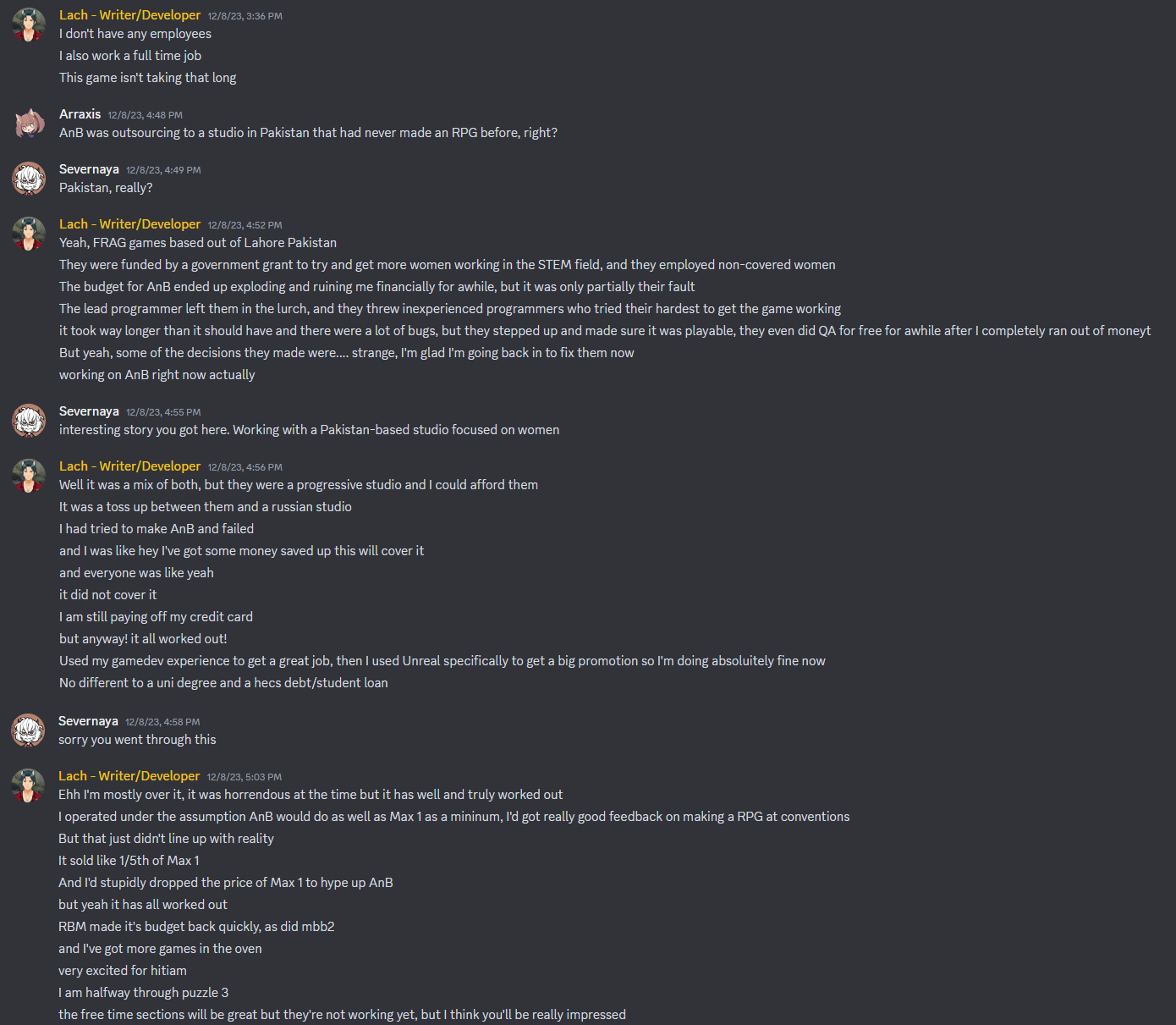

It’s not an ideal situation, but it’s one that makes sense considering what the market for PC only independent games like this is like now. Dozens of games are released every day. It’s increasingly hard for smaller titles with no publisher backing to get noticed. And while games could put in the extra time and polish to possibly get noticed, you are more likely to make back your budget if you focus on what is necessary. You could argue that more effort should be put into fewer projects, but Lach is a guy with a lot of ideas, and he wants to bring as many of them to life as possible.
Just sniffing up the Discord, I quickly found that the following games are planned or in some form of development. (Thanks to Jag for compiling things into a nice timeline.)
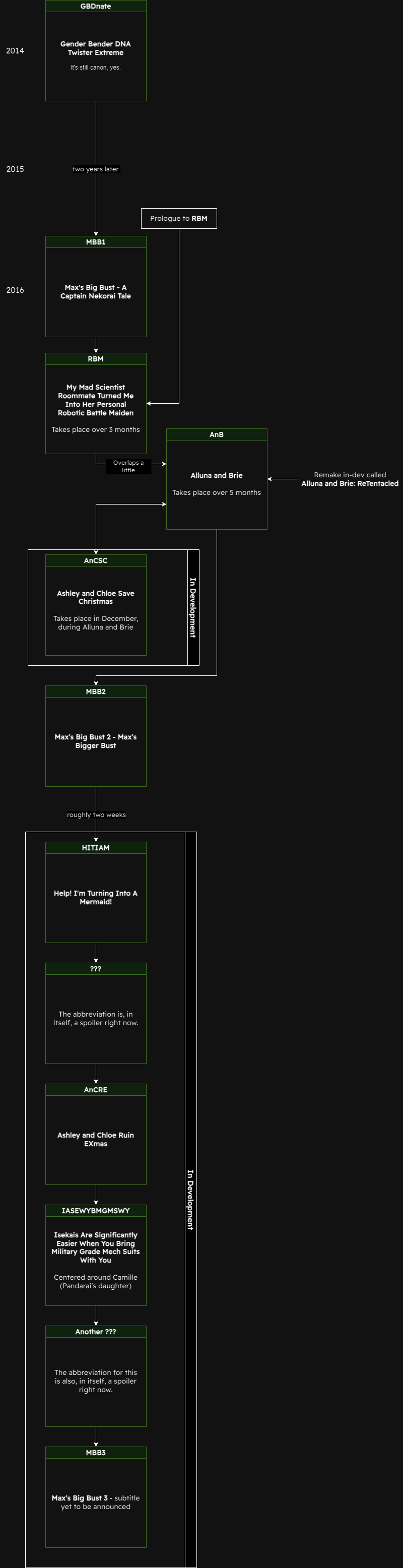
- Alluna and Brie: ReTentacled – A remaster of the original game using the updated tech of Robotic Battle Maiden
- Help! I’m Turning Into A Mermaid! – A buddy cop visual novel adventure game similar to MBB that is meant to be a more gradual gender bender title
- Ashley and Chloe Save Christmas – A Christmas themed RPG (most assets have already been made)
- Ashley and Chloe Ruin EXmas – Another Christmas themed RPG, I guess(?)
- Isekais Are Significantly Easier When You Bring Military Grade Mech Suits With You – Another RPG centered around Pandarai and his daughter Camille.
- Unnamed Project 1
- Unnamed Project 2
- Max’s Big Bust 3 – The culmination of every prior game in this Lachlanverse.

Needless to say, Lach is a man of many plans. His upcoming slate manages to somehow make my convoluted novel multiverse look unambitious. So his decision to aim for this more minimalistic approach, prioritizing function over making every game a dream game… I get it. He would rather make a lot of things quickly and cheaply rather than putting all his time and money eggs into one basket. It’s an approach that I respect quite a bit, and I admire all the passion he puts into expanding this world and its characters.
He could have just given up on these things after being faced with failure, but even after entering his 30s, getting a partner, and becoming a dad, Lach is still working on these games. Because he has stories to tell and dreams he wants to make real! …Or so I’d imagine. I haven’t talked to him beyond one cordial email.

…Okay, but do I think My Mad Scientist Roommate Turned Me Into Her Personal Robotic Battle Maiden?!? is good? Eh, it’s alright. It is a game where much of the draw is its personality, story, and characters. If you liked the gaggle of weirdos and truckloads of nonsense found in prior games, RBM offers a whole lot more of that. If you never played a Lached Up Games title before… this one is a weird place to start, as it appeals to an existing fanbase. And as a simulation RPG, it’s actually pretty easy to get into, and does not require any extra fiddling or a guide to play. Which, as someone sheepish of the genre, I consider a plus.
It has a bunch of little problems, and I probably would be singing a more bitter tune if not for the hugely beneficial glitch I noticed 5 hours in. But overall, I had a pretty fun time with it.
Also, I intend on checking out Lach’s next two games: Help! I’m Turning Into A Mermaid! and Alluna and Brie: ReTentacled after they release in (probably) 2024. …But my 2024 schedule is going to be busy, as I’ve got novels to outline, write, and edit, so who knows when I’ll get to them.