

‘Cos You Gotta Gacha ‘Em All!
Pokémon Trading Card Game Pocket Review
Platforms: iOS(Reviewed) and Android
Developer: Creatures Inc. and DeNA
Publisher: The Pokémon Company International
For the past four months, I have been playing Pokémon Trading Card Game Pocket. A streamlined version of the Pokémon Trading Card Game that was launched way back in 1996 as one of the key pillars of the Pokémon IP. Games, anime, cards, and merch/toys. As someone who was highly invested in Pokémon from a young age, I definitely amassed a collection of… nearly 1,000 cards back when I was a kid. However, I never actually played it as a card game. Partially because I was a fiercely anti-competitive child (code for I lost any competition 90% of the time), and because I did not understand how to play it properly.
Instead, the TCG was just a way for me to amass nice little physical images of Pokémon art, put them in a binder, and later sell some of them for a couple hundred dollars. Specifically two punk kids about three years younger than me— named Elroy and Feng— who eventually stole my copy of Pokémon Diamond, erasing my save file and several Pokémon I imported from the Gen III games. It really soured me on the card game in general, and after failing to sell my collection at a card shop, I just put my collection in a box that I left at my local elementary school. …Along with my 800-ish card Yu-Gi-Oh! collection and some ONATaRT artwork I printed out.

Since then, I have not engaged with any TCG at all, and I was ready to pass on TCG Pocket after it was announced. However, I was curious about its approach to gacha mechanics, giving players access to ten free cards per day assuming they log in twice, and featuring rather mundane dailies. It was positioned as a hyper-casual live service that could easily fit inside a working person’s schedule. And seeing as how I have a bad case of Pokémon brain poisoning that I keep making worse and worse, I figured it was worth giving a whirl.
At first, I was just going to go a month into the game and pen a review. However, a key mechanic— the trading in this trading card game— was not available at launch. So I decided to stick with it, going through a full ‘season’ with the title so that I could develop a fuller assessment. Which is probably how live service games should be reviewed, but online attention is fickle, and reviewers are in a never ending battle between time and ambition. I would know.
So, how does Pokémon Trading Card Game Pocket— or rather Pocket— fare? Well, it’s pretty good… once you get rid of the crap, anyway.
Pack 1: Overarching Overview

As a digital card game live service, the structure of Pocket is about what one would expect. Starting the game, the player only has access to a few packs of cards they can pull, but as they clear early missions and tutorials they can assemble a few slapdash decks. Decks that are initially used to take on the tutorial-esque single-player offerings to get assorted rewards that let them amass more cards, but the core of the game is in the PVP multiplayer mode.
There really is not much the player can do beyond solo battles, versus battles, deck building, pulling new cards, or arranging up to 30 cards in a binder that can be shared with others. In terms of functions and menus, it’s honestly one of the more bare bones mobile-geared live services I have encountered, which I’d consider to be a strength. It is a game that does not want to devour the player’s life, and depending on the day, the player might only need to spend 5 minutes to complete their dailies across two sessions. A move that makes the game far more palatable to the casual market than, say, if it required players to win one multiplayer battle per day to get their darn cards.
As such, most of the emphasis is placed toward the card game and… it’s not the TCG, but rather a highly modified blitz version of it, with far simpler cards and different mechanics.
For instance, decks are only 20 cards thick, and players can only have two copies of each card, so decks should be kept rather low in terms of variety, only featuring about 4 to 6 different species of Pokémon. The rest of the deck is then reserved for support cards, which come in three varieties. Items equipment cards that players can use as many times as they so choose in battles, and trainer cards the player can only use one of per turn.

On the board, players can put down up to four different Pokémon, one active Pokémon and three “benched” party members. Once played, applicable Pokémon can evolve if the player has the necessary cards in their hands, boosting their HP, the power of their moves, and sometimes introducing a passive/active ability. However, in order to attack, or trade places with a benched party member, the Pokémon needs to have energy attached to it.
This sounds largely familiar enough, but the biggest point of divergence in the main TCG and Pocket is the handling of energy. In the main TCG, energy is one of the types of cards a player has in their decks, and generally the player can only attach one energy to one Pokémon once per turn. In Pocket, energy instead comes from the ‘energy zone.’ Starting in the second turn of a match, players can draw and attach one energy to their active or benched Pokémon. What type of energy is available is something that is customized as the deck level, and Pokémon need the right type of energy to actually use their moves.
On that note, much like the main game, types are important, but the way the player engages with them is far different. The 18 types of the main game were whittled down to ten. Grass, fire, water, lightning, psychic, and fighting are the main ones. Dark is there but less common. Steel and dragon are pretty rare and have limited use because of that. And then there is the largely supplemental yet plentiful colorless type.

Types are important, as every Pokémon is weak to another type, and if Pokémon are hit by an attack they are weak to, they take an extra 20 damage. Yes, rather than being a straight multiplier of two like in the physical game, or featuring any type resistance, it’s just a standard +20 for every super effective hit. Regardless if the attack normally does 10 or 150 damage. It’s a bit of an odd move, but it prevents disadvantageous type matchups from being definitive poundings.
Matches themselves are a race to see who can snag three points the first. Players get one point for every regular Pokémon they knock out and two points for every EX Pokémon they knock out. With EX Pokémon being particularly strong Pokémon, with a lot of HP, some devastating attacks, and potentially more investment.
At the game’s core, that’s about it. You log in to get cards, and battle in a streamlined and simplified version of the main TCG. It really is that simple. …Except for when it isn’t, and there are a lot of things that push my buttons in a bad way. Some of my grievances have to do with staple elements of the PVP card game genre, but others just do not sit well with me.
Pack 2: A Game of RNG X RNG

What I like about Pokémon is that the game is slightly more complex grade school mathematics. The formulas are a bit complex, but it is easy to guarantee most things that happen in the games’ combat. Faster Pokémon move first, buffs do X, debuffs do Y, status or environmental effect does Z, etc. There is randomization at play with accuracy, critical hits, or effect activation, but the game is largely consistent, and offers many avenues to minimize randomness
…Meanwhile, I simply was never a huge fan of card games, because they are so strongly driven by luck. In many trading card games, you can figure out your chances from the first hand you draw. If you have good cards with good synergy, then you can trounce your opponent. If your opponent gets bad luck, then chances are you could cream them even with an inferior deck. And these factors of luck, or RNG, are plentiful throughout Pocket.
That is not to say that strategy is not important. How you play the cards you’re dealt is part of the appeal of a card game of this ilk. And deck-building is an essential part of the TCG experience. Though, different card games have different levels of RNG and the level featured in Pocket is rather extreme. With 20 card decks, a short-form format, and a core mechanic of enhancing cards with energy, matches don’t last long, and are largely determined in the first few turns.

Whether you go first or second (second is always better) can determine a match. Whether you get an EX card in your first hand can determine a match. Coin flips are a core mechanic and can completely change a match. Luck is such a core element of Pocket that it is as, if not more, important than having good deck building skills or good cards.
It turns combat into something I have a love/hate relationship with. Randomness is generally great for more casual-competitive games, a la Mario Party, Mario Kart, and Smash Bros. with items and good stages. But Pocket is not really one of those.
It is not designed as a social game, as most online matches are random. Players only get full rewards from solo or versus matches if they win. And there is no instance where it feels fair when one player starts with a Ponyta while the other fills their field with two Mewtwo EXes and a Mew EX. I hate this randomness when it is used against me. …But goldarn does it feel good when everything just goes your way, all according to plan, and the opponent is left with a 0% chance of victory, conceding by turn 5.
However, the worst part of the randomness easily has to be the coin flips used in this game. I DO NOT like the coin flip mechanic, as it is the most overt form of RNG, but it disguises itself as not being that. In real life, there are very real ways to manipulate a coin flip to land on heads depending on how you toss it. (Trust me, I cheated enough to know.) In Pocket, the player needs to flip a virtual coin, and the animations are reflective of how the player flips it. This makes it seem like there is a way to game the system by performing a ‘heads flip’ or ‘tails flip’ by moving one’s finger the right way. I do not think this is true, but it sure as heck feels like it.

Admittedly, coin flips can be avoided by building a deck that does not feature any coin flip moves or effects. …Which is easier said than done, given the quality and quantity of cards with a coin flip effect. And even if you don’t use cards that rely on coin flips, you will inevitably encounter solo and versus matches built around this sort of thing. Coin flips are a core part of this game. They are a key part of many of the meta behind the game. They represent a randomness at the heart of this game.
That being said, do I think Pocket is a good card game? Well, I think its mechanics are simple yet sound. There is a lot of room for the game to build with lateral power creep. And for as random as it could be, there is a good level of strategy, planning, and experimentation. Something that is bound to get more complex as new cards are introduced and the meta keeps evolving. I enjoy the core mechanics despite my criticisms, and find the tension of battle enjoyable.
That being said, this is the first card game I have played since casual Yu-Gi-Oh! back in 2004, so I am a pretty bad judge. And that can be seen with my ultimate conclusion. I actually quite enjoy Pocket as a single-player game. Knowing what deck my opponent is bringing to an encounter, being able to build around it, relying on luck, foresight, and fortune to outsmart them and net myself a win? That’s a lot of fun to me. It’s learning how to defeat a boss, and even if it is bullcrap trying to get a win against them… it feels rewarding in the process. This game actually made me deeply curious about playing a deck building RPG in a similar vein.

As for the multiplayer… how to put this? I have never been a fan of PVP in anything due to the level of variability involved, how you never know what the next challenger is going to do, or what they are going to be. This is seen as a quintessential part of gaming to hundreds of millions, and I know that many view PVP as more emergent and engaging than single player PVE affairs. But Pocket just served as a reaffirmation that I just do not like this type of play.
Also, PVP is just slow. There’s another player making their moves, judging their hand, and possibly waiting out the clock in hopes of getting their opponent to concede out of frustration. You never know what type of deck they are bringing, and the encounters range from easy to a decent challenge to damn near impossible. I simply do not like this level of variability, and if the game did not offer rewards for it, I would not even touch the PVP mode. …Even though it is intended to be ‘the real game.’
Pack 3: Card Collector Friction

Pokémon TCG Pocket is all about the cards, so there is naturally some flavor of friction around accumulating and organizing all of them. How does one obtain cards? Well, there are a few avenues, but let’s start with the main one. Opening card packs. Every 12 hours, players can open up a new pack of five cards. If they are impatient, or want to get new cards in bulk, they can use pack hourglasses, a currency that decreases the wait time by an hour per hourglass consumed.
Card packs are released in expansions with their own subsidiary packs, which all have their own pool of possible drawable cards, and their appearance rate determined by an 8 tier rarity system. Within the first three months of its life, the game has introduced over 600 cards, though that is somewhat misleading. Over 100 of those cards are merely shiny, holographic, and rarer versions of existing cards with more common renditions, and the allure of these cards is largely rarity for rarity’s sake. Or alternatively, some hidden cosmetic unlockable.
The rarity system is deliberately obfuscated by the nature of these five card packs. The most common tier, tier 1, will always make up three cards in a pack, while tiers two through eight will only appear across two cards. Meaning players will inevitably amass a deluge of tier ones compared to anything else, and without much they can do with them. Well, beyond a cosmetic feature that affixes digital glitter onto the cards, but frankly, I see that as more of a punishment.
Actually, let me just illustrate the rarity tables per pack of five cards, meaning the totals should amount to 500%, not 100%.
- Tier 1 – 300%
- Tier 2 – 150%
- Tier 3 – 25%
- Tier 4 – 8.325%
- Tier 5 – 12.856%
- Tier 6 – 2.50%
- Tier 7 – 1.110%
- Tier 8 – 0.2%
This distribution disproportionately favors the lowest rarities, a true gacha game staple. It makes tier 3 just rare enough that players would likely have difficulties accumulating all of the tier 3 cards in a large enough set. Tier 4, which consists exclusively of powerful EX cards, is lower than tier 5, which are just shinier, prettier, versions of tier 1 to 3 cards. Tiers 6 to 8 are what I call whale bait. They are designed to loosen the wallets of the obsessive neurodivergent collectors that Pokémon has been fostering for nearly three decades. They offer zero mechanical advantage, or much of a chance to ever draw more than a few of them. Oh, and there is absolutely no pity system, when I view that as an industry standard.

However, for every card the player pulls from a pack they are awarded with a pack point. An expansion specific currency that can be used to buy cards of the player’s choice. This sounds promising… but here are the prices based on rarity. Bear in mind that every card pulled results in one point.
- Tier 1 – 35 Points
- Tier 2 – 70 Points
- Tier 3 – 150 Points
- Tier 4 – 500 Points
- Tier 5 – 400 Points
- Tier 6 – 1250 Points
- Tier 7 – 1500 Points
- Tier 8 – 2500 Points
Assuming the player only opens up two packs a day, it would take 50 days to buy a tier 5 card of their choosing, or 250 days to get a tier 8. And remember, pack points are expansion specific, so if a new expansion comes out— and one should approximately every 45 days. So good luck making use of these buzz bucks. (That’s an obscure local reference.)
This gacha system is generous from a certain perspective, allowing players to roll for ten new cards every day. Yet the appearance rates are designed by someone who will never see the light of heaven. There is no ability to outright purchase the cards, unlike in the physical TCG, which makes the gambling allegations all the easier to make, as the guarantees are so damn narrow. The lack of a pity system sucks. And its sparking system is… just not designed around the game’s schedule or structure. These are not banners with a 90% overlapping roster. Every expansion is a fully new series of cards, and once you’re done with one… then I guess the pack points are useless. They don’t even let you turn them into shop tickets or anything.
However, packs are refreshingly transparent next to Wonder Picks. Wonder Pick is effectively a shell game with five cards, based on a pack that another player opened. Once they are shuffled, the game has already determined which one the player will receive when they flip it over, and if the R-N-Gods, or RNGesus, have blessed them, they will get what they desire. Otherwise, they get something else.
Every 12 hours, players accumulate one Wonder Pick point, and these points can be spent on Wonder Picks that cost anywhere from one to four points, with the maximum capacity being 5. This limit can be sped up by using wonder hourglasses, which are like pack hourglasses, but orange. Players are expected to engage with Wonder Pick every other day, if not more frequently, and when they do, they can experience either delight or despair.

Whenever the player engages in a Wonder Pick, there is a 20% chance they will get the card they want, and if they get it while knowing these odds, it feels damn near euphoric. Like they’re a genius or something! …But they are going to feel despair 80% of the time, feeling like a dumbass for picking the wrong card. And it is all so much worse than getting a pack of cards because you only get one card from the affair, and need to personally choose something. You need to select what Wonder Pick you want and which card to flip over after it shuffles.
Next, you can obtain a few cards by… actually buying them at an in-game store, which is populated by item cards and one trainer card, all sold for a de minimis amount of shop currency, Shop Tickets. There are a handful of promotional events where players are just given cards for being good little players. And there are also events where cards are randomly distributed, but I’ll get to those in the events section.
Now that I’ve detailed how to obtain cards, I need to discuss the act of organizing them. I would describe Pocket as a spreadsheet game. A game with such a strong fixation on collecting and such remedial in-game tools that it warrants using a spreadsheet to organize a dysfunctional system. Namely which cards do I have, which do I not have, which do I want, which do I have two copies of, and which do I have a third copy I can trade away.
The game is capable of presenting this information, and tries to do so. But despite being a card game built around collecting hundreds of cards, the game is horribly bad at showing the player’s collection. You can either view ~12 cards at a time while scrolling through it, waiting patiently for the quantity owned to appear after each scroll, not showing gaps in your collection. Or you could view ~30 cards with no listed quantities. Sure, you can sort this information, but it is all rather primitive and insufficient to catalog the vast information that a collector needs to know.

This led me to make a basic spreadsheet, but it is a ripe jerk to update, because of the sheer number of new things to check, and the need to reconcile figures between the game and the spreadsheet. For a game all about cards, it sure makes getting and managing one’s collection WAY less engaging and rewarding than it is in real life.
The collection screen also just… performs poorly. I am playing this game on an iPhone XS, definitely an older phone, but even then, a largely 2D game like this that performs fine in the 3D effect laden battles should not be like this. The game jitters whenever I scroll to see a new row of cards, and if I scroll all the way from the top to the bottom, it can take 7 seconds before the cards load. For the record, my settings are for high performance and the game is running at 60 fps.
Oh, and the game also only gives the player enough slots for 15 decks. Considering the player is expected to have one for each of the 10 types, decks for specific single player challenge runs, and decks for experimentation, this is simply not enough.
Pack 4: Events and Scheduling

Events are the lifeblood for most live services, and I am accustomed to them being handled in a certain way. With reasonable lead times, a predictable schedule, and a fixation on giving the player a steady stream of things for the player to do. And Pocket is really bad at this, for no good reason.
Events are not announced ahead of time. You just log in and see that a new event is going on and check its details either by checking the inbox or going to the battle screen. This is a deeply curious way to handle user hype and anticipation for future content, and it almost feels like the developers want users to rely on fan-made calendars forged using datamined contents that are… mostly accurate. And in a game like this, the main reason to play for more than 15 minutes a day is because of the events. Or new solo content that dropped with a new expansion.
Actually, to interject a tangent I could not fit anywhere else, but actually opening the packs, grabbing the free daily ‘gift’ and completing the dailies only takes five minutes. However, the game prolongs its true dailies by incentivizing players to amass 5 shop tickets every day. These can be earned by pecking away at a card showcase page or by thanking players after a multiplayer battle. In practice though, the best way to guarantee these is to access a community-run private PVP room called ‘Thanks’ where everybody concedes and gives each other a shop ticket. Meaning that part of the dailies is playing the game by not playing it. Now that’s what I call game design!
…So, what event types does this game have? Well, there are basically three, but they like to be cute and gussy them up with a few like-same offshoots.
Emblem Events are events where the player is urged to rack up wins in online battles against other players, forging their best decks and praying RNGuddha for success. Victory is met with teensy rewards as the ultimate goal is to get a staggering 50 wins per event. While losing is just lost time. It’s a standard multiplayer PVP incentive, the events last for three weeks, the good rewards stop after 10 wins, and I cannot really begrudge them. I don’t really like them, because I don’t like PVP most of the time, but it works.
SP Emblem Events though? Yeah, these can piss right off. They’re another PVP multiplayer event against other players, but this time the goal is to get a consecutive five wins. Which is a LOT harder to do than to get 50 wins. Assuming that the player and opponent have a 50/50 chance of winning, as should be the case, then the player has a 3.125% chance of achieving this. If they fail, then it’s back down to the first peg of the ladder. Fortunately, the only reward for achieving this feat is an emblem, and the rewards cap out after winning 15 battles. Which is… a lot more feasible. And since they only last a week, I sure hope you have time to grind things out in an RNG battle against whales.

Next are the Drop Events, which sound like events where new cards are dropping and available for purchase or redemption, but… not quite. Instead, Drop Events are this game’s solo play events, where the player battles against the in-game AI using a stamina system unique to these events. A 12 hour recharge and five stamina slots mean that it’s a two run a day affair, and the battles are pretty typical. Fight against incrementally more challenging decks all with the same theme and recurring cards. Starting with butt-easy to decks that either require luck, strategy, or cards so powerful that you can just auto-play through them.
Every Drop Event lasts two weeks and you start with 5 stamina points, so that’s 32 plays per event, and players can also get 15 stamina point recovery items each event. Okay, but why would you want to play these events again? Well, each Drop Event comes with five promo cards. Some of which are just reskins of existing cards, others have different moves, and others are just flat-out new cards.
To get these cards, the player must complete solo battles, with only the hardest one having a 100% chance to distribute a promo pack. Though, calling it a pack is misleading, as it only contains one of the five cards. The distribution of which is something like 12/15/24/24/24, so not bad by gacha standards. …But that also means it’s very possible to not get the ‘rarest’ promo card after opening 30 packs, or you’ll get 16 of one particular card. (Trust me, I know…)
Needless to say, I would rather just earn cards by completing missions. It’s bad enough the missions only reward players with a measly 5 wonder hourglasses for clearing the hardest difficult 20 bloody times. At least have the decency to give me one copy of the rarest card for such labor!
However, that is all a minor frustration next to the worst event types, both of which could be surmised as Wonder Pick events. These events are not challenges that require the player to test their skills, or play the game as a game. Instead, they urge the player to open up the game and refresh the available Wonder Picks, in search of a free bonus Wonder Pick, or a promotional one that costs 2 or 3 stamina points. And they should refresh this every half hour or else they’ll lose it.
Now, I HATE Wonder Pick events, as they change the player’s relationship with the game. It goes from a casual game you open up while eating breakfast and lunch into one where you are urged to constantly go back to it to see if a magical present has arrived for you. The work is beneath any human, or dog, but it is still a reward, so there is an incentive to do it. …Or you could just not interact with a system that is built around distracting you with mindless guff and switch to something without this predatory, attention grabbing hogwash.

The first variant of the Wonder Pick events are the main Wonder Pick Events, where the game released two promotional variants of common, first-stage evolutions of existing cards. They have zero statistical difference compared to their main versions, but they come with different artwork and a stamp indicating that they are limited edition. Every 30-ish minutes, maybe, the player has the opportunity to do a “Bonus Pick.” This typically consists of two wonder hourglasses, two shop tickets, and one of four cards. The two promo cards exclusive to this event and their pre-existing, functionally identical variants. However, the player also has the ability to trigger a Chansey Pick, where they are guaranteed one of the promo cards in exchange for two stamina.
By serving such poor odds, it can be hard to get two copies of each promo card in the event, and it’s easy to get an excess of tickets that the player has literally zero use for. Trust me, I know from experience, and I loathe the fact that I kept falling for this obvious engagement trap. The worst part is that they last two bloody weeks.
Mass Outbreak Events are brilliant by comparison, but still pretty crummy. Rather than introducing new cards, they feature existing cards of a specific type, or theme, and feature far more favorable results.
One, it is easier to get more cards, as every Wonder Pick has two to five cards, instead of just one. Two, the available roster of cards includes both basic and stage 1 Pokémon, helping new players amass a more workable deck of the specified type, which is typically done in preparation of a Drop Event where that type is useful. Three, rather than featuring tickets for cosmetics, if you don’t get a card in a “Bonus Pick” you will at least get a shop ticket, pack stamina, or wonder stamina. Four, the “Chansey Pick” is instead a chance to get a selection of cards with some, potential use. They always feature the premiere EX card of the event, a tier 3 card, and three tier 2 cards. So… it’s not terrible.
Also, in exchange for getting X amount of cards of a specific type, players get 20 shop tickets and 12 wonder hourglasses. It is not much, but it’s better than nothing. Sadly, these events only last six days, but at least it feels like I’m being given stuff, rather than spinning my wheels for the sake of completeness.
Now, the Wonder Pick Events are just misguided on a conceptual level, viewing players as workers they expect to be glued to their engagement app for all hours of the day. What they really should do is feature a stamina system where the player gets “Bonus Picks” and “Chansey Picks” by expending this stamina. Sure, that would take work to implement, but it would be the greatest quality of life update this game could ever receive.
I really do not like the arbitrary structure they have with these events, in part because they do such a bad job of illustrating it or conveying it to players in a parseable manner. But with one complete ‘season’ behind us, I think I can understand the structure of Pocket’s events.
- Launch major expansion near the end of the first month of the quarter.
- Launch minor expansion halfway through the last month of each quarter (halfway between major expansions)
- Start off each month with a Drop Event (duration 2 weeks)
- Have a Wonder Pick event a week after the Drop Event (duration 2 weeks)
- End each month with a Mass Outbreak Event (duration 6 days)
- Run a Standard Emblem Event within a week after a new major/minor expansion launches (duration 3 weeks)
- Run an SP Emblem Event a week before a new major/minor expansion launches (duration 1 week)
Putting it like that… this actually makes sense, but like I said Pocket doesn’t start off each ‘season’ by announcing its plans and making a schedule clear. And rather than have one thing, there can be up to three events going on at the same time, or zero events going on. Which just does not feel right to me. It makes the game experience feel uneven, going from overstimulation to understimulation, and I would much rather they either fill up the schedule, or spread it out more. In fact, here’s my take on a better schedule.

This is ultimately a very basic schedule, but one that nicely conforms to the 52 week calendar. If something is done quarterly then, on average, you have 91 days to devote to something, and 91 is nearly divisible by 7, giving you 13 weeks. That is an odd number, but if you devote one week to a lull period after a major expansion, then you have 12 weeks that can be nearly divided between events. In my approach, I filled this period with 4 3-week-long Drop and Emblem Events, while Wonder Pick and Mass Outbreak events run every 2 weeks. This ensures that players will consistently have something to devote themselves to, with new events cycling every Monday. Specifically Monday because… it just seemed appropriate.
…I also spent way too much time figuring this out, because calendar software is not made for viewing things across multiple months.
Pack 5: Perplexingly Plain Presentation

One of my first impressions of Pokémon TCG Pocket was how… plain it all felt. Pokémon games try to deliver upon some sort of style across nearly every entry, and even its mobile offerings developed by contracted studios have tried to push an aesthetic. Yes, the artwork ranges from good to incredible, but there is more to a card game than just the cards, and from that perspective, Pocket is most similar to Pokémon Bank. It has a sparse, smooth, functional interface… that looks so generic that I don’t know what aesthetic the dev team at DeNA were going for.
Everything is precise, and laid out for ease of use, but it is also very white. There are some aesthetic flourishes with colored diagonal lines, a shimmer effect, simple backgrounds that look so basic I would believe they were bought from an asset store. Oh, and of course, two renders for two of the in-game menus that look… nice, but take up 75% of the screen, because the buttons were big enough as they were. This aesthetic is reflected in the music, being very light and ethereal, as if you are traversing through a gentrified corporate cyberspace. It is well composed for what it is, having a lot of keen detail, thoughtful sound effects, and a cohesive audio identity. But it all feels so… reserved.
Well, reserved on one end, but the presentation can also be a bit too… elaborate for its own good. Battles are adorned with many visual flourishes, animations, and effects. Drawing cards, shuffling decks, using attacks, using effects, and so forth. This is clearly meant to convey information visually, rather than via text, though it can cause battles to drag out for far too long, as there is no option to speed things up.
This similarly applies to the aforementioned Wonder Pick event, which has a needless level of pomp surrounding each pull. Regardless if the player is getting their second copy of a limited edition card or if they are getting a single wonder hourglass. All picks (except for pack hourglasses for some reason) get a lengthy animation. It is one thing to do this when opening a pack of five cards, but for anything less than that, it seems like a waste.

This slowness weirdly also adds to the plainness of this presentation. It feels like this UI could be used for any licensed card game just fine. Not cheap, just bereft of the personality inherent to an IP, giving me the impression that the developers wanted this game to be as cost effective as possible. There’s no way to know what this game’s launch budget was… but I would be shocked if it were more than $10 million. Especially when so much of this game’s artwork is largely repurposed art from existing cards.
Heck, the game requires so little to create each new batch of content that I have to imagine that this game has some of the highest profit margins for a modern live service. It made over $400 million in its first ten weeks, and I have to imagine that it will eventually reach a billion at this rate. Especially if the game is doing stuff like McDonalds promotions, urging children to download the game to get them hooked on gacha.
Sure, Pocket needs new cards, new art, new effects, game design and balancing, trailer editing, community support, technical support and some routine UI increments. But that’s all relatively cheap and could be handled by, like, 30/40 people and some art contractors. I have to imagine this has some mobile game devs who tried to emulate AAA production values scratching their heads wondering what the hell they are doing. All they needed was access to the most lucrative IP in history!
…But wait, how did this game make such an excess of money so quickly?
Pack 6: Follow The Money!

As a mobile live service, i.e. a tool for brand growth and ideally a revenue center, it is worth examining how Pocket is monetized, and it’s… fine, I guess?
Monetization is done through three primary ways, the most prominent being a $10 a month premium pass subscription that gives players a few perks. Bonus missions that can be used to obtain extra hourglasses and shop tickets that can be used to obtain a series of cosmetics. Including coin designs, playmats, card sleeves, back drops, binder covers, really any product from the card game they can turn into a digital facsimile. An exclusive version of an existing card with unique artwork, often a better one. But the primary draw is the ability to open an extra pack a day.
This means that premium payers can amass far more cards at a faster rate than F2P players, getting 50% more rare cards, completing the card dex approximately 50% faster, and just getting more stuff in general. It’s a clear, calculated advantage, and one I made use of during my time with the game. The results are random, but the opportunities to draw cards are so plentiful, 150 extra cards per month, that the player is almost guaranteed to get something good from their draws. It’s also cheap enough to justify, with each pack costing about $0.33.
The premium pass is advertised on the home screen, right next to the obligatory gift box, and the progress that they will make on this pass is visible whenever checking the list of active missions in-game. Meaning the player is consistently pushed toward paying for the premium pass and, in all fairness, it is the best bang for one’s buck.
The alternative monetization methods are nestled in the obligatory shop section, where players can purchase Poké Gold for increments of obfuscated value, sometimes bundled with a set of premium cosmetics, and subject to holiday discounts. Poké Gold can be spent on cosmetic packages that largely exist to flaunt one’s affluence and vulnerability, but it can also be spent to reduce the amount of time one needs to wait for their next draw.
One Poké Gold decreases the wait for pack or wonder pick stamina by two hours. You can technically obtain Poké Gold by playing the game, but it is a pittance. After playing and completing every available mission, I only accumulated 39 Poké Gold. Which, ignoring ‘discounts’ equates to almost $8.

Poké Gold is just a really crummy deal in my purview, as it just does not add up. The base price for one Poké Gold is $0.20, meaning a single pack would cost roughly $1.20. Expanded across 30 days, that would be $36. The premium pass, which comes with extra goodies, only costs $10, while delivering a comparable value, albeit distributed incrementally and daily.
Additionally, the game is not exactly stingy with the hourglasses it hands out to players. As of writing, I have accumulated almost enough pack hourglasses for 100 pulls, and enough wonder hourglasses to get over 70 stamina points. To match this with premium spending, assuming the worst-case scenario, it would cost about $200.
Poké Gold is simply a bad deal, and when a game is presenting players with a bad deal, I cannot view it as anything less than predatory. Unfortunately, I have seen over a hundred players fall for this deal by using premium cosmetics in their pseudo-social card collections and in PVP battles. It is one thing to sell physical kitschy knick-knacks for a card game. It is another to do this for a purely digital game where players cannot exchange them or take them with them when the game dies out.
Unlike the physical card game, every dollar spent in Pocket is merely going to be lost as the game inevitably is depreciated, shut down, or left as a husk. Old Pokémon cards have proven to be a surprisingly effective investment, while the only return on putting money in Pocket is the vicarious enjoyment one gets from playing the game. It can be worth it, but it is important to acknowledge how fickle this game’s very existence is, and how the people who will get deeply into it are people who really shouldn’t touch it.
As a collecting game, it preys upon those with an insatiable urge to collect for the sake of collecting. And unlike the main Pokémon games where the main lost cost is time, here people could spend hundreds of dollars a year chasing after an SSR PNG with an attached video file.
Pack 7: Trading Turmoil and Troubles

When Pokémon TCG Pocket launched in October 2024 without the trading feature, there was a communal expectation that the game would offer something comparable to the GTS in Pokémon Bank. A global trading platform that allows players to specify the card they want amongst millions of players and obtain it a few minutes/hours later, by virtue of having an absurdly active playerbase. Instead, Pocket got a busted trading system that both makes sense from a balance perspective, but also is a ripe pain in the rear.
Instead of being able to trade anything, players can only exchange cards of the first five tiers, which is fair, as tiers 5 to 8 are just there for bragging rights and hidden mission rewards. They can also only trade cards for cards of the same tier— so tier 4 cards for tier 4 cards— in an effort to limit people trading a Pidgey for a Charizard EX. Partially to prevent players from getting too overpowered, but likely more in an effort to prevent real money trading. This sounds like a fair enough system, and I was on board with this, as I do not even like the higher rarities that much. I don’t want a shiny variant, I want the original, dangnamit!
…But then they announced you could only trade with friends, that you can only trade based on how much trading stamina you have, and that you need to destroy cards to get trade tokens to execute a trade.
…At that point, I would rather they just scrap this entire system. Just… try to extrapolate this idea into real life. If you want to get a card, you need to set four cards of the same rarity on fire, find an individual to exchange the card with, and hope that they will accept an offer. Oh, and you can only trade, like, one card a day. Like, this is such bullcrap, people need to use sketchy websites to find trade partners. You are telling people to leave the app, devs!
It is absurd, it is disgusting, and after going through the tutorial, I was committed to not using this garbage mechanic. I do not care if I have four or five copies of a card, and I can only possibly use two. I just will not accept this. I had four cards I wanted from the initial expansion, Genetic Apex. Second copies of Misty and Starmie EX along with my first copies of Machamp and Wigglytuff EX. Effectively one tier 2, one tier 3, and two tier 4 cards.
This seems like a modest cluster of desires, and I have ample duplicate cards I could convert, like one of my three immersive Pikachu EX and three immersive Mewtwo EX. But screw that!
This entire system actually reminds me a lot of some sketchy NFT game where users need to burn four of one series of tokens in order to mint another one. And you know what I don’t want a goldarn Pokémon trading card game to remind me of? Cryptocurrency trading.
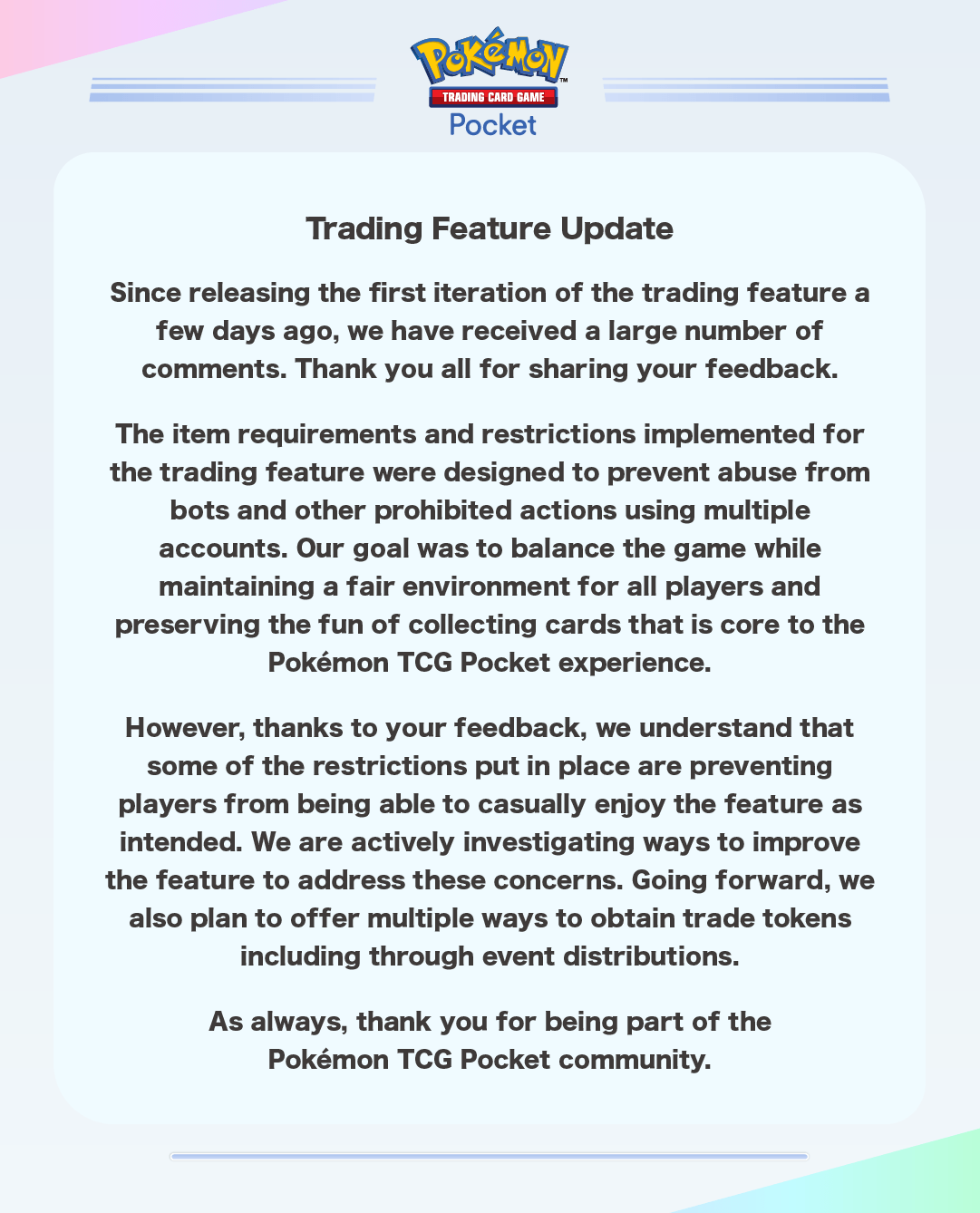
Fortunately, this feature is going to undergo some manner of revision in the near future, according to an update on the official Pokémon website. An update that was not shared in game, and is not on the Pokémon TCG Pocket section of the website. Just a random news article that was also shared on social media. …Why not just post this as news in-game? Who is going to religiously check the official Pokémon website news feed to learn about one game?
Regarding this upcoming trading update, I struggle to believe that the developers didn’t know their needlessly restrictive system would frustrate players. Game management is often incompetent, but systems like this are not created by accident. Either they were stupid enough to think that players would just accept the hardships, or they introduced these immense barriers so they can look like heroes when they take them down. I think it’s the latter, but that’s just an unsubstantiated theory that I have with a lot of live ops game devs. I believe that many games intentionally launch with crap and unfair systems just so they can promise to make them better in order to garner artificial goodwill. Thus allowing them to be seen as a company that ‘listens to its payers.’ Sorry, I mean… actually, yes, I do just mean payers.
Pack 8: Good Dopamine and Bad Systems

After seeing what I am assuming to be the first ‘season’ of Pokémon TCG Pocket play out, I am left with… mixed feelings. For as much as I have railed against the game, I do find it to be a fun card game whose complexity increases meaningfully with each new expansion, and with enough friction to remain engaging without being truly unbalanced. As a live service, I think it is low commitment, and manages to largely succeed in being a casual game, barring the garbage wonder pick events. And while it is basic in terms of its presentation, it is also clean and functional.
However, it also has a lot of miscellaneous points of frustration. The randomness of combat and reliance on good draws and coin flips. The RNG of obtaining new or rare cards. The crummy trading system with too many barriers to warrant engagement. The bad and opaque event schedule. And, of course, the way the game pressures players into payers by promoting exclusive goodies only available to premium players who pony up $10 a month.
In many respects, it is just another live service. A game that benefits from becoming part of one’s routine, delivering bite sized dopamine hits as commitment grows over time. Something that is fun enough, yet is marred by deliberate, if not intentional, inefficiencies and points of friction. I cannot call it bad or say it is not fun— it is good dopamine. But many of its systems are designed in such a way that I cannot call it a good game either.
Games like Pokémon Trading Card Game Pocket makes me wonder how a generation of people will view game design if this is their main exposure to the genre. Because despite whatever merits the game has, it is ultimately a corporate product meant to siphon money in exchange for entertainment. And every inefficiency can be circled back to that goal. To keep the players always eager, always wanting for more, until their resolve falters and they become payers. It’s not close to being the first game to do this, but it is definitely another one.