

The thing at my doorstep… who handed me a letter from my friend.
TSF Showcase 2024-40
The Thing on the Doorstep by H. P. Lovecraft
Coming in as a Halloween themed request from Natalie.TF reader Ouran Nakagawa, it’s time to go even further into the past, all the way to 1933 with a short story from… H.P. Lovecraft?
I’m just going to assume that you are all familiar with Lovecraft given how ubiquitous and popular his work has become over the past few decades (oh the glory of public domain). Personally though, I cannot say I was ever a true fan. I tried to get into his work when I was a teenager, going so far as to buy a big shiny hardcover omnibus of his works. But after getting maybe 15% through it, I just stopped for whatever reason and never went back. I still have the book actually— one of the dozen or so physical books I still own.
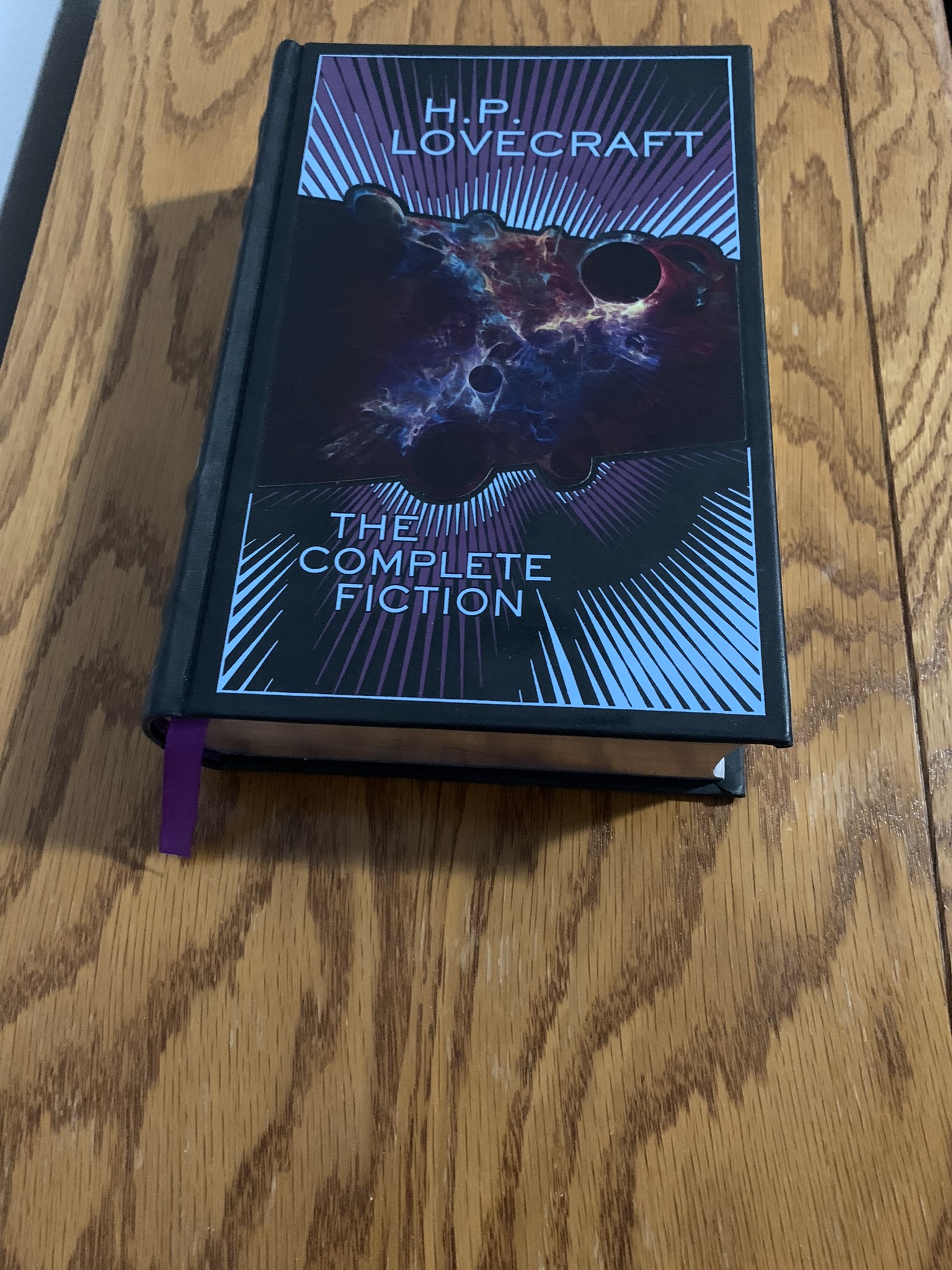
Lovecraft is also such a prolific author that I feel outside of my depth as nearly everything that could be said about their work has already been said. …Except from the lens of a niche genre subset that this story wasn’t trying to build upon, but ultimately did.
The Thing on the Doorstep is a story with a place within the broader Lovecraft mythos, but it is also an early example of a body swap story that does things a bit differently. Not as differently as 1911’s An Exchange of Souls by Barry Pain, which I talked about last year, but in a way that’s more historically interesting. But first, let me try to abridge the story.

Edward Derby is a smart man with a weak will who falls for Asenath Waite, a woman 15 years younger than him. He’s 38, she’s 23, and yes, that is a questionable age gap. The two bond over their love of the obscure and occult, including the study of the Necronomicon. After a few years of this, they get married and pursue their studies at Asenath’s decrypt mansion in Innsmouth. Over the intervening three years, they lead secluded lives, but the residents of Innsmouth and the neighboring Arkham notice various personality exchanges. With Edward going from his more reserved and passive self to a more confident and aggressive persona that’s capable of driving a car, something Edward normally could not do.
The story makes it abundantly clear that there is some body swapping or possession afoot. With Asenath’s mannerisms and gaze being often described as uncannily similar to her late father, Ephraim, who “died insane— under rather queer circumstances.” However, Edward does not seek help and is seemingly compliant in this ‘study’ with ‘Asenath’, at least until he winds up spouting nonsense after emerging from the woods one day. He confides in his lifelong friend, Daniel Upton, explaining the story to him and claiming that Asenath, or rather Ephraim, was conducting a ritual to permanently steal his body, so he could be a man again. But before Daniel can help Edward, Ephraim switches bodies with him, and returns himself to the mansion. Daniel then speculates for a few months before Edward, back in his own body, informs him that Asenath is gone. Edward then prepares to move back to his old family residence— that has been left abandoned for years— but before he can get on with his life, he gets a case of madness.
Daniel sends Edward to the Arkham sanitarium for about a month when Edward’s reason suddenly returns and he makes plans to leave the sanitarium. But Daniel can tell that this is not the Edward he knows, and is instead Ephraim in Edward’s body once more. This fills Daniel with a “dim feeling of blasphemous alienage and ineffable cosmic hideousness” and a few days later, he hears Edward’s signature knock on his door and goes to answer it. Rather than his old friend, he sees a stinky “dwarfed” figure in one of Edward’s cloaks, incapable of speech, who hands Daniel a letter in Edward’s handwriting. A letter that explains what happened.
Ephraim stole Asenath’s body some years ago and as Edward realized Ephraim’s plans, he attempted to kill him, burying the body in a cellar. However, Ephraim remained in this world through some demonic magic and attempted to steal Edward’s body even in death. And he succeeded, permanently claiming the body for himself and leaving Edward trapped in Asenath’s body. …Her partially rotten body with a cracked skull. Edward crumbles after giving Daniel this letter and heeding his friend’s advice, Daniel goes to the sanitarium with a handgun to kill Ephraim. However, he remains fearful that he may somehow steal his body after the deed is done.

On a pure conceptual level… I think this story is wonderful. A romance gone wrong as the woman the main character loved turns out to be a malicious spirit who only wishes to steal his body and all he owns to extend his own life. The main character gradually comes to terms with this truth when the switch is about to be made permanent and tries to claim his body for himself. Only for the spirit to decay his sanity and steal his body, leaving him trapped in a form that is quite literally falling apart. Then, in a final bout of desperation, reduced to a monstrous form, the protagonist implores their friend to seek vengeance on this body theft, and after the friend does so, their fate is left unknown. Perhaps they became the spirit’s next host, or the evil had been banished from this world.
It is such a good structure, prime for exploration and with multiple angles and perspectives to follow. The cold revelation that the one you fell in love with is a mere deceiver. The rush of becoming one’s lover. The all-consuming dread that one feels as their mind is broken time and time again through dark arts. All before being put in a body so decayed it can scarcely be described as human, wanting nothing but vengeance toward the one who betrayed you. There is so much good stuff here… which is what makes the execution of this story more than a little frustrating.
Despite not being a particularly relevant character until its later half, The Thing on the Doorstep is told from the perspective of Daniel Upton. Someone who knows Edward very well yet does not seem overly invested in his life. They are meant to be a passive everyman sort of character, the kind who is spoken to, never tries to push the story too far, and is inclined to stay away from the action. He references rumors and gossip about as much if not more than events he saw firsthand. Aside from his few encounters with Edward’s body, a single in-person encounter with Edward and Ephriam(Asenath) at his place, and the ending, Daniel barely does anything in the story.
I understand why that is the case. Because Lovecraft wanted to capture the horror of being an observer. To explore the conflicting thoughts and feelings that come with disbelief that such a thing can be real. But the horror angle of this story is… a bit weak. Daniel is prone to unrest and fright as he learns more about what is truly happening, yet he oversells the horror of the situation. Not knowing if someone else is possessing your friend’s body while he drives in a motor vehicle is unnerving. Finding a smelly, cloaked zombie at one’s doorstep is unpleasant. Seeing the home of a friend in inexplicable disarray is unusual. And a friend undergoing a sudden shift in personality as they grapple with what could dismissively be described as madness is unsettling. But none of these are nearly as horrific as the way Daniel describes them,

This story is simultaneously meticulously detailed and underwritten. The first stretch of the story is full of these highly truncated and detailed factoids and anecdotes shared by Daniel as he explains the background of his relationship with Edward. Just about every sentence is another information dump, another bit of crucial intrigue worth noting, and is so dense with information that it is hard to truncate without losing something. While the second stretch frequently keeps its point of view character and reader away from the action. It all makes the story as a whole feel almost incomplete, like either a novel’s outline and a highly detailed synopsis.
Actually, the entire story has a big ‘show, don’t tell’ problem that runs so deep that I have to wonder if it was somehow intentional. The story begins with Daniel telling the reader about characters for two whole chapters, telling us things that people told him. And the story ends with him reading a letter that tells him what happened. It’s a lack of agency that I find truly perplexing and simply is not a good or effective way of telling this story. It is functional, there is some good descriptive language thrown in there that, while esoteric, does create a vivid image and a mood. But it all left me wondering how a better rendition of this story could play out.
Better in terms of its focus… and its construction, as Doorstep is kind of sloppy. The story is afraid that the reader might not understand what the story is going for and basically tells you the body swap twist before it even becomes relevant. For example, take this paragraph from about 20% through the story:
Most unusual, though, were the well-attested cases of her influence over other persons. She was, beyond question, a genuine hypnotist. By gazing peculiarly at a fellow-student she would often give the latter a distinct feeling of exchanged personality—as if the subject were placed momentarily in the magician’s body and able to stare half across the room at her real body, whose eyes blazed and protruded with an alien expression. Asenath often made wild claims about the nature of consciousness and about its independence of the physical frame—or at least from the life-processes of the physical frame. Her crowning rage, however, was that she was not a man; since she believed a male brain had certain unique and far-reaching cosmic powers. Given a man’s brain, she declared, she could not only equal but surpass her father in mastery of unknown forces.
I can understand that the idea of a personality shift or exchange would be read differently in the 1930s, when many Americans genuinely believed in demons and possession. However, this is just far too overt for what is effectively a character’s introduction.
The story begins with the framing device of Daniel killing Ephraim in Edward’s body, yet it does not end with Daniel doing so or even preparing too. Instead, he mentions going over to kill Ephraim before explaining his encounter with Edward in Asenath’s body. Meaning the actual story ends with the reveal that Asenath’s body was actually that of a corpse which, in all fairness, was a surprise to me. Because Daniel kept describing it as inhuman, terribly smelling, and interpreting the words spoken by the body as ‘glub glub.’
…That is how you describe a decaying fish person, not a seemingly human person. And an undead decaying fish person would have been cooler and a better form of body horror. Especially if you got to see their perspective. There is so much mileage a decent writer can get out of the idea of someone coming back to life as a decaying, inhuman creature. Even if all they are trying to do is write and deliver a letter, they are going to be constantly disturbed or inconvenienced by their new form.
There are also a lot of little details or quirks that just bugged me while reading this. Daniel abruptly states how “later I would help [Edward] get a divorce” only for him to seemingly never do so. Ephraim’s personality shifts are frequently conveyed in how he drives his car with such regularity that it feels like Lovecraft thought driving technique was a fundamental aspect of one’s personality. The story takes far too much time setting the stage before getting into the core of the story, throwing around far too many details for an 11,000 word romp. And when the story gets going… it’s mostly built around Edward visiting Daniel a total of three times while he narrates in the middle. It’s a bizarre lack of variety that makes the story almost read like it was written for a play with a single set.

In conclusion, this is yet another TSF Showcase subject that I adore for its core idea and narrative ambition, but feel that the writer did not know what they had here. All the signs are there for a body horror romantic tragedy. A story about a desperate man clinging to life, killing his daughter to benefit himself, and doing all he can to manipulate someone else. A story about a man who fell in love with a like-minded young muse only to realize she was not what she seemed and was after his… everything. A story about a man losing his dearest friend to what seems like bad taste yet blossoms into madness and then into something truly demonic in nature. Stories like this really make me wish I had the leeway to work on more TSF Series installments, as I would love to tackle something like this.
Especially because Lovecraft does not really delve too much into the differences experienced by the men who are in Asenath’s body. Nothing about navigating the world as a woman, about the way they feel trapped or weaker when deprived of what they desire, a male body, or really many attempts at being another person. Because despite my claim that Edward is the protagonist, his perspective is absent, as is Ephraim’s. It introduces the idea, yet does not really explore it beyond some trite about how “a male brain [has] certain unique and far-reaching cosmic powers.” Which is… just Lovecraft being a dumb, lonely man from the 1930s who was racist and sexist even by the standards of his time. He was not the sort of person to consider this.
However, I am not saying that the work is of poor quality either. Its era needs to be taken into account, along with the fact that body swap fiction, as a broader concept, was not as commonplace. So there were no rules. As such, I do consider it an important early example of male-to-female body swap, albeit one that is a bit too timid— or cowardly— to really delve into its own premise.
It’s an A+ idea with a C- (and that’s being generous) execution. It makes me wonder if there are any adaptations of spin-offs of this story that emphasize the body theft and TSF aspect more. I’m sure there are— there are adaptations of every Lovecraft story out there. But finding the good ones involves sifting through a lot of mediocre works that are just cashing in on a recognizable name. …So, if you know of any of them, and they are good, I would be happy to check them out and feature them in a future TSF Showcase!
Also, in case you are curious about Lovecraft’s other body swap story, The Shadow out of Time, I’m 90% sure that is not TSF. She/her pronouns are only used in a single paragraph, and the words woman and women are not used at all. Which probably says a lot about the work
Thank you for the review, Natalie. And thank you Ouran for finding this story! Was an interesting read.
I also read it since you mentionned it some posts ago. The version I got my hands on was a compilation of other stories of Lovecrafts and many are written in a similar way : a narrator disconnected from the plot for most of the story, giving fragmented second hand accounts from acquaintances who claim having witnessed something unspeakable. I think the philosophy Lovecraft was going for is that whatever horror you come up with in your mind to try and explain these fragmented stories is going to be more terrifying than anything he can put on the page. Cosmic horror and fear of what lurks outside of the known world is kinda his thing.
And that clashes with the “playing with social norms” iconic to TSF/TG. For that to happen, the unknown factor would have to be humanized first and thus made less “other”. Which, in my opinion, would go against a main aspect of Lovecraft’s writing style. In effect, Ephraim might as well not have been human in this story since he acts more like a demonic entity than a human male.
Also, while the plot twist was pretty obvious to me too, I kind of think we were primed for it here. I wonder if this would have been this obvious for Lovecraft’s readers at the time, where quite a few of his story contain mentions of esoteric practices at the start.
Hiya Chari!
Yes, I am aware that many of Lovecraft’s stories are told from a the perspective of acquaintances, but I do not think that is really an effective vessel for cosmic horror, or horror in general. Horror works better when you at put into the situation, when there is something to ground it.
Ephriam is only loosely described physically and I believe his dialogue mentions him wanting to become human again, which implies to me that he was originally human. But he could have always been some sort of entity who lived as a human, within the real Ephriam’s body.
There is a difference between mentioning esoteric practices, and basically saying that someone has the ability to swap bodies and exchange personalities. There is a level of subtlety needed to really sell the horror of a body swap, and knowing what is going on detracts from that.
It’s another story that I look at and think ‘I can do a better, more cohesive spin on these ideas’ but, alas, I am a bit too busy with editing my next novel at the moment. So many ideas, so little time…
Definitely not a lot of prominent female characters in Lovecraft. There’ve been women and queer writers who’ve set stories in the Cthulhu Mythos though. See e.g. “A Short History of the LGBTQ+ Mythos” deepcuts.blog/2023/02/08/a-short-history-of-the-lgbtq-mythos/ Some quotes from letters by HPL in there with ugly stuff. Not only did his letter writing far exceed his output of poems and short stories, but he may have been one of the most prolific letter writers of all time. As one site has written, “it is estimated that Lovecraft wrote 100,000 letters — or roughly 15 every day of his adult life — ranging from one-page diaries to seventy-page diatribes”. Possibly if others were as prolific we’d find a lot repellent in them too.
That Deep Cuts post also makes mention of a story “including the first explicit transgender and bisexual characters in Lovecraftian fiction.” And the book Sex and the Cthulhu Mythos by Bobby Derie sounds really interesting.
Suitable Flesh (2023), starring Heather Graham, is loosely based on “The Thing on the Doorstep.” It does have M-F body swapping.
Sajah’s coming in with the research yet again!
Dang, I have no idea how anybody could write that many letters without developing crippling hand issues…
Hmm… 70s ideas on gender and sexuality tends to be a bit dated. Well intentioned, but not always gelling with modern sensibilities. Plus, novels are big commitments to a showcase. However, looking over the description of Suitable Flesh, and checking out the critical consensus, it might be a good TSF Showcase candidate! Adding it to the list!
Aww… This was my second time re-reading the story. I could’ve sworn the bad guy did more stuff in the daughter’s body but oh well. I appreciate so much for accepting my request, Natalie. 😭
tfw no Male-to-Rotting-Female-Corpse Bodyswap Erotica since 1933. Sad!
Nah, there has been male-to-rotting-corpse body swap erotica since 1933. I cannot name an example, but I just know that statement is wrong.
Also, come on now, this is not erotica. :P
Google search:
transgender site:deepcuts.blog/
… turns up several items that may be of interest.
Similar search on “body swap” or “gender swap” just turns up just two posts, though:
deepcuts.blog/2023/06/21/seabury-quinns-lynne-foster-is-dead-1938-a-mistaken-gender-identity-by-sophie-litherland/
deepcuts.blog/2022/02/05/a-transmasculine-horror-writer-looks-at-lovecraft/
The latter touches on “The Thing on the Doorstep.”