

Hazardous Hollow Hackers!
Zenless Zone Zero Review
Platforms: PC(Reviewed), Android, iOS
Developer/Publisher: MiHoYo Co., Ltd.
Inanely Intrepid Introductions

Two weeks ago, Zenless Zone Zero launched as the latest project from notorious gacha developer MiHoYo and promptly became a hit, netting over 50 million downloads in its first week. Normally when a game is that big, I do not pay it much mind, as there are already so many people talking about it and sharing their thoughts on it, good and bad. But ZZZ immediately stuck out to me from the deluge of other live services with its aesthetic flourishes, being a stylish cyberpunk action game. One complete with character designs that neatly nestle into my preferences.
So even though I probably shouldn’predt have, I decided to play ZZZ for a week and a half to gauge the quality of the game. …Okay, that’s not strictly true. I am on an anti-live service schtick after losing my beloved Dragalia Lost, and I wanted to confirm that, despite how it may look, ZZZ is just another atrocious gacha game.

Having gotten to player level 35 and just started chapter 3, I think I have played more than enough to write an early review of this title. I originally wanted to call it a ‘first impressions’ piece, but after you put 40 hours into anything, I think you’re able to call it a review.
My ultimate conclusion is that Zenless Zone Zero is a game that comes tantalizingly close to being something that I love. A gacha game that seems somewhat fair in its distribution and reward structure, the biggest barrier being the energy system. And a game with design decisions that occasionally leave me utterly baffled. I have a lot to say, so let’s get started!
Loosely Lavish Lore

I tried to go into Zenless Zone Zero relatively blind, but the more games of this sort I do that with, the more I realize that might be the actual wrong way to engage with them. Particularly when it comes to understanding the lore.
Zenless Zone Zero follows Phaethon, a legendary hacker duo trying to make a living in the cyberpunk capitalist gig economy or New Eridu. After losing access to their account and acclaim in the prologue, they get mixed into all manner of corporate conspiracy, reconstruction projects, and mysteries involving shadowy figures. Pretty standard affair, complete with an assortment of factions, familiar friends, and odd jobs from absolute weirdos.

As for what exactly Phaethon does, it involves jacking into a Bangboo— a smart device, pet, and plush hybrid— in order to guide people through the hazardous realms of the Hollows. Space-time distortions that are filled with corrupted monsters known as Ethereals. These environments are ripe for plunder and rife with danger, requiring both government forces to protect citizens and opening up a black market of Hollow Raiders, who Phaethon is strongly associated with. I would say that they are the characters you play as in the Hollows, but the game actually calls those agents, and only some of them are Hollow Raiders, so…
Okay, that is the simple version of the story, and in describing the game this way I am making some broad simplifications, due to how questionable the game’s lore actually is.
You see, ZZZ is not set in a ‘cyberpunk capitalist gig economy.’ It is presented like one, and just going through the game, it sure as hell feels like one. But it’s not. Instead, ZZZ is a post-apocalyptic story where the overwhelming majority of humanity has died. New Eridu is the last urban city to still stand. And humanity has been largely overtaken by the Hollows, whose presence has destroyed much of contemporary technology… except for smartphones.

This is a… perplexing bit of backstory for the game that simply is not reflected in its tone. Phaethon, in addition to being a hacker, also runs a quaint video store. The city of New Eridu is clean, lively, and full of quirky characters, including a police officer who wears a damn mascot costume. The game is bright and colorful, and the soundtrack largely consists of lo-fi beats.
I understand that this is not the first game to try and balance a background like this with such a vibrant cityscape— Astral Chain comes to mind. However, it simply does not feel right for a game like this to have such a dismal backstory. There is too much recreation, too much cartoonishness, to match the drama associated with humanity being nearly extinct.

This one bit of lore just raises so many questions. Such as… if this is the last city, where are people getting things? Where are they making things? Where is food coming from? What is on the container ships that are constantly moving down the city’s river? And if this is New Eridu, shouldn’t the city be designed to be self-sufficient? I’m not saying that a story like this needs to take things as seriously as, say, Muv-Luv Alternative. But the writers could have chosen anything for the background for their game, could have used less extreme language to describe the effect Hollows have had on humanity. But they chose not to, and I think that was a bad decision.
Another lore decision that just… does not make sense to me has to do with the Hollows. Starting up the game, I thought that the Hollows were not actually interdimensional anomalies. I thought they were rifts between the real world and cyberspace. Places where the digital world is encroaching on the physical world. Kind of like in Digimon Story Cyber Sleuth.

Phaethon is a hacker who does work by logging into the Hollow Deep Dive (HDD) on their computer. There, they can take on various jobs posted on Inter-Knot, a micro-blogging platform with terrible UX, or received in-person, by accessing Hollows. When accessing Hollows, they both navigate through a GUI representation of the Hollows and control either the avatars of the selected agents or guide the agents themselves, depending on the mission.
Thanks to Phaethon’s abilities, the agents can perform better than they could on their own, even if it is at the cost of trusting their lives in the hands of someone else. After completing missions in their appropriate Hollows, and finding various goodies in and out of combat, Phaethon and their allies jack out and get their job rewards sent to their accounts.

In pursuing this interpretation, I may be conflating diegetic and non-diegetic elements, but it’s hard not to when they seem so compatible. As a player, I do not strictly believe that all mechanics are meant to be literal, but I expect major ones to be. So if Phaethon is not actually accessing some digital manifestation of the Hollows then… what is the HDD actually doing? Just letting them control the Bangboo, who converts the Hollows information into the cyberspace screens the player sees? Why would you want it to work that way? Hell, how is Phaethon even contacting these agents? They’re not employees, they don’t live at Phaethon’s home base, so during side missions, what’s going on if Phaethon isn’t controlling a digital representation of the agents? I mean, that’s how it works for the VR side missions.
It’s just a messy bit of world-building that makes it hard for me to get properly sucked into the world building of ZZZ, as these disparate elements just do not mesh together properly.
Talky Texty Tribulations

Speaking of things that do not mesh together, Zone Zero implements many different presentational formats as it tells its story. Cutscenes, voiced dialogue, unvoiced dialogue— if you played any semi-modern RPG, particularly one developed in Japan, you’ll understand what I’m talking about. Normally, I just view this as a simple result of budget allocation, and don’t think too much of it. With ZZZ though, this usually acceptable difference is… jarring.
For the biggest and most elaborate moments, the game implements in-engine cutscenes. They contain hyper-fluid animations, bombast, spectacle, and are generally of a quality befitting a feature film. They deliver a lot of information quickly and are the visual apex for the game as a whole.

Next we have comic panels, which are implemented when scenes are important and story relevant, but either too expensive or difficult to animate in-game. The end result is akin to a, well, comic book, paired with full voice acting, smooth transitions from panel to panel, and ample room for characters to emote and make their personalities known. They are an incredibly efficient means of delivering a story, are a treat to look at and, in some cases, I think I actually prefer them to the cutscenes.
But then we get to the calls. Which are those particularly blasé brands of cutscenes where two character models idle or go through stock reaction animations while they stand facing the camera. They’re functional, they’re an economical way of delivering voiced dialogue, but they kind of fail to do much more than the bare minimum from a visual perspective.

Then we get to conversations, which are just talking to a character in the explorable world, pressing a button, and being met with voiceless dialogue boxes as character models idle about. The presentation tells me, as a player, that whatever I’m being told is not very important. Because if it was, then the developers would do more to emphasize and display the story. If this were the primary means of the game delivering its story, I would probably just accept it. After all, I still consider voice acting to be a treat. But in contrast to the other narrative delivery methods, this one’s just lame.
I’m not saying that the game should voice every single line— that would just be silly— but there are things the game could do to make its unvoiced scenes less of an obvious downgrade. Such as using a better in-game font.

I believe the game uses Inpin Hongmengti, a thick, bolded font that is… not great for readability. When choosing a game’s text font, you typically want to use something more straightforward and simple, something easy on the eyes, that supports Latin and Asian languages, without contrasting the game’s art style. Maybe something like, I dunno, New Rodin, or my beloved Noto Sans. But this one just sucks and is bad for accessibility.
There are also a lot of little frustrations with how they present text. How the in-game social media page makes the rookie UX mistake of putting gray text on a black background. How text is often crammed into a tiny box during certain content, even when the game has plenty of room to display this information. And how tiny the font can be, even on a 1080p monitor. Truly, I do not envy those who are trying to play this on a damn phone.
I know this is a nitpick, I know that most people would not explicitly notice these things, but a jump in presentational quality like this and a bad font can affect their experience.
Stylish Saviors’ Saga

Now that I have gone through all that, what do I think about the overall story? …I like it.
It is, ultimately, about a group of self-made people and those with a mind for justice trying to stop shady corporate scumbags from decaying their city, with additional hues of conspiracy. The game’s main storylines all have some general hook or underlying mystery to them, making them interesting enough to get through. All of which is broken up by side content teeters between blasé concepts too plain to be worth remembering and ideas that indulge this world’s more silly and whimsical side.
I’ll admit to still not fully ‘getting’ what the core thrust of its main story is, beyond a more general conspiracy narrative. But there’s enough interesting going on hour-by-hour to keep me engaged. Well, at least up until the last story mission I finished, Mission Unthinkable, which was just a bunch of copaganda. And not in the national defense force sort of way. Just inner-city cops, trying to convince the public that they are ‘on their side,’ as if there aren’t bigger problems going on. …Like the ravenous monsters who have destroyed most of the world.

The story has its moments, but what really sells it is the cast. ZZZ puts its characters at the forefront with its main story, with sub-chapters focusing on individual groups. Showcasing their personalities, their dynamics, their struggles, and how they play as characters, letting the player grow attached to them. Once the player is attached to them, they can dive deeper into their characters as they unlock agent stories— similar to the loyalty missions from Mass Effect 2. And if the player is able to pull for them, they can call them up to chat, hang out, and get in micro-skits while raising their trust levels. Also, for the record, these Persona-like hangouts are locked away for about the first forty hours of the game. Because somebody thought that was a good idea…
While I definitely do not love everyone, the Phaethon’s posse are a merry bunch with enough personality and quirks that I at least don’t dislike any of them. Partially due to the careful construction of their defined and pronounced personalities, but also due to the English voice cast. You can tell the voice actors were doing their all to bring the characters to life, despite whatever limitations and constraints the production was under. They add a lot to the personality of the cast, make the story more engaging with their presence, and my only criticism is some of their barks. But that’s mostly due to the development team assigning voice lines to mundane actions and only recording three different lines for that action. Or as I like to call it, the Brink (2011) problem.
Just seeing these characters, getting to know them, and seeing Phaethon work alongside them toward a mutual goal is enough to keep me thoroughly engaged in whatever is going on. It’s nothing amazing, but I’m bummed that I’m not going to get to see what comes next.
Weary World Wanderers

The full gameplay of ZZZ is a bit hard to fully grasp as it dabbles in a lot of different subsystems and styles that are somewhat awkwardly meshed around, with menus and a progression system to tie everything together. But when it comes to actually playing the game (whatever that means), things tend to fall into one of three core modes.
The first is traversing the world of New Eridu. Unlike Genshin Impact, ZZZ is not an open world game, and its main setting is segmented into smaller, disconnected, zones. I would call it a charmingly retro game design approach. A throwback to when a AAA game’s world could only be a few well-trodden areas rather than a big, empty, vast map.

I highly appreciate this approach, as it makes a more walkable, hang-out-able environment, and forces the player to pay attention to the detail and craft put into these 3D places. In my time with it, I came to memorize these streets vividly, and I genuinely enjoyed walking down them as I checked to see what’s going on and what’s new. That being said, there are two… problems with this world.
First, while the entire traversable world of ZZZ could probably fit into less than a single square kilometer, the game is adamant about breaking it up into smaller bite-sized chunks. Areas that are just one room, are turned into their own unique place that players are meant to access via fast travel, rather than walk to. I think this is a… bad way to go about designing a contained city environment, and I have no idea why they chose to do this.

It’s easy to see how the city could be stitched together, how the player could just walk from place to place via the in-game subway to travel, and any modern technical justification is just… wrong. This is stuff that developers were doing over 20 years ago in games like Sonic Adventure (1998), Super Mario Sunshine (2002), and Wind Waker (2002). Let alone GTA III (2001). Any phone that could run this game should be able to manage a more connected world, and if not, that’s what loading screen transitions are for.
My second problem is that the world feels static. Phaethon can walk, run, or interact with intractable persons by pressing the interact button, but that’s about it. Balls, trash cans, and milk crates can be lightly nudged with physics, but generally you cannot really do anything but look at this world. I understand why this is… but I could not stop thinking about how much I wanted to be able to do something while running around at a reasonable pace. The ability to jump, run into people, or kick around stray boxes. Something to make the world more tangible.

Instead, the game treats these places like corridors littered with tasks. There are dozens of micro-missions that can only be found by walking around, and only appear at certain times of day per the day/night cycle. Some of which have pre-requisite spawning conditions that have not been documented, and possibly won’t be. I understand that it is supposed to give meaning to going out into the world, but there are better ways to do that.
I want to love this world, feel as if it’s a little digital neighborhood, but it just doesn’t feel as real as I want it to be.
Tube Traversal Technology

When doing story and exploration missions in ZZZ, players are sent to the HDD, a digital interface on Phaethon’s computer showing a navigable grid of nodes, where every node is a small CRT television. From a visual perspective, there is a lot going on here with perspective, depth, a row of TVs in the background showing a different image, and general camera work, all before getting into the dozens of icon designs and animations. It’s flashy, looks cool, and nails the cyberpunk look that I would expect when navigating a virtual space.
That being said, according to the lore and supplemental information, this is meant to represent people walking around in the Hollows. Something that I object to as the visual analogy does not work. Watching a little man step on tiles with grass is an effective visual analogy for someone venturing across a field. Clicking on an icon using a cursor to be teleported to a location is abstract, but that is clearly meant to be non-diegetic. Here though? It has to be diegetic. Many puzzles, mission-based mechanics, and general systems rely on this tile-based presentation. If this is meant to literally represent characters navigating the Hollows… that raises more questions than it could hope to answer.

The HDD is cyberspace, and only when characters enter specific nodes do they travel into an instance in cyberspace that resembles reality. I know some cutscenes make this out to be one continuous, large space but, no matter how you view the Hollows, impossible space is a thing that exists.
Moving past that tangent, from a mechanical nuts and bolts level, this is… a throwback to early 80s computer games. As in, Rogue (1980) and Dragon Slayer (1984). There are unique interactions and sub-mechanics, yes. But when you take the flashy shell off, this sub-game is not far off from the sort of thing I saw my peers create in my AP Computer Science class back when I was 14.
Don’t get it twisted. I ultimately prefer this over just running around an empty copy-pasted world, looking for things of interest. I do enjoy this basic to-the-point form of traversal and think the puzzles are neat in a ‘student project’ or ‘game jam mini-game’ sort of way. Such as the mission that’s a basic auto-battler RPG in this system with unique party members and buck wild skills. But I want to know how the HELL this got into the design doc for a game with a budget that must have exceeded $100 million.

Something this simplistic just does not make sense for a game with this much money behind it… and the same is true for the ‘arcade games’ in ZZZ. This diversion is clearly meant to be built up over time with event quests and diversions, but at launch there are only two games here. A Mr. Driller clone, a puzzle game so simple that a first-year programming student could probably develop a decent proximity. And… Snake.
I’m sorry, but that’s just insulting. I literally made a version of Snake as a midterm when I was 14-years-old and then made a four-player version a week later. Sure, the presentation and fine details of the ZZZ rendition are way better than what my stupid-ass made. But this is not only an optional side game with its own dedicated achievements, but the player needs to play Snake to progress the main plot. How? Why? What is the point of this thing?
Cool Character Clashing

The meat and minority of Zenless Zone Zero is devoted to combat, which takes the form of a fairly shallow action game. The player marches across combat arenas with a party of three characters, and mostly engaged in a dance of attack, rechargeable special, rechargeable ultimate, dodge, character switch, and parry. That might sound like a lot, and there are myriad mini-mechanics going on under the hood, but it’s quite formulaic.
Attack with the character’s standard combo and/or charge attacks to deal damage, accumulate special and ultimate meter. Dodge when enemies are attacking, potentially slowing down time if you time it properly. If the enemies do a yellow flash before attacking and you switch characters, the freshly swapped character will deal an assist attack. As basic attacks are performed, characters get meter for their stronger element-based special attack. And as the party deals damage, they build up an ultimate move. Something that should deal massive damage, but it’s not really the showstopper it seems like it should be.

Dealing damage will ultimately stagger daze an enemy, building up a yellow bar under their health, and when that bar is full they will enter a break stunned state, immobilizing them and weakening their defenses. Once stunned, the player has the opportunity to unleash a chain attack, dealing massive damage while swapping out their characters, one after another.
After playing what had to be 10 hours of combat, I think that covers it. There are more nuances like stage hazards with mine and motion detecting turrets. There are afflictions anomalies for the five element attribute types in this game, with some enemies being weak to different ones. I don’t know what any of them really do, I just make sure to grab the elements the game says are best for any mission. Meaning I only needed to build up 5 characters. Which is better than 7 and way better than 40.

My dry recounting might make you think I don’t like this combat, but… I actually really enjoy it. It’s simple for about 90% of encounters and suffers from the level scaling problem that hinders most modern action RPGs. But it does have tense moments when boss enemies show up. Crowd control is something to be wary of, as they will disperse and try to hit the player from behind. Many challenges require defeating enemies swiftly and efficiently to get certain bonuses, so there is a benefit to proper strategy. And while the reaction windows are generous, players need to keep their eyes open and fingers at the ready unless they want to get their agents’ asses kicked. It is simple, but it does require players to pay attention and react promptly. However, the biggest allure to the combat is, inarguably, how stylish it is.
MiHoYo put in a lot of work into making this game look sick as shit and fly as fuck. Every character has their own carefully curated attack animation and weapon, giving them all their own unique form of spectacle. Enemies are similarly flashy with their attacks, but rarely in a way that impedes their readability. (Well, unless they are big, but big enemies have been the bane of 3D action games since, like, 1994.) The camera work and effects for special moves is quite effective at conveying a sense of power and impact, even if it barely nudges the health of an enemy. And everything oozes with a palpable sense of coolness so thick that it’s its own reward for doing things properly. From the first break of the enemy defenses to the iconic “wipeout” end screen. (Well, it’s iconic to me at the very least.)

If you are a character action fan who speedruns Devil May Cry games, this might all seem like baby shit to you. For me? This is about one layer of depth away from what I like to see. (Maybe it should have stuck with the old reliable light/heavy attack system?) As a live service? I think this is a good balance. Flashy enough to keep the goblin brain entertained for multi-hour play sessions, but simple enough for you to go in, do your dailies, and move on. And as a game meant to broaden to wide audience, including many action game newbies? I can’t imagine much the combat being better than this.
Plodding Persnickety Progression

Okay, so I described the story and gameplay elements of ZZZ, but I have not touched on the most important part. The progression. ZZZ is a game that wants people to be playing it forever, and to achieve that it locks power behind several layers of obfuscation and complexity. How many layers? Let me list them out and count the ways!
- Agents do not level up by being used in combat, but rather need to be fed Investigation Logs to gain EXP.
- Agents start with a capped level and that can only be unlocked using Certification Seals so they can reach level 20, 30, 40, 50, and finally 60.
- Agents have another layer of six unlockable buffs via Mindscape Cinema, which can be unlocked by getting Agent-Specific Focus materials, but those can only be obtained via gacha or bought via the gacha store.
- Agents all have eight Core Skill buffs that can be unlocked with Core Skill Unlock materials.
- Agents’ standard, dash, special, chain, and ultimate attacks can all be enhanced from level 1 to 12 using Skill Enhancement Chips.
- Agents wield weapons known as W-Engines, which are assigned based on their fighting style. These can be bought via an in-universe store or obtained via gacha and can be upgraded in three ways. All W-Engines enhance the offensive power and passive skills of the character who equips them.
- W-Engine levels can be raised by W-Engine Batteries.
- W-Engine level caps can be unlocked by W-Engine Ascension items.
- W-Engine star rating can be increased by feeding duplicates W-Engines to the appropriate W-Engine.
- Similarly, agents can also wield six pieces of randomly generated equipment known as
Disc DrivesVinyl RecordsDrive Discs. Which can boost pretty much any stat of the respective Agent, but can only be leveled up using Master Copy Plate items. These items improve the stat buffs and unlock new ones with every level gained. - When deploying on missions, the player can bring a Bangboo with them to act as a helper character, offering some passive effects and occasionally dealing damage. I don’t think they are very useful, but they also have their own progression system. They come with both a DPS source and passive buffs, as to be expected.
- Bangboo levels can be boosted by Bangboo Systems.
- Bangboo level caps can be unlocked by Bangboo Electrolytes.
- Bangboo star rating can be increased by feeding duplicates Bangboo Cores the appropriate Bangboo.

…So, you got all that? No? Good! Because this is a lot of stuff and if you thought that was easy to digest, you should try eating an airplane! This system is deliberately designed to obfuscate and overwhelm the player with myriad confusing doodads. Both to ease them into loosening their wallet and to have them consult fan-made sources, helping the community behind the game grow. It is facetious, and I don’t like it.
From what I can tell, the biggest bottlenecks to power are the level caps for agents and W-engines, the agent skill upgrades, and the agent core skill upgrades. All of which can be obtained in the same way. By playing missions that expend the player’s stamina. Yes, stamina! The gacha stable automatically generated resources that players use to do various missions or battles and whose limited nature keeps the player coming back to the game day after day.
If you want to make your agents stronger, you need stamina, and if you want stamina, there are technically items you can get. But realistically, you only get 300 stamina per day and need to spend it on… way too many things.

There are five different types and three tiers of Certification Seals for agents. There are five different types and three tiers of W-Engine Ascension items for W-Engines. There are five different types and three tiers of Skill Enhancement Chips. And there are… eight different types of Core Skill Unlock materials. This means there are 23 tasks to do to accumulate upgrade materials, 4 tasks to obtain semi-common materials, and 6 tasks to obtain Drive Discs. That’s 33 different tasks, all of which consume a player’s limited stamina. And for a game that just launched, that’s crazy!
Admittedly, 3 of them do not require stamina, and can merely only be done three times a week. But still, that’s a LOT of stuff to do, and it’s actually bottlenecked by how you are supposed to do 5 Disc Drive quests a week to get battle pass rewards. So that’s 1,800 free stamina to use per week across, realistically, 20 different tasks.

With these hard limitations in mind, I focused on five agents— Nicole, Nekomata, Grace, Lucy, and Soukaku. I raised their level caps, as I knew that would have a tangible effect. I filled up all their Drive Disc slots with A-rank loot. I got some W-Engines to level 30. And I dropped a few upgrades into their skills. Was that enough? Yes. The only issues I had with the game, and the only instance where one of my agents fell in battle, was when I was taking on a level 38 mission with level 30 agents. Beyond that, it could get a bit spongy in spots, but definitely not as bad as Genshin Impact and its rigid world level.
In saying that, bear in mind that I only got about halfway through the game’s launch progression path, so I truly do not know what the endgame will be like or how brutal it will be. I suspect that spreadsheets to determine optimal gear will be necessary at some point, because that’s how it oh-so-often is in the world of gacha.

The progression system of ZZZ is bad if you view it like a real video game, but as a live service, it’s rock solid, as it keeps players coming back and keeps them hungry. Hell, I only played it for eleven days and that was long enough for me to get attached to its loop.
On that note, I probably should talk about the gacha, as it is part of the progression. I think that the gacha rates of MiHoYo games are egregious. I am not fond of any gacha system that rewards players with weapons and characters, as getting weapons from pulls sucks, when I want cuties, damn it! …But I managed to do about 120 pulls from the permanent pool, get two S-rank agents, and I still had a spare 100 pulls between my summon tickets and primogems. (I’m not gonna bother to look up the real name, you know what I mean.)
Much of this success can be attributed to launch promotional events, as the actual in-game distributions of the primogem equivalents are predictably stingy. (Seriously, what is 30/160ths of a summon?) But even if this is another greedy gacha, I did not feel an extreme difference between S-rank and A-rank adventurers, so at least there’s not a rigid tier system from launch. Or in other words, the gacha system, as it currently is, seems fair enough that I don’t sense malice.
Repeating Roguelike Responsibility

Oh cripes, I almost forgot all about this. So, as a separate element from the entire main game, ZZZ has its own roguelike subgame. One where the player gradually accumulates party members, card-based buffs that can be unified to create a stronger combo card, cash to spend at shops, and manages their health between waves of battles. It’s developed enough to be a unique game experience and… I really like it.
That being said, it is partitioned off into its own mode, called Hollow Zero, and the player is… weirdly discouraged from playing it too much. It has numerous weekly goals and resets that I guess are meant to prevent players from diving headfirst into the mode and getting sick of it, which makes sense. Gacha games are predicated on being years-long experiences, and not everybody is a Kaleidoscape Queen like me. But this mode also barely has any real impact on the rest of the game.

You pretty much only get items related to Hollow Zero itself, as part of a persistent upgrade system. Upgrades and summon currency for the generally unmonetized Bangboo helper characters. And points that can be used for a currency conversion shop. Which are… kinda lame rewards, even if there are bonus primogems thrown in for good measure.
I actually think the poor rewards are something of a shame here as, when the mode opens up, it’s arguably ZZZ at its best. It forces players to manage with both boons and banes while managing health as a long-form resource. It encourages more diligent play, while also rewarding players for fast clears. That being said, the mode also asks for about two and a half hours of playtime a week, which does not sound like it would fit into the gacha game liker lifestyle. Especially when the main game dailies can be done in… maybe fifteen minutes?
Absolute Aesthetic Achievement

The first thing that draws anyone to ZZZ is, without question, its art. Its style, its world, its meticulously crafted cast of characters, its incredibly high quality visual finesse, and its silky smooth animations.
The world of New Eridu is crafted with a meticulous eye for detail in order to make it feel like a lived-in place people actually enjoy being around. The disheveled objects nestled into the corners of the environments. The unique logos and accouterments unique to every storefront. The posters and promotional art strewn about, frequently boasting designs not seen elsewhere. It is never too lavish, never feels too idealistic, it feels just believable enough to get lost in the fantasy.

Character designs look like they were workshopped in an art lab for several months before being put into production with just how considered they are. So many small details and bits of personality are thrown together yet they are never burdened by the details and can always be reduced to a more simplistic design. It immediately makes them recognizable, and by being characters from a contemporary setting, there’s simply more you can do with them. Characters in a fantasy game must conform with the generally accepted fantasy art style, same with sci-fi, and I often think that can hinder the design. But here? The world of streetwear boasts enough diversity to give everybody their own style. Shit, even the pigs got flair!
It would be one thing if this was just good designs and models, but the animations carry with them a flourish and fluidity that still managed to impress me over 30 hours in. No matter what the characters are doing, they look cool. From combat to cutscenes to even the damn character select menus.

The UX design does a decent job of gelling with this direction, featuring many unique flourishes and small bouts of style that do not impede function. Though, the design and segmented nature certainly does, as it is easy to get lost in the rows of options, shortcuts, and vague icons. I’d say this is a problem, but this is just the way gacha games are designed.
ZZZ is a very strong looker of a game… but there are two things about it that just bug me. Firstly, the design of the Hollows. Rather than make this part of the world look truly corrupted or distorted, the Hollows are most often depicted as dilapidated construction sites or tattered snippets of urban sprawl. Complete with bright blue skies, even though Hollows exist in domes of darkness.
I understand the ‘lore reason’ behind this, but there is a palpable lack of diversity in these locales— a lack of personality in a game dripping with it. It really makes me pine for the biome diversity and bespoke locations of something like… God Eater, as dilapidated concrete rooms are soooo 2012.

My second issue comes with the use of antiquated technology as a core visual motif, namely CRT displays and VHS distortions. This is a long standing gripe of mine, but I simply do not like to exonerate or view the inefficiencies of older display technology as an aesthetic.
I know that the distorted and blurred screen of CRT can paradoxically enhance certain low quality images by masking imperfections. That decades of media were produced with the expectation that they would be seen on these displays. And I will even concede that the tactical heft to a videotape can make it feel more ‘meaningful’ than something someone you tap on glass to beam onto your phone. However, this era had its problems, and I worry that only focusing on the unique aesthetics, the children are being fed ‘CRT propaganda’. Tricking them into thinking that old, antiquated, technology was somehow better.
That being said, I do truly think ZZZ is an incredible game to look at, and one that impresses in so many ways. From the random snippets of artwork to the visual effect flourishes in combat to… everything.
Musical Muse Missing
When I first saw ZZZ, I had a strongly bitter reaction, and one of my key comments was “I can tell it will not have a GOAT electronica and/or hip hop soundtrack.” I hate to say it, but… I was right. A game with this type of urban street style warrants an appropriate soundtrack, and there is no shortage of musicians who know how to blend electronic, hip hop, pop, and contemporary new flavors. Instead… the game sold its soul to not spook away the normies.
ZZZ is a game that really should have three different groups of music. Light music for wandering the streets of New Eridu, as that place is supposed to be a chill, hang-out-able, walkable city. Hacker music for anything involving the Deep Dive, as the player is traversing cyberspace, which is not meant to be chill. And lastly battle music. Ideally vocally-driven, high BPM bangers that get people’s blood pumping. Music people rock out to. Music people work out to.

In execution… the soundtrack is mostly lo-fi to vibe with. While it is not devoid of lyrics or high intensity tracks that are fitting for bosses, there simply are not enough of them. And those that are therenever reach the intensity or coolness of other game soundtracks that I could name. Anarchy Reigns, Dragalia Lost, Nier Automata, any modern Persona soundtrack. Shit, Foamstars has loads more sauce than this! I can practically feel a desire to do something more intense with some of these tracks, but there simply is not an opportunity for the composers to go all out. Hell, even the gacha theme has absolutely nothing on BANG!
Here, let me go over three examples just to defend my sanity. As the music for most stamina consuming quests, VR is a fine enough piece of combat music, but despite going on for five minutes, the track never really evolves or shows much flavor. It sounds like something licensed or developed in isolation of the main game.

Endless Construction – Day is often used as the music of the Hollows— as it is a place locked in endless construction— and I appreciate the interjection of English backing vocals. However, this is not appropriate combat music, as it is too laid back and low energy to match the spectacle of combat.
Four-Armed Sword is alright standard battle music, a bit droning and prone to melting into a dubstep daze, but sometimes that is what you want. Except it isn’t standard battle music, it’s treated as a boss theme. I don’t want to say that boss themes should sound straight outta Revengeance, but… they would be WAY more memorable if they were
The entire soundtrack just feels too damn safe. I was actually looking forward to adding this to my musical rotation, but instead of having another pumping soundtrack… this is closer to beats to relax and study read and write to.
Fiercely Ferocious Finale

Taking in everything I have said, I really like Zenless Zone Zero. So much so that, if I had the time, I would keep playing it. I want to see how the game grows, see how it evolves, and have it fill the gacha shaped hole that exists in my heart. I have problems with its story, including a fundamental disagreement about its lore. There are a lot of little things that bug me about how it was constructed. And think that the live service nature inarguably hurts the overall quality of the game. From its reliance on retention to sprawling paths to power to the likely power creep that will spawn from its monetization minded pull rates.
However, the loveable characters, simplistic combat, and undeniable style balance ZZZ out to a game with immense highs and more lows that are more middling than anything else. There’s a lot that I wish it did better or was more realized, but what’s there is still… special. Even after uninstalling it, I feel the clawing desire to come back to it.

…However, I felt more of a desire to replay NEO: The World Ends With You instead. Because that game… pretty much did everything I like about ZZZ, but better. A quirky cast of endearing characters. An urban world oozing with style and liveliness. Flashy yet simplistic combat dedicated to bashing out waves of enemies. A story with colorful characters, peripheral side tangents, and overarching conspiratorial intrigue.
Except NEO TWEWY also has a lot of what ZZZ lacks. A player-directed progression system limited by however much grinding they want to do. An equipment system with some depth to it, but is limited to a few hundred items with pre-set stats. And gameplay that involves a lot of single button attacks, yet contains a level of customization and depth that give players dozens, if not hundreds, of options.

I know this is a gauche way to end a review about one game— praising a game that is clearly trying to do something different— but I genuinely could not stop comparing the two during my time together. Both in their similarities and in their differences.
NEO TWEWY was the sequel to a cult classic that did not sell particularly well, and it presumably did even worse, despite having a vastly higher budget. It was a single-player title with no DLC, no bonuses, just a packaged game you buy, play, and can enjoy for 40 to 100 hours, depending on how much you like the combat. It had a unique combat system with a lot of versatility, and took risks in both its position as a sequel and a game in general.
While ZZZ is ultimately the type of game that I believe to be doing immense harm to the game industry at large. It houses many excellent elements and is clearly the work of passionate and skilled people who put their all into it. But it also is another example of a game normalizing design trends that make games worse, all while getting a lot of attention and making loads of money. And as more people play these games, as this design continues to be normalized, games will continue to bury enjoyable experiences under layers of obfuscation and malarky.

I have spoken before about how I worry about the “Genshin generation,” and in the ensuing three years, my concerns have only grown. I would love for live services to be broken up and sold as packaged titles after making most of their money, even though that can still suck. I would love to see many games instead launch as early access titles that can grow with continued player support over years, rather than act as perilous live services that want to consume your time. And I overall just want more games like NEO TWEWY. Games that just focus on being a good game.
Sadly, gaming, like every major industry, has become victim to the destructive whims of revenue hungry corporations and endgame capitalism. Meaning that instead of being a polished single-player experience that you buy once, ZZZ is a game that aims to exploit the most vulnerable. A game with a cost of entry measured in GB and an upper echelon of how much one can spend exceeding thousands of dollars.

Live services, gacha games, games-as-a-service, whatever you want to call them, can be very good games. But this precarious relationship to monetization, their function as a product, their desire for user retention, will forever prevent them from being truly great games. You might love them, I might love them, and it is fully possible to form an incredibly strong connection with them. But their design will always be hampered, always be hurt, by the greed that lies at the heart of their production. For greed… is the primary reason they exist. This is masked by the genuine work and artistry of people, people who, ultimately, just want to make a good game, but are beholden to their cruel taskmasters to make a product that bears dividends.
Video games are awesome.
Corporate greed sucks.
Live services are destructive.
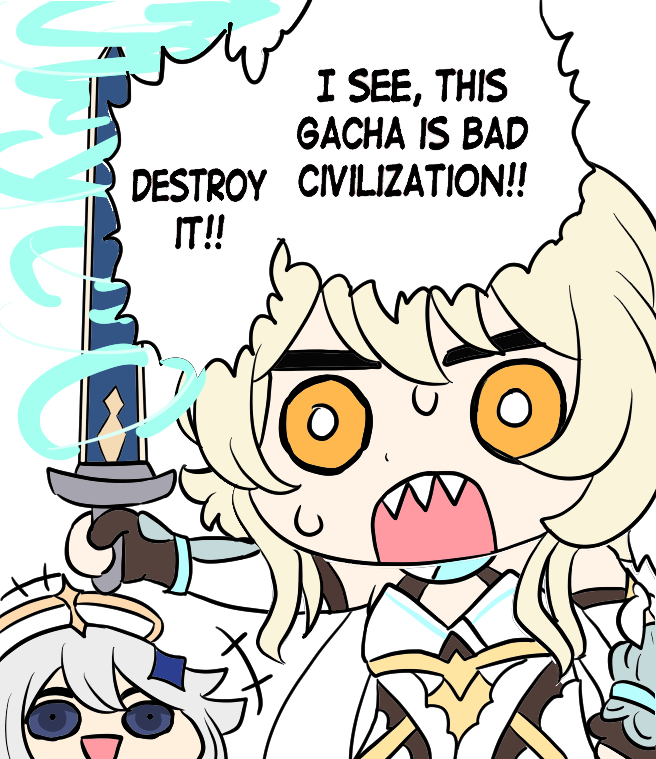
And that… is the straight dope!

>If you are a character action fan who speedruns Devil May Cry games, this might all seem like baby shit to you.
lol, hi there. Can’t believe that after all these years *this* is what finally taunted me enough to make a WordPress account to comment. I did in fact speedrun Devil May Cry at a world-record level for a few years under the name PvtCb/PvtCinnamonbun. I’m a bit washed-up now, but I still have a lot of knowledge of this genre of video games (usually called “character action games”) and would consider my opinion on it worth at least a bit of weight.
ZZZ’s combat as a character action game is… serviceable. There are things vaguely resembling launches and juggles, you have a pseudo dodge offset on a few characters, you have multiple cancels, you’re incentivized to read enemies as not everything you can “just” time (i.e., you “just” dodged an attack and get a benefit) is gonna have that very distinct orange star telegraph, and you are rewarded for keeping and changing tempos. There are a lot of the parts for a character action game with customization and a big toolkit for how you want to approach a number of problems (somewhat in the vein of God Hand), and the developers put enough work in to make characters feel different. Ben turtles in more than one way but dishes out good counters, Grace zips and zooms around with a dance beat due to her stacks system, Anton pockets enough big burst damage to make him feel like a closer, Anby stuns and launches (as much as this game has a “launch”), Soukaku builds a rally that adds depth as you almost play more than one character with her, and Billy… looks cool, but has all the complexity of someone playing Bayonetta who thinks she only has a kick move you hold to make her shoot a gun.
Sadly, despite all of the work ZZZ’s devs have clearly put into the game and how much they demonstrate a deeper understanding of the nuances of what makes a competent action game, it having to be a phone game since the revenue from that market is so lucrative hinders a lot of what this game could have pulled because there is only so much a phone screen can do to act like a controller. That flat phone screen alone has simplified the game’s mechanics, and it’s acted like a piece of sandpaper scraping off the top layers of a coin: what’s left is shallow, rounded, and a bit flat.
Even on the hardest of its hard content, there’s just not hard enough to encourage stylish or optimized gameplay and it makes the common mistake of equating damage with enemies having more health and hitting harder when a more satisfying difficulty comes from making them more complex on top of that (something Devil May Cry excels at). Many players will fall into the trap of thinking they need a different team or more leveled equipment to do more damage when what they should be doing is getting good. The consistent reward I’ve found with this genre is from adapting, reading, improving, creativity, and spectacle. On that 5-star system, I can fairly give ZZZ a 3.5, but no higher.
Maybe we’ll get more complex tools (characters) in the future, but as of now, the Swiss Army knife is missing a few tools, some parts need sharpening, and . For a more casual audience (and for someone whose right hand has gone to hell), it’s acceptable enough for me to give it a pass, even if that comes with a sigh since this did character action on a phone better than the terrible Devil May Cry: Peak of Combat (which suffered even worse from being a gacha with a Chinese developer).
The Captain finally appears!
Character action games are far from my forte— I am notoriously bad at them— So I tend to prefer the more simple nature of ZZZ, and I’m glad that an expert in the field could chime in with their thoughts. With the lack of a style ranking system, the primary incentive is to clear within the specified time limit and avoid character KOs, so the barrier for perfection will likely never be as high, and I’m not quite sure how much it will be able to encourage optimized gameplay.
My time with Dragalia Lost showed me how much afflictions, status effects, and mechanics baked into character kits can be the key to clearing content in a real-time action RPG, and part of me wonders if ZZZ could do something as intense or complex as the legendary difficulty Agito or Dominion fights. Because in those, you straight up needed units with certain abilities to clear them, and certain equipment, or else it was borderline impossible, no matter how optimal your play. Heh. I say that and I still consider Dragalia to be one of my favorite games. :P
Well, I’m certainly not as much of a fighting game expert as you, but I’m a bit skeptical that they couldn’t achieve a higher degree of complexity while still making the game work on phones. For example, their earlier game, Honkai Impact 3rd seemed to have some pretty complex combat elements that could rely on some precise timing or combos to get the most out of the characters’ move sets.
I suspect they made an intentional choice to lower the complexity so they could appeal to an average player more, rather than being forced into it by the platform they chose. I think that if they really wanted to, they could add more complexity to the game’s combat while remaining mobile-friendly, but it’s a question of whether that’s a priority to them. And I think that remains to be seen.
This is a very well-done review! I don’t have super-detailed thoughts but I think I can maybe clarify a couple of things:
> Diagetic / Non-Diagetic, controlling agents
As far as I can tell, what a Proxy *normally* does is, through gathering information about a hollow (its… effects on nearby public IP-enabled stuff? Or something?), they are able to find where the hazards to avoid in a hollow are, and where the best place to exit it. They program this into a Bangboo, which the agents take into the Hollow to guide them. There is no communications between the Hollows and outside… normally.
Phaeton is special because they have unique technology that lets Belle or Wise not only remote-control a bangboo as if it were their body, but more importantly, they can do so, and communicate through it, *while their bangboo is in the Hollow*. Only Phaeton can do this; only Phaeton can respond to unanticipated changes inside a hollow, with the chosen sibling able to think and respond like a human and the other sibling able to gather data to detect new hazards or find new ways out. This is why Phaeton is legendary. weirdly, though, Agents never comment on this in story; yet, when meeting people not on your team, it’s often a plot point that Belle/Wise has to pretend to be a normal Bangboo. Maybe the Agents you work with just think the Bangboo is really well-programmed and plays pre-recorded lines for conversation?
As best I can tell, controlling agents is you the player, not you-Belle/Wise. WHAT precisely Belle/Wise is doing in VR training is never explained, same as having characters on your team who shouldn’t be there in story in any gacha :shrug:
> Hollow navigation / CRT
From the inside, Hollows look like they do in combat scenes, this is well-established. The HDD CRT thing is weird in that it’s presented as a bunch of screens when Phaeton don’t *have* a zillion tiny CRTs actually there; I guess it’s an aesthetic presentation of an abstraction of the Hollow’s layout as the non-player sibling sees it while guiding you — the PC sibling might also be able to see this in some form while controlling the bangboo?
Yeah, they were pretty sloppy with making some of this actually make sense.
Thanks, I’m glad you liked the review. ^^
I understand how the game defines a Proxy and how Phaethon is supposed to work. I abridged a few things for the sake of brevity, as I didn’t want to dive into the minutia too much. Especially when I swear I saw a trailer that heavily implied that Phaethon is accessing the bodies of agents in the Hollows. I, admittedly, would like that approach a whole lot more, so I guess I might be projecting a bit onto what I want the game to be.
I also know that there is a lot that establishes that the Hollows look like the combat scenes, but there are also a lot of scenes, particularly in side quests, that really make it hard to imagine the Hollows always looking like the combat scenes.
I have a pet theory that the game’s lore underwent a major revision at some point, as some of these elements seem a bit too inconsistent for something that went ‘according to plan.’