

A compilation of TSF Showcases released on Natalie.TF from April to May 2024!
TSF Showcase is a recurring segment where I discuss and platform a TSF work as part of my weekly Natalie.TF Rundowns. This segment is meant to highlight a wide spectrum of TSF materials I encountered throughout my travels and works recommended by Natalie.TF readers. These showcases are evergreen writings buried in a topical post, so I like to compile them into these digest posts for easy reading.
TSF Showcases are not meant to highlight the best TSF materials, but rather anything that I came across and found interesting or otherwise noteworthy. Meaning while there are some high quality works featured here, there are also more than a few oddities, relics, and miscellaneous monstrosities.
This post collects 6 segments, or 11 segments depending on how you count them, originally published throughout the second quarter of 2024. These segments were left largely unchanged from when they were originally published.
For those who don’t know what TSF is, I would recommend checking out my 2022 article, Natalie Rambles About TSF, where I define TSF as the following:
“TSF is a genre of fiction wherein a character undergoes a change in sex through fictitious or fantastical means. With the ensuing narrative, assuming there is one beyond the initial transformation, following how they adapt to these changes. [The name] TSF is an abbreviation of Trans-Sexual Fiction or Trans-Sexual Fantasy, and the term has several different variants. This includes TG, Gender Bender, Gender Swap and so forth.”
Q2 2024 wound up being so full of lengthy explorations and side tangents that I had to split it up into two segments. And it contains a deep dive into one of the most wonderful TSF comic I have ever read. Which one is it? Well, it’s not not the one featured in the header.
- TSF Showcase 2024-14 Ojou-sama Irekawari by Yuniba (TSuniverse)
- TSF Showcase 2024-15 TS Boshi Techou by Seto Kouhei and Matsuzono
- TSF Showcase 2024-16 Futaba-kun Change! by Hiroshi Aro
- TSF Showcase 2024-17 The Auto-Closet by Kristen O
- TSF Showcase 2024-17.1 One Sexy Error by SapphireFoxx
- TSF Showcase 2024-17.2 Two Sexy Errors by SapphireFoxx
- TSF Showcase 2024-17.3 Shifting Roommates: One Sexy Error by SapphireFoxx
- TSF Showcase 2024-17.4 One Sexy Error: Role Reversal by SapphireFoxx
- TSF Showcase 2024-18 Idol Pretender by Haruse Hiroki
- TSF Showcase 2024-19 Change Ring by Kawaii Tsun’aho
- TSF Showcase 2024-19.1 Change Ring the Manga by Kawaii Tsun’aho and MPZ
TSF Showcase 2024-14
Ojou-sama Irekawari by Yuniba (TSuniverse)

Starting off things for Q2 2024, I’m still in crunch mode at work, so I decided to do the most sensible thing and create a spreadsheet featuring TSF Showcase worthy materials. And in my re-examination of my catalog, I realized I forgot about another showcase candidate that I originally considered for Natalie Rambles About TSF Comics. It wasn’t right for that, so I just wound up using a screencap in Natalie Rambles About TSF. Meaning it’s definitely good enough to be the headliner for a new quarter!
Ojou-sama Irekawari— or Refined Lady Replacer if you prefer— wastes no time getting started. Eyeless self-insertable protagonist Fred snags a magical body swap potion that will let him steal the body of the local ojou-sama for a full day. Her name’s Amelia, but I’m going to call her Ojou-sama because I think it’s funnier. He snags it off-screen, leaves the ojou disheartened and shocked, and does what any sane body swapper would do. Hit up his new mansion, sexually harass the maids because ‘it’s okay if we’re both girls’ and then head into his bedroom to masturbate until he passes out.

The following day, knowing his time as a lady of a refined calibur is at its end, Fred visits his buddy Hans and does him a solid. More specifically, a titjob where he does not take off his top and only undoes a few of the buttons which… I don’t think I’ve ever seen before. Probably because titjobs often end with cum on the woman’s face or the top of her breasts, and if a shirt’s in the way, you’re gonna get cum stains. But here, the cum stays in Fred’s cleavage for some reason. Then, being a good bud, Fred smears the boob cum over his stolen panties, because “that’s insanely erotic.”
Satisfied by his sexual escapade, Fred walks away only to come across the real Ojou and her sister, Cynthia. Cynthia earlier caught Fred masturbating and, with burgeoning suspicions, believed that this eyeless creep was her sister. Fed explains that this swap only lasts a day, so he’ll free Ojou-sama in a day and, emboldened, Cynthia uses this as an opportunity to go on a rant at Fred, decrying him for defiling her sister’s body. Yet before she can finish calling him out for being a nasty pervert, Fred’s body gropes her butt and runs away.
So, they swapped bodies back? …Nope! Fred’s still in Ojou-sama’s body and gains the ability to read Ojou’s memories appears to be! And I just love Fred’s narration as he discovers this.

Though, I do have a slight issue with Fred’s theory here. While Fred clearly gained access to Amelia Ojousama’s memories, I don’t think that Ojou would just up grab her sister’s ass and run right when she gained Fred’s memories. That makes no sense. An ojou would not give up her body just to be a perverted commoner unless she is thoroughly corrupted. And this one definitely wasn’t! Instead, I think this has to be… another soul split! Kind of like Becoming Lindsay, just with the classic memory access problem solver. But, wait, hold on. If this is a soul split situation, then what happened to Amelia Ojousama? Is she just gone? …Yeah, I think so. I think this ojou is DEAD!
Blissfully ignorant of what happened, Cynthia says that her newly unswapped sister should take a bath to wash away the pervert stank. Fred the ojou-sama agrees, gets naked, fawns over himself, as he is the man who got it all, but as he relishes in his victory lap, Cynthia comes in, having once more seen through his guise. She demands that Fred gives her sister’s body back— even though I’m pretty sure she’s dead— yet does not have a way to force Fred to do anything. Cynthia loves her sister, so she’s not going to roughhouse her body.

Confident in his position, Fred fondles himself in front of his new sister… and quickly pegs her for an incestuous pervert who wants to have sex— hard sex— with her older sister’s body. So Fred takes advantage of her love, having Cynthia suck his nipples, lick his feet, rest in his lap, and do kissy-sissy stuff. Finally having an onee-sama who is willing to sexually love her, Cynthia confesses that she loves the new Ojou-sama and the two cum together, bonding themselves as lovers.
While Ojou-sama Irekawari is pretty basic when broken down like this, I think it is incredibly effective at what it does, and has a wonderfully endearing tone. Not counting the cover or character list, this is a 24 page comic that manages to back in a lot of ideas without feeling rushed, unfocused, or like it is leaving potential on the table. It knows what it wants to do, is executed by an artist skilled enough to bring their ideas to fruition without any material compromises, and it does not waste a single page. That includes sex scenes too as, despite being a hentai comic, I would argue that it prioritizes comedy above sexual thrills.

Characters are brazen and focused on their desires to an extreme. There is something silly or goofy to enjoy on just about every page. The story is rightfully shameless with its execution, neither bothering to dwell on morals nor revel in immorality. And the translated script got a chuckle out of me in a few spots. While erotic comics can be— and are— a way to explore serious and complex subjects, I will forever have a soft spot for scripts that take the piss out of themselves like this.
Then there’s the artwork itself, which manages to hit a lot of soft spots that I’ve come to internalize in doing these showcases. Yuniba has their own distinct style, is great at character expressions, and manages to use the medium well to create something visually dynamic and compelling to read through. It’s got flow, it’s got style, it knows when to deform things and go to cake on the details, and it manages to feel lively with its paneling and presentation.

Ojou-sama Irekawari is short, sweet, and efficient. It alone got me curious about this TSuniverse person, so I started following their works… and I forgot about them after they released Kanojo to Oji-san no Karada ga Irekawaru TSF in July 2020. Doing a few minutes of digging, it appears they have transitioned to the ‘patron artist model’ which is my term for artists who primarily focus on releasing requests for those who financially support them. With their platform being Fanita and their works primarily being shorter form manga, often only eight pages per idea.
I think that is simply too short to tell a compelling story most of the time, and I don’t like it when artists put everything behind a subscription like this. It’s more consistent revenue for them, which is great, but it obscures their work behind a paywall and makes it harder to access and… save. Seriously, the process of laboriously saving and naming every page of a comic has discouraged me from supporting certain creators. Because I do not want to spend three hours doing boring file management work just to get access to their backlog. But hey, at least they’re still active and still creating their TS universe.
TSF Showcase 2024-15
TS Boshi Techou by Seto Kouhei and Matsuzono

It’s still tax season, so I’m tackling another shorter TSF work this installment. Don’t worry, I’ll get back to doing 500+ page deep dives next time. I promise. In the meantime, here’s a recent release that hits enough notes to get a showcase, TS Boshi Techou.
The comic follows Ayumu Randou, an eager young man who wants to spend his summer break becoming a man by picking up girls. Which I’m 90% sure is code for cashing in his V-card. His friend, Ryuji Kusanagi, is the more serious and experienced sort who tells Ayumu to temper his expectations and not get into a relationship just for sex. Then… Ayumu just looks at the ground and sees a maternity health record book and flips through it, causing him to transform into a woman. …And that’s when I decided this had to be featured on TSF Showcase, because I’ve seen some cheddary, popcorny TF triggers, but what the heck is this? The protagonist picks up a cheap magical booklet in a park and gets poof TF’d!

It’s efficient if nothing else, same with how Ayumu puts his hands down his pants, like all good TSF protagonists, and finds out that he’s on his period. That seems like an odd choice, but the comic quickly establishes its general premise. Ayumu has been transformed into a woman by a magical “gender morph maternity handbook,” a tool to help men become pregnant to, presumably, help Japan’s declining birth rate. And it immediately caused Ayumu to start menstruating, because the ‘pregnancy period’ begins with the start of a menstruation cycle. …I did not know that, but now I do.
Anyway, the book turned Ayumu into a woman for 28 days, and if they get pregnant during that time they’ll stay a woman forever. If they avoid getting pregnant for a month, they’ll return to normal. Ayumu is adamant about taking the latter option, but is currently dealing with their first period. Cramps, pains, dripping blood all over the damn place (even with pads), and general discomfort. The only thing that gets them through this is Ryuji who, naturally, is a proper gentleman, giving him hot chocolate, back rubs, and general affection.

He is such boyfriend material that, on day seven, after Ayumu got through their period, they put on Ryuji’s shirt, and start masturbating over his scent. …Kinda like in A Gender-Bent Maiden and a Confession Under a Starry Sky, except not really. Ayumu has far fewer reservations about embracing their new form. They happily shower in it, recognize it as a great body, and are eager when it comes time to play with themself. They put on a performance of moans, cry from the rush of emotions, sniff Ryuji’s shirt while fingering themself. It shows Ayumu to be an emotionally loose person who can easily get lost in the throes of sex… and that they desperately want to bone Ryuji.
Ayumu tries to hide it at first, yet quickly succumbs to buying a bikini online and begging Ryuji to go to the beach. …Only to get cold feet when presented around others, misread a social cue to think that Ryuji cares more about ‘real girls’ than him, and hide in the corner. It’s actually a super humanizing sequence in my book, as I did something like that a good 40 times in high school alone. It makes Ayumu seem like a socially stifled dork.

Now alone on the beach as a hot girl, Ayumu naturally gets harassed by a pair of sleazeballs who want to take them onto a boat. …Kinda like in Boku Tamasaburo, but with less jellyfish. Fortunately, Ryuji comes to save Ayumu from these thugs, and the two have the best beach day! Delicious pool snacks, volleyball, swimming on inflatable dolphins, learning how to swim with flotation devices, and giving Ryuji sand titties.
Ayumu rightfully recognizes how great this day was, and says they learned how to not act like a sleazeball in front of girls. They have “grown as a man” through this experience… but they also want to learn more about women and think the best way to do so is… to have sex with Ryuji! Partially to satiate their curiosity, partially because they believe that this will help them get girls, but also because their inner damsel wants to reward Ryuji for helping them so much.

Ryuji reluctantly agrees and, with the protective power of condoms, the two have sex. Ryuji starts by stimulating the nipples, fingers Ayumu to get them all wet, and while his technique is a bit aggressive for a lovey-dovey dynamic like this, Ayumu’s narration leaves little to the imagination. They love it, they’re floating, and gradually get over their uncertainty if it’s okay for them “to remember a woman’s pleasure.” In fact, they get along so well in bed that they go through the box of condoms within four days and decide to do it raw, because “it’s actually not that easy to get pregnant.” Which genuinely reads like something out of a safe sex PSA.
From there, the two have nonstop, passionate, affection-riddled sex with each other, and keep trying out new positions. Anal, blowjobs, 69-ing, cowgirl, doggy style, all conveyed through a fixed angle time lapse of their apartment, seeing the sex get wilder as the trash piles up in their corner. Some might call that slobby behavior, but I call that love and priorities. They prioritize it so much that, even on the final day, they are still having sex, somehow thinking they’ll go back to being friends after having sex every night for over two weeks.

Predictably, Azumu does not turn back to normal on the 29th day, is shocked to see they’re still a girl, and does the pregnancy test meme. Actually, she’s holding it in the wrong hand, so maybe it’s just a coincidence? Anyway, with Azumu’s fate as a woman sealed and a baby on the way, she goes through a page full of preamble leading up to that point. Getting permission from both families to get married, getting an engagement ring, getting married, attending childcare classes with Ryuji, having eight months pregnant sex, and holding her newborn daughter in her hand.
The story properly ends with Ayumu, pregnant with her second child, talking to her young daughter about her maternity book. Explaining that it’s what helped her become a mother. It’s pretty sweet… except every time I look at this page, I keep expecting there to be a second one that goes the full chaos route and age progresses Ayumu’s daughter. I mean, that’s probably the worst way to solve any birth rate crisis, but it is a solution.

On one hand, I feel like I should criticize the story for brushing past its ending so briskly like this. I love long-form stories that pile on minute details like cream cheese on a New York City bagel and just keep on going. However, I also acknowledge that the lack of detail can get the imagination going and that, just from detailed snippets with recognizable characters, the mind can fill in the blanks. It goes back to my pet theory that sometimes people can attach themselves more to any idea than anything that actually exists.
Okay, so why did I bring this to the class to share for this installment of TSF Showcase? In short, I think it’s just a very cute TSF comic. It’s simple, direct, and honest with what it is, not pulling in many twists beyond an oddball trigger and the bold choice to start with menstruation. Ayumu, as a protagonist, is an adorable little cutie capable of some wonderfully exaggerated reactions and carries with her an airheaded optimism that I enjoy and respect. She has ‘sexy housewife and great mom’ written all over her from the moment she transforms, and someone like Ryuji is perfect for her. Experienced, responsible, and loving. Very loving.

The cuteness of its characters is also carried over into the artwork. Everything looks soft, the content shown is kept pretty safe and squeaky clean beyond the sex scenes. The paneling keeps things simple and easy to read, while still having a few more dynamic or creative layouts, which I always love to see. And the entire thing feels like it came from a trained professional. …Which is why I was surprised when I realized I’m actually familiar with Matsuzono.
I know them from the manic, semi-intelligible nonsense (that’s a compliment) of Succubus, Level 1, which had such a different art style I never would have guessed it came from the same artist. And the grossly detailed transformation insanity of Sex-Swap Machine [Nyotaika Kikai]. A comic is basically just a crossdressing boy getting raped by a machine, because their friend thinks they’re trans. It’s gross, the protagonist looks like a 12-year-old, and I’m not going to feature it on my website.

Actually, both Seto Kouhei and Matsuzono worked on Sex-Swap Machine, when that is basically the polar opposite of TS Boshi Techou, and they worked on 9 other works together, in about three years. Either they have incredibly broad ranges, or they’re both some flavor of insane. I don’t know which one, it’s probably both, but regardless I’m glad that people like them are making so many contributions to the TSF genre.
TSF Showcase 2024-16
Futaba-kun Change! by Hiroshi Aro

My busy season is finally over, so now it’s time to get into something BIG! …But not necessarily obscure. In fact, this is probably in the top ten of the most well-known TSF manga out there. Futaba-kun Change! A comedy series following titular protagonist Futaba Shimeru after he develops a condition where his body switches sex when he’s sufficiently excited or stressed. This gives way to dual identity shenanigans, overzealous absurdist hi-jinks, a fair bit of erotic mishaps for good measure… and a level of unhinged insanity that I seldom see.
Despite knowing about it for… 15 years I, somehow, never actually read the whole thing through , so I went into this comic with two burning questions. Is Futaba-Kun Change! a good manga, and is it a good TSF manga? …To destroy the tension, I think it’s a great manga, and a slightly underwhelming TSF manga. But before getting into why, there’s a surprising amount of backstory that I found while prepping this showcase.
Also, the showcase itself wound up being WAY too big— surpassing 10,000 words— so I broke it down into sections, just to make it a bit easier to read.
The History and Translations of Futaba-kun Change!

Futaba-kun Change! ran from 1990 to 1997 in various Shonen Jump imprints— meaning it must have had some following, or perhaps it was just coasting off of the popularity of Weekly Shōnen Sunday’s Ranma ½. A series that I’ve always seen Futaba-kun compared to, often deriding it as a rip-off. This factoid is supported by a quote from an unspecified issue of Animeria where Hiroshi Aro claimed it was ‘his version of Ramna ½.’ claim that makes sense on a surface level, though the actual contents and general tone of the series are considerably different. It’s not really a rip-off or a clone, as much as a different creator, with his own strengths, tackling a similar idea in the same (then) burgeoning genre.
Personally, I find the more interesting comparison to be in the text itself. In the sixth volume, Aro claims Futaba-Kun Change! is an homage to Boku no Shotaiken [My First Time] by Yuzuki Hikaru. One of the first TSF comics ever created, a comic I highly recommend, and a historical relic that was only translated into English last year by Natalie.TF all-star Charishalo. The works are definitely different, but I can see a clear overlap with their absurdist madcap comedy.

Speaking of shared influence, Hiroshi Aro was mentored by Osamu Akimoto, the creator of the legendary KochiKame: Tokyo Beat Cops and the dope globe-trotting TSF comedy spy manga Mr. Clice. I don’t know if Akimoto was inspired by Boku no Shotaiken, but… there’s a pretty good chance. I mean, both of them involve a guy getting a brain transplant into a female body after a terrible accident.
It’s stuff like this that makes me wonder just how many degrees of separation are between any given historically significant TSF works…
Aside from the Ranma connection, Futaba-kun Change! is also somewhat well-known in the west, as it was localized by the short-lived Studio Ironcat. An American manga publisher who released all eight volumes of Futaba-kun Change! as 48 comic issues from July 1998 to July 2002. Now, if I were a manga historian, I would be able to spout some insights about Studio Ironcat, but I’m not.

Everything I was able to learn from ANN articles, an OtakuWorld page, and a spotty Wikipedia article made it sound like it’s something deserving of an hour-long video essay. They started with good intentions, had a good thing going, but company heads tore things into pieces. They stopped operations in early 2003, but at least they got some things published.
This actually put the English rights for Futaba-kun Change! In limbo for a few years, but it was eventually picked up by Creek & River. A Japanese contracting and freelance hiring company whose operations mystify me. I originally thought they were a game developer after seeing their names in the credits of recent Pokémon games, but it turns out they do a bit of everything. Back in 2015, they launched an initiative to localize 11 Japanese manga series digitally, and Futaba-kun Change! was one of the series. However, this was not the launch of a new publishing initiative. Oh no.

Based on various Amazon listings, they published these titles from December 2014 to June 2015, then released three volumes of a twelfth series, Sayonara September, in August. After that, they were done. They haven’t published an English language comic in almost nine years, and they also took down their library from BookWalker a while back. Which pissed me off, because I actually bought their releases of Futaba-kun Change! on BookWalker, before I realized BookWalker sucked. Every DRM-based comic distributor sucks. Because when the works are delisted, you get nothing!
Anyway, I bring this up for historical purposes, because I think it’s an interesting oddity— that this comic received two official localizations. But also because I’m going to be showing excerpts from the original Studio Ironcat version. Which mirrors pages and is meant to be read from left to right, like a western comic, as was the style at the time. Ironcat actually did an admirable job considering the standards of the era, with a translation that seems both accurate and respectful. While Creek & River were… just really cheap and lazy.

The Ironcat version— which you can still find on MangaDex and other sites— redoes the SFX text, uses a quality comic font, and the script adds a lot of character to the cast. It contains some cool little extras, including a few exclusive gag comics from Aro and pages highlighting assistant artists who worked on this series. Hell, it even has proper credits for the assistants who worked on this comic, which is a feature that I don’t think I’ve ever seen, but should be the industry standard.
It also has some questionable quirks with its distribution, as it was released as 30-ish page issues instead of 180-ish page volumes. So certain chapters are chopped up and the 48 full-color covers often don’t represent the story featured within them. They also decided to give female Futaba blonde hair for about half of the series’ run… despite using green hair on the original cover. It’s weird, but I can forgive it. There were no rules in the 90s.

Meanwhile, the 2015 Creek & River version features higher quality scans, but does not redo the SFX, uses a font that would be frowned upon by scanlators circa… 2009, and reads like it was written by a scanlator from 2006. It’s acceptable as a fan translation, but the best thing I can say is… just that. It’s better than nothing, better than a machine translation, but as an official product? It’s disgraceful to the original work. I did a side-by-side comparison for volume 1 and half of volume 3, and it was a stream of constant disappointment.
Also, you know what I said earlier, about how Aro cited Boku no Shotaiken as an inspiration? That page does not exist in the Creek & River version. Meaning that Creek & River effectively erased a piece of TSF history that could have easily gone unnoticed. However, I will begrudgingly say this translation gets two things better than the Ironcat version. It properly distinguishes the difference between sex and gender, and it avoids using a slur I’ll get to way later.

Beyond that though? Avoid it at all costs. I want to support the official release in almost every circumstance, but that comes with the caveat that the original work is respected. It always boggles the mind how big companies care so much less for work than individuals, but I guess that’s capitalism for you! Everything is just sludge, value is monetary, and artistry is a needless expenditure.
Futaba-kun Change! Showcase – Part 1

With that taken care of, let’s actually go through the comic. It’s eight volumes long, about 1,500 pages, so we’re in for the long haul! I’d apologize, but somebody has to do a deep dive into Futaba-kun Change!, and it may as well be me!
The story starts in Komatane high school, where Futaba Shimeru, a typical teenage boy, is staring at his crush, Misaki Shima, during a lecture. After class, Futaba gets into a tussle with one of his buddies from the wrestling club where, upon performing a backdrop, he gets a face full of Misaki’s panties. Because if you want to launch a successful romantic comedy manga in 1990, a scene like that is damn near obligatory.
Typically a heroine like Misaki would react to this with disgust, but she actually has a crush on Futaba, and even engaged in a superstitious ritual to get him to notice her. Still, Futaba doesn’t know this and is left hanging out with his buddies at the wrestling club. Consisting of two gag characters named Takeru and Splat Chima and the team captain, the brick-like Yossher Motomura. Motomura, being a good friend, hands Futaba a porno magazine to help strengthen the bonds of the wrestling team. Rather than just take this home, or beat off in the woods like a normal person, Futaba decides to check it out in the school restroom.

Futaba cracks open the magazine, his mind gets racing, and as his body grows all hot and excited, he passes out. When he comes to, he has undergone his first transformation into his female form. His plain protagonist black hair has shaped itself into a stylish green perm, his muscular wrestler build has become slim, and he got a bust that will go on to be the envy of the girls at school. Right as he is coming to terms with this through a thorough revelation scene that I’m certain inspired many TSF artists, his wrestling buddies barge into the school restroom. Futaba panics, does a sick grab, and bursts out a window, running through the sports field with no pants on and quickly becoming the talk of the school.
After sleeping in the infirmary and turning back to normal, Futaba heads home, wondering if this was all some bizarre dream spurred by his first sight of a naked woman. But after unwittingly transforming again, Futaba attracts the attention of his family. Including his older sister Futana, his partially unnamed father, and his unseen mother. They explain that they come from a clan with a ‘genetic composition’ that causes them to switch sexes when excited or stressed. Something that you’d think Futaba would have gotten a briefing on before they were… however old they are, but no. Instead, he is given this bombshell all at once, and learns that his father is the one who gave birth to him. A factoid that, predictably, breaks Futaba’s mind just a little bit.

Futaba is left frazzled and disheartened by this revelation. While he is a growing boy interested in girls, he has his eyes set on Misaki above all others and is not interested in the more perverse powers he has access to. He’s just worried about being outed as some unlovable genetic anomaly to others. Sadly, he cannot just suppress this part of himself after his big splash at school. He’s the talk of the halls and the wrestling term is determined to recruit this mysterious green-haired girl to their side. But first they need to find her, and the first idea that comes to their mind is to… tie Futaba to a rope and fling him through classrooms to find this girl.
This is the first instance where Futaba-kun Change! shows off how utterly unhinged it is. The wrestling team throws Futaba off a roof, he crashes through a window, rolls across desks, lands in the cafeteria where he rides a catering cart through the halls, down the stairs, and out the second story window. There, he clashes with Misaki, knocks her into an equipment shed, and seals it shut from the impact. It makes no goldarn sense, but I love it. It is an amazing encapsulation of the frantic, chaotic energy that defines so much of what I adore about 70s to 90s manga. A confidence and commitment to cartoonish farce, because it’s more fun than anything realistic.

Sealed in the dark storage shed, unable to see each other’s face, Futaba and Misaki share a moment together, each trying to ignore the romantic undertones of the situation, and too timid to make the first move. Which brings up something about Futaba and Misaki’s relationship that I should acknowledge now. They’re both awkward dorks when it comes to love, too scared of rejection for their own good, and too paranoid to believe the other party loves them back. Normally I’m not a fan of relationships like this, but here, it works for two reasons. One, they are stupid about romance in the exact same way. They routinely freak out about the same situation for different reasons, have parallel eccentricities, and ultimately feel like they are perfect for each other. Two, they actually get together later, so this all has a point, and isn’t just the writer jerking the audience around for a cheap thrill..
With tensions high, Futaba transforms again, flees the shed at the first sign of escape, and there’s another mad chase for the mysterious green-haired cutie. This one involves an expected shower scene, because you need to have at least one of those, and ends with Misaki and female Futaba, or rather Futaba-chan, meeting for the first time. Misaki just thinks Futaba-chan is a weird girl who got herself into trouble, so she decides to share a bed with her while the wrestling team scours the infirmary again, thinking nothing of it, as they’re both girls… right?

The next chapter sees the first, and one of the few, scenes of Futaba really exploring their female body. Bathing and feeling over his transformed body, getting dressed in lingerie— meaning female underwear— and getting a crash course in femininity from big sis Futana, along with her old uniform. I actually really like this segment but wish it were more in-depth, as Futaba-kun Change! is doing something far different from most other ‘back-and-forth’ TSF stories. Futaba is not just some isolated oddity, they’re part of a family lineage of sex switchers and Futaba could be given a lot of support, wisdom, and general advice. There is a great opportunity to tell a more introspective and nuanced TSF story here… but this is a 90s comedy series, so… screw that!
This comedic focus is made plainly obvious with the introduction of the next few recurring characters. President Hiroin is a tiny man with a giant spherical head who should not exist in a universe outside of 70s gag manga, but has defied the shackles of reality to appear here. Justice Maker is a traditional Japanese hero who bears a slight resemblance to President Hiroin and defends Komatane high school when evil is afoot, wearing a different costume with every appearance. And Futaba’s homeroom teacher, Mr. Sabuyama. His name is a play on a “popular gay magazine,” he hates women, and he bears a strong affection for Futaba-kun. He’s a gay stereotype and a pedophile. That’s his schtick. And that’s something you sometimes run into when digging through 20th century media.

Following assorted shenanigans, Futaba-chan is introduced to their class, where they quickly become the center of attention for every boy in class. Not sure how to deal with dozens of people asking twenty questions each, Futaba-chan panics, only to be saved by Misaki, who takes them to the bathroom. There, Futaba accidentally transforms back into a boy while in a stall, and we get one of the first of what will become a recurring scene in this series. Relationship juggling with Misaki.
Throughout the series, Futaba’s transformation is used to give him access to two identities, to juggle for the majority of the comic’s duration, each of which form different relationships. But the main relationship is a pseudo-love triangle between the Futabas and Misaki. Where Futaba-chan is friends with Misaki, Futaba-kun and Misaki are unspoken lovers, and Misaki keeps trying to figure out the relationship between Futaba-chan and Futaba-kun. If they are lovers, related, secret friends, or just two people with the same name attending the same school. It’s something that could get annoying if it remained unchanged or unaddressed for the entire run. But, like I said earlier, that’s not the case here.

Ultimately, Futaba is then saved by Justice Maker, who reveals that the school is actually equipped with secret rooms specifically for inconspicuous wardrobe changes. A handy dandy plot point that… makes sense, as how else would Justice Maker uphold his flawless secret identity? Also, I’m guessing Futana used these a lot back when she attended this school a few years ago, for reasons I’ll get to in a bit.
After establishing a central element for the rest of the series, Futaba and Misaki then have folk dancing. A prime opportunity for the two to get closer and for Futaba to get the ‘ka-girl jitters.’ …But the creative team wanted to make this extra exciting. So they had the former mercenary gym teacher, Mr. Strike, plant land mines all around the dance area, to blow up any students who date step out of line. But they’re weak land mines, so there definitely weren’t any fatalities.
Moving into the second volume— I said this would be a long one— things shift away from Futaba in order to shine a light on his sister, Futana, and what her life is like as a seasoned Shimeru sex switcher. In short, she is the ideal TSF playgirl/playboy. Futana is a college girl who coasts through her classes, doing as little work as possible, and dedicates her life to four things. Sex, partying, scamming, and being a relentless sexual predator.

She starts her marquee chapter by curling up into Futaba’s bed, naked, kissing him, and barfing into his mouth, because he’s just a toilet to her. After nursing her hangover, she goes out to the city, looking like a classy business lady who takes no guff, hunting for women she can seduce and screw. She ducks into restrooms to transform, and even when she gets caught, she has enough suave and dominance in her male form to turn any woman into putty in her hands.
She tries a few targets, only for them to get swept away by a rival playboy, and Futana decides that this simply cannot stand, so she starts scheming revenge. She makes herself look demure, gets the rival playboy to take her out for dinner, and not only uses this as an opportunity to stuff her face, she turns into a man at the love hotel and beats the shit out of the playboy.
That would be one thing but Futana, woman of many faces, then reverts back to her girl form and begs the playboy to save her from the ‘stalker’ who beat him up. She has him take her to his family’s cottage outside of the city. They arrive there, sleep, and come morning, Futana turns back into a man and… presumably rapes him so much that he develops gynephobia. And when hearing about this the next day, all she can say is that “he must’ve gotten involved with a really nasty bitch.”

Futana is not only a self proclaimed nasty bitch, she’s a bloody menace! And she only gets worse as the series goes on. From molesting high schoolers to chronically abusing her fiancé who desperately wants to love her, to her continued sexual harassment of Futana. She is a creature of pleasure, one who uses her genetic gift as a tool to live life to the fullest, and acts like she is the protagonist of the universe. …And I kind of wish that she was, because she is so good in her role. Her life is a power fantasy, and she knows it. I want to see her go on a bender so extreme, so destructive, that it would make the creator of Skinsuit Ellie shake in horror. I want to see her commit sexual war crimes! Instead, we’re stuck with damn Futaba who… I probably should talk about as a character a bit more.
Futaba, as a character, tends to play the straight man, or straight woman, next to the absurd situations he regularly finds himself in. He is presented as a normal relatable person who just wants to live a simple life, get Misaki as his girlfriend, and avoid conflict. He’s a strong person who will do anything for those he cares about, has a sense of justice, and is also surprisingly buff for a… 16-year-old? He’s awkward, bad with romance, and a bit of a worrywart… but all of those are pretty boilerplate teenage manga protagonist traits.

Okay, okay, but what about the transformation angle? How does Futaba deal with that? Well, he doesn’t necessarily see it as a boon or a way to improve his life, and aside from a few instances, rarely ever takes advantage of it for personal gain. He learns to accept it as part of himself, gets used to it, yet still views himself as a boy and never takes a plunge deeper into the ‘girl world’ without someone else urging him.
Futana makes him attend school as a girl for the first time. Futaba-chan eventually gets involved in extracurriculars because his peers want him to. Futaba uses the Futaba-chan persona to get closer to Misaki, yet would prefer to get this close as himself. And even when taking on a new venture later on, he only does it because his mom told him. Even when he has ample reason to enjoy this new part of his life, there is a lack of little, impactful, moments that emphasize Futaba’s enjoyment of things. There are scraps that could be used to piece together… but it’s clear this wasn’t a focus of Aro and his team. For better or worse, they prioritized comedy and craziness above all else.
Futaba-kun Change! Showcase – Part 2

Anyway, volume 2 really begins— yes, I spent seven paragraphs on one chapter— with a multi-chapter storyline. Futaba heads to the local department store to get some girl clothes, where he runs into Misaki, who offers to help him do some shopping. They head to a lingerie store, Misaki measures Futaba, gets jealous of his bust, and Futaba deals with the latent awkwardness of being a boy-minded female-bodied person in a female only place. But before things could billow toward the staple fashion show, the wild nature of Futaba-kun Change! pivots things into a new direction with the introduction of a bit character. She doesn’t have a name, but I’m going to call her Tabako. …Because she likes tobacco.
Tabako is a store attendant who, in true 90s Japan fashion, is constantly smoking, causing the white lingerie around her to turn beige from cigarette smoke. I’d call this farfetched, but as a kid who grew up in a smoker’s household, it’s not. That crap turned everything white into something yellow. Tabako ‘tries’ to help Futaba and Misaki find some good underwear, only to undergo withdrawals after a few minutes. She takes her smoke break outside the store, going through a single cigarette with each drag and, like a typical smoker, throws her butts into a panty display, causing a fire!

The alarms go blaring, people start evacuating, but the sprinkler system doesn’t go off as the flames worsen and spread across the entire mall. With Futaba in a changing room, his body reverted back to being a boy, and Misaki in the bathroom, they are left in a deadly situation. It is an insane level of escalation for the first proper storyline, and whenever the reader is led to believe it might get serious, something comes around to shatter the tension.
How do Futaba and Misaki protect themselves from the smoke? By breathing through panties. Rather than be upset by this, Tabako acts like this is just another Tuesday as she turns on the emergency sprinkler system, powered by peeing baby statues. And rather than just depict the firefighters doing their job all normal like, the honorary fire chief, acclaimed actress Kahoru Ioka, is put in charge, and is psyched to play fireman for real! She undermines the actual fire chief, views this entire thing as a promotional exercise, and takes charge, only to embark on insane maneuvers that, somehow, kind of work.

Every few pages, the story pivots, zigs, and comes up with some new way to zag into an unseen direction. Such as introducing a fire fighting cyborg with a monkey brain, Sarubrain, who is too much of a coward to do his job. So Kahoru throws him at a water tower, causing it to roll down the building, into the stairwell, and send Futaba running out of the building, like he’s Indiana Jones. Merely describing it utterly fails to capture the manic energy of actually reading it. Also, Tabako just stays in the building until the fire goes out. Because, like a true smoker, she can breathe smoke.
After escaping a burning building Futaba learns that Kahoru Ioka is actually his father’s female alternate persona. A move that threw me for a loop for a moment as, Kahoru Ioka has dark hair and their male form has light hair, implying that their female form is their default. Meaning that they’re someone so gender fluid they live as both a man and a woman throughout a given day. It’s simultaneously an exhausting sounding prospect… but also a fascinating one that, much like with Futana, would make for an interesting story in and of itself. Unfortunately, nobody has had the audacity or gonads required to attempt a story about someone who works as an eccentric beautiful actress by day, but is a silver-haired family man by night. Also, as a reminder, Futaba’s mother and, presumably, biological father never shows up.

All this excitement has turned Futaba-chan into an even bigger talk across this slice of Tokyo, and garnered the attention of the first rival character, Takane Hiroin. A veritable ojou-sama with two sunglasses wearing goons at her beck and call who wishes to be the most popular girl at her father’s high school. She’s got poise, a delectable laugh, and an alter ego that looks straight outta Yatterman. Evil Mistress X! Or Dark Mistress Queen X. Or Mistress of the Dark, Queen X. Or just Queen X. This can be said for many characters in this story, but whenever she comes on page, I always perk up, as I knew she would get up to some absurd mischief of some manner. And she never disappoints!
She makes her grand entrance riding a horse costume stuffed with her two minions, barging into the classroom and stealing Futaba-chan. Only for Justice Maker to make his grand return and introduce the next arc of the story. The tournament arc! Where the winner shall claim Futaba-chan as a member of their club. Why doesn’t Futaba-chan just object to this and say they’re not a prize to win? Because that’d be dull, and the creative team had some killer ideas for this tournament arc.

There’s a sumo wrestler who can fire deadly energy blasts from his hands at the speed of sound. A mangaka who has a giant inkwell he uses to slather the wrestling ring in ink, allowing him to sink into the ink and catch Futaba from behind. A tag team featuring a home ec ninja who calls herself the “kitchen knife kamikazee” and a “spice magician” who wears a gasmask. A vampire venus flytrap controlled by a dandy gentleman. And a special effects guy who transforms his opponent into Mecha Ghidorah using only piano wire. If I sound insane in reciting this, that’s because I am being accurate.
However, that is all arguably secondary next to the crowds, as these are the best crowds I have ever seen in a comic, ever. This applies to the entire comic, as the crowds are consistently an assortment of random designs and references to other manga, anime, and game series. You can tell Aro just told his assistants to draw whatever, and they make every one of them worth looking at and worth savoring. Because you never know what they’re going to throw in there! Sadly, the most I could spot were a few Street Fighter and Tenchi characters, as I’m not as versed in 90s manga as I ought to be.

I won’t go over the beat by beat of this section in detail, but it has some of the best moments in the entire series. The Futaba versus Misaki fight really does a great job of illustrating their relationship as both are so reluctant to actually hurt each other, and Futaba is terrified of transforming on stage. Misaki in general gets a lot of time to shine and show her moves as a fighter, which I appreciate. She’s not a fighter, though she’s crafty and manages to hold her own… unless her opponent cheats, in which case she is home to the most suggestive moment in the entire series. And that’s saying something. It’s a glorious display of dope comedy action that feels like it goes on for longer than it actually does, in the best way.
Following that story arc, the Futaba-kun Change! sees a few more one-off chapters. One where Futaba-chan goes to Misaki’s home after school, giving the two more time to bond with each other and support the idea that these two would make a good couple. Though, there is a slight conflict as Futaba just chipped a tooth and Misaki is the queen of sugar. Someone who packs a painful amount of sweetness into everything she makes. It’s a weird play on the whole ‘love interest who’s a bad cook’ schtick that only gets more absurd as the story goes on. She is so good at packing sugar into things, and has such an inhuman tolerance for the stuff, that she literally secretes sweetness.

This chapter is also the introduction of the… peculiar approach Futaba-kun Change! takes to chibi reactions and deformities. Throughout the manga, characters frequently and seamlessly shift from detailed humanoid forms to the typical tiny little expressive gremlins for exaggerated effect. A tried-and-true element of Japanese comics and animation. However, Aro and his assistants decided to add some unique features to this deformation process.
Giant ‘cartoon clown bird feet.’ Mouths with lips so exaggeratedly elongated they look like birds. Limbs that detach from bodies, like a plastic doll, when sufficiently scared. An iconic exaggerated cat yelp that should be emulated because it’s both adorable and horrific. And these big circular hands, used sometimes for cartoon violence. Not all of these features appear in every chibi reaction, though they are consistent enough that they give this comic a style all its own. …And one that I would just adore to see adapted by other artists, as something about it seems so deeply correct. I wish I had a 3D avatar of one of these weird duck gremlins. Or an 80 centimeter tall statue.

Next chapter is the train molestation chapter. A concept that is all over hentai comics, has become semi-common across TSF hentai for a good while, and I don’t particularly care for it. It can be used well, but it’s exhibitionist molestation, so it’s an uphill battle. Which is why it’s actually impressive that this chapter mostly works.
It starts with Misaki getting felt up by a figure later revealed to be Futana. Follows up with a scene where Futaba-kun is being comedically jostled across the train as he is flung from woman to woman, who righteously beat his ass for his unintended perversion. Followed by a scene where Futaba-chan is subjected to molestation, but rather than show the act itself, the comic instead focuses on Futaba’s reaction.
The shock of being suddenly touched, the mixture of pride and embarrassment for being touched like that, and being made painfully aware that he’s a woman. You can still tell this was written by a man in the 90s, but there’s at least a kernel of something there. …And then Futaba gets jostled around the train again, this time getting wrapped up in the bag rack. Which is more funny than anything, thanks to the inclusion of the cartoonish crowd, featuring… Bert from Sesame Street?

Following another cute communication mishap chapter where Futaba-chan takes Misaki to his house, the next story arc begins with the introduction of two new rivals. Anzu and Karin! A pair of tough girls who want revenge on the person who defeated their sumo wrestler brother and… are just so delightfully stupid. Karin hates using her brain and Anzu doesn’t know how to use hers. They ask for answers before asking questions, are the most prone to super deformation of any characters in the cast, and dish out so much slapstick they’d be right at home in a classic cartoon.
Futaba-kun and Misaki battle them in a tag-team fight that reprises the mixture of tension and cartoonish absurdity from the tournament arc. With Anzu and Karin being so stupid that they forget to do things like stand while kicking and get distracted by even the mention of food. However, when they do focus, they leave Misaki bloodied and put Futaba in a bind, needing to use all his brain cells against the cumulative two brain cells of these sisters to overpower them. It’s far more comedy than action, though there is enough tension and follow-through to make things feel engaging, right until the… fetish awakening conclusion.

After the fight is over though, Misaki is left in a pool of her own blood, her wounds reopened and the school nurse needing to perform a blood transfusion to keep her going. Futaba naturally volunteers in a move that seems like yet another loving gesture… but if the reader remembers the venus flytrap battle, they’ll realize the next bit was foreshadowed. Futaba, as part of his genetic condition, has unique blood as part of his genetic condition. So naturally, a blood transfusion would have certain… repercussions.
When Misaki wakes up, she is shocked to see that her body has transformed into that of a man. While her hair and face are unchanged, the artists didn’t skimp on making her male form… really hot. She was a sporty and fit girl, sweet tooth notwithstanding, and her male form is complete with broad shoulders, pecs, and defined musculature. It’s similar to Futaba-kun’s wrestler body, but depicted with what I could best describe as a feminine eye, meant to capture how Misaki views this body.

Honestly, this section of the comic hits every note that I would want it to. Misaki is understandably thrown through a loop-de-loop by all this, the artwork takes great time to emphasize the maleness of her body through brief somber moments spliced with exaggerated reactions. It treats Misaki as the main character, it’s not afraid or sheepish to show anything— except for a penis. And by making this an incomplete transformation, Misaki needs to suppress her more male parts, stuff her bra, and try to pass as female. Staple TSF elements that are otherwise absent in this comic.
Fortunately, rather than just be another one-off chapter, it leads into its own storyline, with Misaki switching between male and female forms against her will. It is a fine mess and, right in the middle of it, she gets her own stalker. Sheena O’Oka. A frizzy-haired misandrist who wants her so badly that she’ll chloroform her, even though that causes brain and organ damage! She’s an okay character in a sea of great ones, and I think Aro realized this. The plot gradually shifts away from Misaki being pursued, and assaulted, in favor of exploring the realization by the school nurse, who Misaki confides in.

The nurse, Miki Kojiro, is a mad scientist who previously showed up during the tournament arc and fully comprehends the power of this discovery. Something that could be used to synthesize a sex switching drug could, in her mind, “create a world without any gender inequality.” But her twin sister, Maki, who created the venus flytrap monster, views this as a way to get rich. With their incompatible ideologies clashing— equality versus capitalism— they do what all great powers do… and have a kaiju battle!
Armed with a muscle exosuit and a giant venus flytrap, the two clash their way through the school, duking it out over who will get to claim Futaba and his special blood, while arguing about his origin. With capitalist Maki rightfully deducing that Futaba-kun and Futaba-chan are the same person, aiming to expose the truth and experiment on him. But right when Futaba thinks that his goose is cooked Justice Maker barges in, donning a wig and mask that make him the spitting image of Futaba-chan. With the dual identity theory disproved, the two overpowered scientists go back to destroying the school and beating the crap out of each other. Maintaining the status quo as the story reaches its 50% mark.

As an intermission, something I’m not emphasizing, for the sake of ‘brevity’ is that Futaba and Misaki are seriously crazy about each other, and will do just about anything for one another. They are both too timid to let the other one know, but their relationship does progress as they spend time together. The love triangle of Futaba-kun, Futaba-chan, and Misaki gets stronger, thicker, with every chapter centered around their relationship, making not only the characters feel slightly more developed, but strengthening their connections. It’s a though line of character and progression that gives this hyperbolic nonsense some needed weight.
Futaba-kun Change! Showcase – Part 3

Moving onto volume 5, there are a lot of short one-off chapters that exist mostly as vessels for silly nonsense that the creators thought would be fun. Also, Misaki’s transformations have gone away for the time being and the story goes back to its status quo. That’s pretty lame to me, though I suppose it makes sense. It doesn’t take that long for a human body to replace donated blood.
These minor chapters include one about a bunch of panty photographers trying to expose Futaba-chan as a reprehensible boxers-wearer. The obligatory onsen vacation chapter, which is most notable for kicking off a subplot involving the wrestling captain Yossher Motomura, developing a mahjong debt with the Kansai capitalist, Negiri Shusendou. She’s Misaki’s designated friend character, whose schtick centers around her desire to profit off of everything, but she doesn’t play a big role until later. A chapter where Futaba finds an egg in his bed, thinks he actually lays eggs due to his weird biology, and tries to protect it while going to school. …Except it turns out it was just a hard-boiled chicken egg Futana left in his bed when she was having a late night snack in her brother’s room. The egg chapter has amazing key art, but is the worst chapter in the entire series.

Fourth is the menstruation chapter. …Yes really, they did that. Futaba wakes up unable to change out of Futaba-chan. He explains this to Futana who, rather than help her younger sibling, leaves them to go to school and find out what it’s like when a Shimeru starts flowing. He’s irritated, stinky, starts bleeding, and is relentlessly assaulted by hordes of men who want to make love to him. He is thrown for a loop until Misaki finally helps him out, gives him pads, and shows him the ropes. Because she loves Futaba at least five times more than his entire family does.
Like everything else, this chapter is mostly played for comedy and absurdity, but I cannot help but find the deep lore ramifications of this to be fascinating. The Shimerus must stay as a woman while menstruating, meaning they must live a good… fifth of their adult lives as female no matter what. Their bodies will just transform against their will, and the only time they have to use their female form is during the singular worst time. I get why this is the case, as Aro is trying to accommodate an experience that the overwhelming majority of women go through, but this is a damn fantasy. If I can believe that anime titties never sag or that Futaba can go from boy to girl in five seconds, I can buy that he can reabsorb old womb-lining. …Like a dog.

The next story arc centers around Kahoru recruiting Futaba-chan to be their apprentice in the world of superstardom. Futaba is reluctant to do so, but Negiri currently has Futaba-chan in a life debt via the wrestling club, so he doesn’t have much choice. Slavery’s been illegal in Japan since 1590, but I guess in capitalist Kansai, debt peonage is alive and well. Just like in modern America! To start her career, she needs to partake in a competition with other amateur teenage girls to star in a… commercial promoting an amusement park called Great Land. …Which uses the old Walmart logo for some reason.
Rather than focus on the competition itself and Futaba fumbling their way to success— like in Boku Tamasaburo, a story that most likely inspired Futaba-kun Change!— the chapter instead focuses on backstage sabotage. Takane Hiroin barges in to expose Futaba-chan to the other girls and they retaliate with an all-out assault… that horrifically backfires. They put glue in his hairspray, but Takane uses it instead and loses her precious ponytail. They ruin his swimsuit, but he improvises with the hottest swimsuit in the group. They slip laxatives into his tea, but all the girls, except for Futaba-chan, shit themselves on stage, in front of thousands of people. No, I’m not kidding.

After this, Futaba’s face is on 25 meter tall posters and, as he is strutting down the streets, dressed like a French model, Futaba concludes that, for the first time, he’s happy as a girl. I’d say this is the start of a turning point for gender fluid Futaba, but that’s sadly not the case. Instead, we get yet another rival character with Katari Kara. A burgeoning idol who Futaba-chan indirectly made expose herself— in addition to shitting herself— on national television. She looks like a doll, bites like a tiger, and tries hard… only for things to blow up in her face in a comedic manner.
When Futaba is filming a sci-fi movie at the Great Land amusement park, Katari uses the power of dynamite to… blow up a good chunk of the amusement park, nearly killing herself in the process. And when they are in a swimming, water sliding, and climbing challenge between various other celebrities— I don’t get it either— she tries, and fails, to get a leg up against Futaba-chan. All until, finally, she reaches the top of the OSHA violating floating tower, claiming the spot as the top idol… before getting zapped by lightning. I’m breezing through it, but it’s the same hectic comedy that one would expect, and even finds time for more Futaba and Misaki relationship building.

This is followed by what I call the revelations arc. It begins with a school festival, complete with the expected insanities and battle spectacles of this series. Such as a barbed wire wrestling match that ends with the ring blowing up. However, it’s mostly a turning point in the relationship between Misaki and Futaba-chan. Disguised as a fortune teller, Takane makes Misaki superstitious of her relationship and, in all fairness, she has reason to be. Futaba-chan and Misaki are best buds at this point. Futaba-chan is incredibly defensive of Misaki, protecting her from creeps and the like. While Futaba-kun gets so excited around her that he has to remain distant, lest he transforms at a bad time.
With Misaki’s mind buzzing with FUD, she thinks back on this messy situation, rubbing her sugar-filled brain cells together as she tries to work out why things just don’t add up in this relationship triangle. As she delves through this, Futana starts teaching at Komatane as a student teacher, though she doesn’t do any teaching. Really, it’s just a thinly veiled way to get Futana at the school setting, so she can have another encounter with Misaki.

Misaki is thoroughly confused, theorizing that Futaba-kun and Futaba-chan are the same person, and thinks it will be easier to ask Futana than offense either Futaba. However, it’s already been established that Futana is a sexual child predator, so you can imagine what her thought process here is.
After Futana pins down Misaki in one of the many secret rooms, Futaba comes barging in, transforming from girl to boy… and immediately fainting as he realizes he just let his secret slip. After a titillating dream sequence, Futaba wakes up to see Futana has stripped both him and Misaki, and urges the two to fuck while she watches. Futaba rightfully kicks Futana out using his giant cartoon duck clown feet, sending her out on her own B-plot. One where, disguised as her handsome green-haired playboy alter-ego, she hosts a school beauty pageant in order to find her next girl to do crimes to.
…Actually reciting things verbatim really makes Futana seem like the worst type of person, and she kinda is. But I need to once again emphasize that this is all done for chortles and hahas. It’s an almost 30 year old story, and despite her attempts, Futana always gets some flavor of comeuppance. She gets scratched, punched, and you just know she’s a deeply empty person with a chronic sex addiction. Also, she gets a pass because she’s pretty and not an overt creep about things. Pretty people get tried better when it comes to rape charges. That’s a fact, yo.

After Misaki wakes up and dresses herself, Futaba explains everything. That he and Futaba-chan are the same person, and he has been lying to her all this time. The girl she confided her feelings in, who she shared a bath with at the onsen, who has seen her naked multiple times, was just the boy she loved in disguise. This breaks Misaki’s heart, breaks her trust, and she storms out, proclaiming her hatred for Futaba.
This sends Futaba into a spiraling depression. He does not know how to mend things with Misaki, cannot focus on anything but her, and Misaki’s in the same boat. The entire story, up until this point, has made it clear just how perfect these two goofballs are for each other, and it’s upsetting seeing this rift build up between them. Futaba eventually happens upon his father begging for forgiveness with his mother— over something that will be important in just a bit— and is given a pep talk. If one has made a mistake and hurt someone they care about, then the best thing to do is relentlessly apologize. …That’s not the best advice, yet Futaba takes it to heart.

Misaki downs a couple beer steins of honey with Negiri, who urges Misaki to be a bit more empathetic to Futaba. After all, what would she do in that situation? Well, Misaki actually knows, as her body became male two volumes ago, and she hid it from everybody, just like Futaba did with his transformation. Right as she reaches this conclusion, and gets over her initial spite, it starts raining outside, and Misaki sees Futaba waiting outside of her house… his head shaved.
I don’t know much about real Japanese culture, but I do know that shaving one’s head can be seen as a form of penance. At least based on that widely circulated story about an AKB48 member shaving her head a decade ago. Anyway, Misaki is receptive to Futaba’s action, and while she hasn’t fully forgiven him, the two are at least on speaking terms again. This fallout has enough tension, length, and build up to feel like a grounded break-up, and feels in line with their characters and age built up to this point. Which isn’t always the case with romance stories. It’s a satisfying conclusion, breaks the status quo, and brings volume 6 to a triumphant close.
Futaba-kun Change! Showcase – Part 4

Volume 7 is where things start getting extra wild. Volume 6 ended with a cliffhanger, stating that Futaba had a fiancé his parents engaged him to 14 years ago, in a move that is plainly lifted from Ranma Saotome’s numerous fiancés. I’d criticize this, citing how bizarre and wrong arranged marriages are, regardless of cultural standards. But they make for great drama and easy quality storytelling. It introduces a new love interest that the writers can play around with and breaks the status quo by adding a new conflict. Really, it all depends on how good the love interest is as a character, and how well they are used by the writers. And I love the little freak Futaba got sacked with.
Kurin Shimeru is a two-foot-tall girl from the traditionalist and high-ranking family Shimeru clan of… Shimeru Island. She makes a splash with her debut, being this haughty little gremlin so used to her own way she barely sees Futaba or Misaki as people. Though, she’s also a bit of a country bumpkin, not really understanding parts of modern society or the world around her, or what other people are capable of. She is too ignorant to ever seem malicious, and is rendered so cartoonishly that I cannot help but love her.

Futaba and Misaki go to the airport to greet her, but rather than have Futaba deal with her, the comic makes the bold decision to pair her with Misaki while Futaba goes off to perform his idol duties. This is where we get another complexity into this love quadrangle, as it turns out Kurin is a devout fan of Futaba-chan, buying three copies of everything with their face on it. A concept that could be used for great hijinks, having Futaba date two girls under two different identities, though that’s not quite what we got here. She figures out a few chapters later, which is a bit of a let-down, as that idea at least had potential for one good double date chapter.
Also, as a Shimeru, Kurin naturally has the ability to transform. Except rather than just changing the base body type and hairstyle, she grows three times as tall, becoming a bishonen stud… who is also the most cartoonish character of them all. Male Kurin is more bird than human and is able to devour the equivalent of a small child in a single bite as their mouth expands to horrific extremes. And they are always eating, as they have a three dimensional— maybe four dimensional— stomach that cannot be satisfied! This naturally begs the question of how they pay for food, and the simple answer is that they don’t. Male Kurin is so hot, exudes such powerful pheromones that all women who they speak to swoon and allow them to eat for free. It’s a basic joke, but it’s funny every time.

Next chapter… goes back to the mad scientist sisters, Maki and Miki, as they reveal they have a third sister, one more crazy than both of them combined! Yuki Kojiro. A girl who got her doctorate at age 10 and has spent the past decade in cryostasis, meaning she’s still biologically a child, and takes up reigns as the physics teacher at Komatane. She abuses her students with a jet-powered paper fan, and also her co-workers. She also has a thing for bishonens, so she naturally abducts and imprisons male Kurin using a two-dimensional black hole on a stick. …Yes, that is one of the first things that happens as Kurin attends Komatane high school,
This gives way to a rescue mission where Miki gives Futaba her muscle suit, meaning we get more muscle growth fodder, as Futaba infiltrates Yuki’s underground lab. …Which she just has, because shut up! Except by the time Futaba gets into the lab, Kurin already went back to their girl mode, and Yuki wants nothing to do with this shorty. Also, Futaba is still bald, but has taken up wearing and carrying around two wigs while his hair grows back. Just in case you think this chapter didn’t have enough weirdness going on.

The next few chapters, similarly, kind of bleed together into a manic blur of cool, weird stuff. There’s a frantic rush throughout the school as Futaba-chan needs to sign a stack of autographs as part of the debt peonage imposed by Negiri. Which is broke up with antics involving Kurin, Yuki, and swarms of other students, all while Misaki plays the role of babysitter between Futaba and Kurin. It’s just raw madcap insanity that makes more sense while reading it than it does when looking at things from afar.
The chapter after that reprises Futaba-chan’s actress career by seeing Negiri cast her into a kissing-centri drama. This leads to a subplot where people audition to be with Futaba by kissing each other, because that’s exactly how the Japanese entertainment industry works! You’d expect Kurin or Misaki to win, but instead there’s another new character in the form of Ikuya Maku. He’s a pretty face, not much else. I would’ve just replaced him with a fully transformed Misaki after she drank more of Futaba’s blood, but nobody asked what I think would be cool!

I want to love it… but volume 7 was a messy stew of ideas that needed more refining. It has great creative energy, yet struggles to manifest it into a more cohesive or balanced form. A problem that I am all too familiar with, and doesn’t get easier even when you’re aware of it. And I think the best way to represent that is… how the relationship between Futaba and Misaki shifts.
Futaba basically confesses to Misaki partway through the volume and kisses her all night long, basically undermining the whole love triangle by presenting the OTP. Just 25 pages later, it doubles down on this dynamic and… implies that they have sex in the infirmary. Then, less than 20 pages later, Futaba-chan gets in a suggestive situation, like your typical anime girl, and Misaki views this as a breach of trust. …Only to forgive Futaba 15 pages later. It just feels like the creators were running out of steam, losing sight of what they wanted, and that applies for the first two chapters of volume 8.

The first is a Christmas special where Futaba needs to balance work, studying for finals, and Misaki ahead of a Christmas party, just barely making everything work out in the end. Also, we learn that Kurin creates lunches for Futaba every day, since Misaki’s would make him a diabetic in a week. Kurin has been present, though not really involved in the past few chapters, taking more of a backseat role. Being kind to Futaba, while recognizing that… she doesn’t have much of a shot with him. Still, she tries, spending her free time making things for him, such as a sweater… with a pouch so he can carry her female form. It’s a bit infantilizing, though sweet all the same.
The second is a Valentine’s day special, which is noteworthy as it gives Futaba-chan another girl thing to do, giving chocolate to all the boys… only to not show that. Instead, the focus is put on sugar queen Misaki as she prepares chocolates so dense, so overbearingly high in calories, they cause a chemical reaction and set themselves on fire. …Yeah, that’s about it. It’s a short chapter.

The final arc of Futaba-kun Change! sees Futaba’s entire class get into a plane crash during their class trip, where they land near Shimeru island. A moving island that does not appear on any map and is the homeland for the Shimeru clan of sex switchers. Finally, in her home turf, Kurin uses this to expedite her marriage to Futaba, rushing through the customs, forcing her parents to comply, and holding Futaba prisoner for their wedding the next morning.
Futaba-chan is in chains, a prisoner, doomed to be wed against his will, by obligation instead of love. In this dismal time Misaki comes barging in, dynamite in tow, and she takes Futaba to an isolated cave system to escape. Once there… they realize that Kuring switched back to her girl mode and tagged along. She calls for her people to come find them, Misaki prepared to detonate the dynamite on her head so she can die together with Futaba, but right before the suicide pact can be complete… SHIT GETS REAL!

It turns out that Shimeru island is actually a spaceship and, after hearing the pass phrase, it emerges from the Earth, venturing into the depths of space. Futaba, Misaki, and Kurin awaken in this spaceship, where its computer reveals all. The Shimeru clan are actually a race of aliens who crash landed on Earth 12,000 years ago and the spaceship disguised itself as a moving island, spending 4,000 years undergoing microscopic repairs. It took so long that the Shimeru clan forgot about the spaceship’s existence and it laid there, dormant and lonely, until these three teenagers woke it from its slumber. Fully functioning again, the spaceship is now taking these three across the stars to its homeworld.
During this voyage, Kurin starts getting racist, going on about how Futaba will need to marry her if they are going to be on the alien homeworld, as she would be the alien! …Only for the computer to reveal that Misaki carries some of this clan’s blood, making her a member of the alien race. I would call this bullcrap… but this was actually foreshadowed from the very first chapter. Because her name is Misaki Shima, which contains the first two syllables of Shimeru.

Also, you remember how I said the Creek & River translation removed a slur? If you don’t, I understand. That was a long while ago, but this is where it comes up. The Ironcat translation refers to the Shimeru clan’s race as Shemales. …Because shemale and shimeru sound the same when spoken in Japanese, and that’s probably what Aro had intended when they wrote the first chapter in 1990. Back before that word was seen as a slur. The 2015 Creek & River translation instead calls them Shimerians, which is a pretty lame name, but it’s better than a slur.
This sends Kurin off the edge, sobbing as she confesses how hard she tried to earn Futaba’s heart. How she tried to evolve past her bad attitude, give Futaba space, and work so hard her hands were literally left bloody and brushed. It sends their relationship into a tizzy, but before they can explore this new burgeoning shift in their relationship… they make it to the WORLD RING!

The Shimerians were a society so advanced they tore apart their solar system, and surrounding solar systems, to create a ring of space ivy as thick as a planet. And on this ivy, they created leaves containing hundreds of worlds the size of contents, all sealed in massive domes, rotating around the sun to simulate a day-night cycle. It is an utterly wild sci-fi concept that depicts a civilization so advanced their exploits seem indistinguishable from fantasy.
However, when the spaceship examines this ring, it discovers that it has long since been severed. Every single civilization in this expansive system has been destroyed. Cities were left abandoned or shattered, doomed to forever float in the recesses of space. Over 300 billion lives, if not more, are just gone, with no trace of them remaining. No words alluding to their escape.

When confronted with this… mind shattering revelation, Futaba panics, has a revelation about his life and how lucky he is to have two beautiful women who care for him. He vows to become someone worthy of their affection, promising to grow up into someone worthy of their love. Misaki and Kurin agree on a truce at this news and, upon learning this fate of a world they never knew, they chart a course back to Earth.
Upon arriving, they realize that time dilation is a thing and while this was only a few hours for them, eight years have passed on Earth. After the loss of Shimeru island, everybody on it was left stranded in the sea, where they were eventually rescued by a ship. Presumably the rescue ship that was sent after the plane crash. With no homeland to call their own, the Shimeru clan revealed their secret to the world… where they caused a commotion, spread out over their walks of life, and were implicitly accepted by the world at large. Especially Futana, who became the world’s number one playboy.

Meaning that… oh shit, Futana doom this world like Junta Momonari from DNA²? Because she is The Mega-Playboy and her kin could spawn 100 kids each generation, no problem. …That series technically has a TSF episode, so I’m calling that reference fair game. It’s just barely on topic!
With this brave new world before them, and humanity now having access to a spaceship loaded with knowledge of a lost people, a now successful adult Negiri urges Futaba to make a comeback. And with a flakey agreement, the series comes to a close.
…Well, not quite. The final fourth of volume 8 is dedicated to shorter skits and chapters that arguably should have been interspersed with the rest of the comic. They’re fun gags that add more to various characters, and one excellent chapter featuring Futana and her fiancé, Misao, who’s a masochist. However, reading these did help me reach a conclusion I had been bubbling toward for a few hours at that point.
Futaba-kun Change! Showcase – Finale

Futaba-kun Change! is a glorious manga, filled with oodles of fun characters, a smorgasbord of antics, and an overabundance of energy packed into nearly every page. I adore the series, will likely be picking away bits and pieces of influence from it for years if not decades, and… it is one of my favorite manga series of all time. However… it has two major flaws.
The first is what I’m going to call focus and structure. While Futaba-kun Change! has no shortage of fun ideas, the distribution and depth of these concepts can often lead something to be desired. Many characters come and go without much care or thought or expansion, while others go on weirdly prolonged hiatuses, like the author forgot about them.

While it is a very lengthy story, jam-packed with ideas, it also crafts a world rife for supplemental exploration and additions. Making it one of the only manga I have read where I wish it received an anime adaptation. Not so I could see and hear these characters in a whole new way, but so that I could see more creators adding to its cast and storylines. It does not really fail in its execution of anything, as much as fumble with the pacing, distribution, and expansion of ideas. Thus making it a respectably long and fulfilling manga… that I wish was bigger and fuller.
The second is… in its execution as a TSF story. Despite being the central premise, and despite taking inspiration from a series that did this very well, Futaba-kun Change! isn’t a great TSF comic. As I discussed earlier, Futaba uses his female form to get closer to Misaki and appease Kahoru. He neither enjoys it or hates it, and his thoughts on it barely develop, despite getting more comfortable presenting as a woman. He’s more… ambivalent toward it.

You typically don’t want ambivalent characters unless that is the point, as characters are more appealing when they have extreme emotions, big reactions, and give passionate performances. Which the comic does in spades… except when it comes to Futaba’s transformation. Futana makes better use of her transformation than Futaba. Kahoru makes better use of it. And Misaki’s transformation dilemma hits more marks on my metaphorical TSF checklist than Futaba’s does… throughout the entire series.
Instead, the reader needs to look in between the lines, read the mood rather than the text, and insinuate Futaba’s unprojected feelings for this to really feel like a thorough TSF story. Now, this could have been addressed with… two or three chapters that delved more into Futaba going out and about, taking advantage of his pretty girl privilege, and flaunting it for his own gain. But instead… we got stuff like that egg chapter.

I highlight these as problems… because I love everything else about this comic. The artwork, the characters, the general weirdness, and the madcap nature of its unparalleled insanity. It is a comic that strongly resonates with me, where I love the vast majority of what it does, and the worst thing I could say about it is… that it left me wanting for more.
…Actually, I spent almost 24 hours on this segment between reading, writing, editing, and grabbing screencaps, so… maybe I shouldn’t ask for more.
TSF Showcase 2024-17
The Auto-Closet by Kristen O

After last entry’s novella-length rundown of Futaba-kun Change!, I was given a suggestion from a Natalie.TF commentator, Sajah, who asked for my thoughts on an influential piece of TSF media from the alt.sex.stories newsgroup of Usenet. Oh yeah, we’re going way back to a 1994 short story from Kristen O, The Auto-Closet.
Now, this story is old— older than me— but I find this era of internet writing to be fascinating, as this was the proto-internet, this wasn’t even Web 1.0. This was the first time where people all around the world could communicate anonymously and share their thoughts and writing. This was before standards existed, back when the culture was still being established, and before people had widely cataloged or categorized TSF into a genre, or launched foundational sites like Fictionmania, Susan’s Place, and so forth.
I’d imagine this would be a great area of study. …If not for the fact that much of the early web, net, and so forth simply was not well archived, as people did not figure out how they would work. Also, gaining a full understanding of this era would likely require reading… an obscene amount of stuff. And mostly bad stuff!
Now, I will leave that duty to the actual historians. But as someone who just sat down and read The Auto-Closet for the first time… I want to talk about it, because I find it to be a nifty little piece of fiction.
Starting with a synopsis, The Auto-Closet sees a man named Jack transport himself to the future using an invention of his own creation. As he finds himself in this brave new world, he immediately investigates a massive piece of machinery that turns out to be an Auto-Closet. A dressing machine capable of not only dressing a person into a wide variety of outfits and doing their makeup, but altering their weight, body shape, hair, and breast size, among other things. …Like performing rapid electrolysis.
Jack unknowingly walks into this device, his feet kept in place by magnets, and is subjected to the beauty routine of a woman named Linda. The Auto-Closet proceeds to ignore Jack’s pleas as he begs the machine to stop, and forces him through the procedure. By the end of things, he is dressed in a distinctly feminine outfit, unable to speak after his vocal pitch was adjusted, and every part of his body— except for his penis and testicles, has been feminized. As the machine releases its grip on Jack, he falls, being unable to balance his reformed body or walk in heels.
Waking up, Jack is quickly met by a doctor, named Steve, looking over him. He was called by the Auto-Closet after Jack passed out. Jack panics as this happens, humiliated by his circumstance, and is restrained by Steve, who sedates him and ties him up to his bed. Waking up, he is confronted with Linda, the woman whose home he entered, who immediately flees and calls the police. Jack undoes the restraints and goes to the Auto-Closet, hoping to become a man once more, only to be given a different outfit. Needing to leave before the cops come, Jack wanders out of the home, grabbing contents out of Linda’s purse, before escaping.
After effortlessly avoiding the cops as he escapes Linda’s condo, Jack is apprehended by Steve. Steve overpowers Jack, stuffing him into a van where he is bound and gagged. The van then drives away and, after reaching the destination, he is rescued by a woman named Janet. Jack, claiming to be a woman named Jackie, says he was abducted by Steve, and Janet cordially lets him use her Auto-Closet and spare bedroom as he spends the night.
During this stay, Jack gets his penis constrained by a “skin-like putty substance” that sexually pleasures him whenever he feels arousal. Unable to remove this, and entranced by a mirror in his bedroom, Jack proceeds to masturbate before falling asleep once again. After waking up, Jack decides he needs to undo this transformation and proceeds to use Janet’s Auto-Closet. However, as the procedure begins, Jack begins traveling back in time, and his fate is left ambiguous.
…At least until an epilogue, which reveals two things. Steve was arrested for Jack’s disappearance and attempted to ‘disguise’ himself as a woman using an Auto-Closet. Doing so left him unable to transform back into a man, so he was sent to a women’s prison, where the constant harassment from his fellow inmates drove him mad. Meanwhile, Jack, returned to his own era, was unable to undo his transformation and is still in his forced feminized state. However, he is currently making good progress on his latest invention, the very first Auto-Closet.

Now, there are two big takeaways from this story. The first is how… almost perfectly fetishistic it is, and how much it manages to cram into a short story like this. I went in expecting this story to basically just be the first of its five parts, but instead it just kept going, introducing more and more concepts. The auto-closet sequence itself is just a forced feminization sequence, albeit one with so much detail and so many elements that I cannot really imagine it existing in a pre-internet era. As a writer of transformation sequences, this 30-year-old bit of digital tapestry really isn’t that different from what I do.
From there, the fetishes keep on coming. Jack is unable to express himself and is, against his will, seen as a woman by a strong authoritative man. He was forced feminized so well he passes as a woman. As he resists, he is instead seen as a hysterical (or “delirious”) woman. In response, he is overpowered and bound by Steve and his goons. Being made to feel like a woman before multiple men. Then, he wakes up, in a common bedroom bondage position, because Linda has a canopy, and is caught by Linda.
Upon escaping, Jack is swiftly abducted again. He’s shoved in a van, gagged, handcuffed, and needs to escape his smooth nylon stockings. That is just a tour de force of fetishes! And everything that happens at Janet’s home? The putty is basically just a cage for his penis, making him unable to masturbate like a man. The mirror-driven masturbation scene is… just an early example of a TSF mirror masturbation scene. A male-minded person with a female body getting off by controlling the female body in the mirror.
I don’t want to assume what the creator was thinking… but I’m pretty sure this story was just stitched together from ideas Kristen thought were hot, arranged in an optimal manner. And in that respect, she definitely succeeded. Because if someone was into stuff like this, or any sort of fantastical feminization concepts… This was probably the best you could find in 1994. Hell, I could easily see someone getting off to it nowadays.

That being said, I also believe that, out of respect, writings like these should be assessed as creative works, and this one made some… truly odd decisions. Such as… why implement time travel? Nothing about the story, other than the Auto-Closets, are futuristic, and half the time I forgot that this story was even supposed to be sci-fi. It just raises so many questions about how and why a time traveler would be this inept of a protagonist, and just wander into some strange contraption. …Other than the pertinent need for the plot to go vroom!
The writing itself has a lot of quirks that show its age. The double-spacing, the very 90s view on gender and desire to present women as something otherworldly next to men, and a script that would benefit from a basic grammar editor. Or even spellcheck. The dialogue all reads like it was written by a robot, bereft of any character or meaningful humanity, which I cannot defend even under the guise of characters being ‘blank slates.’
The narrator refuses to use the terms ‘butt’ or ‘ass’ and always refers to Jack’s behind as his ‘derriere.’ Which is perfectly acceptable if you want to act cute, but… it’s weird when you only use that word. Jack’s breasts… expand when he gets aroused, which is not how boobs work. Nipples get bigger, but not the breasts themselves. Jack wears nylons with a sundress, which is questionable, as sundresses are worn when it is hot and sunny, and nylon retains heat.
The whole story is predicated on the idea that men and women have different Auto-Closets that they each use… even though these things are the size of a full room. The dimensions are 8 feet by 20 feet and 10 feet tall. Which is taller than any ceiling of any home I have ever been in, …aside from a foyer, but that doesn’t count. Why on Earth wouldn’t all Auto-Closets know what a man or woman are… And why would they just have genital putty that helps them masturbate? The story clarifies that Janet is a lonely, horny widower, but that raises so many questions.
Then there are the epilogues which… one, I don’t think should have been included. The story ends on a good, ambiguous note. Jack could go back to being a man, could remain a (mostly) woman, and could either stay in the future or go back to the past.
That is just completely undone by the epilogue, which is really confusing to me. Because not only does Jack still have his augmented form, he has continued to wear pantyhose, dresses, and lipstick. Meaning that… Jack is trans, right? No, ya sinky idjit! Because Jack is trying to build a male Auto-Closet so he can become a man again, when… okay, I won’t ask why it needs to be an Auto-Closet. But I will ask why does he bother presenting himself as a woman if he just wants to go back to living as a man? That makes no sense, and even after reading these two paragraphs five times over… no, I cannot see the logic here.
However, I do not view these ‘flaws’ as a bad thing. They give this work more personality, more texture, and make it more interesting to discuss and revisit after the concept of auto-closets has remained… present throughout the past 30 years.
Yeah, I don’t think I ever actually presented an auto-closet work on Natalie.TF, when I remember seeing them on occasion during my DeviantArt years. Stuff like the 2008 Pokémon fan comic, The Cleanser by LaprasKing, Quarma Sonic TG by SoraWolf7, and the Insta-Cosplay series by KannelArt. But in hopping around DeviantArt, there are fewer examples than I recall seeing. Why is that? Well, I think it’s because an auto-closet is actually a very specific concept that is similar to other, more fluid, concepts.
These include bodysuits, which are things one wears to transform who they are entirely and, sometimes, permanently seal someone inside them. They, just like auto-closets, involve putting on clothes to become someone else.
Clothing-based transformations, which see a character put on a piece of clothing in order to gain a body that fits that form. A concept that is forever tied with the Medallion of Zulo in my mind, which is an old carryover from Fictionmania (I think) that only old folks like mbrad of The Swapping Grounds still use.
What I call ‘surgical sissification.’ A flavor of TSF that I do not care for, as I view it as dehumanizing in many instances, in part due to encountering the work of Milda7 at a young age. It is an irreversible transformation, most often done by a woman, as a means of punishing a man who has wronged them, or a broader group of women. And as part of the punishment, they are transformed into a sexualized female gendered object.

…Also, just regular crossdressing stories can cover many of the same appeals of an auto-closet, especially if there is some fantastical element thrown in to make the crossdressing more ‘convincing.’ To me, crossdressing is something distinct and different from TSF, though I will admit that there is more than a fair share of overlap between the two. Shout out to Velvet-Peach by the way, for playing within the margins. Some of their stuff is crossdressing, other times it’s TSF, but a lot of the time it’s both!
…I think I figured out the problem with auto-closets. Their concept is a cross-section between various other forms of transformation. It is a niche within a niche, and is an impractical concept that… just raises so many questions about the world they exist within. It is just easier to have a standard transformation, body swap, possession, or bodysuit. Or if one wants to go the clothing route… you could just have the clothes be magical, or be full of nanomachines, or make someone just magically transform their body based on what clothes they were. Like in… the first example that comes to mind is Different Perspectives by SapphireFoxx.
However, something about this conclusion strikes me as… underwhelming. I feel that I just identified a deficiency in my understanding of a niche of TSF, so I should dig deeper and try to find an auto-closet work that digs a bit deeper.
…And the only one I can think of is something also mentioned by Sajah. The 12 part SapphireFoxx series, Two Sexy Errors, and its 2014 predecessor, One Sexy Error. I said that I didn’t want to cover SapphireFoxx unless I was going to go through everything, and basically make an unholy long video review. …But screw it. Promises are like laws. They’re made to be broken!
TSF Showcase 2024-17.1
One Sexy Error by SapphireFoxx

I previously gave a brief overview of the history of SapphireFoxx last year, so I’ll just jump into the first part of this entry in the SFU (SapphireFoxx Universe). The first One Sexy Error animation was something SapphireFoxx made way back, right after migrating to their premium site, but before they moved past 4:3. As such… it’s really basic.
The setting is a vague sci-fi future, but everybody looks and acts like people from the time this animation was released, January 25, 2014. And the actual transformation… does not adequately capture the appeal of an auto-closet transformation as well as it could.
The animation sees Ray go into an auto-closet to get ready for work, only for its AI, known as SARAA, to get a virus, causing her to mistake Ray as his wife, Rachel. The auto-closet is not receptive to Ray’s protests, and proceeds to use its many robotic appendages to restrain Ray as it gradually goes about reshaping his form into one that matches Rachel’s. This is first done using a purple mist that makes all of his hair out, which is far less visceral than the rapid fantastical electrolysis depicted in The Auto-Closet, but also far easier to animate. However, the rest of the transformation is pretty basic from an artistic perspective.

SARAA has access to a wide variety of appendages that cover Ray’s body. His torso, his butt, his arms, his face, his hands all of which are seemingly molded for the body part. The machine uses suction tubes with vacuum sounds to make his boobs grow— which I have seen many times in the past— but also does not really make sense. And it transforms his voice by injecting his throat with some mysterious pink liquid.
But for the most part? The transformation is basically a cheap magic trick. A part of Ray’s body is covered in a mold, it remains there for a few seconds, and as the robotic limb moves, that part of his body is transformed. There’s no visual shifting of his body, just a replacement, and Ray does not offer any narration to explain what the visuals do not.

By the end of this, Ray’s body, and his character model, have been converted into that of Rachel’s… aside from the penis. He is then dressed by SARAA, who binds him in a set of lacy red underwear, a tight red dress, and red high heels through a clothing process that… makes me wonder if SapphireFoxx understood how dresses work.
After being released from the auto-closet, SARAA shuts her door, preventing Ray from changing into something more comfortable, or undoing this transformation. The animation then ends, leaving it up to the viewer to determine what fate befalls Ray next.
Now, this is… perfectly fine, and within the standards of what was acceptable at the time. Animation made specifically for an audience of TSF enjoyers was barely existent, and while I criticize the transformation for being so basic, there is still an allure to seeing a sequence like this depict things visually. It feels weird to call something made a decade ago a relic… but this sure feels like one.
TSF Showcase 2024-17.2
Two Sexy Errors by SapphireFoxx

Three years after One Sexy Error, from October 7, 2017 to January 17, 2020, SapphireFoxx began a 12 episode series that aimed to expand the concept of One Sexy Error. Specifically, it is called a reboot of a “very popular one shot” which makes me wonder what ‘very popular’ means in this context. What kind of numbers the original animation pulled. This is something I’ve always been curious about, but legitimately how much does SapphireFoxx make? Because SapphireFoxx has over a quarter million active members. They have payroll. They have a team of artists. There’s a staff writer. They need to pay for voice actors, and while voice acting work is cheap, it’s still an expense, especially as works become more dialogue-driven.
…So anyway, Two Sexy Errors is about a homophobic father trying to turn his gay son straight.
Okay, let me start with a straightforward 500 word synopsis, as otherwise I would just go off into way too many tangents.

A young man named Miles invites his father, Colin, to visit him and his boyfriend, Ryder. Colin pretends to be cordial, reconnecting to his previously disowned son, but he is just as bigoted as ever, and believes that Miles ‘just hasn’t met the right woman.’ So he plans on turning Ryder into a bombshell using his admin privileges at the auto closet company, Automatic Integrations, or AI. Except Colin’s hacker friend spills coffee over his keyboard, causing his plans to go haywire. The auto closet not only transforms Ryder, but transforms Miles, giving the two identical SapphireFoxx bombshell proportions, but with different hairstyles.
Colin was so sure of his success that he had preemptively erased identity records of Miles and Ryder, meaning they’re pretty much stuck like this. This causes strain in Miles and Colin’s relationship, as Ryder is vehemently attracted to men and will not even kiss Miles, so he decides to have sex with multiple straight men. After discovering this, Miles and Ryder break up and their relationship becomes shaky.

Some time later, Colin and his unnamed wife visit Miles, belittling his sexuality and calling him a “sinful fag.” This pisses Miles off and, using his father’s admin controls, he transforms his father and mother against their will. Turning Colin into a woman, turning his mother into a man, and erasing their original identity records. This does not solve Miles’s problem, transforming him back to normal, but it makes him feel better.
When on a vacation to Hawaii, Miles finds a lookalike of himself, named Max. Miles seduces this man, has sex with him, and steals his ‘auto-closet ID card,’ using it to regain a close approximation of his original form. Also, there’s some kerfuffle about a legal settlement between Miles, Ryder, and Automated Integrations, but the storyline never receives a proper resolution.
Meanwhile, Colin is fired from his job at Automated Integrations for abusing his power, and is banned from ever using an auto-closet ever again. Thereby trapping him with a female form unless he wants to detransition the old-fashioned away. Accepting this fate, and refusing to be a lesbian, Colin spends months mentally conditioning themself to be sexually attracted to men by masturbating to porn of gay men. From this conversion therapy, Colin comes to accept their body and life as a woman, calling herself Colleen. Her spouse, now going by Neil, objects to this, but is made bisexual after Colleen seduces him until he has sex with her, ultimately impregnating Colleen.

Seven months later, Miles, Ryder, a pregnant Colleen, and Neil all meet up at a St. Louis restaurant, where they make up and reflect on their experiences. Miles is effectively back to normal, barring a pair of glasses he now inexplicably wears. Ryder has fully transitioned to being a woman and plans on marrying her boyfriend. And Colleen and Neil are a happily married heteronormative couple, expecting a set of twins of opposite sexes.
…You know, with The Auto-Closet, everything felt tightly planned around a specific series of scenarios the writer thought were hot. But this one… where do I even begin? Probably with the auto closet itself.
Two Sexy Errors takes place in an unspecified time in the future, long enough that 2036 was implied to be some time ago, and long enough for auto closets to become a commonplace item. One featured in hotel rooms and apartments despite being the size of a primary bedroom. They are a fantastical sci-fi concept, but one that raises so many questions that it boggles the mind. I’ll just recite a series of facts about auto closets that I gathered when watching this series, and I trust you to find the holes.

- Auto closets can be used to easily give anybody whatever body type they prefer, regardless of weight or muscle mass, indicating they can add and absorb biological matter.
- Auto closets can fully style a person’s hair within a matter of seconds.
- Auto closets can change a person’s generics and alter them on a biological level.
- Auto closets can be used to copy a person’s identity, phenotypically and genotypically, allowing people to become physical clones of the other person.
- Auto closets are widely available and can seemingly be used without government intervention, indicating that this cannot be the first time they’ve been used maliciously.
- Individuals keep physical auto closet ID cards that store their genetic information, indicating that Automated Integrations has access to the genetic profiles of millions, if not billions, of people. Because there’s no way you could store that much info on a next gen QR code.
- Auto closets have the ability to turn prostates in uteruses, testicles into ovaries, and vice versa. They can seemingly do this an unlimited number of times.
- Auto closets do not alter a person’s fingertips, meaning fingerprints are among the best ways to confirm one’s identity.
- While the user can customize physical, and presumably genetic, traits via the auto closet, there does not appear to be a true equivalent to, say, a video game character creator.
- Body models can be created by artists, but apparently company made bodies do not look right. However, Miles’s edits look quite good, given how attractive his parents became..
- It is possible to prohibit someone from ever using an auto closet, implying that auto closets have access to a database of banned individuals and scan all users.
- Auto closets can make people physically younger and more energetic, turning the 50-something-year-old Colleen and Neil into people roughly twenty years younger.
- Auto closets seemingly lack the ability to just change a person’s sex without admin intervention, as Miles, Ryder, Colleen, and Neil never try to revert their sex back to normal after their transformation.
- Auto closets all contain multiple arms not only for restraining people, but for applying the shapeshifting molds. These arms come out of the ceilings, floors, and walls of auto closets. This fact, combined with the massive size of each auto closet, indicates these things must be exceedingly expensive to assemble, install, and purchase.

So many things about the auto closet in this story just do not make any sense. It would be one thing if it were some up and coming facility where one visits to customize their body to their liking. Kind of like the Image As Designed stores from the Saints Row series. It would be one thing if this was some new, state of the art, body molding device. But this isn’t that. This is something common, something people casually refer to, and something that would change the entire world.
With an auto closet, people could theoretically remain young and sexy forever! Hell, I’m pretty sure that something that transforms someone on a genetic level means that this thing can cure cancer, as it remakes a part of a person. And do you have any idea how thriving the black market for this would be? How many people would pay to look just like a celebrity?

This would ruin gyms, as people could just get a six-pack by visiting an auto closet. Beauty salons? I think you mean the one minute auto closet! If you think that deepfakes are a big issue now— and they are— can you even imagine the level of identity theft that would happen here? I don’t want to say that this is a bad premise… but it has so many holes, it kind of collapses in on itself.
Next, let’s talk about the gay stuff! While I respect Sam Mokler for trying to take an unconventional approach here… he doesn’t seem to get how gay men view women. Now, gay men are not a monolith, and there is a wide variety of perspectives among people who are merely grouped together by their sexuality. However, the depiction here is just bizarre.

Ryder refuses to so much as kiss Miles while Miles has a female body, as she finds the idea of kissing a woman to be “gross.” Which… I’m sorry, but even if someone is a ‘gold-star gay guy’ that’s just an unbelievable reaction. And the same is true for Miles, who says that “a woman’s body still grosses me out, but actually having one feels nice.” Only to have sex with a man a few weeks later.
Generally speaking, gay men tend to be pretty comfortable and friendly around women, and many women tend to feel the same around them, as they understand their relationship will not be sexual. Gay men do not feel ‘grossed out’ by naked female bodies, and most of them have tried looking at them in great detail while determining their own sexuality. Yes, there are some gay men who want nothing to do with women, and are full-on misogynists. Both open and closeted. But you can find crazies in every group of people.

Also, I thought the ‘four percent of men are gay’ statistic dropped by Ryder sounded unbelievable, but it turns out it was about accurate at the time this story was written. …Except the LGBT population is rising, and just passed 7.6% in the US (thanks Gen Z), and this story is set in the future. So I guess Sam Mokler just assumed that number wouldn’t budge?
Overall, the gay representation isn’t terrible. But for someone who, at the point of starting this, was over three years into making extensively queer stories, advertised as transgender animations, there was no excuse. Same with how the script forgets what the difference between sex and gender are. This was written by Sam Mokler after they transitioned and detransitioned, so you would think they would know the difference, but noooooo!

Then there’s the bigotry of Colleen and Neil, which I find to be depicted in a very… optimistic manner. They are implied to be fundamentalist Christians who believe that people should only be attracted to the opposite sex. So, after being transformed, they stick to their principles and adapt their sexualities into being straight. Because they don’t want to be hypocrites. …That is just not how real life bigotry works.
Bigotry is not upholding principles, it is about upholding conclusions. It is not about facts, it’s about feelings. Hypocrisy, repression, and conspiracy are cornerstones of bigotry, and rather than waking up to the truth and going down the rabbit hole, they don’t pass the threshold. It’s such a weird take on this idea, and while I sorta get what the creative intent was— to have them be so haughty they would sacrifice their identity over their ideology, it’s just unrealistic.

There are a lot of little things wrong with the series that I could pinpoint. Specific lines that made me pause the video to write a scree of notes to express my befuddlement. Animation and art quirks that really emphasize the limited budget of time the creators were working with, from hilarious walk cycles to three meter long bathtubs. Certain plot beats that made me feel like the story was rewritten or re-imagined during its run, despite being about as long as your typical screenplay for a film. And I still think the auto closet transformation sequence… is lame next to almost every other TF type SapphireFoxx has tackled.
However, I will say that I found Two Sexy Errors to be consistently entertaining. I find the visual shortcomings to be endearing, a reminder of the work required to do animation even of this scale, and I can’t deny the effort present here. For all of its plot holes and questionable choices, they helped me stay engaged with the story, and enough things happen in each episode is always building toward something. And when broken down to its core elements, there are a bunch of ideas that got my creative juices flowing.

I think that the idea of a gay guy getting stuck with a female body deciding to slut it up and use this body to embrace something he couldn’t before is a cute premise. It has some stinkiness from the antiquated cultural belief that gay men and transgender women were basically the same thing, but I think it has a lot of potential.
I find the concept of a homophobic parent transforming their child’s sex to make them straight, because they’d rather have a straight trans kid than a gay cis kid, to be weirdly hilarious. Because it is accepting of something further down the acceptance totem pole (women’s rights, Black rights, gay rights, trans rights) while still somehow being a bigot. And I straight up love any depiction of a world where people can freely change their bodies, even if the logistics are a bit too caca for my liking.

But the part where Two Sexy Errors strikes gold is episode 11 of 12, the climax, and I love every damn minute of it. Seeing Colleen just accept her new fate before her husband, present herself before him as she tries to bring him down deeper with her, and voicing her enthusiasm for her new life. One where she is reborn, filled with vigor anew, and desires to fulfill something missing in their past life by conceiving and carrying a child, fully submerging herself into the life as a woman.
Her lap dance and gyrated dancing is rendered in a sloppy exaggerated mesh that segmented her body in a bizarre way, forcing her to move in a way no human should. Which I think is better than good animation. Her enthusiasm is so damn convincing that it makes her feel like the true self that always lurked within the repressed shell of Colin. The dialogue left me laughing from start to finish with just how absurd and earnest it managed to be. And the actual sex scene… is genuinely hot.

The growing enthusiasm of Neil as Colleen ekes out every last drop of reluctance from him. The corny yet inspired way they swap wedding rings, cementing their new roles as husband and wife, while promising to renew their vows. And the extended version of this scene where Neil just pumps Colleen with cum, enough to not make one, but two babies, in his first ever time banging out. Hell, I even like the bang out music, the use and the ‘creative choice’ to keep the two silent when getting into the real naughty stuff. It just works.
Two Sexy Errors is a messy and error filled story, yet one that has enough creativity, passion, and madness to keep me thoroughly engaged. …But as an auto closet story, I think it completely misses the mark. The auto closet introduces so many problems with the story, the lore, and character decisions that I cannot believe it got past the editing phase. But as a general story about experimenting with gender, sexuality, and people going on a transformation journey… there’s a lot to like here. A lot that got my creative juices flowing. And it somehow managed to end with a surprisingly hot climax that comes out of nowhere… but in a good way.
I give this series as a whole a passing mark, a C for cool. I’ve covered way worse and less entertaining works. But as an auto closet story, it gets a failing grade in my book. An F for ‘you Fucked up.’
TSF Showcase 2024-17.3
Shifting Roommates: One Sexy Error by SapphireFoxx

…Okay, I am not going over Shifting Roommates, as I have not properly read the series in about a decade and this has already gone on for far too long. Besides, the background really isn’t that important for the actual story, which is very simple.
It begins with Jamie, a young woman and mother of two getting ready for work by using her auto-closet. Mostly just to get dressed, but also to perk her breasts up a size to help out with a meeting. As she finishes, she is approached by her husband, Scott, who is tasked with taking his son to school and picking up a friend later today. Needing to get ready, Scott enters the auto closet but fails to properly log Jamie out and log himself in, causing the auto closet computer, once again called SERAA, to transform him into a copy of Jamie.

The details of the transformation are pretty familiar, and once again cover up every part of the transformation behind body shaping molds as Scott’s form shrinks and expands to Jamie’s proportions. It ends by putting Scott in a little black dress and placing him right before his young son. Not having enough time to undo the transformation, Scott accepts that he will need to go out today as Jamie’s clone, but first he needs to breastfeed his infant daughter.
It’s straightforward, though it does add three additional tidbits of lore to the auto closets of the SFU. They require cartridges to perform shapeshifting actions, which makes ‘sense.’ I would ask what the cartridges contain, but I don’t want to know. When a penis is transformed into a vagina, the user undergoes an orgasm— you love to see it. And the auto closet comes equipped with a dildo arm, meaning this thing also doubles as a masturbation aid.

This was produced as part of the SapphireFoxx tenth anniversary event back in 2022, so it was more just an excuse to bring back the auto closet and transform a familiar character from the first SapphireFoxx comic. And you know what? I’ve done stupider crossover nonsense, and will do stupider crossover nonsense, so I have no shame to offer here. I still think the SapphireFoxx auto closet fails to capture the initial appeal of the concept, but this animation does everything it sets out to do.
…Though, it does commit the faux pas of ending at the most interesting point in the story. A guy getting transformed into his wife should be chapter one, but living as her should be another matter. And you just know the machine would run out of cartridge goop after Jamie gets back home, uses it, and gets accidentally detransitioned into Scott. (Jamie’s trans by the way, learn the lore and read the wiki.) Then they’d have— effectively— body swap sex, and decide to stay like this for a week… or longer.

Anyway, that covers the SapphireFoxx auto closet series. Now if you’ll excuse me, I need to— actually, I should just double check to see if… Ah, shit! I just realized that SapphireFoxx added a premium American hentai comic based on One Sexy Error. Be right back. I gotta pony up 15 bucks.
TSF Showcase 2024-17.4
One Sexy Error: Role Reversal by SapphireFoxx

Released as a comic from January 7, 2024 to February 20, 2024, One Sexy Error: Role Reversal is an actual reboot/reimagining of the original One Sexy Error animation. Set in 2074, the comic follows Ray and Rachel Kent, a power couple working at an unnamed advertising firm who are currently undergoing a snag in their marriage. Ray is overworked and is neglecting his marriage and home life. Rachel feels neglected and while she still loves Ray, she wishes he would calm down and relax a little. During one morning prior to an important meeting, Ray is in a rush to get dressed and decides to use his auto closet, one of the first to be produced.
Just like modern high luxury goods, this basically makes Ray a beta tester, and this advanced and feature-riddled machine encounters a bug where it believes that Ray is Rachel. Ray resists, but is unable to stop the machine as it goes through the process. A process that is nearly identical to all prior auto closet TFs in the SFU, but rendered in comic form. One might think that this would make things look more stilted, but I would beg to differ. Animation is hard work and requires one to balance creative ambition with time constraints. Meanwhile, comics are among the most economical sources of popular media around, and operate on a different set of rules.

In a comic, motion is implied, insinuated, and the mind’s eye fills in the blanks. There is less illustration that needs to be done, and one only needs to focus on the key frames. So shortcomings like poor transitions and awkward walk cycles simply are not as notable. And for a ragtag bus-sized operation like SapphireFoxx, it is far easier to deliver a compelling looking comic rather than an animation. Especially when each panel is not drawn as much as it is rendered using 2D character models. …Though, I’m sure some of them are drawn, because it’s sometimes easier.
Furthermore, the pacing of a comic is different from an animation. Pages and panels do not directly translate into seconds, more dialogue can be interwoven into scenes, because it’s all text, not spoken, and time flows in a more fluid state. This allows the story to include more and longer dialogue, more narration, and makes it easier to interject a stronger narrative, as the costs are far lower.

What I’m getting at is that I think the auto closet sequence is far better, as the story is better able to focus on each element of the transformation. The way it shows on the limbs before and after. The constant commentary of Ray. And the ability for the story to better frame each part of the transformation with a clear before and after. Because comic frames can be whatever shape you want.
By the end of it, Ray is fully transformed into Rachel and is given a pair of glasses that… raise the first major question about auto closets in this continuity. Auto closets have the ability to change people on a genetic level, can alter the shape of their very bones, but they cannot fix someone’s eyesight? I would understand if some people are just opposed to doing this out of principle— insert anti-vaxxer jab here— but if one is using an auto closet, why would this not be something someone would just fix? …Actually, no, how is the auto closet able to make someone’s eyesight worse? Why design it like that? And no, they are not just cosmetic glasses, as Ray mentions Rachel also wears contact lenses.


Anyway, Rachel barges in after Ray is transformed, and fucked, by the auto closet and her reaction is… strange. Rachel is highly skeptical of this just being an error, finding it to be ridiculous that Ray would allow the machine to do this, and insinuating that he actively wanted to be her, as a kink and an escape. Ray denies this, but Rachel is someone who thinks nervousness means someone is lying, and chooses to go along with the narrative she crafted.
Honestly, you can read this in two ways. Rachel is simply misunderstanding this situation and extrapolated her own conclusion. Or Rachel using this strange circumstance to fulfill her own fantasy, roping her husband into it, because she wants it. It’s possible it’s a mix of both, though this behavior raises questions about their relationship.
An effective relationship is predicated on communication above all else, and one of my pet peeves is depicting a ‘healthy’ relationship where people don’t know how to talk to each other, or believe each other. Because that’s not healthy, and it does not matter if the SSS-tier sex makes up for it. I would accept this if they were meant to be a dysfunctional relationship… but they’re not. They’re a power couple who succeed in their careers and are well respected within their firm. So… why don’t they act like one? And don’t tell me this wouldn’t work with a lovey-dovey couple. I am currently editing a story with a lovey-dovey couple who love swapping bodies and roles, and not only are the results pretty hot by my definition, it’s really easy to write.

You can say that a relationship of equals lacks the contrast and friction that make for an entertaining couple… but you would be wrong. Even if characters love each other, and communicate well, you can have different personality types and opinions, and have the friction be seen in how they compromise. You just need to make them emotionally mature adults. …Though, that could be seen as unrealistic, as a lot of couples, even married couples, don’t understand that. I would hope that would be different in the year 2074, but the writers sorta forgot to make the characters act like members of the late 21st century and the unborn generation… Delta? Epsilon?
Anyway, I’m getting distracted with my bootleg literary analysis. The point is that, rather than have Ray turn back into normal, Rachel wants to go to work as Ray for the day, so she can fulfill her fantasy of being a strong assertive man. Because office politics have not updated themselves in the past 50 years. Also, office decorum hasn’t changed either. Except for the introduction of ceiling fan lights in a bog standard office. Which definitely isn’t just a background art error.

Rachel proves the tried and true theory that ‘women make better men’ by pulling off the presentation without a hitch. She impresses the executive— who’s a doppelgänger of a lawyer from Two Sexy Errors— declines a stressful job, pencils in a vacation for soon, and earns the respect of her superior. Something that Ray finds baffling, failing to understand when a man should act assertive and how to appeal to the sensibilities of the elders.
As a reward for doing such a good job, Ray rewards Rachel by role playing a blasé secretary interview porno scenario, because Rachel is the kinky sort and this comic has a sex quota. Just like real hentai! This is followed by the two returning home, changing into their bathing suits, for some fun in their pool… or rather kiddie pool.

This is a weird artistic flub, as Ray and Rachel have a pool in their backyard, yet it only goes up to their butts. Even though most ‘single depth’ pools tend to be 5 feet deep so people can… swim in them without banging their hands and feet on concrete. I understand wanting to show off the bodies of the characters as they splash around, feel each other up, flirt, and have backyard afternoon sex. But they could just apply a water filter over their bodies and only have their upper thirds poking out from the water, hiding their feet. It’s genuinely distracting to me, but most of the dialogue is just them roleplaying as each other and saying how much they love each other. Indicating that they are one of those couples who connect better physically than mentally.
The comic then ends with another sex scene, this one vaguely BDSM themed, featuring Ray acting like a sub, for the third time in this comic, while Rachel dominates him. It goes well, they decide to stay like this while attending their vacation, and whatever relationship issues I mentioned earlier are basically done. Meaning that this conflict… was just there so it could be solved by body swapping. Okay, they didn’t actually swap bodies, but they effectively did, and that’s the most important thing.

So, what do I make of this comic? Well, I absolutely love the idea of a power business couple swapping bodies and rekindling their spark not only at work, but in bed too. It captures the refresh and life improvement angles that I’m partial to in body swap stories, and while I love the cruel and the nasty, I love the lovey-dovey stuff in equal proportion. However, I don’t think the comic properly captures the transition and acclimation of roles as well as it should have.
Ray is ‘immersed into womanhood’ as he is subjected to the advances of some schmuck who likes hitting on his boss’s wife and is subsequently ‘rescued’ by Rachel. He is humbled by Rachel’s masculine performance. But he does not need to be thrust into a female role, learn to discard his masculinity, or bargain to retain his pride. He just accepts playing the sub for three for three back-to-back sex scenes, and it hurts the back half of the story by… robbing it of story. Sex scenes should be events, culminations, and a way to show something new in a relationship. Not a new position for the reader to gawk at. I get that sex scenes are mandatory… but what good is sex without character?

Also, the auto closet bit here is just an excuse for a body swap. Meaning that… I seriously think the original The Auto Closet did auto closets better than SapphireFoxx ever did. At least that one was full of references to what clothing the protagonist was wearing, and could not easily be replaced with another means of transformation.
…Next time, I’m only going to talk about one thing, and it will only be 560 pages long.
TSF Showcase 2024-18
Idol Pretender by Haruse Hiroki

Coming in as a request from Natalie.TF contributor Cassie, Idol Pretender was a short-lived 15 chapter monthly comic that began in 2011. It was among one of the few fully translated multi-volume TSF manga series that received a semi-timely fan translation during that era, and one that I have the vague memories of reading a decade ago. I remember reading it, just not having any opinion on it, so let’s see how well this work has fared.
The premise itself is pretty straightforward. Etia Chinami is a high schooler who wishes to become a man among men in order to attract the most popular girl at school, Yuika Kitano. After roughing up some people to look tough, Chinami meets up with their bishonen buddy, Keisuke Oguri, who suggests they take some medicine for a spontaneous illness. Chinami does, downing what looks to be an fist-sized bottle of pills, before passing out. Waking up, they find their body completely transformed, with long hair, soft features, and huge boobs.

After the requisite freakout, Oguri returns to explain that Chinami took the wrong medicine. What they actually took was a “magic potion” Oguri bought from Amazom called Godlike Beauty DX, assuming that it was a beauty enhancement supplement. Naturally, the solution would just be to buy more, but the medicine costs 300 million yen for each bottle. Which is 342,739,380 yen in today’s money and, due to current exchange rates, $2,166,044.33 USD. How did Oguri buy this in the first place? He got lucky in the stock market, of course.
With Chinami stuck like this, the only plausible way out of this is for Chinami and Oguri to take on the stock market together in order to get rich and, eventually, save the economy itself! …Wait, no, that’s the plot of World End Economica. The plot of Idol Pretender is that Chinami needs to become an idol in order to make enough cash to get more of this miracle drug.

Oguri, being a skilled crossdresser and overall lover of beauty, positions himself as Chinami’s manager and begins pushing them through the ringer immediately. Chinami panics though, fleeing their shared home and venturing out into the city, where they meet with Yukia, who rescues Chinami and even gives them a bath. You know, something totally normal for teenage girls to do. Yukia gives Chinami a pep talk, reminds them that she loves manly men, and fills Chinami with determination.
Chinami returns to Oguri and begins their off-screen idol boot camp before it’s time for Chinami to make their debut at an amateur idol competition. …Where they also run into Yukia again, as she is a fellow aspiring idol. Chinami fumbles their way through things, but before the competition can end, a thug with a knife shows up and grabs Yukia. Chinami, not willing to let his wannabe girlfriend get shoved around like this, delivers a swift high kick to the man, sending him flying off the page, and loosening her bikini bottom in the process. Fortunately, just like in Boku Tamasaburo, idol judges just love wardrobe malfunctions, meaning Chinami is awarded the title and a 300,000 yen cash prize, a resounding 0.1% of their goal.

This display emboldens Oguri, showing both his talent’s cuteness and determination. Causes mental damage to Chinami as they are left needing to balance their fragmenting identity. And fills Yukia with explicitly romantic feelings for Chinami. Thus bringing the first chapter to an end.
…Yeah, this comic front loads a lot, but its beats are pretty straightforward. A tough guy who is forced into being a cute girl, and in order to regain his masculinity he needs to develop the rigid feminine sensibilities of an idol. With every chapter, Chinami’s male persona fades, their female persona grows, and these opposing parts of their psyche clash as Chinami is forced to ask themselves myriad pertinent questions. What do they truly want? Who are they at this moment in time? Do they actually enjoy being an idol? If the costs to become a man are so severe, if they require sacrificing what one has built up by living as a woman, is it really worth it?

As an internal conflict for a TSF protagonist… I think this is a very strong one. Identity is messy, it fluctuates based on context, experience, and the actions one is required to perform. Identity is something fluid, ever-changing, ever-evolving, and this fixation helps ground what is otherwise a very silly, comedic, and exaggerated series. I think Chinami is a good protagonist, and one whose clinging to masculinity can be read in multiple ways. Are they truly determined to be a man among men, and has this been a lifelong goal? Or is that something born out of insecurity and uncertainty? Their stated reason was to impress Yukia after all.
Applying a transgender lens over their character… it’s actually not too different from what a significant number of trans women have done. A lot have tried to make masculinity work for them by pursuing bodybuilding, sports, military careers, or taken the advice of masculinity gurus and grifters. You’d think that wouldn’t be the case, but some people are very stubborn when it comes to their identity, because without it… what even are you?

Hopping over to chapter two, things begin with a great example of Chinami’s wavering identity as they find themself at odds with their transformed body. Wanting to explore it, feel their breasts, and masturbate, while still being bound by chivalrous tendencies they internalized during their male upbringing. They want to save themself for Yukia, brand this conflicting feeling as shameful, and when overwhelmed, they begin cartoonishly bashing their head against a wall.
The core of this chapter begins with Chinami being sent to a photoshoot in Okinawa… despite having just made their idol debut. Whatever, it’s a good enough excuse for summer vibes and girls in swimsuits. Naturally, Yukia is also here, and serves as Chinami’s hotel roommate during their stay. …Which is at least structurally similar to the Mali trip from Boku Tamasaburo, that happened right after its idol contest. Coincidence? …Probably!

Chinami gets frazzled by sharing a room with his crush, and gets further frazzled when Yukia asks them if they and Oguri are in a romantic relationship. Chinami naturally denies this, blowing up in an exaggerated way that will become their signature reaction to any romantic acquisition. And as this conversation progresses, Yukia gets drunk on a can of beer she mistakenly grabs, and proceeds to flop onto Chinami, about to ask if they love her. This marks the first of a recurring gag with Yukia and… it gets funnier every time.
Things then shift over to Chinami and the girls on the beach, modeling for a scuzzy erotic photographer. Being thrust into this so quickly is too much for Chinami, who is reluctant about sexualizing their new body. However, sexualization is one of the five elements of idoling, and, after getting in some shots of Yukia, they relent, doing whatever the photographer requests, even taking off their top. This shocks Yukia and pisses off Oguri, who chides the photographer for failing to capture beauty the right way. His words aren’t that deep, but the gesture continues to push the romantic angle of this romantic comedy series.

Chapter three kicks off with the introduction of what is clearly meant to be a core theme of Idol Pretender. The regularly recited idea that “gender doesn’t matter” when it comes to love. Which sometimes means sex, and sometimes means gender, because confusion around those terms is baked into the TSF/TG community. You can’t even trust the translators to get it right all the time.
It’s actually a pretty progressive stance for a comic from 2011 to have, and speaks volumes about Hiroki’s desires with this series. He clearly wanted to make something that explores a wide range of sexualities and identities as Chinami gets deeper into this world of idols and meets more people who are in frictional states like them. However, its execution and handling of this concept leaves something to be desired, and I think you’ll see why as I go on.

After the introduction, the chapter sees Chinami compete in another rising idol program, this one being a variety show called Fresh Pudding. The actual mechanics of this variety show aren’t important— it has a game where girls dress up in swimsuits and try to pop balloons with their asses, enough said. What is important is the introduction of the next character, Aoi Subaru. Another idol rival for Chinami who spends the entire show testing their resolve by being a nuisance. Causing wardrobe malfunctions, lacing hot sauce into their food, nearly killing Chinami with a… ceramic flan prop, the usual.
However, Aoi begins to respect Chinami after they try to save her from falling down a flight of stairs and confesses that ‘she’s a guy.’ Which… is a revelation worthy of a diversion.
During the late 2000s and early 2010s, the understanding of trans issues and trans people in Japan was… not great. A lot of characters reflect this, as creators were hesitant to commit to outright declare certain characters as trans or accurately portray those that fit the bill. The biggest examples are probably Naoto Shirogane, Luka Urushibara, and Chihiro Fujisaki. Characters who were not written to be trans, but who feature enough ‘transgender traits’ to have sparked over a decade of debate about their trans-ness.

With Aoi Subaru though… they wear dresses every day, present as female professionally, wear a padded bikini at the beach, are referred to using female pronouns by the narration, and are never seen wearing even androgynous clothing. I could see how some people would moon logic their way into seeing them as ‘just a femboy.’ But as a trans girl, I know a trans girl when I see one, and Aoi’s a trans girl, plain and simple.
Now is she a good depiction? Well, she’s a stalker who develops the gimmick of putting GPS transmitters on Chinami, and that’s no good, even if it’s just for comedy and plot convenience purposes. But she’s also someone who highly values femininity, human beauty, and dedicates herself to overcoming the way she was born to achieve peak cuteness by becoming an idol. Meaning she’s determined, hard-working, and despite being a bit aggressive in her debut role, she softens up as she shifts from rival to friend. For a product of her time and considering the context… yeah, this get’s my trans seal of trans approval.

So, how does Chinami react to learning that Aoi is trans? By reassuring her, accepting her, and being so kind that Aoi falls for them. Aoi, in return, throws herself at Chinami in a hug, only for Yukia to walk in and quickly misinterpret things. Because harsh immediate judgements are easier than asking questions and discussing things with people, and make for better drama.
Now that most of the cast has been assembled, chapter four has the luxury of mostly being zaniness that shows how Chinami, Oguri, Yukia, and Aoi work as a unit. After repenting for the events of chapter three, Oguri points out that Chinami’s boobs have gotten bigger, meaning it’s time for the requisite bra shopping scene. Following an awkward run-in with Aoi, Chinami reconnects with Yukia, and the two head to the mall to buy bras, which is where things start getting… sapphic. This has been built up to until now, but watching Yukia fawn over Chinami as they put on a bra-based fashion show, and asking “do you think two girls being together could actually work out” just seals it!

However, the confession and reciprocation scene is cut short— get used to that happening constantly— leading Chinami and Yukia to venture through the parking lot, where they get nabbed by a creep. Not the same creep from chapter one, but a zealous fan of Chinami who wants to rape her, because that’s something women of all walks of stardom must deal with. Chinami tries to act tough, but they are far enough from the person they were in chapter 1 that they get kidnapped. Things look dicey for a moment, only for Oguri to come to rescue Chinami, like a shining knight. A move that firmly established this character dynamic into a full-blown love quadrangle, and one that is quite explicit about its relations, literally ending with the characters restating their romantic pursuits.
The next chapter begins with a bit of an update to Chinami’s idol situation, namely that they are making good money doing this, which Orugi has spent on a swanky apartment that Chinami moves into.
…This is the point in the comic where I realized just how loosely defined the setting is. Chinami never goes back to school after their transformation. Oguri seemingly drops out to focus on this idol management full time. The two were ‘roommates’ from the start, yet their living situation is never clarified. Are they dorm mates? If so, how can they keep ditching school? And where are their parents in all of this? Also, this apartment just confuses me. The cast barely spends any time in there after they rent it, the layout seems to shift with every rendition, and it is referred to as their ‘office.’ When it’s a luxury apartment.

It’s all a bit of needless preamble, as the real nugget of information here is when Chinami points out how they are living together despite, physically, being a boy and a girl. Orugi’s response to this is to claim he has no interest in Chinami, “absolutely none! Not even a little bit!!!” And to further hammer that home, he outright tells Chinami to go pursue someone else. This is, pretty transparently, the author reaffirming their readers that this comic will be gay. And chapter five is, indeed, very gay.
Yukia and Chinami are paired up as idols yet again, this time for a photo shoot at an onsen in Hokkaido. They pose together, wear yukatas, and most importantly share a bath together where Yukia basically confesses to Chinami. Except they’re both thick-skulled airheads, so neither of them rush toward the ending. It’s sweet, adorable, and silly fun like everything else. …And then they get attacked by a bear! They run away, fall down a mountain together, Chinami carries Yukia after she gets a sprained ankle, and they find a cabin to stay in. A cabin with booze, so Yukia winds up getting drunk again, dry humps Chinami, and says the love word. But for those who do not believe in vino veritas in case that wasn’t clear enough, Yuki kisses Chinami after they get rescued.

Honestly, this is probably my favorite chapter of the bunch, as it is so direct and shameless in what it is and wants to be. A comic about cute girls, getting into silly sapphic situations, confessing their feelings for each other while doing borderline ecchi things, without ever crossing the line. The random bear attack, melodramatic escape into a log cabin— the gayest of houses— and the wardrobe shifting fun of a hot spring, it’s all great!
Chapter six is similarly another vessel of hi-jinks above all else, as Chinami sees Oguri drop the mugshot of a beautiful woman, and starts getting fiercely paranoid. Sure, Oguri said that he wasn’t interested in them, but… Chinami just cares about their friend and who they’re dating, alright? Chinami lets the word get out to Yukia and Aoi, and the three band together for a tailing mission, where they all dress up in adorable disguises and follow Oguri as he visits increasingly suspicious spots.

From meetings to dress shops to a hotel to meeting up with a different girl than the one in the photo. The evidence seems damning, Chinami’s heart breaks, leading Yukia and Aoi to swear revenge. They venture to the final destination, the Tokyo Big Sight, and… you can probably guess the twist from that alone. It’s Comiket season, the three cuties get thrown into cosplay against their will, and just when the fans start overwhelming them, they are saved by a tall beautiful maid. …Who’s revealed to be the legendary cross-player, the Seeker of Beauty, Lord Oguri!
It’s such a corny premise, lifted right out of the sitcom playbook, but it captures the strengths of Hiroki as a comedy writer, as a drawer of adorable girls, and of the cast of exaggerated characters he created. However, even this ends with another reminder of the burgeoning romantic tensions, with Yukia declaring that Chinami will be “head over heels” for her after she launches her next attack. …A line that I want you to keep in mind… because she never actually does this.

Instead, chapter seven sees Chinami making their next big break by getting the role of the heroine in a TV series, where the male lead is played by rising superstar Rintarou Takizawa. From the minute Rintarou appears in the comic… it’s clear they’re just a girl crossdressing as a handsome boy. The ponytail, soft face, baggy clothes. And pretty much the entire chapter is built around that build up and reveal. hinami is gung-ho about a nude scene, because they are bold enough to do that at this point, Rintarou, or rather just Rin, is not. After a trip into a decorative pond, her sarashi comes off and undergoes such a drastic change in proportions I’d believe they had a Ranma thing going on.
Now, unlike the very queer cast or Idol Pretender, Rin is pretty much just a straight girl. She is only crossdressing for her acting job, as that is the only way she can pay off her family debt. Which… I understand it as being a sort of parallel to Chinami, but it doesn’t really work. She’s just another girl thrown into a trio of cuties, and is mostly there to serve as a romantic rival who’s interested in Oguri, rather than Chinami. She is given a utilitarian role in that sense… but her character just does not seem to fit in with the rest. She doesn’t really add much beyond being… the clumsy one, and after this chapter, she is never seen crossdressing again.

Chapter eight is all about Chinami trying to set up Rin with Oguri, mostly to curb their own romantic feelings for Oguri, because this comic has a monogamous, traditional, view of relationships. It’s a pretty simple, yet silly and fun, chapter about the two trying to make cookies together. With Chinami, the boy-girl trying to become a boy-boy, making perfect cookies on try one, and Rin being a disaster in the kitchen. Also, Rin molests Chinami in the bath and needs to have Yukia dress her, because she forgot how girls worked, I guess.
Chinami lets Rin go out to confess to Oguri in public, but as she waits to see this scene play out, like a weirdo, Yukia starts filling their pretty little head with FUD and… I do not understand this scene. Yukia’s last appearance saw her promise to do something to make Chinami fall for her. Yukia has done nothing since then, and now she is going against her stated goal, when she should be trying to get Chinami to fall for her. I understand that Yukia might care more about someone she loves being happy than being with them, but… she needs to pick one. Does she want to be the aggressive lover who swoops Chinami off her feet, or help nourish Chinami pursue what she wants above all else?

Regardless of her plot-driven reason, Chinami stops the confession and… the story starts running headfirst into the romantic conflict. This has been something present as a background element for the entire series. But for the remaining 7 chapters of the series, it is the foreground conflict.
Romance isn’t really my forte, and a lot of the reason why has to do with how the conflict so often rooted in bad communication and misunderstanding. There are good reasons why someone would be uncertain or frazzled about love and romance. It is hard for people to comprehend their own feelings, to verbalize them into words, and the concept of attraction is driven by so many factors that it can be hard for one to identify love. And if they are teenagers? Crank that up to 12.

However, a lot of writers stretch things out, refuse to have characters change or confess their feelings, and become steeped in antiquated ideas that… just make romance harder. The fixation at doing the best thing at the best time. The fixation on a monogamous and chaste relationship. And the very idea of a romantic rivalry.
When romantic conflicts work, I think they work best as a background element or if the story is less about romance and more about the development of a relationship. It is important to show the characters interact, collaborate, and work together, to be friends before lovers. Otherwise… you just know they’re not going to connect in five years.

This constant romantic back-and-forth conflict usurps the goal of Chinami becoming the best idol to get crazy cash. The entire idol angle becomes an afterthought.. The script is still interspersed with high energy comedic hi-jinks, but it takes so many chapters to get to the end that it feels like the story is abiding by a mandate. And when it gets there… it ends in the lamest possible way.
Having said that, I’m not even sure where to begin with the remainder of these chapters. They all feel like the writer spinning the wheels, extending a love story longer in order to continue feeding the audience adorable gay cuties. Things happen, there is some build up, but you can pretty much jump from chapter 8 to chapter 12 page 7 to 25, then resume chapter 14 when Rin shows up again. I don’t want to say that five of the seven remaining chapters are filler… but whatever cute moments they have are bogged down by how the writer is clearly stalling for time.

Chapter 9 is just the template for the rest of the comic, as Chinami runs away from her problems, fleeing to Kyoto, and when her friends tag behind her, she runs away from them. They try to give her a pep talk, she runs some more, and keeps getting marred in indecision and worry.
Chapter 10 sees them travel internationally, which features more confessions to Chinami, Oguri being a thick-headed man who cannot read the room, and plenty of swimsuit shenanigans. It also introduces a subplot as Yukia checks Chinami’s passport, and sees it labeling them as male.
Chapter 11 is built around Yukia and Chinami going out on a date after Oguri struggles to understand that Chinami loves him. Honestly, it’s my favorite chapter in this latter half of the story, as it is just cute girls doing cute things for the first half before Chinami and Yukia go out for dinner, where Yukia gets drunk again. She becomes overtly sexual, starts actively trying to get Chinami to fall for her, and does just enough to make you think their relationship will change… before everything is interrupted by a fire! The office building is burning, Chinami tries to escort her date out, only to get injured, leaving drunken berserker Yukia to carry Chinami out, kicking down doors and doing a proper princess carry. Also, Yukia then inspects Chinami’s crotch to confirm she’s a girl. Which would be messed up… if it weren’t so cute.

Chapter 12 has two main hooks. The first is Rin declaring war over Oguri’s heart after coming out as a woman on national TV. But that core element is book ended with the introduction of a God of Beauty DX bottle that Chinami finds for 390 yen— that’s $2.82 in today’s USD, which Chinami refuses to take. This is partially due to their growing love for Oguri, partially due to how they would be throwing away their relationships, and partially because Chinami… is just a trans girl. A stubborn one, but that’s par for the course for most trans folks. However, she does wind up tripping and swallowing some of the pills, transforming her into… a littler girl. I think she’s supposed to be 8 or so.
Chapter 13 sees age regressed Chinami go on an aquarium date with Oguri, where he confesses to loving Chinami. …Not the age regressed chibi Chinami, the regular sized girl one. It’s all meant to be cute antics, but I just view this 12 hour transformation gimmick as an excuse to draw a cute child. A way for Chinami to get into Oguri’s mind, because she won’t be honest with her. Yet he will be honest with a random child who claims to be Chinami’s friend. …Yeah, that’s a telltale sign that two people should not get together. If it is easier for one of them to speak to a total stranger than their partner-to-be.

Chapter 14 sees everybody in the main group learn that Chinami used to be a boy, and they’re all pretty cool with it, having internalized the theme that “gender doesn’t matter.” Also, Oguri saves Chinami from a car, but she doesn’t confess right then and there, even though that’s one of the top ten times to confess to someone. Right after they save you from death or injury.
Chapter 15 sees Yukia and Aoi helping Chinami prepare for her confession, even though she just rejected Yukia last chapter and Aoi never had a chance. It’s one last gasp of cuteness as the girls make Chinami look like 300 million yen and Rin peaces out into the sunset. Then, when the two are finally together, once Chinami and Oguri are together on a rooftop— one of the worst places to confess because of the wind— Chinami smooches this dumbass.

From there, the series just… ends. Oguri does not reciprocate Chinami’s feelings with an “I love you” of his own. Instead, things fade out, and fade back in on Chinami on the cover of a magazine. That’s it, and all that’s left is a simple 8 page Valentine’s chapter.
…Well, that ending sucks. There is no true falling action, no resolution, just a kiss, and bam, show’s over kids, get out! It’s such a bad, unfulfilling way to end a love story like this. I don’t feel like I know how these two will work as a couple, and I don’t know what becomes of their lives after this. If the creator really wants to end things on an open note then… why bother with this at all? This comic is full of queer ships, and while a deliberately open ending where nobody gets together is weird… it’s better than waffling around a confession for so many damn chapters only to do… nothing beyond that. I don’t really care that things ended on a heteronormative note, I just wanted them to end on a good note.

Idol Pretender is a… frustrating series for me. It does so much so well, yet completely botches its conclusion and manages to make a 3 volume manga feel both bloated and rushed.
It has excellent cute and cuddly vibes, an adorable art style that is consistently delightful and expressive, and a cast that is queer as heck. Complete with a dissociative magically transformed trans protagonist and a regular old trans girl. When it is on a roll, when it is choosing to just tell a story about its cast getting into some manner of mischief, it’s great. When it’s trying to be a love story, it has no damn direction or clue on what it wants to do. And the ending… feels rushed despite an obscene amount of build up..
It all makes me wonder what happened behind the scenes. If the series got extended by a few more months and was supposed to end with chapter 12 or something. But no matter the reason, the end result is what it is. Wonderfully fun, a bit ahead of its time, but loses direction in the end.

I’d like to say something like how this was Haruse Hiroki’s first lead, or highlight how he moved on to some other TSF project. But he started publishing works at least five years before Idol Pretender, and is still making series to this day, without a speck of TSF in sight. …Except for this one request. Meaning that… this was pretty much their only foray into the genre, and I think that’s crummy. I would like to see them tackle a similar idea again, as they have the drive and skills needed to tell a good TSF story… or at least start one.
In summation, would I recommend Idol Pretender? …Yeah, I guess so. It’s still mostly fun and good, and that counts for something.
TSF Showcase 2024-19
Change Ring by Kawaii Tsun’aho

Well, I sure took my sweet time getting around to this. Kawaii Tsun’aho is one of the many TSF creators I keep tabs on who use Koikatsu. A program that I have sung the praises of in the past, as it allows individuals to tell stories by customizing and arranging 3D character models, and has resulted in some utterly bananas comics. Comics that I would talk about more often, but a lot of creators have been telling these humongous epics. …Including Kawaii Tsun’aho
I’d say something about how they came onto the scene in 2021 and have been delivering oodles of works, and became buddies with the excellent Vel, but that’s not the full story. Kawaii were actually one of the founding members of the Student Transfer development team and worked on the project for the first three years of its development, under the alias of Grizz. So, needless to say, they have almost a decade of experience making TSF works, if not more.

Now, they have a bunch of comics and series that I could discuss, but if I’m going to talk about anything they’ve done… it’s gotta be their tentpole series, Change Ring. I’d begin by declaring it an ongoing 1,600 page comic, but that’d be somewhat misleading. A lot of Koikatsu creators askew the traditional comic paneling in favor of making every page a single panel, exported from the program, with text bubbles and other effects added after exporting things. I actually really like this approach. You don’t need to scroll or zoom in, you just need to press one key per page navigation, and each ‘page’ can be read through in a few seconds, which is good for pacing.
However, Change Ring is also a mostly textless comic. A wise move that makes the comic accessible to readers of all languages, but also means that some of the storytelling needs to be intuited. This might make it a bit hard to talk about… but I’ll try to summarize things accurately, highlight the highs, point out the lows, and explain some things cleared up in supplemental material.

First, the titular Change Ring is a military espionage tool that is capable of capturing and transferring someone’s form to another person. Allowing subjects to exchange identities and for one individual to become someone’s clone. Also, it looks like a hula hoop and the subject’s body is transformed as they pass through the device. It’s like a portable, more versatile, more science-y magical TF mirror, and… I really like it. It’s not as visually striking as a full detailed transformation, but it is one that allows for a clear visual exchange of one form to another, and I admire it from a technical aspect. I don’t know how Kawaii is doing this in Koikatsu, but I know the software was never made to do something like this.
Every chapter follows a different scenario, but they typically fixate on four club members at an unnamed high school. Satoshi is the average brown-haired boy, so potato-like he was born to be a protagonist. Yusei is the glasses pervert whose mother developed the Change Ring and ‘allowed’ him to ‘borrow’ it. Miho is the responsible blonde bombshell who brings in the hammer of order. While Rika is Miho’s mischief-prone redhead friend with breast envy.

Chapter one sees Yusei introduce the Change Ring to the club, where they promptly make like a bunch of sensible people and use it to trade about their bodies. Satoshi and Yusei both become copies of Miho, Miho becomes Rika, and Rika becomes Satoshi. Yusei heads to the roof to masturbate, because of course, while the rest of the crew run around the school after Rika stormed out of the classroom. Whatever she had planned is quickly discarded though, as Satoshi, Miho, and Rika return to the classroom, where they meet the club supervisor and PE teacher, Asuka Miyamoto. A woman with a giant brunette ponytail who, like all adult women in this series, is very well endowed.
Asuka immediately asks to use the Change Ring, where their bodies shuffle around in a scene that still catches me off guard. Kawaii breaks up chapters with recap pages describing who is who in the story, which are a great help in making sense of all the body exchanging shenanigans. Heck, I liked the format so much that I stole it for Verde’s Doohickey – Session Extra. Except here the ‘who is who’ page informs the reader of swaps that happened off-screen. It makes sense as an omission, but it is still strange, nevertheless.
Also, while I’m pointing out oddities, for some reason Kawaii decorated the geometrically simple Change Ring with the dash panels from Sonic Adventure. I guess it was supposed to make it look more abstract and futuristic, but once I saw it, I could not unsee it. This detail is only present in the first chapter, and was omitted from all other depictions.
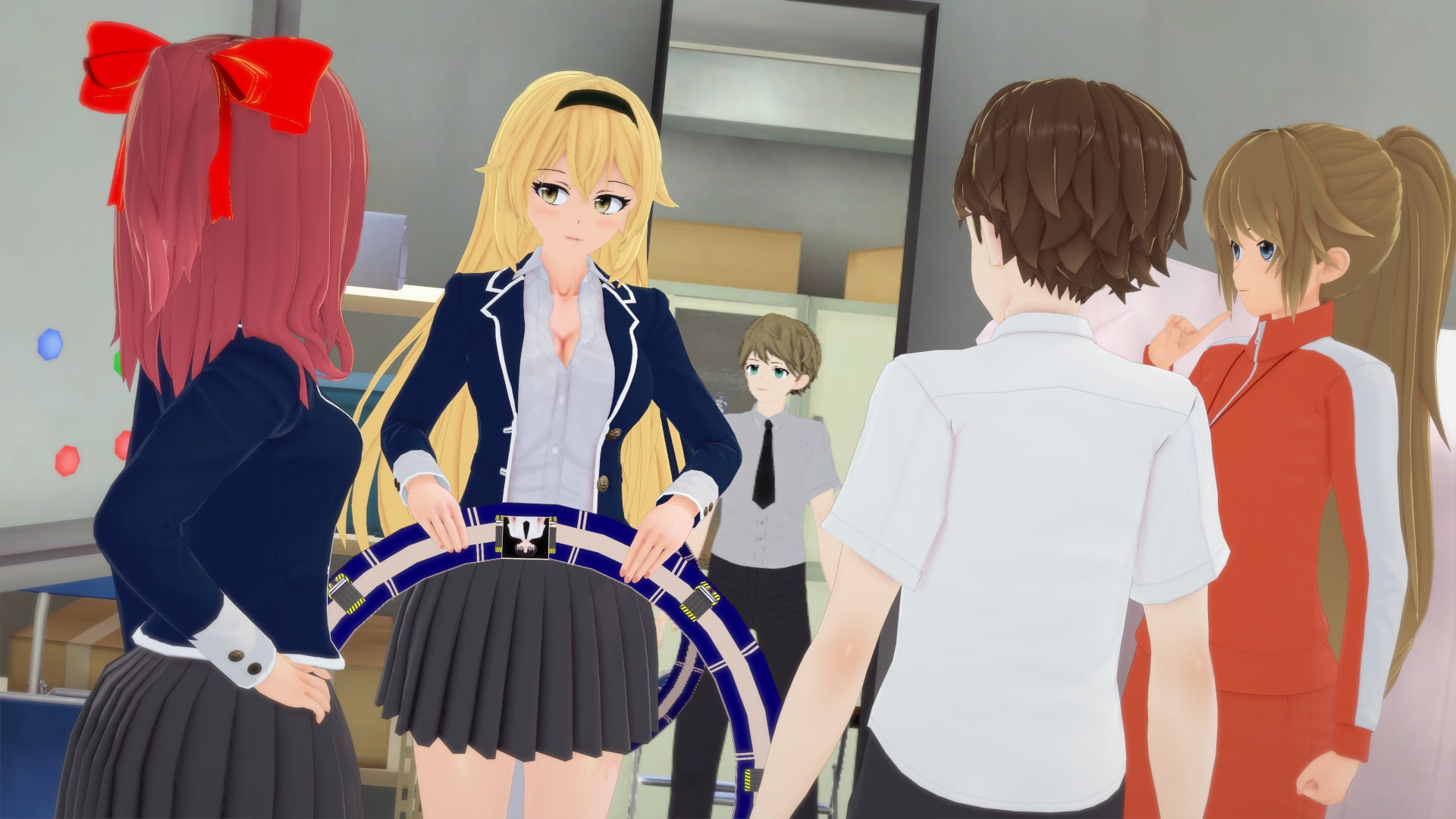
Anyway, under the guise of Asuka, Satoshi feels himself up, as one does, only to stop as Yusei, in Miho’s body, transforms him back to normal before stealing his military grade body swapper. Satoshi meets up with Asuka, currently in his body, where they chat about something or other in a scene that highlights a key strength and weakness of this textless approach. You need to rely on what the characters are doing and their expressions to gather what they are discussing, which leaves many scenes open to interpretation.
In this scene, we can see that Satoshi uses the Change Ring to transform back into Miho, while Asuka changes back to her usual form. They wave goodbye and Satoshi, still in Miho’s form, leaves with the Change Ring in hand. It seems simple, but the lack of dialogue raises several questions. Does Asuka know that Satoshi is Satoshi, or does she think that he’s the real Miho? Because Asuka never saw Yusei in Miho’s form. Does Asuka know who owns the Change Ring and does she think that Satoshi is its rightful owner? And why is she just okay with a student having this powerful tool in their possession, when she could easily confiscate it? Do they have some agreement to share it? I personally like the openness here, as it is an absence of information that spurs the reader’s imagination in the good way.

Now back home, with the Change Ring in tow, Satoshi masturbates in Miho’s form, enjoying himself and getting lost in the erotic thrills. However, and this is the part that just kills me, while he is masturbating, Satoshi’s little sister, Yuuka, sneaks into his room. Sheignores the fact that there’s a girl jilling off on her brother’s bed, and goes right for the Change Ring. She then slyly uses it, transforming into Satoshi, and leaves the Change Ring, never making a noise, or exiting the background of the frame. It lasts all of three panels, it raises so many questions, and is utterly hilarious to me.
Naturally, when Satoshi goes to return to normal, he winds up in Yuuka’s form. Shocked and weirdly choosing not to immediately swap back, Satoshi runs downstairs, tries to get Yuuka to switch back with him, only for their mother to intervene, breaking up their ‘argument.’ Meaning the story just went from a group of friends swapping bodies at school to a family swap scenario without skipping a beat. And that… that is part of the essence of what makes Change Ring such a fun comic to read.

Without the presence of dialogue, the transformations here feel very impulsive, casual, and… recreational in nature. Everybody just wants in on this new toy, trying out another body of their preferences, and their motives are shrouded in ambiguity that leaves room open for a pleasant level of reader interpretation. There are no wordy contemplations about being someone else or anything like that, and everybody cares more about keeping up the crazy combo and having a good time with their borrowed bodies. It’s not egregiously shameless. It still feels grounded in some form of humanity. And it is clearly the result of a creator who wanted to deliver a particular flavor of transformation shenanigans. While there are some missteps, I’d overall say Kawaii succeeded.
Before getting into the next chapter, I’m going to switch over to using my custom format of referring to characters by their mind followed by their bodies in parenthesis. So Satoshi in Miho’s form would be Satoshi(Miho). I’m doing this for brevity’s sake, this is not a standard, and some prefer the opposite, but I just used this format over 4,400 times in a novel I just finished editing, so… I’m sticking with it.

Chapter 2, Family Time, picks up immediately afterwards, with Satoshi(Yuuka) and Yuuka(Satoshi) having dinner. Satoshi(Yuuka) wants to switch back, but his sister doesn’t, so Satoshi decides to just use the Change Ring anyway. Instead of making him Satoshi again, it turns Satoshi into his mother, Shoko. Confused, he heads to the bathroom, where he sees Shoko(Miho), panics as he sees his new face in the mirror, and decides to… troll his mother by transforming her into Yuuka. He even places the Change Ring on a high shelf, because I guess small children cannot stand on chairs?
Seemingly drunk on his newfound power, Satoshi(Shoko) then decides to make Shoko(Yuuka) watch TV with Yuuka(Satoshi) before heading to another room, where he starts to masturbate. Because he is just shameless, and bless him for that. Before he can finish though, the father of the family, Hirotaka, comes in and kisses Satoshi(Shoko) on the mouth. Which Shoko(Yuuka) thinks is just hilarious.

Satoshi wants out after raising this incest flag and goes to grab the Change Ring, but Yuuka and Shoko took it while he wasn’t looking and begin swapping back to normal. Though, I have to wonder if the characters actually know who is who yet again, as Yuuka’s response to landing in Miho’s body during the exchange is to feel up her boobs. So… does Shoko think she’s swapping her children around while they’re going back to their original bodies? Frankly, I don’t wanna know. Shoko is crazy enough that I wouldn’t put it past her.
Why do I say that? Well, once Satoshi goes to sleep, Shoko takes the Change Ring and uses it to make sex with her husband more interesting. Shoko(Miho) shows Hirotaka(Shoko) the joys of a woman’s body as he has his first lesbian experience. But not content to just have sex as a virile busty blonde, Shoko then transforms herself into Hirotaka, and the two have body swapped sex. They go all across the room, in three different positions, and after presumably fucking all night long, Shoko has Hirotaka wake up in her body as the chapter ends.
This is an artistic choice that I choose to interpret as meaning that the two don’t swap back for… a while. Hirotaka’s model doesn’t show up again, and Shoko’s doesn’t appear again until chapter 5. You might think that’s a bit much but… everything in this chapter leads me to think this family embodies many platonic ideas of a TSF family dynamic. They’re all crazy, all pervy, and down to swap… except for the head of the household. Because you’ve got to have some friction to make the juices flow..

Chapter 3, Teacher Training, is an indirect continuation that sees Asuka, burdened by a day full of meetings, wanting to shirk her duties. Naturally, she decided to swap with Yusei, as she’d rather be a glasses pervert attending lectures than an adult woman listening to teachers lecture. …Wait. This arrangement once again adds to the contextual ambiguity I mentioned before— does Asuka know that Yusei is a big pervert— though things play out all the same. Yusei(Asuka) feels himself up, goes to the meeting, and promptly realizes why Asuka wanted out of this, as meetings are boring. So he instead decides to spice things up by visiting the redhead nurse, Risa, and showing her the Change Ring, turning her into another Yusei.
Rather than grapple with how this changed her entire biology, or remember her duty as the school’s only medical staff, Risa(Yusei) just… abandons her post and sees what it’s like being a teen boy. With a fresh body in the Ring, Yusei(Asuka) calls up Satoshi, who gets TF’d into Risa by his buddy so both of them can lose their virginity as they have lesbian sex on an infirmary bed. …During school hours. I get that they are teenage boys with the bodies of mature women at their disposal. That danger spurs the libido. Though, few things make the sex drive shrivel up than having a mature woman of authority walk in and catch you. Well, unless you have the notorious caught fetish.

Unsurprisingly, they cannot screw and change fast enough before Risa(Yusei) comes back, probably from a quick wank knowing this comic, and busts the boys. Their punishment? To stay in their bodies for the next unspecified stretch of time, while Asuka trades her form for Satoshi’s. From there, the story offers an ‘epilogue’ that sees the two boys going about their tasks as the teachers, though it’s not clear what the arrangement is. Was there a time skip? Are they… taking advantage of this situation? Yusei(Asuka) seems to ask Risa(Satoshi) and Asuka(Yusei) about swapping back and Miho visits Satoshi(Risa), but it’s a bit too vague to really sink one’s teeth into.
Chapter 4, Class Swap Cubed, is a lot simpler. It sees a three-way swap between Rika, Satoshi, and Miho. Miho doesn’t want Satoshi in her body, as he just got outed as a body jacking rapist. And Rika’s got a breast size complex— a disability that affects at least 25% of all anime-flavored women— so Miho gives Rika her body, slums it with Satoshi’s, and peaces out for most of the chapter.
The day starts simply enough, before getting a bit… obscure. Rika(Miho) loves her new bust and chats with other girls using her new identity. Satoshi(Rika) fondles himself in a way that… bothers Rika(Miho) somehow. And there is an implied conversation or joke involving two background characters and Satoshi(Rika)… confessing to Yusei for some reason. It’s all a strange section that emphasizes the weaknesses of the textless approach.

Regardless, the two head to the school pool for PE class, which is where I need to comment on the artwork. Koikatsu is a kitbashed wack job of a program, capable of performing miracles, while having wild quality disparities. A lot of these are texture-based, and make the software look like a weirdly optimized PS Vita game. I can overlook most things, but the water? That’s not even comparable to any gaming generation, it’s just bad to look at. At best, it looks like blue Jell-O, at worst, it looks like a flat blue surface characters clip through.
As she starts swimming, Rika(Miho) begins having issues with her breasts, as they don’t feel great in the water. It’s not clear what the exact problem is, if they just get in the way, if they are sensitive to the pool chemicals, or if they brush against the swimsuit fabric in an uncomfortable way. Either way, it is enough for the two to flee out of the gym and back to the clubroom, to quickly exchange bodies. Despite swimming, Satoshi(Miho) seems to like the way the water feels on his breasts, but before he can delve further, class ends and it’s off to the shower.
Because this school has weirdly large shower stalls, Satoshi(Miho) is able to use this opportunity to masturbate. You know, despite being surrounded by people on all sides. It doesn’t make much sense, but that in turn only cranks up the degeneracy dial, which is good in my book. Asuka, the PE teacher, notices this, and in one of the only bits of spoken dialogue in this comic, tells Satoshi that ‘he owes her one.’ This bums Satoshi(Miho) out, who only perks up when Rika, back in her own body, feels up his boobs, and the two share a… suspiciously sapphic moment.
Before things can progress further, Miho(Satoshi) is waiting for them in the clubroom, having found out that they swapped after finding two puddles. …Which raises a question as to how the Change Ring handles water, sweat, or non-bodily items. It copies clothes, but if someone is wet, will it capture the moisture, or push it down with the transformation? Because otherwise, I have no clue how they could trail behind that much water. Either way, it’s not a great chapter, though I cannot really highlight much else that could really be done with it. The lack of dialogue hurts things here, and much of it is built around the appeal of girls in swimsuits and masturbating in showers.

Chapter 5, Substitute Sister, is pretty simple, and the worst chapter as well. It is predicated on one swap, involving Yuuka and Yusei, meaning Yusei gets to be a disgusting pervert otaku loli for a day. He uses this profound power to fondle Miho’s boobs, get a face full of Shoko’s boobs, flashes Satoshi, and masturbates as a girl who… isn’t out of middle school, that much is clear.
Now, I am used to this sort of thing coming from Japanese creators, because of cultural differences I’ve hopelessly accepted. …But I know that excuse/reason doesn’t apply to Kawaii Tsun’aho. I won’t shame any creator for making this stuff, but I will look at them dead in the eye and ask ‘really dude?’ I know I just defended this stuff with Transformed Into A Busty Blonde, but those defenses don’t apply here.
As an addendum to the original release of this showcase, I would like to note that Kawaii Tsun’aho actually removed the explicit scenes featuring Yuuka’s body from the main work. Speaking with Kawaii Tsun’aho after releasing this showcase, they clarified they were originally apprehensive about including these scenes, but did so after getting overwhelmingly positive feedback from their Pixiv community. They asked if readers wanted to see scenes like this, they said yes, and Kawaii later soured on what they created. You know what I call that? Growth!

Fortunately, things get better with chapter 6, Beach Trip. The chapter sees Satoshi, Miho, Rika, Yusei, and nurse Risa visit the beach along with a new character, Miho’s little sister, Mai. Another blonde girl, but with a side ponytail and two hairpins that land in the middle of her forehead, forming an X. …Yeah, I don’t get it either. The six arrive at the beach, chill, and try to enjoy themselves. However, Miho quickly gets sick of creepy dudes hitting on her and her sister, so she volunteers to loan out her and her sister’s body for the day.
Rather than just exchange them normally though, this chapter introduces the Change Ring version 2.4. An upgraded model capable of scanning multiple targets at once, store up to 8 subjects at once, and its stored data can, somehow, be backed up. It’s a helluva upgrade, and one that mostly avoids the trouble of needing to have characters exchange forms by being in the same room. It does raise the question of why there aren’t more cloning shenanigans, because everybody could just become a Miho, but I guess that’s more of a preference thing.

Satoshi swaps with Mai while Yusei swaps with Miho. The girls turned boys play with Rika in the water, because they don’t have boobs to worry about. While Yusei(Miho), seasoned pervert, joins Satoshi(Mai) in an obscured corner for some nipple frottage and double fingering. A scene that could really have some additional weight… if these relationships were a bit more developed, if there was more direction in how this should be interpreted. They both clearly love Miho’s body, and think she’s hot, but what about Mai? Is Yusei supposed to be selling the incestuous thrills to Satoshi? After borrowing Asuka and Risa’s bodies, did they get up to more sexual antics? How should their expressions be read?
Tangent aside, Miho(Yusei) seems to understand what Yusei was getting up to in her body, yet before he can face her ire, Risa suggests they do an exchange. Thereby granting Yusei the privilege of being a curvaceous beach MILF, while Risa is free to frolic with the rest of the teens. They have their fun, and curiously head to a… hotel? It’s a series of six rooms that are basically all windowless bedrooms, and the hallway looks over a road that appears to go under the building they are currently in. Not a hotel, not a home, probably just a kitbashed setting from Koikatsu’s limited locales.

Regardless, the crew are only here to do one thing of significance: fuck. With Satoshi(Mai) and Mai(Satoshi) doing the honors, going at it in four different positions, and making them the first couple outside of Shoko and Hirotaka. Now, I want to comment on the narrative significance of this scene. How it informs the reader of their character. How they sell the experience of being a man/woman. Sadly… I don’t think I could really do that here. It’s not a bad sex scene, but unlike the one from chapter two, nothing really sells it as a body swap sex scene, due to the lack of text.
The absence of dialogue makes it hard to read intentional or willful characterization from the creator. Rampant swapping, relentless lewdness, extreme reactions, callous abuses of power, and myriad manifestations of spectacle, can all be sold through visuals alone. But subtler actions, personal desires, and interplay between characters, these things either need text or more detail than what Koikatsu allows without a lot of extra work. Like I said at the start, it’s a strength and a weakness.

Chapter 7, Study Days, is weirdly more of a transitional chapter than much else. It introduces yet another character, the orange-haired glasses girl Moka. Rika brings her into the club as Satoshi is studying, they exchange bodies, and Satoshi(Moka) goes back to studying. Later, he is approached by Miho and Mai, who take him out clothes shopping. Miho is apprehensive of this, and distrustful of Satoshi for his perverted history, while Mai just loves Satoshi(Moka), teases him sexually and regularly, before heading back to school. There, Mai becomes a copy of Satoshi, Mai makes Satoshi a copy of her, and he is sent home so they spend the night as each other.
There’s nothing really wrong with this, but the lack of dialogue hurts it. Moka is just another face thrown in for variety. Much of the chapter is built around the relationship of Mai and Satoshi, but with so much fixation and a lack of dialogue, there is simultaneously a lack of depth and a lack of room for reader interpretation. The visual language makes their relationship clear, they like each other, but Satoshi is not comfortable with Mai taking such a dominant role. Yet anything beyond that is a bit too obscure for me to really grasp. It feels less like something meant to be textless, and more like a textless version of a comic.
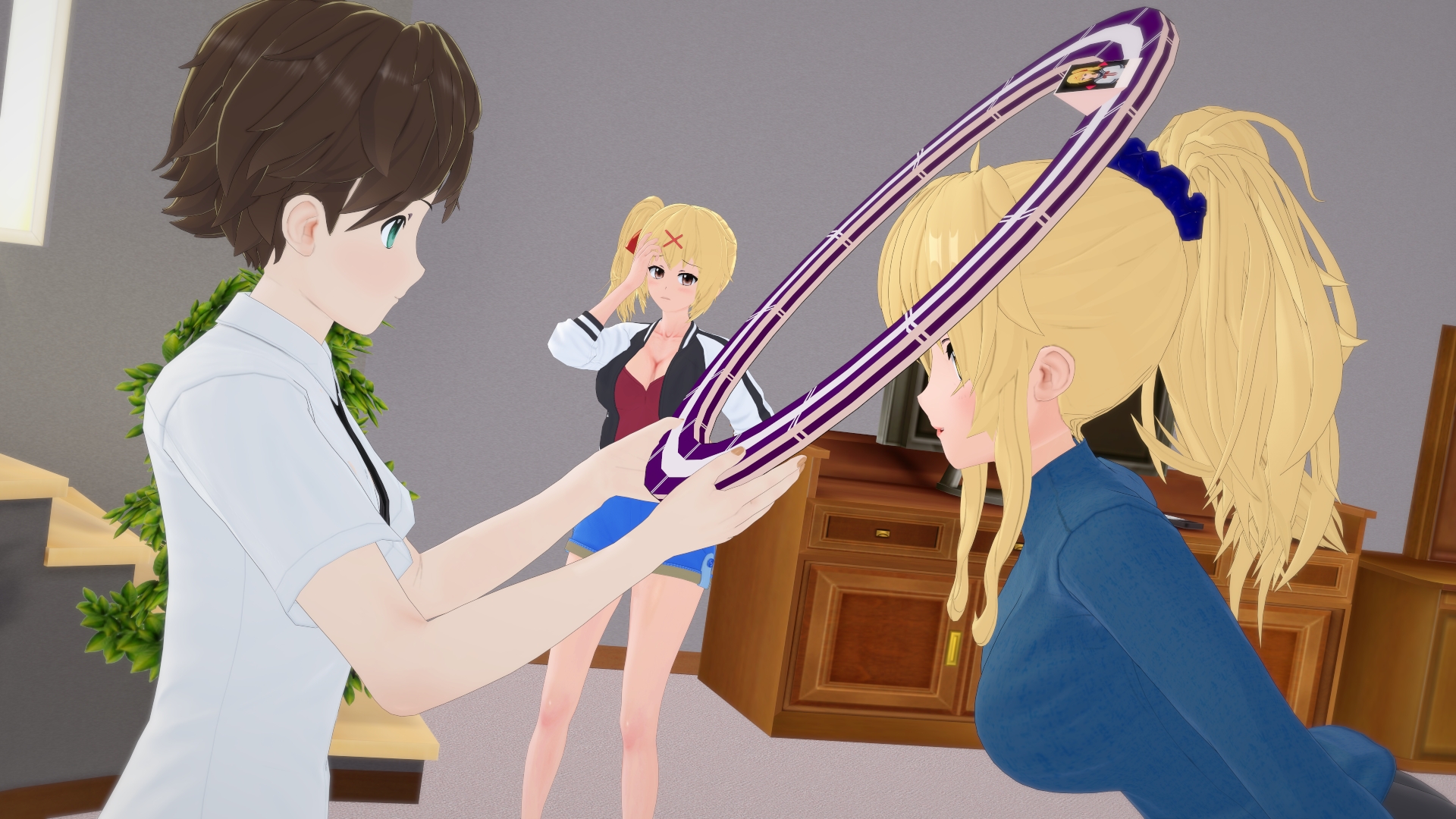
Thankfully, Chapter 8, Swapped Dates is the best chapter in the series! With Satoshi still in Mai’s body and Miho none the wiser, he heads to her home, changes out of his uniform, and meets up with Miho and Mai’s mother, Midori. A refreshingly playful woman who is eager to switch bodies with Satoshi(Mai) using the Change Ring and immediately lumps her husband, John, in on the fun when he comes into the room. Thus leading to an arrangement of Midori(Mai), Josh(Satoshi), Mai(John), and Satoshi(Midori)
This would make for an excellent dual chapter scenario, showing John(Satoshi) and Midori(Mai) going out on a teenage date while rekindling their love enough to ignore the fact that Midori’s in his daughter’s body. While showing Mai to be the loveable girl-pervert-freak she is as she lusts after her boyfriend in her mother’s body. Instead, Kawaii only treats the reader to the latter which… fair enough.
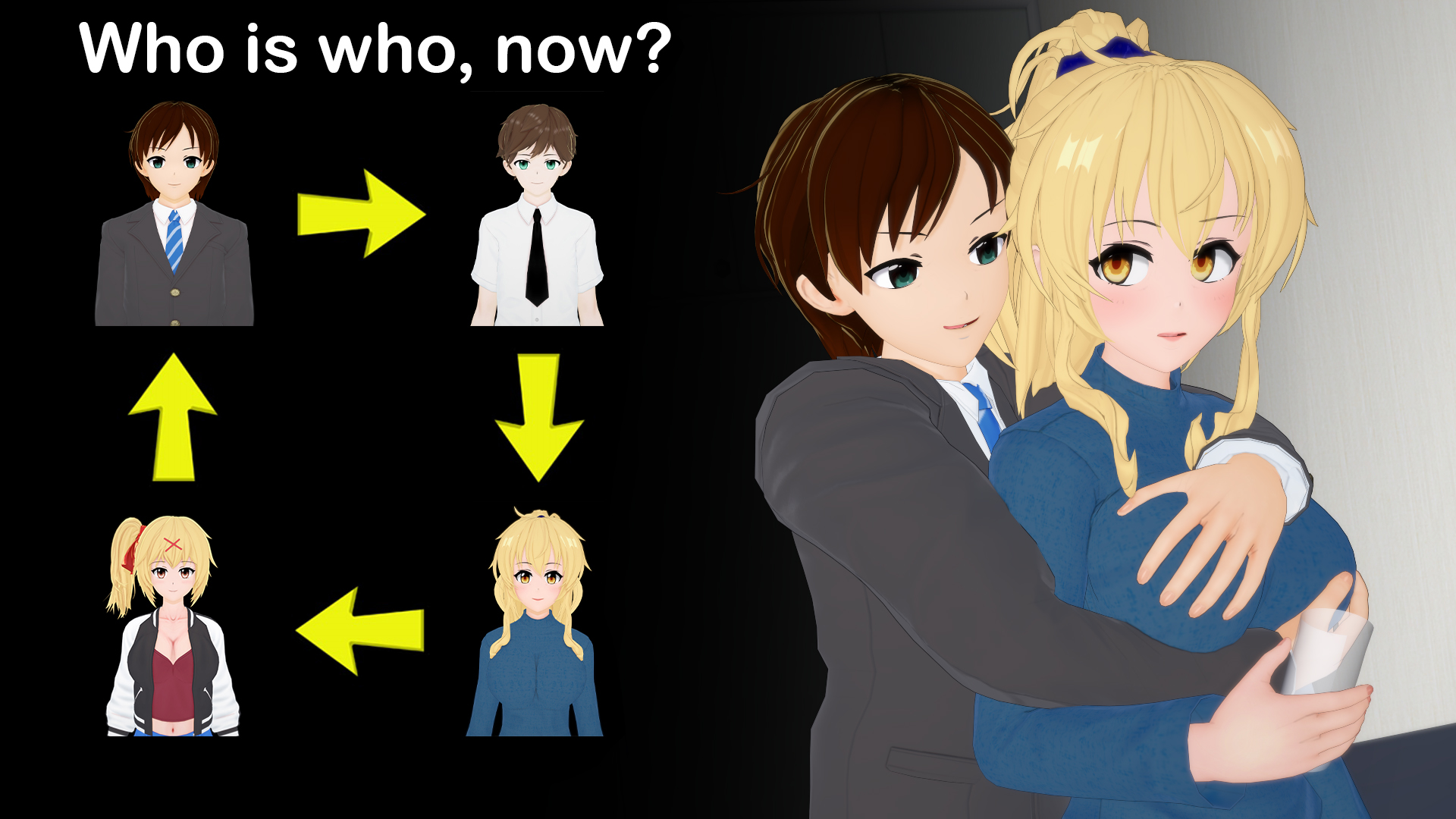
This is followed with some cute diversions, namely a scene where Miho thinks that her suddenly perverted father is actually Satoshi and Satoshi(Midori)’s fashion show— maybe that’s why they had the shopping trip. But the core of the chapter starts when Satoshi(Midori) and Mai(John) are out in the city, going on a date. Playing pool, lounging in what looks like a repurposed castle, and heading to an elevated park, where Satoshi(Midori) enjoys the view of the city. While Mai(John) gives him a better view. His titties. With no inhibitions left, Satoshi(Midori) accepts this and just starts fucking Mai(John).
I love so many things about this scene. The fact that they are physically two grown adults, having sex in the open, in a public park, looking down from the city, it’s some wild exhibitionist shit that I find hilarious conceptually. The sheer disregard Mai has for the fact that she is fucking her mother with her father’s penis. How Satoshi just goes with it, discarding any reservations and letting himself get railed on a railing. Now that’s the erotic kind of danger!
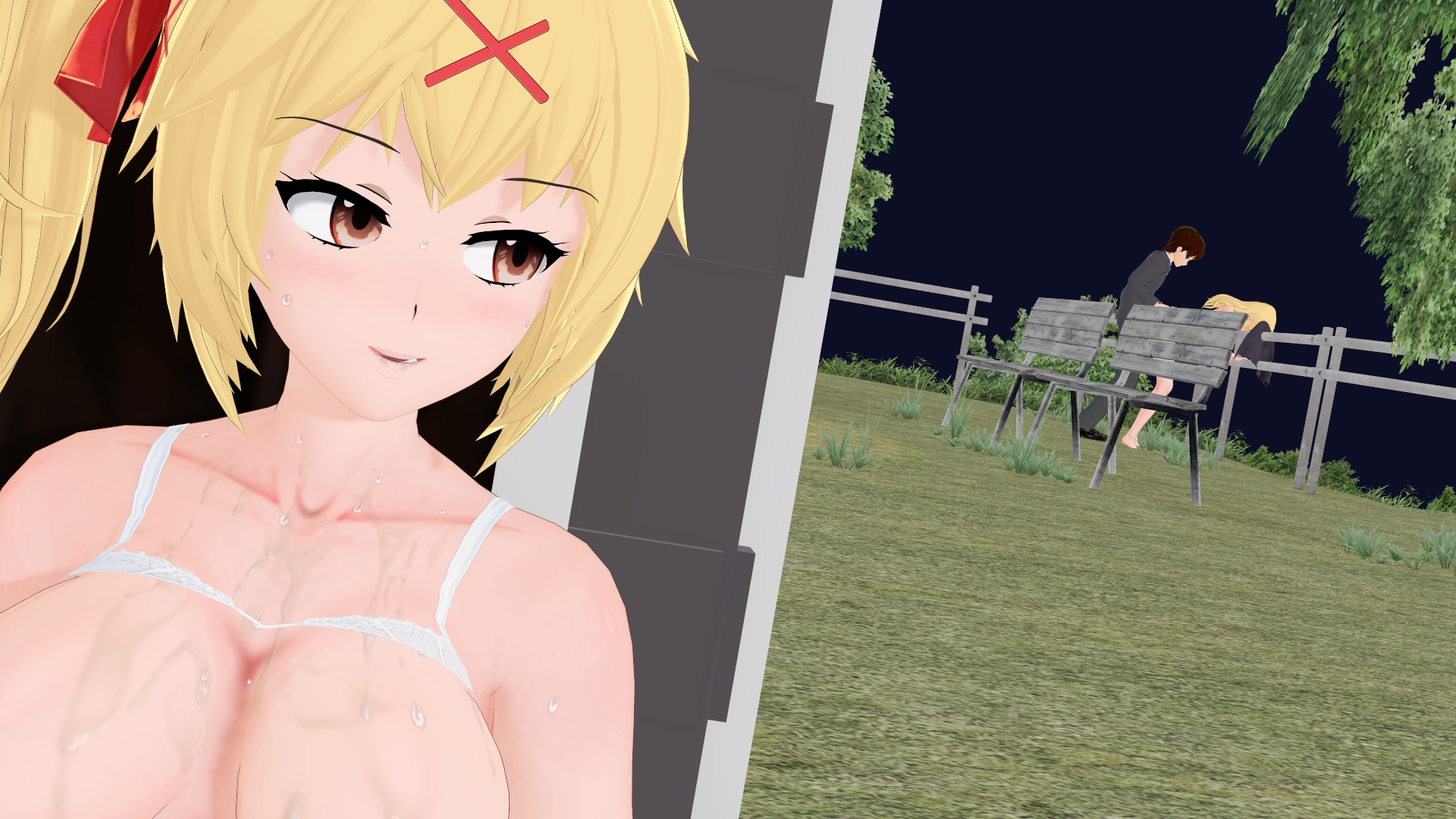
Yet the best part is that, right off to the side, behind some shed, Midori(Mai) and John(Satoshi) are laying there, fresh from their own sexual session. With Midori(Mai) looking at the other pair with a smile, while John(Satoshi) is passed out. It raises so many questions, and I don’t want any of them to be answered. All I know, all I need to know, is that Mai’s a freak in the sheets, and Midori’s pretty much the same, no matter the body, no matter how big the incest is!
After this, Midori returns to her own body, but rather than spend time with her husband, she looks over to Satoshi, now in Mai’s body, and says she loves him. A gesture that… once again, could be read many ways. Because this chapter is full of vague tidbits while never leaving its broad strokes plainly clear, without relying on dialogue. It’s another giddy, eager, body swapping journey, and it didn’t leave me wanting for clarification. It does all it needs to with visuals alone.
Chapter 9, Consequences, is the latest part so far, and… sadly, it feels like a lot of set-up for the next chapter. This is the proper introduction of Yurie, the green-haired English teacher who has been a background character, yet has never done anything worth remarking. She ventures into the clubroom, discovers the Change Ring, and gets involved in a series of transformations. The actual details are… pretty inconsequential, as they boil down to Satoshi and Yurie switching bodies. Yurie(Satoshi) passes out and wakes up in the nurse’s office while Satoshi(Yurie) tries to be an English teacher, his execution being… questionable.
This leads Risa, the nurse, to switch with Satoshi(Yurie) as he would rather lounge in the nurse’s office than teach a class. While Yurie(Satoshi) ventures to Satoshi’s house, timid and unsure. I like teacher student swaps, ethics be darned, and this is a good set-up. …But again, it feels like something is missing here. It’s not extreme enough to be sold through visuals alone, and it feels like the narrative depth is missing.

Going through Change Ring in great detail… I guess I don’t love it as much as I thought I did? Well, that is partially due to how when I read through Change Ring, I am able to treat it as a darn flipbook, going from page to page every few seconds, so things are constantly happening. The rapid pace helps the narrative shortcomings feel like minor bumps in a mad dash, but when I slow down and look at things in more detail, its lesser traits become more apparent.
Still, I do admire the sheer level and volume of things the comic does without any text, and while the zaniness does have ebbs and flows, when it hits, it hits hard! It really makes me wonder what Change Ring could be if it had more. More character added through text, and more expressive and robust visuals than what Koikatsu will allow.
…
…What, you think I just spontaneously decided to give them a showcase apropos of nothing? Nu-uh, hunies! This was all just a prelude to the real 2024-19 showcase, Change Ring the Manga!
TSF Showcase 2024-19.1
Change Ring the Manga by Kawaii Tsun’aho and MPZ
Change Ring the Manga is an adaptation of the first chapter of Change Ring… the Koikatsu Comic, rewritten by Kawaii Tsun’aho and re-visualized by MassivePinkZombie, or MPZ. An artist who TSF Showcase enjoyers might recognize from the visual delight that was sWitch Time. A comic that depicts a multi-page sequence where Bowser Jr., in the body of Princess Zelda, is relentlessly gang raped by the Koopalings. So they were an ideal choice. That might read as sarcasm, but it isn’t. Artists with the capacity to draw buck wild shit have always been some of my favorites.
Having already gone through the first chapter in the above section, the most succinct way I can describe Change Ring the Manga is that it is… more and better than the original. Characters can now speak, so their personality has shot through the roof. Actions that were previously reserved and implied are now vibrant displays. And the erotic scenes have been remixed and enhanced with the refined skills of an experienced NSFW artist.

Instead of having Yusei just introduce the Change Ring with little fanfare, he has all members of the “Scientific Studies Club” gather round and carries himself as a showman. The characters react to Satoshi’s transformation with awe and excitement. The weird way Satoshi in Miho awkwardly removes his tie is replaced with the buttons on his shirt flying off because he’s too damn busty. The way Rika runs away after getting Satoshi’s form is given far more context and feels more natural. Yusei masturbates in the bathroom instead of the roof, like a civilized person, and does so with a perverted vigor that feels… appropriate given where his character wound up.
Every scene is improved and expanded. New minor elements are introduced, such as Satoshi failing to put his bra back on after playing with Asuka’s body. The iffy section with Asuka is fully cleared up, showing that she not only gave the students permission to bring the Change Ring to school, and let Satoshi go home in Miho’s body. On that note, this is the biggest change in the manga adaptation.
This was the most exemplary horizontal-friendly image, okay? And censoring it was fun!
In the original, the Satoshi’s masturbation sequence is just 13 pages of single panel shots, and it’s presented as a straightforward ‘clothed’ masturbation sequence. It shows Satoshi enjoying Miho’s body, but not much else. Not bad, not too remarkable either. The manga version is 10 traditional comic pages, begins with a strip sequence, sees Satoshi masturbate in front of a mirror, narrating as he delights in the joys of his borrowed form. It starts really strong… but then Satoshi imagines himself, his male body, having sex with Miho… while masturbating as Miho.
I know I’ve seen this before, though I still find this as an odd way to present the act of TSF masturbation, of a man enjoying a female body. It is both dissociating from their current body and using its sensations, curves, and tender spots as a form of sexual reference for a masturbatory fantasy. I would expect Satoshi’s mind to at least drift into viewing himself as Miho as the experience continued, as he kept ramming his fingers inside him and fondling his breasts, forming a sensory homunculus. Instead, he just doesn’t. Even in a woman’s body, this TSF protagonist still fantasizes about fucking girls with his dick. It makes me wonder how this rendition would react to being in Mai’s body while having sex with Mai in his.

This is all followed by the same ending, where Yuuka, the deranged girl that she is, steals Satoshi’s body while he is masturbating as Miho. In the manga version, the depiction is far more extreme. There’s a nifty Change Ring POV shot, Satoshi looks as his new reflection in utter horror, and Yuuka… plays dress up with Satoshi’s body, putting him in tight, revealing clothes and giving him hair buns. It’s such a goofy, jovial remix on what was already a good ending, and I love it.
I love every darn thing about this adaptation, from front to back. It is a wonderful refinement of an already quality work. Kawaii, as a writer, did a great job expanding on the original scenario, building up the characters in a way the original couldn’t. While MPZ, as an artist… went hard on this. I adore how some of the shots and panels were framed. The characters are given so much extra life that I feel the need to study each panel to fully appreciate it. It’s premium quality body swap high school hi-jinks, and I’d love to see the same treatment be given to… most of the chapters. Or, hell, maybe something original.
In summary… read Change Ring the Manga, read the OG Change Ring, and read a bunch of Kawaii’s other stuff. Because they know what they’re doing— for the most part— and I’ve only scratched the surface of everything they’ve done over three short years.
I wanted to put all of the Q2 2024 TSF Showcase into a single post, but this post already has over 100 images. You can check out the second part for Q2 2024 here.
If you have any TSF comics, videos, writings, or really any form of media you would like me to cover in a future TSF Showcase, please let me know in the comments below!