

Because with a roster like this, a tier list is necessary!
Hello and welcome to a supplemental portion of Natalie Rambles About Pokémon Black and White. While playing through the game for the general Ramble and discussing its balancing choices with a friend, I got this crazy idea of doing brief analyses of every regular Unova Pokémon obtainable in the campaign of Black and White. All in an attempt to highlight weaknesses with the roster, recurring issues, and answer the question of what’s the best team to bring through a playthrough of Pokémon Black and White? …And which Pokémon are just kind of bad in the game.
I performed this analysis based on a few sporadically applied factors. Stats, when it evolves, when is it available, level up learnsets, TM learnsets, TM distribution, and what roles a Pokémon can fulfill compared to other available Pokémon. I tried to be reasonable and consistent here, but this is by no means an objective list. I have not done a run of every Pokémon in this lineup, I have only completed Pokémon Black and White twice in my life.
This analysis is based on how much a given Pokémon can reasonably contribute to a playthrough, and I am comparing Pokémon against other options available. Just because I think a Pokémon is low tier in terms of performance, that does not mean it cannot gel well with the right team. This is all just a little bit of fun for me personally, hued by what I look for when adding a new Pokémon to a team.
Also, to reiterate, this is ONLY considering what a Pokémon contributes to the CAMPAIGN. The postgame is its own thing.
So sit back, hop around with this handy directory, and keep your hands on that keyboard, because I am expecting somebody to send me a bitter manifesto for my “bad takes.”
TABLE OF CONTENTS:
- Snivy/Servine/Serperior
- Tepig/Pignite/Emboar
- Oshawott/Dewott/Samurott
- Patrat/Watchog
- Lillipup/Herdier/Stoutland
- Purrloin/Liepard
- Pansage/Simisage/Pansear/Simisear/Panpour/Simipour
- Munna/Musharna
- Pidove/Tranquill/Unfezant
- Blitzle/Zebstrika
- Roggenrola/Boldore/Gigalith
- Woobat/Swoobat
- Drilbur/Excadrill
- Audino
- Timburr/Gurdurr/Conkeldurr
- Tympole/Palpitoad/Seismitoad
- Throh
- Sawk
- Sewaddle/Swadloon/Leavanny
- Venipede/Whirlipede/Scolipede
- Cottonee/Whimsicott
- Petilil/Lilligant
- Basculin
- Sandile/Krokorok/Krookodile
- Darumaka/Darmanitan
- Maractus
- Dwebble/Crustle
- Scraggy/Scrafty
- Sigilyph
- Yamask/Cofagrigus
- Tirtouga/Carracosta
- Archen/Archeops
- Trubbish/Garbodor
- Minccino/Cinccino
- Gothita/Gothorita/Gothitelle
- Solosis/Duosion/Reuniclus
- Ducklett/Swanna
- Vanillite/Vanillish/Vanilluxe
- Deerling/Sawsbuck
- Emolga
- Karrablast/Escavalier
- Shelmet/Accelgor
- Foongus/Amoongus
- Frillish/Jellicent
- Alomomola
- Joltik/Galvantula
- Ferroseed/Ferrothorn
- Klink/Klang/Klingklang
- Tynamo/Eelektrik/Eelektross
- Elgyem/Beheeyem
- Litwick/Lampent/Chandelure
- Axew/Fraxure/Haxorus
- Cubchoo/Beartic
- Cryogonal
- Stunfisk
- Mienfoo/Mienshao
- Druddigon
- Golett/Golurk
- Pawniard/Bisharp
- Bouffalant
- Rufflet/Braviary
- Vullaby/Mandibuzz
- Heatmor
- Durant
- Deino/Zweilous/Hydreigon
- Larvesta/Volcarona
- Das Ende!
Snivy/Servine/Serperior

As a pure Grass type line, it is hard for the Snivy line to stand out and find its niche, especially in the Unova Pokédex. There are many ways to make a pure Grass type viable, ranging from optimized stats, a deep learnset, and general versatility. The Snivy line does not offer many of those. With high defenses and higher Speed, Serperior is able to move first, but can’t deal the damage expected of a fully evolved starter.
Its learnset has a lot of good Grass moves. Leaf Tornado is a nifty signature move that lowers the opponent’s accuracy. Leech Seed, Leaf Blade, and Giga Drain represent about everything a Grass type would want aside from Spore. And with the triple buffing move of Coil, it has the ability to become an imposing physical sweeper, not even needing to Speed buff of Dragon Dance or Quiver Dance. Its problem is a lack of non-Grass moves, as the best Serperior has is weak 60 BP moves like Aerial Ace and Dragon Tail. This was expanded in subsequent generations with moves like Dragon Pulse and Knock Off, but in Gen V, it faces all the limitations inherent to a mono Grass type, when there are other mono Grass types can do the same thing, but with bigger attacking numbers.
While by no means bad, I firmly consider it to be the middle choice in the game, brought down by the fact that Unova is just not a very Grass friendly region with its Bug, Flying, Ice, and Dragon type gyms.
RANK: C
Tepig/Pignite/Emboar

As the third consecutive Fire/Fighting type Pokémon, Emboar has a certain sense of standards to live up to, and I think Emboar is easily the worst of them all, due to the two things. Its stat distribution and a lack of Fighting type moves. Despite the hefty HP bulk, Emboar has worse defenses than either Blaziken and Infernape which, paired with lower Speed, means it’s likely they will take more hits, and the hits it takes will deal more damage.
This is slightly countered by Flame Charge, allowing the Tepig line to accumulate speed. Yet as a 50 BP move, using it means not using a stronger move, such as its signature move, Heat Crash. A variable weight based move that, while 80+ BP on two thirds of the practical roster of the Unova Pokedex, but lacks the straightforwardness of a Blaze Kick or even Fire Punch. When it hits, it can be incredible, but that requires knowing the weights of opponents and the exact math behind a move. You can just click it and watch enemies go boom, but that just does not sit well with me.
Emboar also has a problem with Fighting type moves, as the only Fighting type move it learns via level up is Arm Thrust. Arm Thrust is terrible multi-hit move with variable power of 30 to 75, with an average value of 47. Even when Arm Thrust debuted, it did so as a gimmick move for Brawly’s Makuhita and nothing else. Even Makuhita, the only line that learned this move in Gen III, learned the 70 BP Vital Throw by level 13, three levels after learning Arm Thrust!
At its worst, Arm Thrust is down there with Triple Kick. At its best, it is a multi-hit Brick Break. In Unova, the best Fighting type TM for the majority of a playthrough is Rock Smash, before gettingaccess to the Low Seep and Brick Break TMs after the sixth gym. This makes Emboar a terrible fighting type for the majority of the game, and most of this could have been fixed if they just gave it Low Sweep as a level up move. Low Sweep is a 60 BP Fighting type move that makes the opponent slower and debuted in these games. This would synergize very well in the mid-game, turning Emboar, or rather Pignite, into a master of speed control, upping their speed while lowering the opponent’s, but I guess that would be too much.
For comparison, Combusken evolved with Double Kick, an effectively 60 BP Fighting type move that, while not very good in the latter half of the game, represented solid STAB damage propped up by a high ATK stat. Monferno evolved with the 40 BP Mach Punch and was stuck with it for a good while, but this move could later be replaced by the incredibly effective Drain Punch as soon as the battle with Maylene. Or, if one were the patient type, they could just wait until Infernape learned Close Combat and use that as the win button for many battles throughout the game.
In conclusion, Emboar would be some stat distribution and one move away from being a drastically better Pokémon. They have great bulk and good TM learnset versatility, but with such frail defenses, slow speed, and a wimpy Fighting type attack, they don’t feel like the powerhouse they appear to be. I tried using one in my playthrough, getting up to the sixth gym before boxing them, so I am pretty confident in this opinion.
RANK: D
Oshawott/Dewott/Samurott

The Oshawott line is easily my favorite of the Unova line, and much of that is for a simple reason. They deal good damage from early on, learn moves that cater to their mixed attacker role, and as a pure Water type in a Water weak region, they have many strengths and few weaknesses. Upon evolution to Dewott, the Pokémon learns the move Razor Shell, a 75 BP physical Water type move with a 50% chance to lower the target’s Defense. This is effectively a variant of Liquidation, an endgame move with 5 less BP and an extra 30% effect chance. It’s busted.
Razor Shell, Dewott’s 75 base Attack, and the early availability of Mystic Water turn Dewott into a monster who, with early Return and Dig for coverage, can handily take on more foes. They can learn Scald before the fifth gym to make use of Special Attack and get in some burns. And thanks to the X-Scissor TM right before the sixth gym, they can also deal good damage to Grass, Psychic, and Dark types. Samurott is admittedly on the slower end of things, and its Special Defense is a bit lacking, but it’s still a quality water type that… I really wished I went with it for my playthrough.
I’m tempted to give it a B Rank as it is not an excellent Pokémon, but it does not have much competition given the scarcity of other Unova Water types.
RANK: A
Patrat/Watchog

As the standard rat Pokémon of the region, the Patrat line has a low base stat total (BST) and is definitely not the sort of thing to carry a team through the endgame. But during the early game and mid-game? This thing can be a menace. For a level 20 evolution, its Attack and Speed are pretty high, it should be faster than most other Pokémon, and when it moves, it has access to a repertoire of nasty tactics.
Detect at level 11, Crunch at level 16, Hypnosis boosted to 78% accuracy via the Keen Eye ability at level 18, Confuse Ray at level 20, and Super Fang at level 22. This rat has enough tools to be a devious wall, to leave opponents asleep, confused, and with half their health before they get to do anything and then use Crunch to KO them before repeating the cycle. There was a clear effort to give this rat a niche and, frankly, I think this is a prime example of making a middling Pokémon remarkable. Even if it can be a piece of crap when you’re on the other side of it.
RANK: B
Lillipup/Herdier/Stoutland

I like to think that Game Freak looked at Staraptor, how popular and successful it was despite being a regional bird, and decided to do that again… but make it less dominant and also a dog. Stoutland comes in, intimidates, and deals damage. It Crunches, it uses Return, it has a light amount of coverage with Dig, Aerial Ace, and the elemental fangs. A bulky, decently fast Normal type with 100 base Attack is nothing too fancy or special, but the power of STAB Return seldom becomes a major issue in a game light on Ghost, Rock, and Steel types. And Stoutland has just enough coverage for when they rear their heads.
With the buffs to Tackle, Lillipup is useful out the gate, gets Bite at level 8, and while Take Down is just a bad move, Herdier with Tackle and Retaliate is still decently practical for the stretch between gyms two and four, before getting Return turns them into a frequent OHKO wonder. I took my Stoutland to the end, and they never stopped being a vital part of my team.
I’d say that Stoutland could be better, but after getting an extra 10 Attack points and Level 24 Play Rough in later generations, I don’t think it needs anything else to be great for a playthrough of whatever game they’re in. Well, maybe access to Headbutt. Dogs like to headbutt people.
RANK: B
Purrloin/Liepard

I don’t really get Liepard in Gen V. They are a fast mixed attacker with wafer defenses whose main use in competitive is through its hidden Prankster ability, making them a useful supporting Pokémon in VGC. …In the context of a playthrough, I don’t know what you’re supposed to do with this thing. It’s a level 20 evolution like Watchog, but its learnset just lacks the same useful level up moves. Assist gives it access to moves of other Pokémon in the players’ party, but it does not learn a move with more than 40 BP until level 31. With Fake Out and Hone Claws, it definitely has some use, but suffers from a lack of Bite/Crunch and a fairly shallow TM pool. Aerial Ace and Shadow Claw/Ball are highlights, and while it natively learn Nasty Plot, it lacks even Dark Pulse to take advantage of it. It could or should be a fast disruptor, but move pools are everything.
RANK: D
Pansage/Simisage/Pansear/Simisear/Panpour/Simipour

I’m lumping the elemental monkeys together because they all have the exact same problem. They are effectively positioned as secondary starters, companions for the player to bring along them on their journey, but nothing about them works as well as it does for a starter. The first stage monkeys are weak mixed attackers with staggered learnsets that have some versatility— like Leech Seed and Yawn— but do not learn a truly useful move until level 22, when they are acquired at level 10. This requires nursing a Pokémon that’s really only good for super effective matchups for 12 levels. Afterward, the player can get an evolutionary stone in Castelia City, and can evolve their monkey into a stronger one. This does represent a drastic power boost, and you can take these fast mixed attackers to the end of the game.
They have some coverage including moves like Dig, Shadow Claw, Acrobatics, Brick Break, even Rock Slide if you want to backtrack. But there’s also something unexciting about their moves, stats, and general presence. After nursing up my Simisage, I frankly didn’t want to use the bloody thing, even if it was the strongest member of my party by sheer stats. And the fact that they are so absurdly rare otherwise just makes them feel cloying and mocking. None of them are strictly bad Pokémon for a playthrough. I feel that the designers expected you to use your monkey as a secondary starter. But using them outside of the first gym sucks so much that I don’t want to use them. I’d genuinely rather use Patrat.
RANK: C
Munna/Musharna

As the fourth wild Pokémon available to the player, Muuna is an interesting addition. It has access to a good bulk and Special Attack out the gate, learns Yawn at level 7, learns Psybeam at level 11, and… falls off pretty quickly after that. Munna is definitely useful and has a few very valuable tools early on, but a lacking learnset prevents them from accessing their potential. In modern games, this is not a problem, as one could evolve Munna to Musharna with a Moon Stone at any time and access a back catalog of moves. But Gen V did not work that way.
Considering the player is given a Moon Stone at the end of Pinwheel Forest, I assume the developers want you to evolve Munna ASAP. Nothing else uses the Moon Stone in the main game. But Muuna learns Psychic at level 37, and is no good way to get the TMs for Psychock or Psychic before the late game. Even if Muuna learned Psychic earlier, their broader move pool is a bit plain with only Shadow Ball, Energy Ball (a postgame TM), and Charge Beam for coverage. I’m assuming the intended approach is a Yawn to Calm Mind to Dream Eater combo, so that much coverage is not that important. But beyond Yawn prowess, most of what they can do is better achieved by Gothitelle and Reuniclus. …Maybe even Beheeyem.
RANK: C
Pidove/Tranquill/Unfezant

What a joke of a Pokémon! The Pidove is the signature bird of Unova, and they chose to make them a pretty fast physical attacker with terrible Special Defense. That’s fine, gives players a way to defeat them throughout the campaign. If this Pokémon were treated like a Starly and got moves like Wing Attack early on, a decent Normal physical move, and maybe some oddball coverage move, this could work. Instead, Unfezant cannot learn any physical Flying type moves until level 66 with Sky Attack, with the soonest Flying type TM, Fly, being locked behind after the Ground type gym.
It’s a joke of a moveset. Unfezant’s best move is Return, the only coverage it really gets is with U-Turn, obtained in the postgame. And learning Detect at level 23… means little when Protect can be acquired around then if you are diligent with your Dex. Its moveset does not allow it to make use of its stats, the best thing it has going for it is 2x crit strats using Scope Lens and Super Luck, but it desperately needed Wing Attack and Brave Bird.
RANK: D
Blitzle/Zebstrika

As one of the first new Pokémon obtainable after the first gym, Blitzle represents a much appreciated element of variety to team building, and is ultimately the electric type of the first half of Black and White. While its stats are pretty low, like most first stage evolutions in this region, it comes out swinging with good speed and attack, giving it the ability to contribute. It has access to Shock Wave, Thunder Wave, and Flame Charge by the first gym, giving it some vital early type coverage, a powerful STAB move, and the ever versatile paralysis.
However, the line also suffers from what I call the troublesome two-stager twenties. Where the Pokémon just cannot contribute much during the period between entering Castelia City and its eventual evolution. Blitzle can Flame Charge through Burgh’s Bug type gym, but it is so frail at this point that it can take only a single good hit to bring Blitzle down. Spark at level 25 is a modest upgrade that uses its better Attack stat, and then two levels later, it evolves into Zebstrika. While not bulky, its speed, power, and versatility in the mid-game makes it a desirable party member.
Zebstrika can easily solo Skyla’s entire gym, only needing to worry about PP, though after this it does fall off due to a less desirable move pool. Its strongest Fire move for the main game is just Flame Charge, and Wild Charge at 39 requires the player to gamble Zebstrika’s not great HP with its desire for power. Thunderbolt is usable, but I always feel bad about using a worse stat with a Pokémon like this. I can easily see a Zebstrika contributing through the end of the game, so it’s going in B rank.
RANK: B
Roggenrola/Boldore/Gigalith

Pure Rock type is pretty underwhelming in general, though Roggenrola benefits from being an early catch right before a series of gyms that benefit from having a slow hardy Pokémon capable of taking hits. It contributes against Lenora with its Normal resistance, high Defense, and can even use Rock Smash if you want. It walls a lot of attacks from Burgh’s bug types. And with Sturdy, it is guaranteed to get at least one hit in before going down. Headbutt and Rock Blast are very good moves for the early game, dealing meaningful damage, and because of Unova’s type distribution, its low Special Defense should not be too much of an issue.
Evolving at level 25 into Boldore and gaining the useful Smack Down, they are actually a hard counter to Elesa’s Emolga and are similarly useful in Skyla’s gym. …Unfortunately, as a trade evolution, it requires friends or modification to obtain its fully evolved form of Gigilith, and Boldore has a 390 BST. If the game was modified so Boldore evolved into Gigalith at level 35 to 40, that would make them a slow yet reliable ally through the game, albeit with a limited moveset of basically Rock Slide, Stealth Rock, and Bulldoze. But with 135 base Attack… that’s plenty. Give it an in-game evolution, back port the Special Defense buff from later generations, make Rock Polish a level up move, and I’d call this A rank.
RANK: C
Woobat/Swoobat

Woobat was clearly meant to be the Zubat of this new generation, but in practice it kind of isn’t that. It’s available right after the first gym, has pretty unremarkable stats, and does not immediately offer much to a team, being a specially inclined Psychic/Flying type. I guess they’re good for Pinwheel Forest, but they don’t resist Bug for Burgh, and half of the Ground types in Clay’s gym are Dark types. The learnset is confused, featuring two physical attacks it learns after capture— Assurance and its signature Heart Stamp, basically Psychic Stomp— but does not learn Air Cutter until level 22 and does not learn a decent special Psychic move until Psychic at level 41.
If one shows a Woobat enough love, they will become a Swoobat, which is better but still not great. It’s incredible fast and can deal an amount of damage with 77 Special Attack, but its defenses and HP are so low it will go down from a sufficiently powerful neutral move. It’s not even the best Psychic/Flying Pokémon at that point in the game, as the player can find a Sigilyph in Desert Resort, which is better in every way except for Speed, and you don’t need to make Sigilyph love you.
RANK: D
Drilbur/Excadrill

I tried using a Drilbur on my team, and I just did not like them. Drilbur is a curious little critter, as they can be obtained in either Wellspring or Chargestone cave, two very different points in the game, and serves as the first Ground type the player can encounter. I went for the earlier opportunity, and taking care of this thing often felt like taking care of an actual baby mole. While it has good Attack and Speed, its weak defenses and level 19 access to Dig made them a benchwarmer that could not take more than two Aerial Aces from an Emolga and one that needed to be recalled so regularly it became formulaic.
The idea is that trying to nurse Drilbur will get the player access to an early Excadrill, and Excadrill is almost a monster. With Rock Slide, Earthquake, and Gen V Steel typing, it can deal ample damage and has loads of resistances. However, it also lacks access to a good Steel move, like Iron Head, despite literally having an iron head. Getting an early Drilbur is a mistake, and they won’t contribute much. But if the player gets one in Chargestone cave and nurses it about five levels, they will have an imposing threat with good TM coverage and a 135 Attack stat that will tear anything to bits. So it gets a B, because if you get it early, you’re gonna have a Bad time.
RANK: B
Audino

Audino is… actually a really good Pokémon. Having used an Audino in my run for novelty purposes, I expected it to be a dead weight party member, and that was true when I got it, as all it could do is Double Slap. However, at level 20 it learns Secret Power, a respectable 70 BP STAB move with a chance to paralyze or make enemies fall asleep. This lets it do something in any battle and, thanks to its Regenerator ability, they make for a great lead into battles. They can deal some damage, take a few hits with their great bulk before switching out for someone else to go in for the KO, restoring HP in the process.
They get even better upon learning Return, and once the TM move pool expands, they have access to a wide number of roles. From early staples like Grass Knot, Dig, and Charge Beam to the ever enticing Fire Blast, Thunderbolt, and Blizzard. Or, hell, just Surf. With its middling attack stats, it will never deal a ton of damage, but it would take a truck to take an Audino down in one hit, letting it contribute, bail, and then come back for round 2, with 33% of their HP restored. …The Healer ability is worthless in the campaign though.
Audino is a reminder that, to make a good Pokémon, all you need bulk, a versatile move pool, an ability that gets regular use… and access to a 102 BP STAB move from level 22. Honestly, the only things keeping them out of A Rank is the fact it doesn’t have its PLZA move pool. Icy Wind and Draining Kiss by level 16, even with 60 base Special Attack, would make this thing a monster in Unova.
RANK: B
Timburr/Gurdurr/Conkeldurr

Much like Roggenrola, the Timburr line suffers from being a trade evolution line in an era where people exclusively play Pokémon Black and White alone. Timburr is presented as the answer to the problem that is Lenora’s gym as a Fighting type with 80 base attack, and with access to Low Kick and Rock Smash, they can get the job done plenty well. Sheer Force is a great ability, increasing the power of its Wake-Up Slap at level 20 to 78 BP and increasing the power of Rock Slide at level 31/33 to 91 BP. And with a level 25 evolution into Gurdurr, the line scales nicely into the mid-game.
Unfortunately, you need to trade it to achieve its full potential, but much like Gigalith, Conkeldurr is a beast capable of Bulldozing, Rock Sliding, and slapping any opposition with a solid 105 Attack stat. …Just, try to keep it away from special attackers and maybe give it an Eviolite. Would be an A if it could evolve via level up, but as Gurdurr, it’s B tier.
RANK: B
Tympole/Palpitoad/Seismitoad

This little runt was a part of my team, and despite really wanting to make a Water/Ground type work, the Seismitoad line just did not have the power to bulk to feel like they were the best call for most situations. Found right before a section full of Grass types, Tympole does not get much use until the desert of Route 4, where a Water type is incredibly valuable, and this was literally the only one available to me. Bubble Beam and Mud Shot give it decent damage and coverage, but with only 50 in each attack stat, it does not feel like much of a contributor until it evolves into Palpitoad at level 25.
While the stat bump is pretty minor overall, it gains access to the versatile Water/Ground type combo, but curiously cannot learn the Rock Tomb and Dig TMs. These TMs given to deal with Elesa, and without access to them, Palpitoad becomes a sponge to suck up Aerial Aces and Stomps, which they don’t handle very well. Palpitoad gains additional usability as it gets Muddy Water and Scald, making them great for Clay’s gym, and in Chargestone Cave, but they do not achieve their next power boost until level 36, where they basically become a Whiscash with a higher BST and a strangely limited learnset. They lack access to any Ice move, not that it really matters for the campaign, no additional Ground type move, and assume a mixed attacker role where they don’t do anything particularlywell. Well, until it got an extra 10 Attack the following generation.
I want to like this vibrating frog freak, but they require a significant investment for a Pokémon that offers no specialization beyond its great typing and… I guess native access to Drain Punch at level 44? Their modern 95 Attack helps them deal solid damage, but their learnset is too limited and progression is too slow for me to give them a glowing recommendation.
RANK: C
Throh

Throh is a rare spawn located right outside of Lenora’s gym, exclusive to White version, and he is one of the best catches in the early game, bar none. With the highest stats seen at this point in the game, Throh is capable of dealing immense damage and taking a hefty walloping. They can easily solo Lenora’s gym with virtually zero investment and remain a powerhouse to rely upon for about everything else. The only problem is that it pretty much only learns Fighting type moves, relying on TMs for coverage, but the standbys of Rock Tomb, Dig, and Return will give it a bunch of ways to contribute, even if the designers just refused to give it a 75+ BP Fighting move with no drawbacks until level 49. But for this amount of sheer power from the get-go? That’s an acceptable shortcoming.
RANK: A
Sawk

Sawk is like a faster, more limber, and stronger Throh. And they are one of the best Pokémon for a playthrough of Pokémon Black. Like, I feel like an utter moron for not playing the game with a Sawk, as they are just so useful. They deal immense damage with 125 base Attack, get access to the much praised Low Sweep at level 17, are pretty fast at 85 speed, and with 75s across the board for defenses and HP, with sturdy as an ability, they are no glass cannon either. Sure, they mostly just get Fighting type moves and only know how to throw rocks and dig otherwise, but with 125 Attack, all you need are a few damage dealing moves and you’re golden. Absolutely a top tier choice, would grab if I actually did any research before my playthrough.
RANK: A
Sewaddle/Swadloon/Leavanny

It’s honestly just funny that they decided to make another Bug/Grass Pokémon in a new generation, but considering that immense liability, the Sewaddle line is not bad. By the time Sewaddle can be obtained, it already knows Bug Bite and Razor Leaf, decent STAB moves to last itself through the mid-game, and comfortably evolves at level 20 into Swadloon, a pseudo-cocoon Pokémon with bulk and decent-ish Attack for the early game, that evolves via Friendship. Unfortunately, this was back when friendship evolutions required 220 friendship to evolve, instead of the modern 160. The means of getting friendship are rather limited in the early game, before the player has access to feathers or vitamins and needs to rely on the RNG of the Castelia Street masseuse. …Though, I guess you can just run around a bunch if you really want an early Leavanny.
This investment makes Leavanny hard to justify, and while it has good stats, it is far from the most practical party member during for gyms 3 to 6. It can Return to win against Burgh, but that feels cheap. It would need to outspeed Emolga to avoid getting one-shot by Aerial Ace. While it can work against Clay, the same is true for any Grass type. And sending a Bud/Grass type into a Flying gym is just… lol. Once it reaches level 36 though, when it gets Leaf Blade and X-Scissor via TM, it becomes a force to be reckoned with, and one that can contribute for the rest of the game, including half of the Elite Four.
I would be inclined to offer it a recommendation if it were easier to obtain, but it requires such a considerable investment while being weak to a third of all types.
RANK: C
Venipede/Whirlipede/Scolipede

Can you believe it took Game Freak five generations to make an actually good Bug/Poison line? One that doesn’t hit the 400 BST wall or cosplay as a Psychic type? I can, because it’s kind of obvious in retrospect, but I don’t want to pry too much. Venipede starts out unassuming, but after some nursing, it gets access to Bug Bite and Poison Tail, decent damage dealing moves with secondary effects. Whirlipede is a novel reimagining of a cocoon Pokémon that has just enough defenses to sorta persist through the 20s of the game, before evolving into Scolipede at level 30, a fast physical attacker that should be imposing.
However, it really needed to natively learn X-Scissor and Poison Jab, as it does no learn a STAB move with over 65 power aside from Megahorn, which requires visiting the move relearner. This miscarriage of justice was eventually addressed in PLZA, where it is straight up good. But in Black and White, and before it got an extra 10 Attack, Scolipede simply lacked an element needed to make it a great. …And sadly the basic access to Dig and Rock Slide really did not contribute much. Yes, damage is damage, but Bug and Poison are resisted by six and five types respectively and only super effective on three in total.
RANK: C
Cottonee/Whimsicott

Whimsicott has a certain presence in the world of competitive Pokémon due to its Prankster Ability and versatile supporting moveset that makes it rather good in doubles. In the context of a single-player campaign however, it just lacks access to the moves needed to contribute and is outclassed by other speedy Grass types, including Lilligant. These two are “version exclusives,” but the other side of the pair can be obtained in both Black and White via an in-game trade. Cottonee is a pretty frail Pokémon that gets good use from after the third gym, but can be evolved via the Sun Stone players can obtain in Nimbasa City. If they wait until level 26, just slightly above Elesa’s level cap, they can learn Giga Drain as their main attacking move, evolve into Shimsicott, and then get level 28 Tailwind and a level 46 Hurricane.
This definitely represents some use condition and allows Whimsicott to do things, particularly later on in the game, but with gyms 6 to 8 being Flying, Ice, and Dragon respectively, the later game does not treat Grass types kindly. Sure, it works well for random trainers, can do stuff during Elite Four battles, and you can get a level 22 Cottonee in Lostlorn Forest to lower the EXP investment costs. But is that really worth it for access to Leech Seed, Giga Drain, and… Tailwind in a game with only a handful of double battles? Also, while it can learn Shadow Ball, Psychic, and U-Turn, none of these are obtained until near the end of the campaign.
RANK: C
Petilil/Lilligant

Lilligant has a lot going for it. Good Speed, great Special Attack, availability both before and after the Bug type third gym, and access to an evolution via a free Sun Stone in Nimbasa City. It learns Giga Drain at level 26, priming it to evolve from Petilil to Lilligant, where it learns Quiver Dance at level 28, the best buffing move in the entire game. This makes Lilligant into a set-up beast who can Sleep Powder opponents, Leech Seed them, Quiver Dance, and then wrack up damage as it uses Giga Drain to suck out the lifeforce of all opponents.
With so many Ground types in the Desert Resort area, it’s fairly easy to have Lilligant be a powerhouse before the Clay’s gym, and they can easily sweep through it. The problem is everything afterward, as Grass just lacks particularly good coverage. …That being said, +2 STAB Giga Drain and Quiver Dance just wins battles through sheer force of attrition and this thing can solo the Elite Four with a couple Ethers and PP Ups.
This makes it something of a cheap tactic Pokémon, but I also cannot deny that these cheap tactics simply work, due to how Pokémon prioritizes set up sweepers. It cannot learn much of anything useful besides Grass type moves, but with Quiver Dance, healing, and a lack of leading super effective physical attackers in the latter parts of Black and White, it just works. Plus, if you get Lilligant as a trade evolution in Pokémon Black, it gets an extra 50% EXP and just can’t stop winning!
RANK: A
Basculin

Single stage evolutions in Unova can be really good, as they lack the same investment as other Pokémon and have stats comparable to a final stage evolution. Basculin is another example of this, an excellent trade evolution, and a speedy mixed attacking force of destruction when it arrives. Basculin can be obtained right before Clay’s gym at level 25, can learn and make great use of the Scald TM obtained right before fighting Clay, and is only three levels away from learning the 90 BP Aqua Tail. This makes them a great choice for a stable Water type, and with their boosted trade EXP, they should be able to keep up even if they are a situational team member. One who is only brought out to dismiss Rock, Ground, Fire, or even Psychic/Ghost types with Crunch.
There are other Water types that one could use, and Basculin does not quite have the defenses to remain attractive in much of the later game. However, Basculin is so convenient and requires so little maintenance that I’m giving them a pass. Seriously, this thing is just an Ice Fang away from being in A tier based on how much it can contribute to a run. And if it could also use Eviolite, or evolve into Basculegion? It would arguably be better than Samurott.
RANK: B
Sandile/Krokorok/Krookodile

Sandile is presented as the no-brainer Ground type to use for Elesa’s gym, being the most common encounter on Route 4 and a cute looking little sand crocodile in general. Unfortunately, it’s kind of a bastard to actually use. Its sub-300 stats are min-maxxed into Attack and Speed, it forgot Bite by the time you can catch one, and for ten levels after capture, it is barely able to DO anything due to a lack of good attacking moves. 50 BP Assurance has some STAB benefits, you can teach it Dig and 50 BP 80% accuracy Rock Tomb, but with Crunch at level 28 and its evolution at level 29, this thing just needs some adjustments. Give it Crunch at level 23 and evolution at level 24, and it’s golden, able to seriously help in Elesa’s fight, and becomes one of the best additions to a party.
Krookodile is awesome. Another fast physical attacker with access to STAB Crunch, Bulldoze, and Dig, a pretty good spread of TMs in general. Two immunities. Two great abilities with Intimidate and Moxie. While level 40 is a late evolution, it’s not anywhere near as egregious as other Pokémon in this game. And while it sadly lacks access to Earthquake in the main campaign, learning it at level 54, it has the sheer strength and power needed to be a reliable member of the team, and only runs into two bad matchups with Brycen (lol) and Marshal (lmao even). It just needed to evolve faster.
…Which actually makes a level 34-37 Krokorok at Relic Castle a great late game pick for a team, as it would take less than an hour of nursing before you get a beast of a team member without any of the crap. But the game kind of pushes you away from that avenue, and Sandile is a pain to level up, so… B rank if you play the game as intended. A rank if you treat this as a late game addition.
RANK: B
Darumaka/Darmanitan

When Darumaka is encountered on Route 4, they are the first accessible wild Fire-type Pokémon and have a monstrous 90 Attack. With Headbutt, Facade at level 19, and Fire Punch at level 22, they can be an utter force of destruction. And it gets better. Its ability Hustle boosts the power of physical attacks by 50%, at the cost of lowering accuracy by 20%. This could be remedied somewhat by giving Darumaka the Wide Lens, but that is locked behind having 5 Pokémon with different trainer IDs, making the feature largely inaccessible in a post online trading world. Well, unless you are willing to spend 10 to 30 minutes working things out with this guide.
Darumaka is inconsistent, but when it hits, it hits like a damn truck, sending its opponents to the next dimensions. When it whiffs, it whiffs HARD. And with only 50 Speed, it’s not going to be outpacing many opponents. This turns Darumaka into a gambling Pokémon, except I hate gambling, and you would need to use it until it reaches level 35 and evolves into Darmanitan. Darmanitan is a huge asset to a team. Monkey go fast, monkey hit big, monkey have large HP so it can Flare Blitz a lot. With Belly Drum, Thrash, and even Hammer Arm, these things are scary and could easily sweep a team if they are left unaccounted for. Which is before considering its ability, Sheer Force, giving it an extra 30% damage with moves that have a secondary effect, like Flare Blitz! Combined with boosted Rock Slide and Bulldoze, this thing just can’t stop winning,
The problem is nursing this level 17 critter to a level 35, which is a prett steep price to pay in my mind.
The game almost gives the player easy access to a Darmanitan. There is a special encounter with a level 35 Darmanitan outside Relic Castle that can be manipulated by playing the game in winter, and this is actually an amazing encounter, or it would be, except these are bad Darmanitans with their signature ability, Zen Mode. When Darmanitan’s HP reaches half of below, it form changes, stats swap around, and it becomes a slow and special attacking Fire/Psychic type. To use these new stats, you either need to diversity Darmanitan’s move slots or prevent Darmanitan from losing HP, which is easier said than done. It turns them from a fast battle monkey into a strangely technical Pokémon that requires either using them suboptimally or giving them constant HP injections via held items or an endless cooler of milk. Frankly, that just sounds like an awful price to pay.
RANK: B
Maractus

…WHAT IS THE POINT OF THIS THING?
Why is there a FIFTH mono Grass type line in this game? Like gee, you think that’s enough? Maractus is pretty much just a worse version of Lilligant without the speed, the buffs, and points that go into an Attack stat it does not really use. It learns some useful moves: Cotton Spore for speed control at level 18, Giga Drain at level 26, Petal Dance at 38, and Sucker Punch at level 42. Aerial Ace and Poison Jab for type coverage. But without Leech Seed or any powder moves, it is working at a deficit next to other mono Grass types. As a single stage Pokémon, it is good right out of the gate and can contribute to a team in Black and White. But it is simply not as good as other alternatives that require a relatively minor level requirement and the use of a gift item to obtain.
It can work, but I would not use it outside of a challenge run.
RANK: C
Dwebble/Crustle

As a type, Bug/Rock actually have a decent amount of synergy, only having three weaknesses and pretty diverse STAB coverage, taking on Flying, Grass, and Fire types to name a few, and Crustle has both great Defense and good Attack. Unfortunately, it’s slow as dirt, has only okay Special Defense, takes until Level 34 to evolve into its second and final form, and does not learn its premiere supporting move, Shell Smash, until level 43. Or sooner if you visit the move relearner. Which, if you’re using this, you just should.
Originating from Desert Resort, they can help out against Elesa’s Emolga, Skyla’s birds, and can use their Bug typing to contribute against half of the Elite Four. Sturdy keeps them alive while they pull off Shell Smash, doubling their Attack and Speed, letting them absolutely wreck shop, similar to Lilligant and their Quiver Dance. The problem is that you need to raise it or nurse it from level 22 to 34 and then invest in its Shell Smash. Which is a bit frustrating, as Crustle could have just been a Relic Castle encounter, saving the player the trouble of investment, and turn this into another late game snag. …Or they could have had it evolve five levels earlier.
In addition to Bug and Rock type attacks, Crustle gets as decent TM coverage as one can expect from most Unova Pokémon, but let’s be honest, you are only going to want to run one other move along with X-Scissor, Rock Slide, and Shell Smash. Also, while it would have appreciated the extra 10 Attack added in Sun and Moon, it only slightly makes a difference when the stat is doubled anyway.
RANK: B
Scraggy/Scrafty

Scraggy suffers as being the third/fourth widely available Fighting type in Unova, and the all too common Unova problem of a late evolution, being stuck with a good first evolution stat total of 348 until it reaches level 39 around the seventh gym. Furthermore, it appears right after the first area where Fighting types are actively useful and shortly before both the Electric/Flying gym and the regular Flying gym. Scraggy is a slower Pokémon with decent Attack and defenses, so it’s hard to say they are bad. They just lack the potential and versatility of their fighting brethren. They rely on their Dark typing as a buff, and it is, but Ghost and Psychic types are not that common on trainer teams, can be dispatched by anything with Crunch. Dark really only shines in the Elite Four.
Scraggy has a good moveset with level 20 Brick Break, its slow Speed makes great use of Payback, and its egg moves are bonkers. But in the practical terms of a playthrough, of the campaign, I think it is simply not worth the investment when Throh, Sawk, or even a fully evolved Conkeldurr are so much easier to obtain.
RANK: C
Sigilyph

Who the HELL thought it was a good idea to throw in a 490 BST Psychic/Flying type before the fourth gym? Because they made one of the best gets in the entire game, as it is just immediately useful. Sigilyph has speed, attack power, respectable bulk, Psybeam, and only needs one additional level until it gets the incredibly useful Air Cutter. It is immune to the Ground types littering the nearby routes, can shred through all the Grass types before Elesa’s gym, and even comes with Tailwind in case you thought it couldn’t contribute enough to the team. Its learnset is surprisingly diverse with access to Thunder Wave, Charge Beam, Flash Cannon, Shadow Ball, and both screen setting moves. I would argue that it is good enough contribute something to every major battle up to the Elite Four because of its power and diversity. Yes, even Elesa, as it can Thunder Wave her Pokémon, paralyzing them, because that was still possible in Gen V.
There are some nitpicks I could have with Sigilyph. It has a 20 level gulf between Air Cutter and Air Slash before Psychic at 44. It’s a Flying type that does not make good use of Fly, which you cannot easily forget in this game. And it is not as useful in a playthrough as it is in other games where it has access to moves like Icy Wind or Dazzling Gleam. But in the low power high investment climate of Black and White Unova, this is a Pokémon that I would have picked if I actually did some planning before my run.
RANK: A
Yamask/Cofagrigus

Yamask is the premiere pure Ghost type of Unova, and not a particularly exciting one, with a pretty middling Special Attack stat, slow speed, and good Defense. It can take a hit, but when it needs to deal damage, its main tools are gambling with Ominous Wind and burning opponents with 75% accurate Will-O-Wisp before using 50 BP Hex for double damage. These are not bad moves, but it’s a one trick horse for a good while. Curse at level 29 gives it some welcome utility in taking down particularly nasty threats. While Power Split and Guard Split are neat, I guess.
The wait until its level 34 evolution is a long and drawn out one, and Cofagrigus is not that exciting. It’s slow, bulky, has a good Special Attack, yet lacks much it can do with its power beyond more Will-O-Wisp, Hex, Shadow Ball at level 39, and… Grass Knot for coverage. While you can get a Cofagrigus later in the Relic Castle revisit, it has no attacking moves and will need to visit the move relearner to get preferred moveset. Mummy can be good for nullifying abilities in some instances— I don’t know which. But it evolves too late and does not learn the right moves at the right time for it to be particularly desirable.
RANK: C
Tirtouga/Carracosta

The Unova fossil Pokémon are interesting as you get them at level 25 right before a gym they are not great fits for on a typing level, but are notably stronger than other Pokémon available in the wild. The level 37 evolution is slightly better than many of their peers, buoyed by their better than average stats, but lack the benefits that Rock had in the early game, while being pretty bad for their first gym battle.
If the player picks and sticks with Tirtouga, they will be rewarded with a respectable Pokémon… that just does not quite get all the tools it needs until the very end of the game. Carracosta has great Defense and Attack, usable Special Attack, middling Special Defense, and no Speed. With Rock Solid or Sturdy, they are able to compensate for their pretty bad typing with extra defenses. Then, once they get Shell Smash at level 40, they will be able to trounce entire fights by themselves through the power of Waterfall, Rock Slide (via TM), and, I dunno Bulldoze?
It’s effectively just a wet Crustle from my perspective, bogged down by the extra three levels to evolve and extra six levels before it gets Shell Smash, and the fact that you need to commit to either a Carracosta or an Archeops.
RANK: B
Archen/Archeops

The Unova fossil Pokémon are interesting as you get them at level 25 right before a gym they are not great fits for on a typing level, but are considerably powerful compared to other Pokémon available in the wild. The level 37 evolution is slightly better than many of their peers, buoyed by their better than average stats, but lack the benefits that Rock had in the early game, while being pretty bad for their first gym battle.
Archen is a Pokémon very much defined by its signature ability, Defeatist. A bane that halves their attacking stats when their HP is 50% or less. They have terrible defenses, good speed, and two impressive attacking stats. When Archen is first received, their highest and best use is getting them to level 28, were they learn Acrobatics, a 55 BP attack that becomes 110 BP if the user is not holding an item. Mix this with STAB, 112 Attack, and 70 Speed, and you have an impressive monster that can knock out almost anything in a single hit, so long as it doesn’t resist.
With immunity to Ground, access to STAB Rock Slide, Bulldoze, and even Shadow Claw, Archen can contribute to most major encounters for the remainder of the game… so long as it goes first and does not get hit. If it gets hit, then it needs to be carted away, given healing, or given the opportunity to U-Turn for some chip damage. The same applies to Archeops, who is terrifying if you don’t resist and can’t bring it down to half HP in a single move. This all makes the Archen line a high risk high reward Pokémon, but it is useful out the gate and can do at least one big damaging move per battle, so I think it deserves a spot higher than Carracosta.
RANK: A
Trubbish/Garbodor

Trubbish is a pure Poison type in a generation before Fairy that does not really learn any campaign available moves other than its learnset of Poison and Normal moves. Its stats are defensive, and while it gets a powerful Sludge Bomb at level 29, with 40 Special Attack, it can’t really do much with it. Using it in the early game is just choosing to challenge oneself, and don’t even think it can help against a bunch of Ground types. Rising it up to level 36 is largely just a waste of EXP, especially when you can get an “illegal” level 31 to 33 Garbodor on Route 9.
Garbodor is also kinda garbage— big surprise. It’s a physical attacker without access to a physical Poison move until 70% accurate Gunk Shot at level 54, so after the game is over. It benefits from access to Body Slam when caught in the wild, it learns Toxic at level 39, but any run using a Garbodor as a key party member would be a self-imposed challenge run. The trash Pokémon is trash!
RANK: D
Minccino/Cinccino

Minccino is a cute Normal type that appears right before the fourth gym, which is always going to be a dampener on its usefulness. Out the gate, the Pokémon is pretty bad in most respects, being speedy with a paltry stats across the board. But the Pokémon is given added utility thanks to its Technician ability, boosting the power of every move with 60 BP or less by 50%., and access to a far stronger evolution in Ciccino, boasting 95 Attack.
You cannot evolve it into Cinccino until you get the Shiny Stone on Route 6, and even then it cannot reach its full potential until the player goes to the move relearner in Mistralton City. If they do so, they can get a strong speedy Normal type with Technician and access to Tail Slap, Bullet Seed, and Rock Blast. Effectively 75 BP to 187.5 BP moves. This access and variety is appealing, and a Cinccino can contribute to a number of hype moments where this little rat pulls through and racks up crazy damage. I can see it working, but the item investment requirements for a mono Normal type with lackluster defenses just does not sit well with me. …Eh, still good enough on paper to get a B rank.
RANK: B
Gothita/Gothorita/Gothitelle

I have really mixed feelings about Gothia. I love the design and want to say they are a good proponent of a team, but they suffer a lot from the evolution levels of Unova and low stats for first-stagers. First obtainable on Route 5 at level 22, it lacks any immediate use case up against Electric types and up against a gym where half of the opponents are Dark types. It gets a power boost with level 25 Psyshock, a level 32 evolution, and access to Charge Beam, Thunderbolt, and Grass Knot for coverage. But its power needs to be compared to two stagers who get far more power far faster, before a second evolution at level 41.
Gothitelle should shine mostly in the late game, and it certainly has the defensive and offenses prowess needed to do so. But with an Elite Four of Dark and Ghost types, a pure Psychic type whose best moves are Psychic and Shadow Ball is not that appealing. While it can contribute to a run, it lacks the immediate power and long-term versatility that one wants upon entering the mid-game. I think it’s better than Muuna, but between a Gothorita and Sigilyth… I think the choice is easy.
RANK: C
Solosis/Duosion/Reuniclus

So, I thought that I would be able to copy and paste what I said for Gothita, but looking at these details, Solosis is a far more interesting Pokémon to use than its more fashionable counterpart. Solosis starts with a staggering 105 Special Attack when it is found at level 22, leans Psyshock at level 25, Recover at 24, and the ever curious Endeavor at level 28. It lacks much in the way of useful TMs in its earlier forms, namely Charge Beam for coverage and buffing in the mid-game, and not getting access to Grass Knot until it evolves into Reuniclus.
However, having such power from the get-go makes them a far more enticing pick, and makes the long process of leveling up a Solosis less frustrating, as it’s largely just getting more defenses. It is a tiny, squishy, yet powerful egg capable of heavy Psychic damage, healing itself, and punishing opponents with Endeavor. While not exactly riveting gameplay, it is a way to get past various encounters and makes for a team member who can regularly contribute.
RANK: B
Ducklett/Swanna

So, Ducklett makes a lot of sense from a game design and placement perspective. It’s a Water/Flying type right before the Ground type gym with access to Bubble Beam and Scald. Any Ground type move will do nothing against it, and it will deal super effective damage on every Pokémon in the gym except for Palpitoad. With access to level 27 Air Slash and Fly right after the gym, this Pokémon should prove to be a pretty useful partner, and not just for its HM versatility. Unfortunately, Ducklett is a weak little weenie with 44 in both attacking stats and does not evolve until level 35, so it can barely contribute.
Swanna fares far better, but the designers opted to make them a mixed attacker with 87 in both attacking stats, with mediocre defenses and good speed. With two good STAB moves, a Swanna can still contribute well to a team, providing decent damage, while Feather Dance, Roost, and Aqua Ring all functioning as good support moves. Unfortunately, Swannas can only be natively caught in the postgame, and while you CAN nurse a Ducklett, Basculin and Sigilyth are literally right there and require no investment.
RANK: C
Vanillite/Vanillish/Vanilluxe

So, Vanillite is the first available Ice type in Unova, and is positioned in a fairly smart spot, right before a gym of Ground types and the Flying type gym. With access to icy Wind and Avalanche, they contribute super effective stab while to control speed. They can deal decent damage and make quick work of the weaker gym opponents, and whatever Grass types the player encounters, but as a three stage evolution line, they just evolve too late. Level 35 and level 47 are nonsensical levels for evolutions, and without seasonal manipulation, you cannot easily find a Vanillish in the wild. Even if you get a level 27 Vanillite, you have 20 bloody levels to go before it evolves.
A Vanillish with Ice Beam, can make quick work of the Dragon gym leader, and Ice only faces one bad matchup in the Elite Four. But waiting until level 47 to get an evolution just feels bad, especially when it can mainly do four things. Ice Beam, Hail, Blizzard, and Flash Cannon. It has some greater utility with Acid Armor and Mirror Coat to boost its bulk and punish Special attackers. Its stats are among the highest of any usable Pokémon in this roster, even if they are all a bit too flat. But it’s also a mono Ice type that doesn’t resist anything but Ice and has four weaknesses. It can work and faces fewer challenges than Ice types in other generations do, but I cannot get over how you get it right before the fifth gym, yet it does not fully evolve until Victory Road. Just too much investment.
RANK: C
Deerling/Sawsbuck

Oh boy, another Grass type and another mid-game Normal type. I wonder how this will fare.
Viewed generally, Deerling is a gimmick Pokémon added to show off the Unova exclusive season system and how it could affect different Pokémon. Not in terms of typing or stats, but aesthetics. Practically speaking though, they are a firmly mid-game addition to the roster with an eclectic move pool of Leech Seed, Faint Attack, Take Down, and Jump Kick who does not natively learn a Grass type attack by level up until Energy Ball at 32. A move that they ideally don’t want to use as their Special Attack is low. While their level 34 evolution is acceptable, considering you can find them at level 24 right outside of a gym that caps at level 31.
As Sawsbuck, the main things you would want to use them for is their level 37 signature move Horn leech— basically physical Giga Drain— Return, Jump Kick, Megahorn, and Leech Seed. Which is actually a pretty decent kit. Or it would be in a different climate. With Flying, Ice, Dragon, and Fighting opponents lining the rest of the game, Sawsbuck it hurt by Unova’s progression, and needs to be compared to other Normal Grass types the player could be using instead.
It’s a solid speedy attacker, but lacks the highs of other Grass types. The lack of coverage moves from subsequent generations hurts its ability to play multiple roles. And while it can do the Chlorophyll user Sunny Day and Solar Beam strategy, its base 60 Special Attack makes them a bad pick. Sawsbuck is usable, but far from ideal within the context of this game.
RANK: C
Emolga

Emolga is a cheeky little rat that works better as an opponent than it does as a team member. With great speed and unimpressive attack, this thing’s highest and best use is making use of Volt Switch, U-Turn, and 110 BP Acrobatics to deal crazy damage. This can make them decently dangerous, and with only two weaknesses, it can be tricky to get rid of them before they have the opportunity to do something. It makes Emolga a good technical Pokémon, though Black and White is probably their worst appearance. That’s not because of stat changes, but they lack the coverage moves gained in later generations. Namely Energy Ball for doing something to Ground types and Electroweb for speed control.
Their frailness is also more of an issue in the context of a campaign, as every time one uses an Emolga, they have a decent chance of just losing them from a sufficiently stiff breeze. 55 HP and 60 in each defense is a balance decision, and can make it a bother to travel with, but it also has enough to do u against Clay, Skyla, and even various Elite Four members. …Though, it would be WAY better if U-Turn wasn’t a postgame TM.
With no evolution and no major investment cost, I think they work as a teammate. They are available as an in-game trade for a Boldore right before Skyla, so they get boosted EXP, but they also lack the stats needed to make them feel like a valued member come the endgame.
RANK: C
Karrablast/Escavalier

What an annoying gimmick this Pokémon has. Karrablast comes in during the mid-game as a measly little Bug type with 315 base stats and no way for the player to evolve it without connecting to another game. Where they not only need to trade it, but trade it for a specific Pokémon, a Shelmet. This causes the two Pokémon to exchange traits, and from a design perspective, that is a really cool idea. One that I would be willing to accept if there were any in-game trades for involving a Karrablast for a Shelmet or vice versa. There is not, and the series never incorporated this in any game. Though, you can find a wild Escavalier in Sword.
Without training, Karrablast’s only value is as a challenge run Pokémon. …But assuming the player can just get an Escavalier on Route 6, then they are getting a powerful tank of a Pokémon with only a single weakness, Fire. It comes with a pretty bad learnset of Slash at level 32, Iron Head at 37, and X-Scissor via TM outside of Skyla’s gym. But with 135 Attack at this thing basically just needs Headbutt and Rock Smash to get through Clay. And after that” it’s all breezy! It might always attack last, it might need healing, but Escavalier is a genuinely impressive Pokémon. …So long as you are willing to bend the rules, trade them, and trade them back.
RANK: D
Shelmet/Accelgor

I HATE how these two are not in the Pokédex together. Shelmet is a purely defensive wall with 305 base stats found around the seventh gym. This is an awkward time to build any team up, and Shelmet offers nothing of use beyond… Yawn and Protect? To make them useful, you need to trade them to another player, or yourself, with another emulator, for a Karrablast. This gives the player access to an Accelgor, one of the fastest Pokémon of all time, with a respectable 100 Special Attack stat, and access to a couple interesting level up moves. Me First at level 28, Giga Drain at 37, U-Turn at 40, Bug Buzz at 44, Recover at 49, the super debuff that is Acid Spray via move relearner.
The catch is that Accelgor is a frail little bug that could probably go down from a decent Fire, Rock, or Flying type, and does not do a TON of damage. By virtue of having such insane speed and useful moves available during the campaign, I think that Accelgor would be a novel Pokémon to run or use. Yet the distribution is so scuffed I don’t think the designers wanted players to use them until the postgame.
RANK: D
Foongus/Amoongus

What is this? A joke or something? A 294 BST Grass/Poison type right before Ground type, Flying type, and Ice type gyms, with no major battles where either type is really desired? AND it does not evolve until level 39? You could have made it 34 like Sawsbuck!
While Amoongus is a staple VGC Pokémon— and trans ally— their highest and best use in a playthrough is to be a stalling PITA. With access to Giga Drain, Toxic, and Synthesis by level 35, they can be almost bothersome for any opponent to get them off the field. Flying types, Ice types, even Psychic types, it does not matter. Just being able to Toxic stall, suck up chip damage with Giga Drain, and heal up with Synthesis, restoring 50% HP under normal weather. This is good, but it in no way warrants nursing this thing for 14 levels until the endgame, and by the time you can find an Amoongus on Route 10, right before Victory Road… you’re just NOT looking for a new team member, especially one that relies on such slow unengaging strategies.
RANK: D
Frillish/Jellicent

Several water types in Unova suffer from not being obtainable until after the sixth gym, requiring backtracking, and only being available at fairly low levels, often capping at 30. Which is bad for Frillish, as they would be a great Pokémon in the early game thanks to their decent Special Attack, great Special Defense, and Normal/Fighting immunity. It would have made Clay’s Excadrill a lot less scary. But instead, you get them late and they are another victim of a late evolution level. Tentacool evolved into Tentacruel at level 30, Frillish does not evolve into Jellicent until level 40.
Stat-wise, Jellicent is pretty good. A bulky Pokémon able to tank any special attack with a usable 85 Special Attack, but it really suffers in terms of its learnset. This Ghost type learns Ominous Wind at level 27, Hex at level 45, never gets access to Curse, and cannot get Shadow Ball until the Relic Castle revisit. It does not really use its Ghost typing until after the seventh gym, and due to the TM distribution, it cannot use Psychic, Grass, or Ice coverage during the campaign. Why would you wait 70% of the game and pick up a 10+ level investment Pokémon that cannot reach its full potential until the game is amonst over? You shouldn’t. You just shouldn’t.
RANK: D
Alomomola

What a little asshole this fish is! It exists as a Luvdisc of a new generation, but one that doesn’t hold Heart Scales! To avoid repeating themselves, they decided to not make it a speedy little wafer, but give it one of the highest HP stats of any Pokémon and 80 Defense. With 75 Attack and 40 Special Attack, it is not incapable of damaging opponents. It can take a pounding, use Brine, Aqua Jet, Wake-Up Slap, and Wish to deal damage and keep it in the fight, but It needs to be directly compared to Basculin. A widely available fish that functions as a fierce, speedy mixed attacker. While Basculin may be lacking in bulk, is a lot more fun to use than this fish.
RANK: D
Joltik/Galvantula

I actually like Galvantula a fair bit. Bug/Electric is an interesting typing that can excel in a number of unique situations, and can contribute to major encounters for the rest of the game. Coming with Electroweb, having access to Volt Switch, getting Signal Beam at level 34, and being blessed by 97 Special Attack and 108 Speed, I can’t really complain about the stats. I can complain about the arbitrarily high evolution level, being caught at 27 and evolving at level 36, right above Skyla’s ace, but at this point it’s just evident that the evolution levels are terrible.
If one invests in a Galvantula, they will contribute through the rest of the game. The out-of-the-way Thunderbolt TM makes them a great dealer of STAB damage. STAB Signal Beam is handy half of the Elite Four. And it’s so speedy it will almost always get a good hit in. However, Galvantula’s their frail defenses and lack of certain utility moves it got in later games hold it back. Namely Giga Drain, post-buff Leech Life, and an actually useful Poison Jab. It’s really close to being in B rank, but just does not make the cut.
RANK: C
Ferroseed/Ferrothorn

Ferrothorn is a very interesting addition to a roster, as a slow, highly bulky, and decently strong Grass/Steel type Pokémon with only two proper weaknesses, and with its Iron Barbs ability, it can be a ripe dastard to get off the field. Conceptually, it has a lot of nice elements in its kit. Curse lets it bulk up Attack and Defense while sacrificing its useless Speed. Gyro Ball does some serious damage while Iron Head at level 43 is more consistent. It is a great user of Payback via TM, but struggles with much of the rest of its learnset. Its only physical Grass type move is Power Whip at level 40, a 120 BP 85% accurate move, relegating the more conservative Seed Bomb as an egg move. In fact, many of the moves that a bulk wall like this would use like Spikes, Stealth Rock, and Leech Seed are relegated to egg moves.
This can make it hard for a Ferrothorn to really do much beyond Steel type damage, which is not particularly valuable pre-Gen VI. While it can learn decent damaging moves like Aerial Ace, Bulldoze, or Shadow Claw, the lack of a good staple Grass type move and lack of means to recover health just bothers me. Every other Grass type in this game, except for Simisage, has access to a recovering move, and while a Horn leech Ferrothorn would be toxic as hell, I think that toxicity would be a good reward for dragging this metal ball from level 26 to level 40.
RANK: C
Klink/Klang/Klingklang

Wow, this is just a joke, right? A 300 BST Pokémon that evolves at level 38 and evolves again at level 49 in order to get a Pokémon that’s… not really good at anything?
Klingklang is a pure Steel type whose best move should be its level 16 Gear Grind, a two hit 50 BP move with 85% accuracy, and with 100 Attack, it could do good damage. The problem is that its learnset is built around its 70 Special Attack and mostly consists of Electric type moves that don’t benefit from STAB. With nice defenses and a respectable 90 Speed, Klingklang can do things, and benefits from the defenses of pre Gen VI Steel. It just does not have the move pool needed for it to do damage, or contribute much beyond universal stalling strategies, debuffs like Screech and Metal Sound, and the postgame Shift Gear, at level 54. With the Plus or Minus ability, its ability is useless in terms of the main campaign. And Klang comes too late to feel like a worthwhile addition to a team.
RANK: D
Tynamo/Eelektrik/Eelektross

Eelektross is the ultimate example of a high investment Pokémon in Unova. Tynamo is a woefully weak, hard to find, but benefits from being an Electric type Pokémon with the ability Levitate. Meaning it is another Sableye of Spiritomb, a Pokémon with NO WEAKNESS! Except, unlike those two, Eelektross has retained this status! …Outside of PLZA, but that’s irrelevant.
Getting a Tynamo at level 27 means you need to nurse it up until level 39, where it will evolve into an Eelektrik. A deeply mediocre Pokémon for that point in the game, but a Thunder Stone will turn it into Eelektross. Eelektross has over 100 in both attacking stats, a crazy good move pool, and while it’s slow, it can take a hit. Before the end of the game, you can give this thing Thunderbolt, Wild Charge, Crunch, Dragon Claw, Brick Break, Rock Slide, Acrobatics, U-Turn, and Flash Cannon. It doesn’t learn Coil without keeping a level 54 Eelektrik— which no one should do. And it lacks access to coverage moves added in later generations like Giga Drain, Bulldoze, or Liquidation. But for this level of power, for access to NO WEAKNESS, I think it is actually worth it.
…Just make sure you get a good Tynamo, as the one I got had pretty bad IVs and a Defense decreasing nature. Meaning this thing was as frail as an eel. Though, that’s true for most Pokémon with bad genes.
RANK: B
Elgyem/Beheeyem

WHAT IS THE POINT OF THIS THING?
Wait, I already made that Code Ment reference. But I NEED to ask why Game Freak felt the need to add four lines of mono Psychic types. There are only two Psychic type combinations in base game Unova! Mono Psychic and Psychic/Flying! …Ignoring Zen-Mode Darmanitan! Elgyem is found at the Celestial Tower at level 29, and has a respectable Special Attack, but it does not evolve until level 42. Beheeyem wants to be a slow Psychic wall, but instead of giving them extra HP or Defense, they have 75 points in Attack. It has a high Special Attack, but so does every other mono Psychic. And in the base game, it’s best moveset is probably Psychic, Thunderbolt, Shadow Ball, and Calm Mind. Which is not bad, but not unique, sexy, or the moveset one would want to bring to a Psychic, Ghost, Dark, and Fighting Elite Four.
Not terrible, just woefully unnecessary and another high investment for a role with many substitutes.
RANK: D
Litwick/Lampent/Chandelure

Litwick can be found at level 29 in Celestial Tower, evolves at level 41, and can be further evolved with a Dusk Stone the player can snag at Mistralton Cave. Which you probably want to visit anyway for Rock Slide. Is it worth it? Honestly, yes. Chandelure has one of the highest Special Attack stats in all of Unova. Its defenses are strong, speed is a respectable 80, and HP… is pretty low, but at least it can outspeed the average opponent. Its Ghost/Fire typing gives players access to Fighting and Normal immunity and some staple Fire coverage. And it’s simply one of the best Pokémon to come out of this generation. …Mechanically and design-wise.
The reason why it’s in B instead of A is twofold. One, the investment cost is still considerable, only buoyed by the side areas that open up after the player gets access to Surf following gym 6. And two, it does not get access to its full potential in the main campaign. Shadow Ball can be found via TM, but you need to decide between Fire Blast and Flame Burst otherwise, as Flamethrower is a postgame move. For much of the game… it’s pretty much just a faster, less bulky, and stronger Cofagrigus with access to Fire type moves. Everything it does not kill is another victim to Will-O-Wisp.
RANK: B
Axew/Fraxure/Haxorus

Mirroring Gibble, Axew is only found in an optional easy-to-miss side area where they are an unassuming little Dragon that can grow into something impressive. Just… with some caveats. Found at level 31, Axew benefits from Dragon Claw, Dragon Dance at level 32, and a reasonable evolution at level 38 followed by a less reasonable second evolution at level 48. Fraxure is a pretty solid Pokémon considering its 410 BST, boasting a bonkers 117 Attack, but it lacks the bulk needed to take many hits, and at 67 Speed, it will get outpaced before it can do much. Haxorus is a strong speedy Dragon that gets scarier with every Dragon Dance, can take a hit no problem, and can destroy most targets with its optimized 540 BST.
Haxorus has a great move pool, is fully capable of sweeping through opponents even without a type advantage, and can be a real asset during the final battles of the game. However, it takes until, basically, the end of the game, before you get to use them. For most of the time you spend raising them, they are just Druddigon without the bulk, and all of this investment doesn’t even get you a Dragon that’s part of the 600 club.
RANK: B
Cubchoo/Beartic

Why did they make three mono Ice types?
Cubchoo is found at Twist Mountain as an uncommon encounter, and while it does not have a huge investment, being found at level 28 and evolving at level 37, the Pokémon just does not come at the right time to be as useful as Vanillite was. Cubchoo is a weak PHYSICAL Ice type that can’t do anything until it evolves, and when it does, it’s a slow bulky physical attacker that can’t do a lot. Its 110 Attack is good, but with 50 Speed, it is mostly going to go second, and when it does attack, it’s with a lot of familiar names. Dig, Brick Break, Shadow Claw, and Rock Slide.
Beatric’s signature move is the 85 BP 90% accurate Icicle Crash that has a 30% chance to flinch. A chance it will rarely get to use. It’s not a good user of the TM Frost Breath. It’s not a good wall for preventing damage, as Ice only resists Ice, and while it can succeed in the dragon gym, as Dragons are weak to Ice, the Fractures are going to outspeed them. Even if Beartic had some of its future additions in later games, like X-Scissor, Night Slash, Heavy Slam, and an extra 20 Attack points, I still don’t think it would be an attractive pick, as so much of what it does can be done by Pokémon with better typing. …Well, except for maybe Ice moves, but you really don’t need Ice moves.
RANK: D
Cryogonal

THINK about what it takes to involve a Cryogonal in a playthrough and what it can offer a player. Depending on the season, it’s a 1% to 5% encounter at Twist Mountain, so finding it is an ordeal, and if you go through with it, what do you get? A mono Ice type with good Special Attack, good Speed, amazing Special Defense, and 30 Defense. If you hit this thing with a physical move, it will just die. Its only reliable attacking moves are Ice Beam, Frost Breath, and Flash Cannon. It does not require any nursing or investment and can immediately do stuff. You can improve its Defense with Acid Armor and Reflect. But Ice is only really ideal for the Dragon gym and is not in high demand afterward. Sure, damage is damage, but that rule goes both ways.
It’s a poorly balanced JOKE of a Pokémon, and it’s no wonder why they gave it an extra 20 Defense. That’s not great, but now it at least has more bulk than a Rattata.
RANK: E
Stunfisk

I don’t understand what Stunfisk’s thing is. It has great HP, good defenses, but with 32 Speed and 81 Special Attack, it’s not going to do much in battle. Ground/Electric is an interesting type combination, the design is hilarious, it has access to Surf, Bounce, and Sludge Bomb. However, I cannot figure out HOW someone is meant to make great use of this Pokémon in the context of a campaign. In competetive? Yeah, this thing is a bastard fish and can counter whatever you bring out to deal with it. But I think it only really works if given tools and applications outside of the main campaign.
RANK: D
Mienfoo/Mienshao

C’mon, this is re-goldarn-diculous! A pure fighting type with a level 50 evolution whose highest claim to fame is its access to Drain Punch, U-Turn, Rock Slide, Acrobatics, Regenerator, 125 Attack, and 105 Speed? That’s… really damn good actually. Mienshao is a DOPE Pokémon that contributes well, makes up for its poor defenses, and its utility makes Mienfoo a useful Pokémon for longer than many of its peers. …But it in no way justifies raising a Meinfoo from level 33 from Dragonspiral Tower, or level 40 from Victory Road? No, just… no. Assuming you follow level caps, it will be an MVP in THREE battles at the very end of the game, and that could have ALL been avoided if this Pokémon just evolved at level 40 instead. Players should NOT feel compelled to use Pokémon with a BST under 430 once they reach level 40 in a Pokémon game. That should just be a rule.
Also, in case I haven’t made this clear, Fighting is not a good type for the Elite Four.
RANK: D
Druddigon

I love this slow Digimon looking mamajama!
Druddigon comes with Dragon Claw, Crunch, and Chip Away, can use Brick Break, Rock Slide, and Bulldoze for coverage, and… that’s kind of all you need. Nothing but Steel resists Dragon, and with 120 Attack, damage is always going to be good. Druddigon admittedly cannot do JACK in Brycen’s gym, and will get outsped by Fraxure and Haxorus in the Opelucid Gym, but for regular trainer battles, for the Elite Four and the final bosses? This thing can still do serious damage, with the added benefit of ample bulk and Rough Skin.
The worst thing about it is that, well, it’s slow, and it does not get Dragon Dance to make up for its bad speed. Why not when basically every other Dragon Pokémon gets access to Dragon Dance? I have no idea, but it’s stupid.
RANK: B
Golett/Golurk

I really want to like the Golurk line, as they are one of my favorite designs from this generation, but they just are not very good in their debut campaign. They appear as a level 33 encounter after the seventh gym that needs to be raised up to level 43 before they are at the power level expected of the late game. Their best Ghost attacking move is the 60 BP Shadow Punch, and even with the Iron Fist ability, that’s only 72 BP. To even learn Shadow Punch, you need to visit the move relearner. And in order to get a Golurk with access to Earthquake, you need to wait until Golett is level 45 before evolving. So that’s a 12 level investment to get a Pokémon that… lacks much use in the endgame.
This is not to say that Golurk is a bad Pokémon. It’s a slow decently bulky physical attacker that can deal some major damage and has access to a diverse move pool including Fly, because… lol. However, Golurk isn’t a particularly great fit for the endgame, given the immense Ghost/Dark/Grass coverage of the Elite Four’s teams and their slow speed. Golurk won’t go down in one hit, but with its slow speed that means it will only get to hit once before it goes down.
RANK: D
Pawniard/Bisharp

Bisharp is a great Pokémon that benefits from high Attack, high Defense, moderate Speed, fairly optimized stats, and loads of resistances. If you have a Fighting type move, it’s a solved problem. Otherwise, it is a foreboding figure whose Night Slash, Iron Head, and Swords Dance makes them fully capable of sweeping through foes. But that all does not matter, as Pawniard evolves into Bisharp at level 52, which is higher than the Elite Four’s levels, is found at level 40 right before the final gym, and does not get Iron Head until level 54 as a Pawniard. Bisharp is a useful counter to the Elite Four, except Marshall, but you cannot get them unless you grind them up over ten levels at the tail end of the game, when your team is basically already decided upon.
RANK: D
Bouffalant

Bouffalant is meant to be the Gen V Tauros pastiche, but it’s pretty much a worse version of Tauros in most respects. It has half the speed, added bulk, and an extra ten Attack stat, but 55 Speed is slow in Unova, and that limits its ability to contribute to battle without taking a hit. It has immense power thanks to its better Double Edge, has access to Megahorn, which is good coverage for the end of the game, and is a good user of STAB Giga Impact. But compared to a Stoutland, which you can get pretty easily at this point in the game, and has Intimidate over Bouffalant’s Reckless, it just seems like a worse investment, despite being good out the gate.
Normal STAB offers damage, but a Bouffalant is a liability in half of the Elite Four, and it’s not an ideal pick for the Psychic or Dark fights. It can work and can contribute from minute one, but not as much as other Pokémon the player would have had available at this time. I mean, you cannot catch a Bouffalant until the eighth gym leader is available to be fought.
RANK: C
Rufflet/Braviary

With a 350 BST, this bird is not that terrible out the gate, but for a late game capture that does not evolve until level 54, I have very little good to say about Rufflet. Braviary is a good bird with access to Rock Slide and Shadow Claw for coverage. Its scary 125 Attack is made terrifying with its access to Sheer Force. But it is basically a postgame Pokémon for all intents and purposes.
RANK: D
Vullaby/Mandibuzz

With a 370 BST, this bird is not that terrible out the gate, but for a late game capture that does not evolve until level 54, I have very little good to say about Vullaby. And… I don’t think I fully get what Mandibuzz’s thing is. It’s likely meant to be a bizarro Honchcrow with access to incredible bulk and lackluster attacking stats, which makes it hard for me to figure out what you’re supposed to do with it. Especially without Foul Play.
Mandibuzz has Tailwind, Nasty Plot, Tailwind, Bone Rush, Air Slash, and Dark Pulse, it has things it can do, but not the stats needed to make an impact. This leads me me to think the ideal way to use Mandibuzz is to Special Attack and Speed via Tailwind and then attack with 2x Air Slash and Dark Pulse. In fact, you can do that with a Vullaby holding an Eviolite, except Vullaby has no business going up against teams of 500+ BST Pokémon, period.
RANK: D
Heatmor

Heatmor is a Victory Road encounter with a typing that is not advantageous to the Elite Four and is… just kind of bad. It’s a mixed attacker, its defenses are mediocre, Speed is middling, it does not get Flamethrower until level 51, and does not get its signature Fire Lash until Sun and Moon. While it can learn moves like Shadow Claw, Focus Blast, and Amnesia to become a special wall, it simply lacks the immediate power that would be expected, if not demanded of an 11th hour encounter like this. Sure, there is no investment, but there should not BE any investment at this point in the game.
RANK: D
Durant

Durant is an interesting encounter to throw into the end of the game. This metal ant has great Attack, Defense, and Speed, with bad Special Defense. It resists half the types, only has a single weakness with Fire, comes with Iron Head, Crunch, and can learn X-Scissor from TM. If it had access to an Attack boosting move like Work Up or Swords Dance, I would call it an easy answer to half the Elite Four. Instead, it’s just a very good low cost addition to the team that can contribute. Nothing in the Elite Four can outspeed it, not factoring in IVs/EVs/natures. And I would not even say it has many bad matchups in the final boss battles. It can OHKO N’s Zoroark and Ghetsis’s Hydreigon… is Hydreigon, nothing is KO-ing it in one hit.
RANK: B
Deino/Zweilous/Hydreigon

The Hydreigon line is NOT a line that players are supposed to use during the base game. Deino does not evolve until level 50, Zweilous does not evolve until level 64, the latest evolution for any Pokémon, ever, and no decently strategic person should consider adding Deino onto their team during Victory Road unless they are doing it for the bit.
At best, they are running a Zweilous, and Zweilous is not very exciting. It does not have impressive stats, is a physical attacker unlike the special attacking Hydreigon, and it comes with the fool’s Huge Power, Hustle. I have never liked Hustle as while it boosts Attack by 50%, it also means 1 in 5 attacks will always miss. Zweilous can deal good damage when it lands a hit with its 85 Attack stat, but it’s slow, lacks good defenses, and can’t even use Dragon Claw, as I guess it doesn’t have claws. Compared to a Haxorus, which can be obtained just as easily, it’s not up for debate.
Hydreigon is one of my favorite Pokémon of all time, a horrifying beast that probably influenced the balancing of the Fairy type, and I would seriously love to use them in a playthrough. But because some brilliant person decided to have Zweilous evolve into Hydreigon at level 64, relegating it to the postgame in every game in the series …Except for X and Y, where you can grab a level 59 Zweilous.
RANK: E
Larvesta/Volcarona

So, this was a surprise. You actually CAN get a Larvesta shortly after the sixth gym in Black and White, but under no circumstances would you want to actually use it. Larvesta is out of the way and obtained as an egg that hatches into a level 1 Pokémon. Larvesta has the build of a Pokémon that one gets in the mid level 20s and then finally evolves around level 35 to 42. With 360 BST, it is not awful by any means, and with only three weaknesses, it is not as frail as other bugs. But Larvesta has a terrible learnset, only getting a new move every ten levels, and does not evolve until level 59!
No. Just… no! Volcarona is a fantastic Pokémon with impressive Speed, Special Attack, and even coverage moves with Psychic and Hurricane, along with the best move in the game, Quiver Dance. But if someone manages to get Volcarona before completing the game, THEY ARE PLAYING THE GAME WRONG! All of this could be a different story if somebody took more care in choosing these levels, instead Black and White are determined to keep so many Pokémon inaccessible until levels scale up in postgame.
RANK: E
Das Ende!
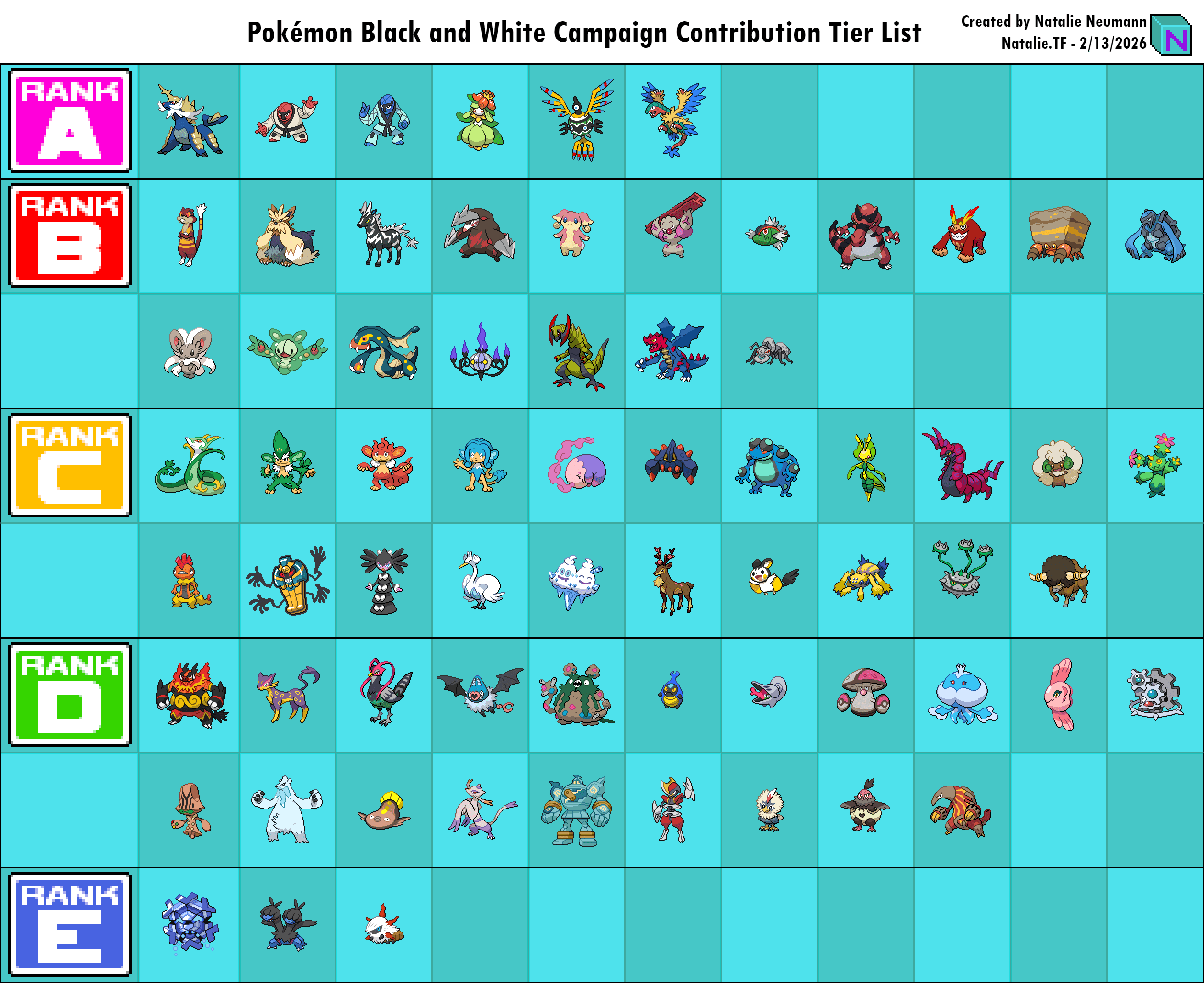
…And those are my thoughts on every Pokémon available in a playthrough of Pokémon Black and White. Well, excluding Zorua/Zoroark, as you cannot get them without event shenanigans, and all legendaries you can get before the end of the game. No, [not the gaggle of legendaries you can get by manipulating the Wi-Fi settings, like I did on by following this guide](https:// Pokémondb.net/pokebase/383345/how-to-obtain-all-the-gen-4-5-mystery-gifts), because I wanted a Scope Lens. I mean Cobalion, Virizion, Terrakion, and Tornadus. I caught all of them in my playthrough, but it feels a bit pointless to go into detail about them. While obtained late, they are powerful Pokémon with 580 BST, good move pools, and they can make the endgame a lot easier because, as I keep saying, damage is damage.
They have little investment cost, coming at levels 40 or 42. They are fast with over 100 Speed across the board, have at least decent defenses of 70 or more, and all attacking stats are at least 90. They all get good moves by level up and TM, and all can do something in the final stretch of the game. Some are better than others— Cobalion is the best— but they’re legendaries. It’d be weird if they were worse than normal Pokémon!
As for what would be the best team, well, it’s some combination of the Pokémon laid out in the tier list. Samurott is probably the best Water type in this Pokédex in terms of usability and only ever faces one major roadblock in gym 4. Sawk and Throh are powerful threats that scale through the end of the game given how low so many opponents’ stats are. Liligant is a powerhouse and the best Grass type in the games thanks to its Quiver Dance, Leech Seed, Sleep Powder, and Giga Drain abuse. Sigilyth is a shockingly strong contributor that only really faces bad matchups at gym 4 and the Elite Four. Archeops takes longer to invest in, but if you keep its health high and just Acrobatics everything, you can’t stop winning.
The B ranks either start good or require more investment to really get going, but contribute nicely throughout good stretches of the game, and are the ones to really try out. C ranks can be useful, but they all have some limitation or weakness that makes them harder to use. While D ranks are… just not very fun to use due to their late availability or limited use in the endgame. While E ranks are just jokes.
After going on about these Pokémon for over 15,000 words, I think I’ve made my point. I’ve already summarized my thoughts on why so many of these Pokémon are subpar in the main part of this two-part Ramble. And while I would LOVE to have done some theorycrafting and math on how to make each Pokémon better, I’m already half a novel deep into this side project. I’ve said all I have to say, and I hope that at least SOMEBODY enjoyed it. Because I DO NOT want this to become a regular thing.